Donald Trump’s Coalition Is Coming Apart

The working-class voters who delivered Donald Trump’s 2024 victory have steadily slipped away in 2026 according to new polling. But few of them are switching to the Democrats.
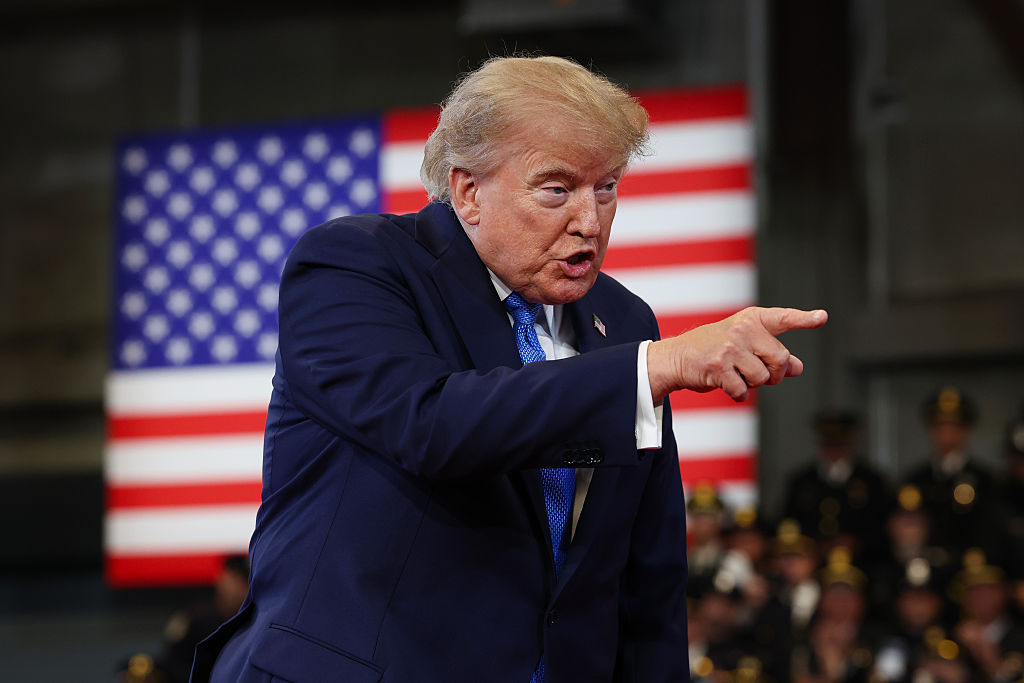
President Donald Trump arrives to deliver remarks at the David S. Mack Center for Training and Intelligence on August 14, 2026, in Garden City, New York. (Samuel Corum / Getty Images)

Donald Trump is finally losing white working-class voters. But leaving the Republicans is not the same thing as flipping to the Democrats. (Samuel Corum / Getty Images)


Republicans heralded Donald Trump’s 2024 victory as the birth of a new majority: a multiracial, working-class coalition powered by newfound support among black and Latino voters, particularly men, who had finally abandoned the Democrats over inflation, the cost of living, and immigration. While that conclusion may have been warranted in November 2024, it is not anymore. Indeed, over the course of 2026, Trump’s new coalition has been coming apart at the seams.

Over the first half of this year, we surveyed Trump’s 2024 voters three times: 1,940 in February, with extra interviews among working-class black and Latino voters, nearly eight thousand in April and May, and 2,360 in a national survey in late June and early July. We found that the share of 2024 Trump voters who are not committed to voting Republican in 2028, what we call “Trump waverers,” has risen appreciably over the course of the year.

In February, one in five Trump 2024 voters had become Trump waverers. By April, it was 23 percent, and by July more than a quarter reported that they were not committed to voting Republican in 2028.

Graph of share of Trump 2024 supporters wavering over the course of 2026

Wavering Spreads to White and College-Educated Trump Voters

The 2024 Trump voters least likely to say they currently plan to vote Republican again in 2028 are the ones at the bottom of the income scale, and that has remained steady over time. In February, 28 percent of Trump voters earning under $50,000 were wavering, against 15 percent of those earning over $100,000. By July, the gap was nearly identical, though wavering grew slightly among both groups, to 32 percent and 18 percent.

By contrast, we see a sharp increase in wavering between February and July among 2024 Trump voters with a college degree. In February, we saw a modest diploma divide: noncollege Trump voters wavered at 22 percent and college graduates at 18. But by July, the gap had disappeared, as wavering among college graduates rose more than six points while noncollege wavering remained unchanged.

The biggest news is that Trump is finally losing white working-class voters. 2024 Trump voters of color, especially black but also Latino, were much more likely to be waverers in February and April than white Trump voters. By July, however, while black Trump voters were wavering at a rate of over 40 percent, the share of white Trump voters who are wavering rose substantially, from 18 percent in February to 24 percent in July. Wavering by both white and Latino working-class voters now hovers around 25 percent.

Graph showing Trump waverers by race, income, and education

Class divides are far smaller among whites than among African Americans and Latinos. In the spring survey (the only one large enough to break race down by income), 46 percent of Latino Trump voters earning under $50,000 were wavering, against 19 percent of those earning over $100,000, a spread of 27 points. Among black Trump voters, the difference was 18 points, 45 against 27. Among white Trump voters, it was two points.

In short, there is no class divide among whites, but dramatic gaps among black and Latino voters.

Graph showing class divides in Trump waverers in each race category

White Trump voters still have the lowest wavering rate of any racial group, but over the past six months, they have moved faster away from the Republicans than either black or Latino voters. This is true of both college-educated white voters as well as those without a four-year degree: among white Trump voters, wavering rose from 19 percent in February to 25 percent in July for those without a college degree, and from 16 percent to 23 percent for college graduates.

Wavering rates are particularly high among Biden-to-Trump swing voters and have risen over time. In February, 57 percent of these switchers said they would not back the Republican nominee in 2028, while by spring, 63 percent did. Voters who stuck with Trump in both elections, by contrast, waver at only 16 to 17 percent.

Why Trump Waverers Mostly Aren’t Shifting to the Democrats

Leaving the Republicans, however, is not the same thing as flipping to the Democrats.

Among the 25 percent of 2024 Trump voters who are waverers today, we found that fewer than one in five say they would vote for a Democrat in 2028. Twenty-two percent name an independent or third-party candidate, 5 percent say they would not vote at all, and 56 percent say they’re unsure. In other words, Democrats have picked up under 5 percent of all 2024 Trump voters.

Share of Trump waverers who say they plan to vote Democrat, independent/third-party, not vote, or are unsure

To better understand what’s stopping Trump waverers from supporting Democrats, we asked them what comes to mind when they think of the Democratic Party. Among the 1,055 waverers who answered in our spring survey, 49 percent named a specific reason they did not support Democrats. Twenty-nine percent had no strong view either way, and 18 percent said something favorable about Democrats.

Graph showing most popular answers to what Trump waverers don't like about the Democratic Party

The biggest obstacle for the Democratic Party is a question of trust and competence: whether the party can be trusted to act for people like them, and whether it is capable of acting at all. Just under half of Trump waverers, 49 percent, said something negative when we asked what comes to mind when they think of the party, and 59 percent of those answers were some version of that doubt, with nothing to say about where the party stands on any issue.

The largest single complaint, 37 percent of everything negative waverers said, was corruption and self-dealing, the charge that Democrats are in it for themselves. Some quotes we heard from interviewees: “When thinking of the Democratic party, I think of people who want power so they can become wealthy while pretending to care for the less fortunate”; “Money hungry, looking out for themselves”; “Only cares about holding power and enriching themselves.”

Another 12 percent doubted that Democrats could deliver on anything because the party has no leadership and no fight in it: “A bunch of people who can’t get along and agree on anything”; “Scattered, no genuine leadership”; “Dishonest and lacking credibility”; “Not strong enough to take a stand. A lot of talking no action.”

Still others, around 10 percent, related that they believe the Democratic Party does not know or care about people like them: “They have no idea what the average American life is like and they do not care”; “A party that used to be about the working class but now has focused too much on the wealthy elites”; “I been a Democrat all my life and I always thought they were there for the poor people. Boy was I wrong.”

Self-interest, weakness, and neglect of ordinary people together accounted for around 60 percent of negative attitudes Trump waverers had toward the Democratic Party.

By contrast, while complaints about the party’s ideology and its “wokeness” were clearly present, they were nowhere near as prevalent. Fifteen percent of negative attitudes toward the Democrats focused on divisive social issues, and a further 12 percent charged that the party has drifted to the far left. What’s more, many of the Trump waverers’ negative responses that focused on controversial social issues were complaints about the Democrats’ priorities rather than disagreements with the party on specific policies: “Worried more about LGBT than crime”; “They only care about woke politics. They’re in league with big corporations, neglected the working class.”

The main problem, in other words, is not that Trump waverers think the Democrats are too radical. Instead, it’s that they don’t believe Democrats have their best interests at heart, they doubt the party would fight for them if it did, and they feel the people running the party are in it for themselves.

Democrats Have an Opening

Six months of our data paint a consistent picture: Trump is losing the working-class voters Republicans hoped would help turn his 2024 win into a lasting realignment and are losing more of them as we draw closer to the midterms. Disproportionately, the voters Trump has lost are poor, nonwhite, and young. But his support is increasingly eroding among white Trump voters and college graduates, who are now wavering six or more points below where they were in February.

The Democrats’ strategic problem is that while many Trump waverers are likely populist on economics, they are also distrustful of both parties and, for now, far more likely to drop out than to defect to the Democrats. Effective outreach from Democrats will have to come with clear signals that they are fighting for the working class.

According to a recent study we conducted, ten out of twelve of working-class voters’ highest priorities are economic, and they care about wages and economic opportunity as well as prices and inflation. Working-class voters also care about corruption: it should be dead easy for Democrats to provide examples of how Trump and his charmed circle of billionaires are making money at the people’s expense.

Whether Trump’s cratering coalition becomes an opening for the progressives or just a growing pool of the disaffected depends on whether Democrats can convince them that the party offers voters something worth turning out for, before they begrudgingly settle on the Republicans as the lesser of two evils or give up on politics for good.

Share this article

Contributors

Jared Abbott is a researcher at the Center for Working-Class Politics and a contributor to Jacobin and Catalyst: A Journal of Theory and Strategy.

Joan C. Williams is the author of Outclassed: How the Left Lost the Working Class and How to Win them Back and has published on class dynamics in the New York Times, the Washington Post, the Atlantic, the New Republic, and more. She is Distinguished Professor of Law and Hastings Foundation Chair (emerita) at University of California College of the Law San Francisco.

Filed Under