Russia’s Authoritarian Neoliberalism Reaches Its Limits
Ukrainian attacks on fuel infrastructure and on online retailer Wildberries are disrupting middle-class Russians’ sense of normality. Moves to step up military conscription could push the system toward a breaking point.
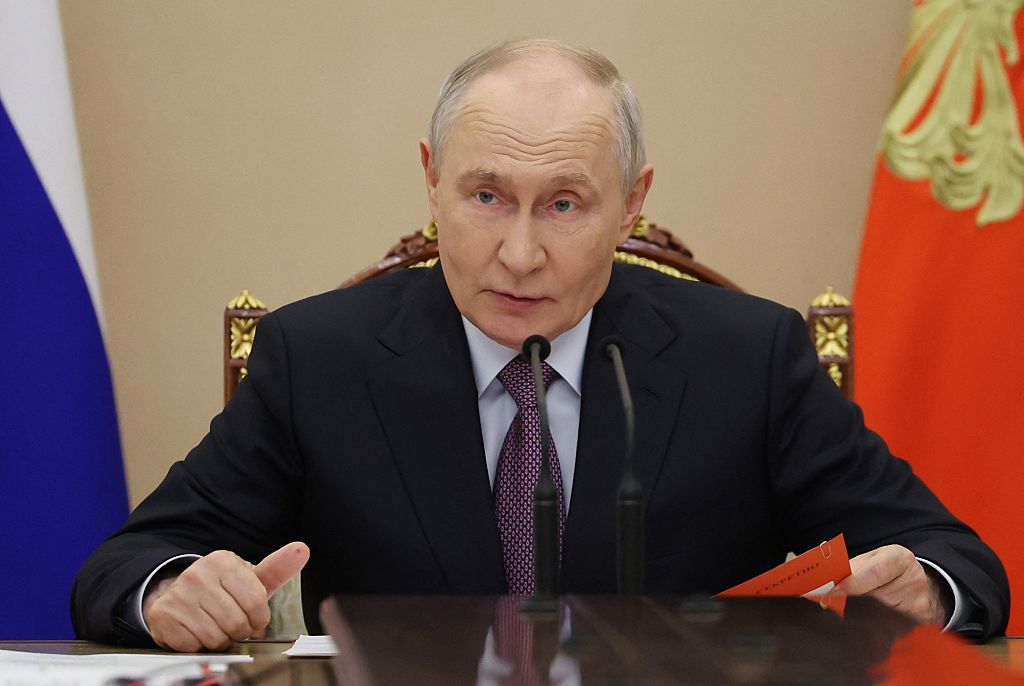
Expert groupthink on Russia often essentializes its society as passive, atomized, and largely supine. This overlooks the contradictions in Russian society, and the limits of Vladimir Putin’s ability to endlessly rally support for the war. (Alexander Kazakov / Pool / AFP via Getty Images)
While Russian forces nightly attack Ukrainian cities with long-range missiles — killing increasing numbers of civilians since the reduction of US military aid to Kyiv — this year has seen Ukraine escalate its own long-range campaign against Russia. Drones have targeted two types of infrastructure important to Russians’ sense of normality: the logistics hubs for Wildberries, an Amazon-style online marketplace which is Russia’s single largest goods distribution network, and, perhaps more importantly, petrol and diesel fuel refineries, which appear to be relatively easy targets and a weak link in the overall domestic economy.
Beyond the battlefield, responses within Russian society matter to the Kremlin’s chances of keeping the war effort going. It appears increasingly likely that after another set of falsified parliamentary elections this September, it will attempt a renewed form of compulsory military mobilization. Such a policy was briefly tried in late 2022 but soon proved a political failure and was abandoned in favor of mercenary payments. This latter approach now appears to be reaching its limits, however, after exhausting the reserve populations of potential recruits among both ethnic minorities and Russians in disadvantaged regions.
There is already increasing fatigue and discontent with the war’s enormous human cost and parlous effect on the economy. If severe demographic decline wasn’t bad enough, then revisiting the politically taboo topic of military conscription will bring, if not open political crisis, at least a more febrile atmosphere of fear and yearning for change. What we don’t know yet is what the texture of this political moment will feel like. It may be “hot” and prickly like the painful mass mobilizations around the late 1980s–early ’90s, or else it may feel, as it sometimes did for the rearguard civil society that bravely resisted the slide into autocracy in the late 2000s, like wading through sand while being pursued by an implacable horde.
In this lies a deeper point about how we understand Russia. As we approach this conjuncture of social, geopolitical, and economic forces, much of what we don’t know is because of the narrowness and superficiality of how we often make sense of Russian society.
Blind Spots
One of the main blind spots in expert commentary stems from groupthink about the nature of Russian society: it is essentialized as passive, atomized, and largely supine. Rarely do the legions of armchair observers move beyond such caricature, because they are reliant on an ecosystem of opinion consensus by measurement, which is itself partly incorporated into Putinism’s media management.
Pollsters present Russians with the correct framing: “The conduct of the armed forces in Ukraine — do you support it?” And dutifully a majority in favor is produced. Even on its own terms, though, cracks begin to show, such as a recent poll that found only 30 percent favor continuing the war — even within what is obviously a self-selected sample of mainly loyalist citizens willing to invite a pollster into their home. Opinion polls and interpretation of elite discussion: that’s the extent of the current Kremlinology. There is a strong allergy to field data and field experts, partly as a result of the retreat of area expertise in the United States. As a result, the Washington-centric common sense about Russia is hegemonic. In June–July, two worthy think tanks, Carnegie and Kennan, both published questionable versions of an argument about a renewed rally-’round-the-flag effect in response to the step change in Ukrainian attacks.
To me, as one of the last of a breed of anthropologists examining politics from below, there is a disturbing groupthink around the idea that Russians are enthusiastic for the war and its aims, even as it becomes impossible to ignore the costs within Russia. Speaking to any selection of ordinary people, it’s clear that a large majority want the war to end now, on any terms short of having to pay reparations. But arguments about public sentiment merely reinforce the sense that we are not even able to articulate a language that would facilitate a discussion about the longer-term crisis in Russia, of which the war is just a symptom.
The invasion of Ukraine is not a departure from the normality of Putinism, but rather the morbid culmination of a socioeconomic crisis inherent to authoritarian neoliberal governance. For over two decades, the regime operated as a distillation of unbridled political power bent on accumulation of economic rents, insider ownership, and constellations of patron-client control. It did this while starving the social state: a system characterized by astute observers like Nick Trickett as an “empire of austerity.” One reason for the catastrophic outcome of the security elite’s decision to go to war is that this same elite failed to understand how weak Russian society had become because of a systematic refusal to invest in public goods beyond the bare minimum required to mitigate immediate crisis. This war is the gangrenous result of a system that has long prioritized the protection of a tiny rapacious elite over the basic survival of its population.
As I argue in my recent book on the war and its less proximate causes, Russia has become a state-of-the-art laboratory for the production of poverty and the imposition of neoliberal rationality — one that is now admired especially by a similar breed of political capitalists in the orbit of Donald Trump and beyond it. Unlike the caricatures in Western media, the Russian state is not a throwback to Soviet planning. Rather, it drives market-oriented subjectivities where the individual is forced to become a contestant in a nightmarish game of social reproduction, in an atmosphere of cynicism and disregard for human costs. This system has successfully depoliticized social inequality, framing the divide between winners and losers as a matter of personal failure rather than structural dispossession.
Putinism’s legitimacy has rested on a hollowed-out social compact: the state provides the veneer of a convenient consumer culture, symbolized by the platform-capitalism world of ubiquitous brands like Wildberries, in exchange for political passivity. Yet this convenience masks a brutal socioeconomic Darwinism where representatives of the elite and government, including those who oversaw the deindustrialization of the country, the legalized theft of its remaining assets, and the casting into poverty of tens of millions in the 1990s, like to hold forth about Russians’ inherent bovine mentality. They are called mindless munchers of coarse feed, inured to suffering and privation, who expect handouts and a paternal state while not understanding that “man is wolf to man,” as the saying goes, and that the government “owes you nothing.” Since the 2008 financial crisis, Russians have faced some of the worst developed-world income stagnation and a wealth concentration that is significantly higher than in the United States or China. Putinism has responded to this long-term decay not with reinvestment of its petrochemical bounty, but with a neoconservative “cultural war” against Western “permissiveness,” using “sovereign democracy” as a shield to protect the ill-gotten gains of a security-state elite.
Observers often rely on a poorly fitting translation from a very different cultural and historical context — the United States after 9/11 and a rally-’round-the-flag narrative — to explain what seems to be Russians’ lack of resistance to the war, or even enthusiasm for it. By contrast, I prefer to think in terms of a defensive consolidation. Russians have not “rallied” to patriotic fervor; rather, they have retreated into comforting narratives of encirclement and civilizational peril, some of which align with propaganda but others which do not. They do this to manage both long-term socioeconomic trauma and a sense of helplessness exacerbated by the war and its resulting stresses. After the invasion in 2022, many consolidated behind the Putinite authorities out of a desperate unspoken hope: that the war would finally break the dismal neoliberal compact and force the state to return to a more prosocial collectivist project reminiscent of the Soviet era’s social guarantees.
Military Keynesianism?
However, this hope for a more protective state has proven illusory. The “military Keynesianism” touted by both the Kremlin and certain segments of the Left who claim that the working classes are “winning” from the war economy is a fantasy. While there was short-lived growth in real incomes, peaking in 2024, this “multiplier effect” was geographically delimited and has already been devoured by inflation, the resulting massive hike in bank rates, and the hard capacity limits of an economy plagued by a lack of investment. The “social elevator” of war money is reaching its limit, and the structural power of labor remains suppressed by a legal environment that makes defending workers’ rights nearly impossible.
The true unraveling of the Putin era will not be found in the dream come true of a revolutionary democratizing subject, which is what Alexei Navalny embodied until his murder by the state. The emotional investment by the West, by the Russian liberals, and by the pundit class in figures like Navalny has led to an analytical myopia. Rather than the smart and charismatic leader featured in Forbes fifteen times between his arrest in 2021 and death in 2024, a much more likely figure to exploit a future crisis, or even precipitate, it will be a composite character embodying features more reminiscent of the 1990s: a red-brown politician from within the existing security elite, promising to resolve the contradiction between spectacular elite wealth and everyday insecurity.
This is because the reality of rising inequality meeting austerity and the inability of a state to ensure basic human needs like adequate health care remains more “real” to Russians than the war itself. Despite the “military Keynesian” rhetoric, measurable inequality remains as stark as ever, with the top 1 percent holding 70 percent of all assets. Russia is an outlier among countries rated as high on the human development index, with 10 percent of the population receiving half of all income, and 96 percent of savers have negligible savings. The tax system is a masterpiece of regressive redistribution. The state funds its war through sales taxes and fees as much as by selling oil and gas. These taxes fall disproportionately on the poor, while a much-lauded flat income tax ensures that even those in extreme poverty pay a higher relative burden than those with assets. There is no wealth tax, and inheritance tax was abolished nearly twenty years ago to help protect the transition of wealth within the plutocracy.
This is the context in which we must view the recent attacks on Wildberries infrastructure. These attacks strike at the heart of the convenient consumer culture that substituted for political legitimacy among the urban middle class. When these logistics hubs are targeted, it strips away the last remaining mask of the neoliberal compact. Putinism cannot provide security, it cannot provide social mobility, and now it can no longer guarantee the frictionless consumption economy that was built on the backs of an exploited, micro-proletarianized workforce.
Conditions of Protest
Periods of apparently immovable political order have often seen growing reservoirs of popular grievance that unexpectedly emerge when existing ways of accommodating to the system fail. Catherine II confronted enormous peasant rebellion despite presiding over one of the strongest imperial states in Europe. The revolutions of 1905 and 1917 emerged from societies long considered politically pacified. The Novocherkassk massacre of 1962 reminded Soviet authorities that workers remained capable of seemingly spontaneous collective resistance despite extensive brutalization. The coal miners’ strikes of 1989 helped destabilize a system that had appeared institutionally impregnable only a few years earlier.
More recently, the labor disputes, social protests against loss of benefits and pensions, environmental campaigns, and local civic mobilizations against housing demolitions of the 2000s and 2010s demonstrated that collective action never disappeared beneath Putinism; it simply operated in fragmented and localized forms typical of what might be called a refined and relatively polite form of classic authoritarianism. Before the war, labor-related protests were at a record high despite legal repression of unions and, essentially, a ban on legal industrial actions. Labor actions alone are unlikely to develop into political protests. Yet they might, as the leading researcher Pyotr Bizyukov argues, create conditions for other forms of political resistance to emerge.
Today micropolitical resistance is already fermenting, from the sabotage of military draft offices to online activists showing people how to avoid mobilization. Indeed, it is hard to keep track of the many groups still organizing, albeit clandestinely or online and abroad. As I argue in my book, the memory of a future-orientated “commonality” (in Russian: obshchnost) and the ideal of an achievable, if flawed, postcapitalist society that provided public goods to all remain alive, represents a lasting political stumbling block to the regime’s largely empty rhetoric and inability to offer Russians better prospects.
Even Vladimir Putin seemed to confront this fact recently when asked an “astonishing” question about what positive roles Russians will be able to look forward to after the war. He clearly found it surprising, when confronted by an ordinary person with the age-old Russian question: “what is to be done”? He interpreted this as about people’s need to be incorporated into a “great cause.”
As the country enters a period of stagflation and illusions in the war economy dissolve, the refusal of the state to recognize that its main purpose is to ensure the social reproduction of its people may finally meet the historical limit of Russians’ patience. In its great laboratory of dispossession, exploitation, and now battlefield disposal, the vanguard of authoritarian neoliberalism has long treated ordinary Russians as biopolitical waste. Now, four years into a war even Russia’s leaders can no longer explain, this elite is entering into sharper confrontation with this same people.