Russia’s War Machine Is Creaking

Russia’s war economy has this year suffered some of its worst setbacks since the invasion of Ukraine. An under-strain Russian society isn’t revolting yet. But Russians’ doubts about the war are growing.
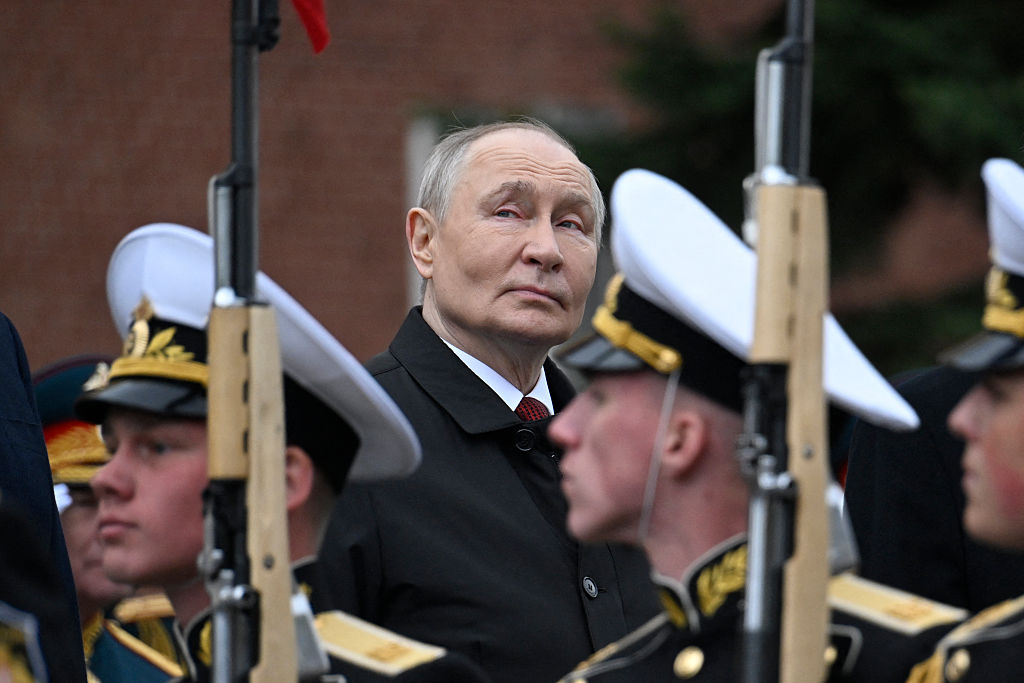
Russian President Vladimir Putin attends a ceremony to lay flowers at the Tomb of the Unknown Soldier by the Kremlin wall in central Moscow on May 9, 2026.

Time and again, predictions of imminent Russian collapse have fallen flat. Yet weak military recruitment numbers and poor economic data show a gnawing loss of confidence in the war effort. (Alexander Nevemenov / POOL / AFP via Getty Images)


“I’m sure I’m not the first to tell you this. But something is definitely happening in Russia. You can feel it in the air. You walk down the street, get on the metro, sit in a café, and everywhere people are talking about the same thing.”

That message was sent to me yesterday by a comrade still living in Russia. Such moods are difficult to measure through polling. But they often detect the beginnings of change more accurately than professional pollsters can.

Since 2024, the Kremlin had been confident that Russia’s war in Ukraine was moving toward inevitable victory. Moscow had weathered Western sanctions, dominated the battlefield and military production, and retained clear resource advantages. Time itself seemed to be on President Vladimir Putin’s side. The Western coalition looked fractured, Donald Trump was seeking accommodation with Moscow, and Ukraine was short of money, weapons, and manpower.

But this spring, expectations of victory in Russia began to give way to a sense of approaching crisis.

According to official data, Russia’s federal budget deficit reached a staggering 5.9 trillion rubles (around 2.5 percent of GDP) in the first four months of 2026 alone. This already exceeds the full-year deficit of 2025 (5.6 trillion rubles), which only recently alarmed economists. For all of 2026, the government had originally planned a deficit of just 3.9 trillion rubles.

It is now clear that, even taking into account the rise in oil prices driven by the war in Iran, the final figures are likely to be among the highest of the century. For comparison, in 2009, at the height of the financial crisis, the deficit reached about 6 percent of GDP, and across the first year of the pandemic in 2020, around 4 percent.

At the same time, Putin himself acknowledged that the economy had contracted by 1.8 percent since the start of the year. The “military Keynesian” turn launched in 2022, which fueled rapid growth in 2023–24, appears to have run its course.

Yet the state continues to increase military spending. Everything has been staked on the war. The question is: Who will pay the bill?

Russia’s economy now increasingly resembles the classic formula of guns instead of butter. The value-added tax (VAT) has been raised for the second time since the invasion began. Utility prices are being increased twice in 2026. The Central Bank maintains punishingly high interest rates that make credit nearly inaccessible for small and medium-size businesses while helping sustain a strong ruble.

That strong currency is vital for the military sector, which depends heavily on imported, mostly Chinese, components. Without it, the Kremlin would struggle to supply drones, shells, and electronics. But high interest rates and an expensive ruble are suffocating the civilian economy. Businesses are starved of credit, while domestic producers become less competitive.

The result has been a wave of bankruptcies and small business closures. Workers laid off from civilian sectors are moving where wages are still stable: into defense plants financed directly by the state. The government is literally transferring labor and financial resources from consumption into the war economy.

The ballooning deficit has also forced spending cuts. Public sector jobs are being reduced. Construction, infrastructure, and urban development projects are being scaled back. This hurts not only workers but also thousands of officials, contractors, directors, and state-dependent business owners whose incomes relied on public spending.

Even the leader of Russia’s Putin-loyalist Communist Party recently warned that economic collapse could provoke a revolution like in 1917. “We have no right to repeat this!” he said.

Businesses, meanwhile, are responding to mounting tax pressure by moving activity into the shadow economy. The state has answered with tighter controls on bank transfers, restrictions on cryptocurrency, and harsher penalties for tax evasion. Whatever their practical effect, these measures significantly expand the powers of police, prosecutors, and security services over economic life.

The Kremlin operates according to a single logic: everything for the front, everything for victory. But sustaining the war machine is eroding Putinism’s own social base.

And problems are mounting at the front as well.

The pace of Russia’s offensive, which had continued in some form for more than two years, slowed sharply in early 2026. In February, Ukrainian forces reportedly recaptured more territory than they lost for the first time since 2023. Russian casualties, according to pro-war military bloggers, also increased.

A serious setback came when Russian access to Starlink terminals was reportedly disrupted at Ukraine’s request. It became clear that Russia lacks an adequate alternative system of battlefield communications.

Ukraine has also strengthened its position in drone warfare. With European assistance, it has not only increased the number of drones in use but also expanded their range and capabilities. Whereas drones were previously used mainly on the front line, typically within 1–2 kilometers, Ukrainian forces can now strike equipment and personnel 20–30 kilometers deep behind Russian lines. This has created what some observers describe as a “wall of drones.” The deadly zone behind the front has expanded dramatically, making it increasingly difficult for Russian forces to maneuver or concentrate reserves near the line of contact. As a result, Russian losses have risen, and one of Moscow’s main advantages — its manpower — has been significantly reduced.

At the same time, exhausted soldiers are deserting in growing numbers — simply failing to return from leave or from military hospitals. Independent researchers estimate that at least 100,000 to 120,000 cases of desertion or draft evasion have occurred during the war, more than half of them concentrated in the last year alone.

The trend appears to be worsening. In late April, the authorities made judicial statistics related to military crimes classified data.

At the same time, the Russian army is also finding it harder to make up for the losses that it is suffering. According to estimates by economist Janis Kluge, based on regional spending for enlistment bonuses, new recruitment fell by roughly 20 percent in the first months of 2026. It is possible that the army’s overall size has begun shrinking for the first time since the invasion.

Until now, the Kremlin managed these shortages through market methods: it simply raised signing-on bonuses. For residents of poor regions, this often worked. But widening budget deficits make it harder to keep buying cannon fodder. Increasingly, the state is turning back to coercion.

Regional authorities pressure business owners — sometimes under threat of prosecution — to recruit employees for the army. Universities are turning student enlistment into a central administrative priority.

But coercion does not always work.

In a leaked recording from Buryatia, a district official berates factory directors for failing to meet recruitment quotas. They reply, “We can’t force them. Nobody wants to go.” When the official orders the businessmen to enlist themselves, he is asked a simple question: “Why don’t you go yourself?”

That exchange captures the Kremlin’s problem in miniature. Formally, executive power appears all-powerful. In practice, orders increasingly hang in the air unanswered.

Shortages of men and equipment, mounting losses, false reporting by military officials, and fading belief in victory have angered not only soldiers and officers but also influential pro-war bloggers and ultranationalist activists. These forces were once key instruments of patriotic mobilization. Now many openly criticize the authorities. Some have even begun criticizing Putin personally.

Russia’s roughly 700,000-strong army is increasingly marked by widespread dissatisfaction. This mood now finds a public voice through ever more strident ultrapatriotic commentators. The Kremlin has seen before where such dynamics can lead: in 2023, Yevgeny Prigozhin’s mutiny briefly pushed the regime into its deepest crisis of the war.

The authorities responded by tightening control over the internet.

First came attempts to block Telegram, Russia’s main communication platform. Soldiers, mobilized families, officials, entrepreneurs, and millions of ordinary users rely on it. Pro-war bloggers built their audiences and influence there. The Kremlin reportedly hoped to push users toward state-controlled alternatives.

Instead, tens of millions downloaded virtual private networks (VPNs) and stayed on Telegram. Then internet regulation was handed more directly to security agencies. In March, mobile internet was simply shut down in many regions, including Moscow.

Banking apps malfunctioned. Taxi and delivery services stalled. Millions struggled to contact relatives, small businesses lost revenue, and with even government offices disrupted, public anger spread far beyond the usual opposition circles.

In this context, once loyal public figures began criticizing the authorities. Establishment lawyer Ilya Remeslo attacked Putin publicly. Lifestyle celebrity Viktoria Bonya released a widely viewed video discussing fear and censorship and a growing list of problems that the government refuses to acknowledge.

Many liberal analysts interpret these episodes as signs of elite division. But the source of crisis may lie deeper.

When people lack the power for open rebellion, they often resist in quieter ways, complying in words while obstructing things in practice. They delay, evade, lie upward, hide resources, imitate obedience, flee control, and desert. These are what might be called the “weapons of the weak.”

That is increasingly what we are seeing in Russia.

Soldiers fail to return from leave. Workers refuse military contracts even for high pay. Entrepreneurs evade mobilization demands. Local officials fabricate success reports for superiors. Officers conceal losses and manpower shortages.

Passive resistance from below makes orders unenforceable. In turn, this epidemic of evasion rises upward through the social pyramid. The lower ranks pass their weapons of the weak to those above them. Gradually, the state apparatus itself begins to function as a machine of sabotage.

Sooner or later, this crisis will surface more openly.

Parliamentary elections scheduled for September could offer a test in this regard. True: elections in Russia long ago lost genuine political meaning and became rituals of loyalty. With factory directors delivering controlled voting blocs; teachers and school administrators helping to manage “difficult” polling stations; and state control over opposition parties demoralizing dissenters, the ruling party could claim overwhelming victories regardless of its real support.

That system appeared stable for years but also depended on the compliance of thousands of intermediaries. Today every component of that machine is affected by demoralization, resentment, and quiet noncooperation.

Putin may still be able to imprison any individual official or businessman, but he cannot easily replace an entire apparatus.The question is whether attempts to forcibly crush the ongoing process in Russian society may transform deserters into rebels and saboteurs into revolutionaries.