Mainstream Economic Myths Are Disastrous for US Policy

James K. Galbraith

In a wide-ranging interview with Jacobin, economist James K. Galbraith discusses how neoclassical economic orthodoxy has badly distorted US policy thinking on everything from inflation to trade policy to the fertility crisis.
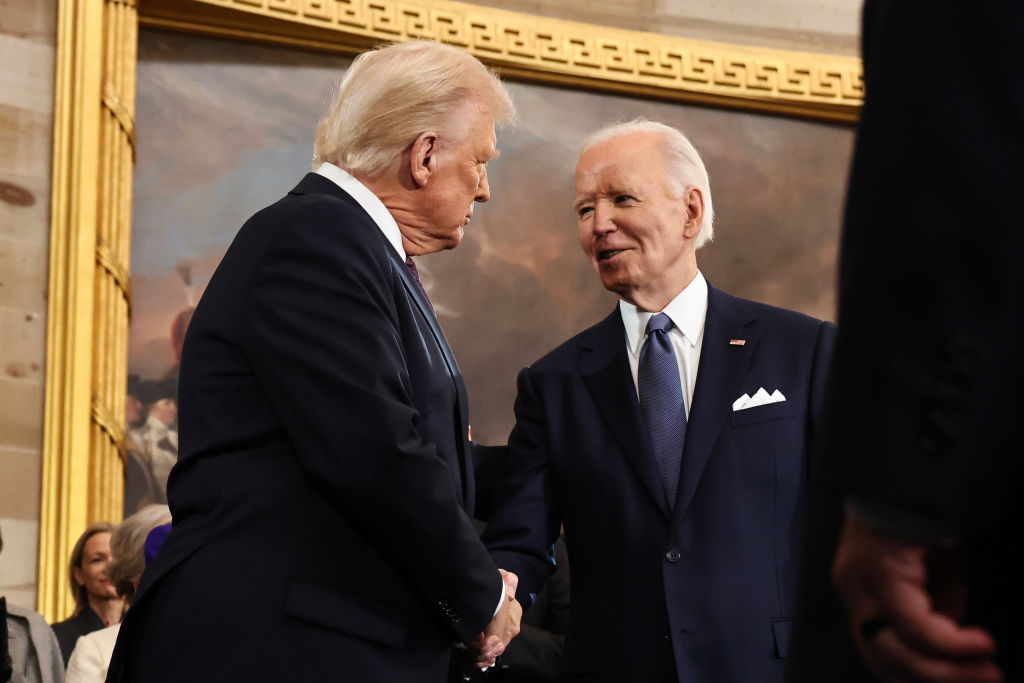
Donald Trump greets Joe Biden as he arrives for inauguration ceremonies in the Rotunda of the US Capitol on January 20, 2025.

In his new book, The Power to Destroy, James K. Galbraith takes mainstream economics to task for fundamental misconceptions on a wide range of issues including inflation, the federal budget, and trade policy. (Chip Somodevilla / Getty Images)


Interview by
Ana G. Perez

After decades of domination by the neoliberal consensus, Washington has started to break with that paradigm under recent presidential administrations, including Joe Biden’s and Donald Trump’s. Their embrace of tariffs and efforts to rebuild domestic manufacturing capacity are a departure from previous policy orthodoxy, inspired in part by the rise of China as an economic and geopolitical powerhouse and, in Biden’s case, by the challenge of climate change.

James K. Galbraith is the Lloyd J. Bentsen chair of government/business relations at the Lyndon B. Johnson School of Public Affairs and a professor in government at the University of Texas at Austin. He previously worked on the House Banking Committee and served as executive director of the Joint Economic Committee of Congress in the early 1980s. An influential heterodox voice on economics, he is the author of several books, including The Predator State: How Conservatives Abandoned the Free Market and Why Liberals Should Too (2008) and Inequality: What Everyone Needs to Know (2016).

In his newest release, The Power to Destroy: How Bad Economics Drove America’s Decline, out next month from University of Chicago Press, Galbraith argues that the dominant framework embraced by mainstream economists has had a disastrous effect on US economic policy over the last several decades. In an interview with Jacobin, Galbraith discussed the arguments of The Power to Destroy, including the problems he sees with Biden and Trump’s recent efforts to move beyond the policy orthodoxy and what the future might portend for US financial and military dominance.


Ana G. Perez

The Power to Destroy is in large part about how the widely accepted neoclassical economics framework — what you call “equilibrium economics” — is empirically discredited and harmful to American economic policymaking. Could you summarize your analysis of equilibrium economics?

James K. Galbraith

First, let me speak in rather general terms about the mindset that one is brought up in as a trained economist. It is a product of an effort at system-building, which had these two not completely well-aligned dimensions: the so-called micro and macro.

The micro dimension, which became dominant during Ronald Reagan’s administration, essentially gives priority to anything that happens to be organized by a market and says the role of the government is just to come in when there are problems with the market. In fact, in the real world, markets only exist because governments provide a regulatory framework within which they can function.

The other piece of it, macroeconomics, starts from the same general idea: that the economy as a whole tends toward a steady state of growth. If it goes down, it’s going to come back up again. Built into this framework are such notions as the so-called trade-off between inflation and unemployment and a whole series of concepts that were predominant in the education of economists of my generation. These ideas are still very much influential on important institutions.

Those institutions include the Federal Reserve, which has gotten the notion that it has the ability to control the inflation rate and the price level; or the Congressional Budget Office, which has the notion that the federal budget ought to be balanced. These are conceits or prejudices that are brought to the discussion by the background noise of a century’s worth of economists framing the policy discussion for everybody else.

It’s a simpleminded but also highly unrealistic portrait of how actual societies work — of how any living system works. A much more successful policy system could be built up from an alternative conception. What I was trying to do in this book was to give a series of cases in which you could pick out where the influence of standard economic thinking had been predominant and point to the consequences.

Ana G. Perez

One of the case studies you analyze is the inflation that dominated the news in 2021 and 2022. You argue that the actions taken by the Federal Reserve to control inflation by raising interest rates not only failed but also might have been harmful in other ways.

James K. Galbraith

There has been a reflexive way of speaking about the Federal Reserve when it raises interest rates. It’s almost automatic that the media will report the Federal Reserve raised interest rates “in order to control inflation.”

The reality is that the lever the Federal Reserve has, which is the short-term interest rate, has no connection to the inflation rate or the price level. The only way the Federal Reserve can actually knock down prices is by forcing the economy through a long and painful contraction — throwing a lot of people out of work, bankrupting a lot of businesses. That has happened in the past; it happened in the early 1980s.

But if you look at the at the financial structure of the American economy today, it’s fundamentally different. Trade unions are much smaller and much weaker. The manufacturing sector is much smaller; employment is largely in services. The public debt is much larger as a share of GDP. And when the interest rate goes up, as it did under Jerome Powell from early 2022 onward, none of the of the sharp contraction that Paul Volcker achieved through impoverishment of the economy in 1979–1980 actually occurred.

So one can’t say that the decline in the inflation rate was due to the Fed. It had nothing to do with the Fed, because the only channel that is operative wasn’t there.

What was going on was that in the wake of the pandemic, first, oil prices [went up]. Second, supply chains got blocked and jumbled. So new automobiles became scarce, and the price of used cars went up. And then there was some complicated business with housing. These price increases had nothing to do with any kind of general increase in demand.

There was then, particularly at the start of the Biden administration, a very substantial increase in federal spending. A lot of people — Lawrence Summers, for example — made a big issue out of that, saying it was going to drive inflation. He was working from a background model or mental framework that was well established fifty or sixty years ago, when we were much younger and starting our careers.

But if you look at what happened when American households got relief from COVID-19 — some under Donald Trump and some under Joe Biden — they very sensibly said to themselves, “I’m out of work right now. This is a useful financial buffer. I will store it up and draw it down over time, and that will give me some leverage. I don’t have to go back to work quite so fast; I’m not desperate to get back to my previously held lousy job.”

They didn’t go on some kind of spending spree that would, in the imagination of the economist, drive up the inflation rate. This is not what happened at all. American households behaved like relatively prudent, risk-averse entities. They saved a lot of [the relief money]. And then they drew down their savings as they needed it. There’s no mechanism there that’s going to drive up prices.

What did drive up prices in certain markets, like real estate, was the conduct of people whose incomes were not disrupted by COVID: in other words, people like me who had salaries and who didn’t get a lot of benefit from COVID relief. What happened to this class, the top 20 or 25 percent of the income distribution, was that we stopped having access to all the things we were spending money on. Restaurants and travel — the whole services economy shut down.

So, we piled up money. What did we do? We remodeled kitchens; we built houses. We went out and bought real estate. We drove up the prices of fixed assets. But driving up the price of a house is not an inflationary act. It’s raising the net worth of somebody who owns a house.

What I’m urging in this chapter on inflation is for people to get into the weeds and figure out what’s really happening, and then design policies that are relevant to the actual conditions. The person who did that, and who did it quite brilliantly, was Isabella Weber, a young economist at the University of Massachusetts Amherst. She pointed out that the when the system was hit by a really major disorderly event, a lot of the habits that normally constrain the behavior of businesses are broken, and they end up scrambling to try to raise prices as much as possible in order to make sure that they can cover their costs. That’s a competitive phenomenon, which you can observe by the rise of profit margins.

That also occurred. The right response to that is to constrain the behavior. It’s not to hit them with a large shock to their sales. Just constrain their behavior so that they can continue to make a reasonable profit, and so they can get back to the sense of reasonable stability of this structured relationship between their prices and their costs.

Ana G. Perez

You also analyze the COVID response more broadly and then Biden’s big infrastructure bill, the CHIPS Act, and the Inflation Reduction Act. One argument you make is that, even when policymakers are trying to rebuild US industry, the American economy has changed too much, from a manufacturing to a service economy, and state capacity has deteriorated. So these efforts don’t work; policymakers don’t have enough to work with.

James K. Galbraith

On COVID: like many people, I became essentially locked up, in my third-floor rooms in my house in Austin. I became very active online and very active in publishing and in trying to move the COVID mobilization in ways that I thought were necessary to meet the supply chain problems.

That was not the direction that the policy eventually took. The policy essentially took the direction of flooding the system with money. That forced me to consider what was going on in the underlying economy.

The first thing was recognizing that the actual capacity of the government to take concrete steps on specific technical problems, like the supply chain issues, was very small. Let’s leave aside whether masks were a good or a bad idea. The reality was that there was a certain amount of capacity, and the private firms making those things were not all that eager to ramp up their capacity, because, quite reasonably, they figured that once this was over, that would be a sunk investment. They’d have to eat the loss.

The reaction in China was very different. Around a thousand firms in China switched over from producing whatever it was, any kind of paper-type product, to making surgical masks. And they exported them very rapidly around the world. That tells you that the structure of productive business in China is very different from what it is here: much more flexible, much more responsive. And if you have the Chinese doing it, you don’t really need other people doing it. You just need to get them to ship the masks out, which they did.

The other part was: What were the consequences of flooding the American system with money? Passing out money is something the American government is very good at doing. With a few glitches at the beginning in the unemployment compensation systems and so forth, it got a lot of money into the hands of people.

Most of those people were working in service jobs that were suspended, and so they were not getting their regular payroll. In some cases, they got more money from the COVID relief than they were previously earning. What one discovered is that this was not a catastrophe, so long as they were able to meet their commitments: rent, utilities, and food. And they’re saving money on gas. Of course, schooling was a big problem. But by and large, when the situation begins to normalize, a lot of people were not all that anxious to go back to the kind of jobs that they had before. Their lives were adjusting in various ways.

Many people did not go back into the labor force, did not rejoin the job search, which tells you a lot about how they felt about the jobs that they had previously been in. What was going on in the Biden administration at the Federal Reserve — Powell was quite explicit about this — was an effort to cut back on the financial support to American households, thereby draining their savings, and raising interest rates, making it much more difficult to redevelop your real estate, and squeeze people back into the job market.

People didn’t like that. And you had this odd situation in the latter years of the Biden term, in which the inflation rate was coming down, because it was a shock phenomenon working through the system, and the unemployment rate was not going up. People who were brought up in the macroeconomic framework that was dominant in graduate school when I was there said, “Unemployment is down; inflation is down. Everybody must be happy. Why aren’t they happy?” Paul Krugman was saying that the people must be stupid; that they don’t understand how good they’ve got it.

Ana G. Perez

The “vibecession” thesis.

James K. Galbraith

They thought something mysterious was going on. But it’s not that mysterious once you realize how much the relationship of the American worker to work has changed in the last fifty years. In the 1970s and ’80s, the unemployment rate went up, and this created a ripple of fear in the workforce. Ninety percent of the population of the workforce is still working, but nobody knows when they might get hit with a layoff. And if you’re a single earner for your family, a layoff is a major blow.

So the unemployment rate goes up, and anxiety spreads across the land. It comes down, and the anxiety starts fading long before the unemployment rate reaches 4 or 3 percent, because you’re no longer in danger.

This is not the way it operates now. Now the unemployment rate comes down because people have decided, “Screw this — I’m not going to be the third earner in my household. It wasn’t bringing us that much extra money anyway, because I had childcare costs and commuting costs, and there was the stress on my time and everything else. If I’m sixty-two, I can take Social Security, or I can just ride this out and do something else.”

That’s what I think happened here. Economists stuck in this old mindset were not adjusting to the changing structure of the American economy.

On [the other Biden policies], it’s a bit of a sad tale because, again, go back forty or fifty years to the late ’70s, early ’80s. This was the time when the deindustrialization of the United States was really getting underway, and the unions were being hit very hard. The unemployment rate went up to 10 percent in October of 1982.

One of the ideas that began to surface at that time was that we should have a policy specifically to support American industry. I was at that time the executive director of the Joint Economic Committee of the Congress; we were engaged in this discussion, and people like Laura Tyson and others who had studied relevant experiences in other countries were engaged in it.

Nothing happened. The idea floated around and fundamentally got no traction until 2020. Some of these people are still around and still influential, and they’re raising these ideas around in Biden’s circles. So they come in with these ideas, and in forty years, the capacity to implement them has largely disappeared.

You got an infrastructure law, which was a lot of local projects. You can see this in the expansion of suburban commuting roads in lots of places. Real estate developers like this very much.

And there was the CHIPS Act, which was subsidies to get semiconductor manufacturing back here. You have to ask, “Who exactly is going to do this, and with what technical capacity?” So you recruit the Taiwan Semiconductor Manufacturing Corporation, which, you can tell by its name, is actually based in Taiwan. And they have trouble because they worked out the whole ecology of semiconductor production where they are in Taiwan. It’s not so easy to implement that in Arizona.

The other big Biden policy was the Inflation Reduction Act, which was really about renewable energy. We’ve seen the effect of subsidizing renewable energies. You got more of it. But if you’re thinking that you’re going to replace fossil fuels, you discover that doesn’t happen. What you get is power for data centers. This is an old problem. This is something that was clearly laid out in the nineteenth century by William Stanley Jevons: every new source of energy is accompanied by new uses for it. In fact, as I like to say, there’s only one source of energy that we’ve ever abandoned. That’s whale oil.

Ana G. Perez

With regard to renewable energy policy, you also point out that people may not see a measurable decrease in carbon dioxide levels for some time. And companies may not see a benefit of getting into these markets, especially if their tax credits are done away with after the next election cycle.

James K. Galbraith

The consequences of somehow controlling the rise in CO2 levels are necessarily remote, because what’s already there in the atmosphere is not going to go away even if you stop putting anything in. You would not see a decline for a half-century, which is certainly beyond the scope of a private corporation’s economic planning and well beyond the scope of most people’s lives. So there’s something intrinsically problematic about this.

Ana G. Perez

Another domestic policy issue you talk about is the mainstream insistence that the federal budget operate like a family or municipal budget, where we have to balance the money going out with the money coming in. You say that this is silly — that actually national governments don’t operate this way at all.

James K. Galbraith

Certainly the government of the United States has not operated that way for half a century or longer. And it is completely unrealistic and not sensible to make that proposition the basis of a budget strategy.

The reason is very simple. Again, these ideas that we’re discussing grew up in a previous period of history, when it was more or less reasonable to treat the world trading system as a set of reciprocal exchanges. That was because there was a third foundation of clearing payments, [things like] gold — an asset that was not under the control of any particular national government.

But since the 1970s, certainly since the Volcker period in the early 1980s, the global reserve asset has been US Treasury debt. So there’s an asymmetry in the world economy. And if the Chinese or the Japanese or whoever it might be are accumulating US Treasury debt, they’re sending real goods and services in exchange for that debt. It is, in fact, to their advantage to do that. But it necessarily means that we’re going to be importing more than we’re exporting, and consequently most of the time we have to be running a substantial surplus of government spending over taxes, which is what we call a budget deficit.

The world economy has been operating on this basis for a long time. Yet the economists, and certainly the people who come into the Congress and work with entities like the Congressional Budget Office, still think in terms of the ideal of a balanced budget. We have something called the Committee for a Responsible Federal Budget. What do they mean by “responsible federal budget”? They mean one in which the government is taxing as much as it’s spending.

That is not the world in which the United States operates and has operated for a long time now. Why do the Chinese put up with this? Why do the Japanese? What they get out of it is the capacity to deepen their industrial and technical development, which they are obviously succeeding at. To the extent that they can sell product at a larger scale, they are reaping a cumulative advantage, which they can also use to raise living standards in their own countries.

Whether they will continue to need this extra outside market, the United States, that’s an open question. But that’s certainly how they have been operating for a long time. And as I say, they benefited from it enormously.

What did we get? What happens in the United States is a kind of Faustian bargain. We have access to a lot of very high-quality and low-cost goods, which we all use: everything from our clothing to our smartphones to a good deal of our food and other products. But at the same time, we have lost the local capacity to do a lot of that highly complicated production in the United States.

Ana G. Perez

This is a central argument you make in the book: that the United States’ financial dominance is at odds with its industrial competitiveness.

James K. Galbraith

You can’t have both. The British discovered you can’t have both; we’re discovering you can’t have both. How you get it back or do something that would give you a better balance are another set of problems. But it’s not an easy question, because the rest of the world has so far mostly liked the system.

What we have been doing, and this gets to another piece of the book, is undermining that system by using our financial dominance as a weapon. We impose sanctions on the Russians, the Chinese, the Iranians, and other countries we don’t like. And guess what they do? They say, “Well, it’s inconvenient for us to set up our own payment systems and settle our trade in our own currencies, and maybe even to hold more gold and more oil and tin and copper and so forth as reserves, and fewer Treasury bonds. But if the Treasury bond is not a reliable asset for us, if it can be seized, then that’s what we’ll do.”

So you end up undermining the basis of American financial strength. Again, maybe that’s not a bad thing for the United States. But it is not the goal of the people imposing those sanctions.

Ana G. Perez

Let’s talk about Trump’s tariffs, about how he’s attempting to change the trade relationship between the United States and China, as did Biden. You say no policy that the US could come up with would significantly alter that relationship in the short term.

James K. Galbraith

I can’t say that I’m completely unsympathetic to the Trumpian attack on free trade as a dogma, which is certainly part of the economists’ creed. It’s a very oversold proposition.

But where we are now, with a tariff policy, one has to ask: What exactly is it going to do? The answer, and I think the Trump people have been quite clear about this, is that it’s primarily intended to force major industrial corporations — particularly European, especially German corporations — to relocate even more to the United States to get access to the American market. It’s not going to succeed in revitalizing US industrial corporations, but it could bring BMW and Volkswagen to the United States, where they can probably operate more profitably than they can operate in Germany, with high energy costs, and also higher labor costs and stricter regulations.

In terms of China: I think we’re very ambivalent about attracting Chinese companies to do major investment in the United States, because there’s a lot of tension over the supposed security implications of that, while we’re not afraid of having BMW here. But beyond that, the notion that we are going to build an autonomous high-technology sector without the global structure of the semiconductor industry as it presently exists is something I take up in the book’s chapter on China.

This is an industry that has practically irreplaceable components spread out all over the world. You can replace the Chinese refining capacity for rare earths only with enormous difficulty. You can’t replace the Chinese dominance in gallium, which is not a rare earth but a by-product of aluminum production. China’s advantage is ninety-to-one over the United States in that; it’s simply not going to happen. We’ve been losing aluminum capacity since 1980.

You can’t replace the sources of neon and helium that are necessary: helium from the Persian Gulf, neon from Russia and Ukraine. And the foundries in Taiwan are highly efficient producers of the chips themselves.

So If you tried to bring all of that into the United States, if you could do it at all, you would end up with an industry that would be much smaller, with a much higher unit cost, completely uncompetitive. You would end up basically collapsing the global semiconductor industry, which is the foundation of most of the manufactured products that we now utilize.

The two models for that kind of decoupling that come to mind are the Soviet Union and Yugoslavia. The Soviet Union fell apart. But what exactly happened when the Soviet Union fell apart? There was this vast industrial chain. The Soviet Union was a very large producer of steel, aluminum, nickel, automobiles, and so on. Some of it was sold on the local market, and some of it was exported, but the supply chain stretched across what became fifteen different countries. A lot of that collapsed.

Yugoslavia had a car industry. [Its car] wasn’t great; it was a knockoff of the Fiat called the Yugo. That industry collapsed, as it had components in Serbia and Croatia and other places, and they stopped functioning.

So you could see that happening to the global semiconductor market. But that would be a much bigger shock to the productive system of the world. That says to me, don’t try to mess around with the development of China. It’s a phenomenon that is not within our power to stop, and the consequences of trying to do so will be much worse for us than for them.

Ana G. Perez

The Power to Destroy discusses a potential multipolar future in which Russia and China and other states like Iran are greater global powers, with a diminishing role for the United States. In terms of the trade-off between the United States’ financial dominance and its industrial competitiveness, do you think the decline of the dollar or the US’s global economic position will spur growth and innovation here?

James K. Galbraith

I want to be careful not to claim that I have some kind of messianic vision for restoring the position of the United States. There’s a tendency when you write a book to say, here’s a problem — where’s the solution? I’m a little bit resistant to that. Because it seems to me that when you have been digging yourself into a hole for forty or fifty years, you shouldn’t imagine that there’s an easy way out of it.

What we have done is constructed a kind of devil’s bargain in which we have a very strong position in world finance, and we buttress it with what we thought was a very strong position in military power. Guess what? It’s not. That has clearly been undermined by the technological revolution.

The military power of the United States, which is the pillar on which our financial power supposedly rests — and it’s not clear that that’s entirely true, but certainly it’s part of it — has basically two parts. Number one, there are the aircraft carriers that became the principal weapon in the Pacific war in 1944. At that time, we had ninety of them; we’re now down to about a dozen or fifteen. Number two is the bases, which we built up around the world to encircle the Soviet Union and China in the Cold War.

They’re both essentially obsolete and indefensible. We just discovered that in the Persian Gulf. The big ships have to stay a long way away, which reduces their effectiveness. And the bases are simply sitting ducks. Everybody knows where they are. They can be hit by many relatively inexpensive missiles and made unusable. And you can’t go back and reconstruct them because you can get hit again. So those two things have abruptly been shown to be paper tigers.

Is US financial dominance going to survive? For a while, because it’s convenient for everyone. On the part of the multipolar enthusiasts, there’s a cheerleader attitude about some kind of alternative monetary system. It’s not obvious to me that it’s going to happen anytime soon, because it’s not easy to do.

So, what can you do in the United States? First, you can take some of the resources that we’re now still pouring down this rat trap of obsolete military technologies that we used to intimidate the world, which are no longer effective at that. Whether you like that or not, it’s what we have been doing. My advice is to stop and use those resources for something else.

Second, the financial system is a source of the huge distortion of the income and wealth distribution in this country. Why are we doing this? This was not the case fifty, seventy years ago. A great advantage Franklin D. Roosevelt had was that the financial system had collapsed when he took power. He could build up what was essentially an industrial, middle-class country.

I don’t think we can recover the industrial aspects; maybe we should want to. But you need to dismantle the oligarchy. The oligarchy is finance and the capital valuations in the tech sector. Those are obviously very closely related; they are who runs the country these days. That’s where you should be thinking about social reform. Then let the rest of the country try and figure out how to rebuild its own basis for sustainable prosperity. And maybe you can get some environmental progress in that as well.

Ana G. Perez

The book also includes an interesting discussion of the issue of falling birth rates and demographic decline.

James K. Galbraith

That’s an issue that has been getting a lot of attention recently. The dynamics of population replacement are fairly implacable. They specify that if you are not keeping the population standing by having a certain proportion of children to the available women, which is 2.1, then the corresponding R ratio, which gives you the population dynamics, will fall below one. If it’s below one, the population will have a tendency to decline and to age, and resources will shift from being directed at children to being directed at older people. And that will become increasingly unfavorable to people having more than a small number of children.

What’s going on here? It seems to me that households are making what are sensible business decisions for them. [It’s happening in] rich countries all over the world — it’s not just the United States. You form a household, and you now are enmeshed with a whole set of fixed costs. You have a mortgage; you have utility bills; you have commuting costs. You have basic living expenses. And you have a desired living standard, and that standard is often only obtainable if both partners work.

You discover — as a result of austerity policies, as a result of attempts to discipline the workforce in the way I’ve described — that the gap between your income and your expenses is getting smaller. So you look around and say, “What can I do to economize?” Well, the big fixed expense that a young couple has is having children, because they have to be raised, they have to be fed, they have to be entertained, they have to be schooled. It’s no longer okay just to get them through preschool; [you have to] pay for their college and their graduate school. And they don’t contribute any income: they’re not working on the farm. And they’re not necessarily going to be around to support you when you’re old, because we have social insurance for that, more or less.

That doesn’t mean you stop having children altogether, but it does mean that it becomes very rare that you have more than two. And a lot of people have one or don’t have any.

How many people do we know that have five? Not very many. In my parents’ generation, it was totally normal. It was a different world. They had a much smaller set of fixed demands and a much larger margin. Plus, in a farming community, the children are valuable from an early age. Adam Smith wrote in The Wealth of Nations that a young widow with eight or nine children, who had no prospects in Europe, would have a small fortune in the American colonies, because every child was worth at least £100 net gain on the farm, and £100 was a lot of money in 1776.

To struggle against this requires a really massive, whole-of-society effort. So far, no society that I’m aware of has slipped below replacement rate and come back up above it.

Ana G. Perez

Republicans seem to be thinking about this issue. But the mechanisms that they’re resorting to are more cultural and coercive.

James K. Galbraith

You have to provide people with the material conditions under which family formation is advantageous to them. You can’t just force them into, you know, homespun . . . 

Ana G. Perez

Becoming tradwives.

James K. Galbraith

It’s a response to an actual, existing problem, but it’s not one that’s going to deliver. There is a lot of flailing around on this issue. But fundamentally, you have to put the resources in people’s hands to change the underlying cause.

This is part of the argument of the book on COVID: households are sensible business-decision-making entities. There’s an idea in traditional economics that says, give households more money and they’ll spend — the “multiplier” analysis — and you’ll get a stimulus to the economy. It’s a term I absolutely despise, because it’s based on the notion of this sort of Pavlovian response: hand people money, and they’ll spend more.

No — the modern household has a more established business model. It has a banking relationship. It has credit cards and has a budget. It has a set of fixed commitments. It’s not like a nineteenth-century working-class household that lived in a tenement and spent Friday afternoon’s earnings at the tavern on Friday night. That’s not the way the American or any modern household works. As we gave people more money in COVID, people piled it into their bank accounts. What else are they going to do? And then they put it into real estate or something else.

They were making sensible business decisions. And that’s what they do when they’re thinking about how many children they can afford.