How the Right Won a Postwar Counterrevolution in Economics
The Great Depression thoroughly discredited laissez-faire economics. But over the postwar decades, with the help of generous business funding and political connections, figures like Milton Friedman led a remarkable revival of nineteenth-century economic ideas. They did it by adopting a pseudo-populist rhetoric that celebrated individual choice and autonomy.
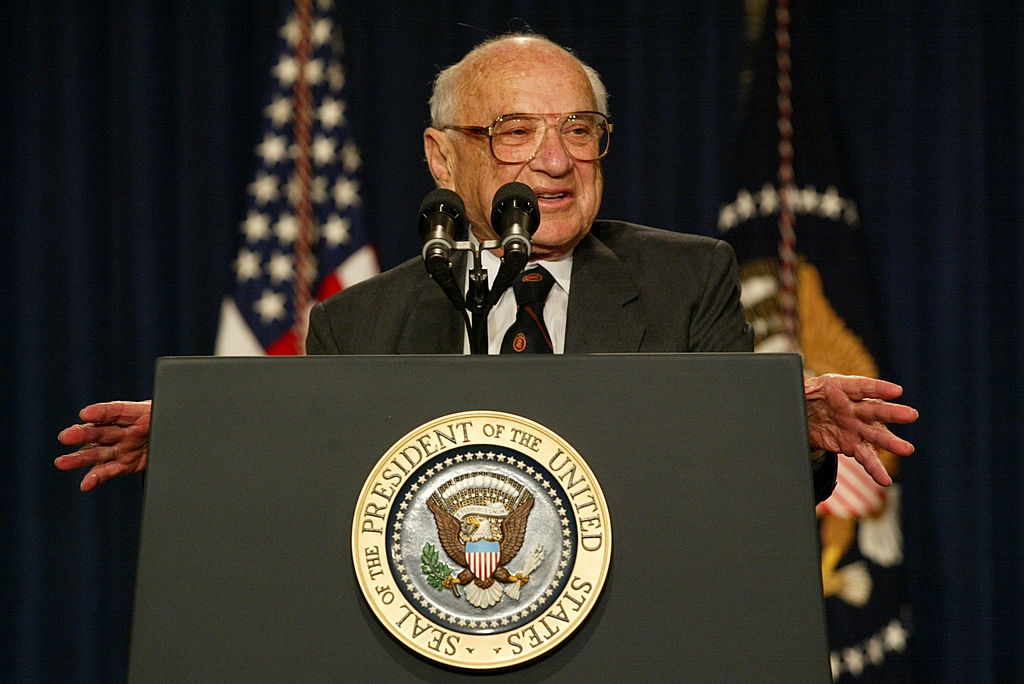
Milton Friedman speaks on May 9, 2002 during a White House event in Washington, DC.Alex Wong / Getty
As New Deal–era Keynesianism reigned supreme during the 1930s and ’40s, traditional neoclassical thinking was largely a minoritarian tendency languishing on the intellectual fringes. Within a few decades, however, it had not only become dominant at many universities, but successfully inserted many of its core assumptions and values into the political mainstream as well.
Marshall Steinbaum is an assistant professor of economics at the University of Utah, and his writing has appeared in Current Affairs, the American Prospect, Jacobin, and the Boston Review. We spoke to Steinbaum about how the neoclassical right’s astonishingly successful intellectual revolution came about, its core beliefs, and the profoundly antidemocratic animus it owes to the liberalism of the nineteenth century. This interview has been edited for clarity.
Luke Savage
In recent decades economics has been closely associated with neoliberal thought, but this wasn’t always the case. So let’s begin with your own alma mater, the University of Chicago economics department. During the New Deal era, it’s fair to say UChicago became a gathering place for thinking that went strongly against the grain of the emerging Keynesian policy consensus — and key figures in what would become the postwar Chicago School studied there.
Marshall Steinbaum