Colombia and Israel’s Cynical Disaster Diplomacy

Under the cover of earthquake response, Colombian President Abelardo de la Espriella has dramatically reversed Colombia’s stance toward Israel, recognizing controversial Israeli claims over the occupied Golan Heights.
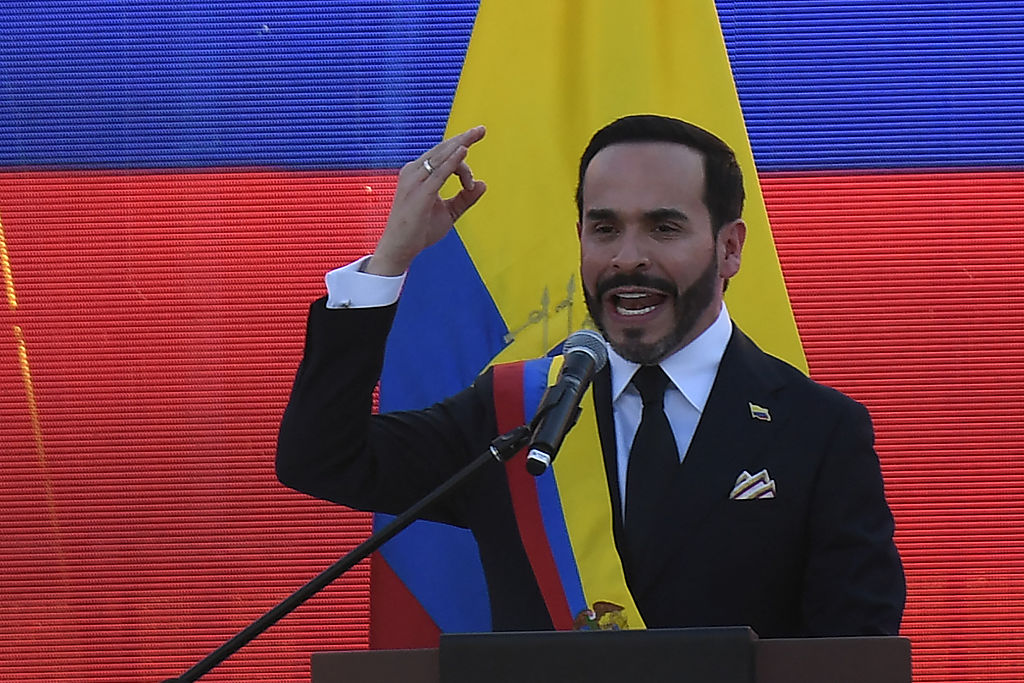
Colombia President Abelardo de la Espriella delivers a speech at the Pichincha Battalion after his swearing in ceremony in Cali, Colombia, on August 7, 2026.

Israel was one of the few countries granted permission by far-right Colombian President Abelardo de la Espriella to send an earthquake response team, and only after the crucial 72-hour window for rescuing survivors had passed. (Jaime Saldarriaga / AFP via Getty Images)


On the morning of August 10, a powerful 7.4 magnitude earthquake struck western Colombia, leaving nearly three hundred people dead, four thousand injured, and potentially thousands more missing by the latest count. The crisis created an early test for new far-right President Abelardo de la Espriella, who was inaugurated days before. A few hours after the quake, as Colombians still lay under the rubble of destroyed buildings, the government published a long statement recognizing Israeli sovereignty over the Golan Heights, a Syrian territory illegally occupied by the country since 1967. The statement, which triggered a diplomatic crisis with the Arab states, placed Colombia alongside the United States as the only other country in the world to recognize Israel’s claim over the territory.

While the Colombian government was rightfully panned at home and abroad for the timing of its announcement, it was not incidental. Although de la Espriella’s desire to deepen ties with Israel predates the earthquake, the new administration’s moves since the disaster demonstrate that it plans on using the crisis to justify its larger rapprochement with the Middle Eastern country. This dynamic just played out in Venezuela, where Israel’s provision of humanitarian aid in the wake of deadly earthquakes paved the way for the reestablishment of consular relations between the former foes.

The closer alignment between Colombia and Israel is especially difficult to swallow given the former country’s recent role as a leader of the global Palestinian solidarity movement under President Gustavo Petro, de la Espriella’s predecessor. Nevertheless, it’s part of a wider regional trend in which far-right governments brandish their allegiance to Israel or immediately make overtures to its leaders upon taking power.

Disaster Diplomacy

The August 10 earthquake caused intense damage in the departments of Chocó (the epicenter), Valle del Cauca, Risaralda, Quindío, and Caldas. The power went out, buildings collapsed, and the human toll continues to climb. The government, scrambling to deal with the chaos, mobilized state resources and relied on local communities themselves for much of the immediate disaster relief. The first seventy-two hours are regarded as essential in earthquake response to preserving the life of trapped survivors, yet it took a whole three days for the state to formally accept international rescue teams and, when it finally did, it limited itself to collaborating only with right-wing allies — the United States, Ecuador, El Salvador, and Israel.

While the last could come as a surprise, this was a familiar role for the Israelis to play in the region. For decades, the country has provided humanitarian aid and rescue teams in the aftermath of natural disasters. In recent years, the Israel Defense Forces (IDF) and the Israeli Forum for International Aid (IsraAID) have deployed to Peru, Mexico, and Haiti following earthquakes as well as Brazil after its 2019 dam collapse.

This aid functions as a form of disaster diplomacy that seeks to launder Israel’s image on the international stage even as it simultaneously wields humanitarian aid in Gaza as a weapon of war against Palestinians. Through these means, the Israeli state seeks to improve diplomatic relations with countries whose governments may at one time have been more critical.

In neighboring Venezuela, the provision of Israeli aid in the wake of devastating twin earthquakes set the stage for their reestablishment of consular ties. As Simón Rodríguez recently reported in NACLA, Israel’s rescue mission was explicitly framed by both sides as a way to reinitiate diplomatic ties that had been severed under former Venezuelan leader Hugo Chávez. Early on, Interim President Delcy Rodríguez expressed her hope that the aid would “open new paths and doors” with “countries with which we do not have diplomatic relations”; Israeli Prime Minister Benjamin Netanyahu, meanwhile, thanked the Israeli rescue team for “rebuilding ruins and relations.”

In Venezuela, the same humanitarian actors taking part in the mission played an active role in justifying and later perpetuating Israel’s ongoing genocide in Gaza. As Rodríguez notes, ZAKA, an NGO founded in the 1990s by a former member of an ultraorthodox terrorist organization, was on the ground shortly after the quakes. The organization, which specializes in emergency response and rescue operations in Israel and abroad, was a prime source for many of the myths that the US media used to justify genocide in response to the October 7 attacks, including the narrative of beheaded babies. Yosef Garmon, its Latin America director, once published a video of himself speaking Spanish from the ruins of Gaza, appealing to Christian Zionists for their support; in Caracas, he met with university students, whom he filmed awkwardly joining him in a chant of “Am Yisrael Chai” (“The people of Israel live”).

ZAKA praised the announcement that Israel and Venezuela were formally restoring consular relations. It also took its share of the credit, pointing to its mission as an essential part of the process.

The Venezuela Playbook in Colombia

Already in the country, having arrived in Bogotá hours before, Garmon was giving interviews to Israeli television from Colombia shortly after the quake struck on Monday morning. Days earlier, he had been in the city of Cali, where he had once served as rabbi, for the presidential inauguration of Abelardo de la Espriella.

De la Espriella has made a rapprochement with Israel a priority. Prior to his inauguration, he had announced his intention to move Colombia’s embassy to Jerusalem and suspend the planned opening of an embassy in Ramallah, in addition to meeting with Israeli Foreign Minister Gideon Sa’ar. He also announced the creation of a bilateral economic commission and a formal visit to the country by a Colombian delegation in October.

Under the cover of earthquake response, Colombia has taken its support for Israel to new levels, including in a statement recognizing Israeli sovereignty over the Golan Heights. More substantively, the government took advantage of the natural disaster to revoke two decrees that had banned the export of Colombian coal to Israel. The mandated five-day window to comment on the proposed legislation began the day after the earthquake, when attention was directed elsewhere.

These actions have been warmly received by the Israeli government. On Tuesday, the day after the earthquake, Prime Minister Benjamin Netanyahu posted a video thanking Colombia for its recognition of Israel’s claim to the Golan Heights, saying that just as the “people are with the Golan Heights,” today the “people are with Colombia.” The day after, following a request from de la Espriella, Netanyahu ordered the dispatch of a formal humanitarian mission.

Israel was one of the few countries granted permission to send a rescue team alongside the United States, Ecuador, and El Salvador. While the government has denied that any ideological considerations are at play — claiming instead that these missions were the only ones that “comply with international protocols” — it is clear that they were only willing to accept desperately needed assistance from their right-wing allies. The government’s rejection of an elite search and rescue team from Mexico, which yesterday morning President Claudia Sheinbaum disclosed was refused entry into the country, made the politicization of aid clear.

Israel’s formal aid mission will complement the work of ZAKA, which is already on the ground in affected cities like Cali and Pereira. As they did in Venezuela, Israelis are already sharing stories with the media about the positive reception they are receiving from Colombian citizens. One Israeli businessman who had also attended de la Espriella’s inauguration spoke of Colombians approaching him and asking for his blessings in the aftermath of the earthquakes. It was “the opposite of hatred,” he said.

Right-wing Colombian politicians are also publicly praising Israeli organizations like ZAKA, highlighting their technological marvels and the essential contribution they will make to the recovery efforts.

Israeli aid may very well be an essential component of saving lives in a situation that remains dangerous; people remain trapped under buildings, and the window for finding survivors among the rubble has all but closed. Likewise, for many Colombians, the belief in Israel’s technological prowess is likely apolitical, a response to an increasingly dire situation. Nevertheless, the government’s rejection of foreign rescue missions like the Mexican brigadistas — a force with far more experience in post-earthquake operations — will surely lead to unnecessary death.

The Colombian government’s attention to Israeli matters has stood in stark contrast to the coordination of its own rescue efforts.

A Regional Trend

Under Gustavo Petro, Colombia was a global leader in fighting to hold Israel accountable for its genocidal crimes. Petro severed diplomatic ties and banned the export of coal to Israel. His outspoken advocacy for the Palestinian cause also placed him firmly in the crosshairs of the Trump administration, which at one point revoked his US visa for his criticisms.

Though he went further than any leader in the region, Petro was not alone in criticizing Israel’s genocide. At the time, the leaders of Bolivia, Chile, and Honduras did the same, often joining forces in organizations like the Hague Group, dedicated to finding ways to hold Israel to account. Latin America was at the forefront of the Palestinian solidarity movement: in addition to its outspoken leaders, students led solidarity encampments, trade unions launched innovative campaigns to boycott Israeli goods, and indigenous groups saw their struggles mirrored in the plight of the Palestinians.

Nevertheless, in the last year, a series of right-wing electoral victories have drastically changed the picture, as these new leaders quickly walked back any pro-Palestinian policies. In the past year, newly elected presidents like Rodrigo Paz of Bolivia, the far-right José Antonio Kast of Chile, and Nasry Asfura of Honduras (who happens to be of Palestinian descent) reopened or actively strengthened ties with Israel since taking office.

A year earlier, with the Israeli government increasingly isolated on the global stage, it turned its attention to Latin America, and its efforts seem to be paying off. At the end of last year, Israeli Foreign Minister Gideon Sa’ar declared that 2026 would be the “year of Latin America” for Israel. He has since worked to make that dream a reality, meeting with allied foreign ministers and visiting the region in person.

In the cases of Venezuela and Colombia, natural disaster relief has provided the Israeli state with a vehicle to connect to local populations directly. It has also enabled these governments to legitimize their rapprochements with a state that is widely denounced by the majority of the population.

Foreign aid missions have long been understood as an extension of diplomacy. Yet aid driven primarily by political rather than humanitarian objectives — exemplified by the Colombian administration’s rejection of rescue missions from nonaligned countries and Israel’s framing of humanitarian relief as a vehicle to achieve geopolitical goals and secure access to resources — only reflects right-wing leaders’ aversion to diplomatic cooperation in favor of transactionalism.