Colombia’s Right-Wing Offensive and the Politics of Order

Far-right millionaire Abelardo de la Espriella has a narrow lead ahead of Colombia’s election runoff. Left-wing rival Iván Cepeda speaks of the outgoing government’s achievements, but rising violence has made the campaign especially volatile.
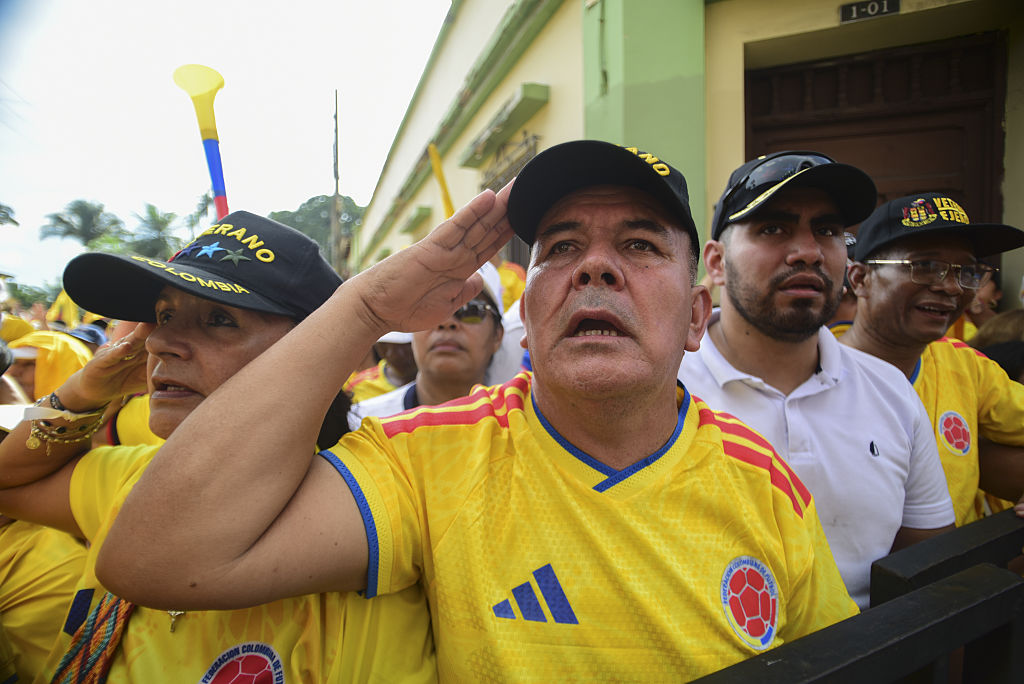
Supporters of Colombia's far-right Abelardo de la Espriella attend a rally during his presidential campaign.

Ahead of Sunday’s election runoff, Colombia’s right wing has warned of the country becoming “another Venezuela or Cuba.” Calling themselves patriots, they favor full subordination to US interests and Donald Trump personally. (Edwin Rodriguez Pipicano / Anadolu via Getty Images)


As Colombia heads toward a high-stakes presidential runoff this coming Sunday, left-wing Senator Iván Cepeda and far-right millionaire lawyer Abelardo de la Espriella have ramped up efforts to reach the handful of voters that could tip the balance.

One ubiquitous symbol on both sides of the fight is the national soccer jersey. De la Espriella, like Brazil’s Jair Bolsonaro before him, has made the shirt his signature look in recent weeks, in a bid to appeal to a popular right-wing base. Critics argued that the national team’s jersey belongs to all Colombians and shouldn’t be appropriated by any one political movement.

The Colombian Football Federation responded by insisting that it, and the national team, should stay outside politics. The dispute became so intense that a judge in the capital, Bogotá, ordered de la Espriella to stop using the national team’s official shirt in campaign activities. Brushing off the ruling, his rival Cepeda’s supporters also began wearing the yellow jersey, reclaiming the shirt as their own.

In a recent viral video, Carlos Lehder — the former leader of the Medellín cartel and drug lord — appears wearing the jersey, hinting not so subtly at his support for far-right de la Espriella: “Putting on Colombia’s national team jersey is a privilege, an honor. People in Cuba cannot enjoy the game the way we do in a free and sovereign Colombia; they haven’t had a domestic league there for sixty years.” It was a barely veiled reference to familiar right-wing claims that left-winger Cepeda’s policies would turn Colombia into “another Venezuela or Cuba.”

Taken together, these disputes signal a campaign that has shifted decisively onto the terrain of order, identity, and authority. It is also overshadowed by political violence, including the bombing that killed twenty civilians in the Cauca region this past April, and a failed assassination or kidnapping attempt targeting pro-Cepeda Senator Alexander López, attributed to dissident members of the Fuerzas Armadas Revolucionarias de Colombia (FARC) armed groups. The violence has come to dictate the terms of the debate, placing security issues at the heart of the runoff.

Will Cepeda regain control over the narrative? In some ways the outgoing administration’s record might seem to help him, given that Gustavo Petro’s left-wing government enjoys good approval ratings hovering around 48 percent and can point to declining poverty levels and continued economic growth. Yet now the left-wing candidate faces the most urgent question of his campaign: how to transform his existing electoral base into a winning coalition. With de la Espriella ahead by 670,000 votes in the first round, the burden is now on Cepeda to close the gap. He would need to gain roughly one million additional votes in the coming days to reverse the momentum of the race.

Reaching for the Center or Mobilizing Nonvoters?

With turnout reaching 58 percent in the first round — a relatively high figure by Colombian standards — the pool of voters who can still be mobilized simply through increased participation appears limited, even though nearly seventeen million abstainers remain theoretically available.

Initially, Cepeda focused on consolidating his existing base among social movements, environmental activists, indigenous peoples, and Afro-Colombian communities rather than pursuing traditional political alliances. From this effort gradually emerged, however, the “Alianza por la Vida,” a loose and evolving umbrella that began within the Pacto Histórico but progressively expanded to include figures from the ecologist Alianza Verde and sectors of the Partido Liberal, as well as other centrist and left-wing actors.

But the limits of that strategy have become increasingly apparent after de la Espriella secured 43 percent of the votes in the first round, edging ahead of Cepeda, on 40 percent. Another likely pool of votes for de la Espriella comes from hard-right candidate Paloma Valencia who won just short of 7 percent in the first round and then endorsed him. To have any chance of success, Cepeda’s Pacto Histórico will need to strengthen and broaden its own alliances.

“Efforts are now being made to reach the political center through overtures to Claudia López, Sergio Fajardo, and Juan Daniel Oviedo, Paloma Valencia’s running mate, who himself has refused to endorse Abelardo de la Espriella,” explains Yann Basset, a political scientist at Bogotá’s Universidad del Rosario.

One of Cepeda’s most significant concessions to centrist voters was his decision to abandon plans for a constituent assembly to rewrite the Constitution, a proposal long championed by President Gustavo Petro. The initiative stemmed from growing frustration with a fragmented Congress that, according to Petro, had actively blocked his ability to implement the social and economic reforms he was elected to deliver.

Supporters of the initiative saw it as a way to overcome those institutional roadblocks and push through structural change. Critics, however, feared it could open the door to sweeping constitutional reforms and weaken democratic checks and balances.

Lessons From Four Years of Gridlock

When elected in 2022, the Pacto Histórico did not win a majority in either chamber of Congress. This led Petro to rely on unstable alliances with centrist forces (the Partido Liberal, and the Partido de la U[nión por la Gente]) and parts of the Partido Conservador to form a governing coalition. These alliances gradually eroded as disagreements emerged over his reform agenda, making it increasingly difficult to pass any legislation.

Petro’s frustration grew in large part from the fate of two major reforms. His health reform, which would have significantly reduced the role of private insurers in favor of greater state control, became bogged down in Congress amid concerns about its cost and feasibility.

There was also his labor reform, designed to strengthen workers’ rights and increase overtime and weekend pay. It faced fierce opposition from business groups and was ultimately blocked by lawmakers who warned it could damage employment. For Petro and his supporters, these defeats illustrated the difficulty of translating an electoral mandate into legislation.

On several occasions, the Colombian President turned to the streets for support, calling on demonstrations and even a national strike in May 2025, as an attempt to pressure the Congress to adopt his reforms.

Both packages were ultimately only partially adopted after significant compromises.

This governing strategy did not sit well among centrists or conservatives. According to Yann Basset, this also explains Cepeda’s dropping of the constituent assembly plan: “By shelving the initiative, Cepeda sought to reassure moderate voters and present himself as a candidate of consensus rather than constitutional rupture.”

So far, however, none of the main centrist figures has responded positively or openly urged their supporters to back the Pacto Histórico in Sunday’s runoff.

The Pacto Histórico’s strong showing in March’s legislative elections made it the largest coalition bloc in the Senate with twenty-five seats of the chamber’s 108. It briefly fueled expectations of a favorable presidential outcome and could potentially make governing slightly easier for Cepeda should he win the presidency. However, those expectations were quickly upended by de la Espriella’s surge in the first round, redrawing the terms of the runoff.

A Reactionary Wind Sweeps Across Latin America

Now formally endorsed by Donald Trump in a post on X describing de la Espriella as an “intelligent, strong and tough leader” who will take on a “radical leftist Marxist,” the Colombian candidate advocates full alignment with US interests, complying with the “Donroe” doctrine in Latin America. It’s hardly surprising, coming from a candidate who spent a decade in Florida and maintains ties with Miami Republican circles, including figures such as Marco Rubio and Senator Bernie Moreno.

As Mathilde Allain, a political scientist at Paris’s Sorbonne Nouvelle University explains: “Until recently, Colombia was the second-largest recipient of US military aid after Israel. It’s considered a key military and economic partner, so the endorsement could potentially hold a lot of weight.”

Not only has de la Espriella vowed to slash government spending by 40 percent — a move that critics argue would deepen inequalities in what is already among the most unequal countries in the region — he has also pledged to legalize civilian gun carrying.

He further promises to withdraw Colombia from major international institutions, including the United Nations, the Inter-American Commission on Human Rights (IACHR), the Organization of American States (OAS), and the Special Jurisdiction for Peace (JEP) — the latter having played a central role in implementing Colombia’s 2016 peace agreement by investigating crimes committed during the armed conflict and providing a framework for truth, accountability, and reparations.

His broader agenda includes restoring diplomatic ties with Israel, expanding fossil fuel extraction, authorizing fracking, and promoting the development of data centers, reversing many of the priorities pursued by the current administration.

Susana Muhamad, Colombia’s former environment minister, told Jacobin: “Donald Trump has made the revival of the Monroe Doctrine central to his approach to Latin America. The objective is largely economic: securing access to strategic resources, particularly the critical minerals needed for US military and industrial power.”

De la Espriella’s campaign fits squarely within that agenda, she argues. “He and the Colombian right have promoted deeper economic integration with the United States and an extractivist model of development that would amount to a surrender of Colombia’s resource sovereignty to foreign capital and US geopolitical interests.” The political impact of this alignment remains ambiguous, and it is unclear whether it can meaningfully shift voter preferences in either direction. Donald Trump’s public endorsement has been seized upon by the Left as evidence of foreign interference and a threat to national sovereignty, while others see it as reinforcing ties with a powerful economic partner.

Perhaps most controversially, de la Espriella suggested in an interview with Revista Semana that Colombia should “legalize 10 percent of illegal capital” derived from drug trafficking, illegal mining, and other criminal activities — virtually offering to legalize money laundering.

De la Espriella’s rise is not, however, occurring in isolation. It forms part of a broader right-wing offensive across Latin America, backed by Washington and emboldened by Trump’s return to the White House. The removal of Nicolás Maduro in a US-led operation, renewed threats against Cuba, and ongoing controversies over alleged electoral fraud in Honduras have all reinforced the sense that the region is entering a new phase of confrontation between the Latin American left and a militarized reactionary right.

The Final Stretch

In the campaign’s final days, both candidates are looking for something to shift the balance. Cepeda claimed in an official press release that he had uncovered a plan by de la Espriella to stage a false-flag attack against himself in order to generate fear and boost support for his “tough on crime” program. Meanwhile, Cepeda’s civil-society supporters are intensifying grassroots efforts, including fundraising to transport activists to remote regions, large-scale local organizing drives, and voter mobilization campaigns inspired by Zohran Mamdani’s successful municipal campaign in New York.

The Left has also doubled down on street-level campaigning and an aggressive social-media strategy, targeting younger voters through face-to-face outreach and networks of digital influencers and political content creators. Petro and Mamdani had scheduled a private meeting this week, at a UN event in New York titled “Dignity in Democracy.” The photo opportunity was intended to signal solidarity between two rising figures of the international left, but the Trump administration quickly moved to block the meeting, with State Department officials describing it as “unacceptable.”

With only days remaining before Colombians go back to the polls, the outcome remains highly uncertain. More than a contest between two candidates, the runoff has become a battle over the issues that will define Colombia’s political future: whether the election turns on the social record of the Petro years, or on the demands for military order and economic deregulation that have increasingly come to dominate the campaign.