The Class Divide Haunting Climate Politics
New research confirms that policy messages on climate favored by college-educated liberals often fall flat with working-class Americans. The good news? Workers are favorable to pro-climate policies that speak directly to their everyday material concerns.
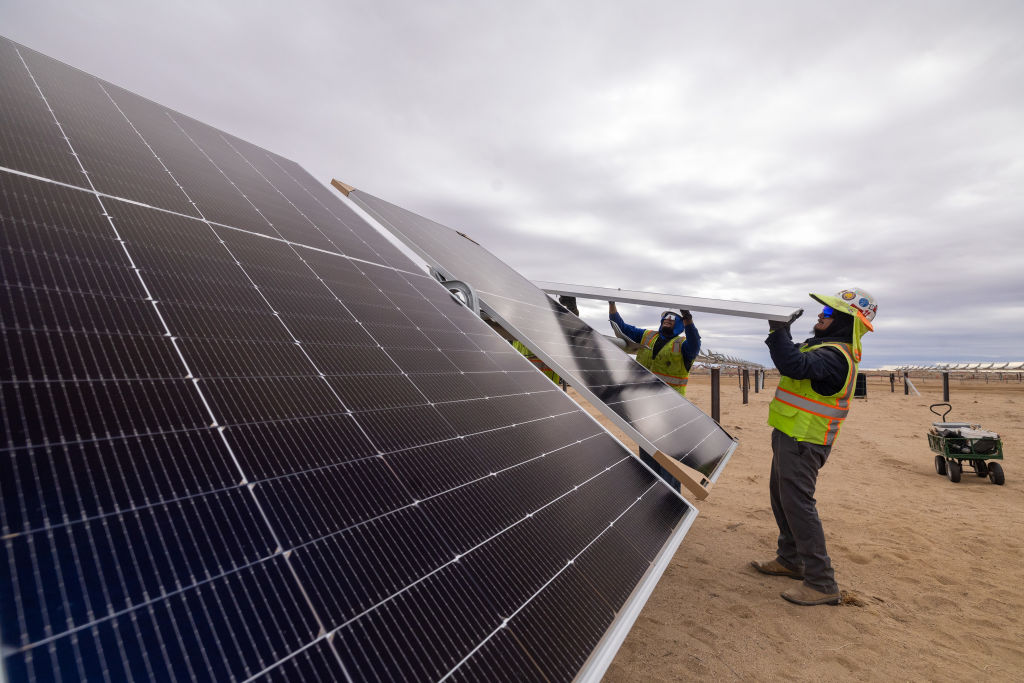
There’s a big divide in political views between working-class voters and educated, affluent liberals, including on climate change. But the Left can bridge that divide with the right message. (Brian van der Brug / Los Angeles Times via Getty Images)
Socialists believe the working class is the key agent of social transformation in a capitalist society. So, perhaps the most important problem for socialists today is the fact that significant swaths of the working-class are shifting to the populist right — not just in the United States but all over the world.
A new report from Joan C. Williams and Jared Abbott, The Left’s Coalition Crisis, explains how working-class views in the US diverge sharply from the views of the educated and affluent liberals and progressives that increasingly dominate the Democratic party coalition — a party that the American working class once saw as their natural home. This divergence has grown so wide — and the Democratic Party so deeply unpopular — that in many parts of the country there is a “Democratic penalty,” where candidates can expect losing sizable support by merely being associated with the party’s brand.
As the Center for Working-Class Politics newsletter summarized it, “A key finding of this report is that college-educated liberals live in a class bubble where virtually everyone agrees with them on culture and climate issues — but working-class people don’t.”
The report is specifically interested in comparing the class gap between upper-middle-class liberals — people with college degrees who vote or lean Democratic and who have household incomes in the top 25 percent of the distribution — and a specific portion of the US working class defined as “the group that has veered far right . . . middle-status voters.” This group is specified as non-college-graduate households in the middle 50 percent of the income distribution, making between roughly $40,000 and $100,000 per year.
The report covers the class gap on a wide variety of issues including immigration, public safety, and abortion rights, but one of the most polarizing issues is climate change. Williams and Abbott write:
Liberal college grads run 29 points more supportive of climate change initiatives than working-class respondents — the fourth-largest class gap we found (87% vs. 58%). There is a 20-point prioritization gap: working-class Americans ranked climate change as only their 27th priority (out of 30); liberal college grads ranked it 15th.
Dig deeper by race, and it’s clear that only one group ranks climate change highly as an issue — white liberal college grads (ranked sixth compared to twenty-seventh for the white working class). Even black and Latino college grads don’t rank it highly (twenty-second and twenty-third out of thirty respectively). Given the scale of what’s required to address climate change, surely requiring large supermajorities to accomplish the boldest action, these numbers should raise alarm bells.
Bur rather than despair, the report bluntly asserts, “Given that climate change is not a working-class priority, advocates need to link it to something that is.” And they have good ideas on how to do that. But first, we should understand what kinds of climate ideas and policies repel working-class support in the first place.
Don’t Give Right-Wing Populists Ammunition
One of the most frustrating aspects of climate politics today is that it is arguably the Right that mobilizes class politics most effectively on this issue. Right-wing politicians consistently argue climate action is a plot of the liberal elite to harm the lives of average working-class families with rising energy costs and lost jobs. On the other hand, liberal activists often make climate change about everything but class — “Believe Science” — and sometimes advocating policies like carbon taxes that would raise the price of energy (affirming precisely what the Right warns against).
The report throws this problem into sharp relief. A question asking about a carbon tax that would impose an additional $40/month on consumers obtains 69 percent support from elite liberals, while working-class support is a paltry 24 percent! Meanwhile, simply reframing the tax to focus on emitters with no increase in household costs increases working-class support to 65 percent (and support from liberal college grads to 90 percent).
While climate activism tends to single out the fossil fuel industry as the enemy, often targeting “Big Oil” in particular, one of the key findings is that this kind of politics falls flat with working people: “Climate action to rein in Big Oil produces the widest class gap, with support from 91% of liberal college grads versus just 50% working class support — a 41-point gap.” This might be because most working-class people understand they rely on fossil fuels for their basic everyday existence — to drive to work, to heat their homes, and more — and as we’ve seen with rising gas and electricity prices as of late, these costs impose significant burdens on already strained household budgets. A politics narrowly aimed against the fossil fuel industry will struggle to overcome the industry’s own highly misleading narrative that they are the key to delivering affordable energy to American families.
Another topic beloved by affluent liberals is the commitment to the Paris Agreement — a nonbinding climate agreement signed by 195 countries in 2015. Not only does the Right paint this as a globalist plan meant to impinge on US national interests, but the treaty itself also translates into an abstract politics of degree targets and emission-cut commitments. Unsurprisingly, there is a massive class gap over whether the US should stay in the treaty: liberal college grads oppose withdrawal at a level of 95 percent, but the working class only shows 39 percent opposition.
There are other topics climate activists should avoid entirely. For good or ill, the electric vehicle (EV) is cemented in the popular imagination as an overly expensive vehicle for the smug elite; thus working-class support for government incentives to purchase EVs (not even mandates) is abysmal at 37 percent (compared to 66 percent for liberal college grads).
But even left-wing climate advocates get squeamish around the idea of an EV-focused transition. One thing the report did not ask is whether there is a class gap on questions of public transit — which, in cities at least, is disproportionately relied on by the working class. Of course, New York City Mayor Zohran Mamdani made expanding free public transit a cornerstone of his campaign, a policy that would have a positive climate impact as well.
Meet the Working Class at the “End of the Month”
The report not only shows the extent of the class gap on a number of climate questions but also demonstrates how reframing the issues can dramatically increasing working-class support for pro-climate policy. If the message shifts focus from “Big Oil” to “corporate profiteers,” working-class support increases by 12 percentage points. This is no doubt due to the simmering popular anger toward the rich in general, rather than the fossil fuel industry in particular.
The most dramatic gains come, unsurprisingly, from a focus on what matters to working-class people every day: energy costs, well-paying jobs, and even pollution. A message emphasizing those issues resonated with an impressive 75 percent of working-class respondents while retaining 90 percent of affluent college-grad liberals.
This finding aligns with a core slogan of the Yellow Vests movement in France, when it complained that the political class only cares about the “end of the world” when workers are trying to make it to the “end of the month.” Indeed, while climate change itself can appear gradual and abstract, it has been the consistent failure of climate advocacy to reach people at this “end of the month” level.
The report also shows the working-class responds positively — increasing 17 points — to a “Build, Baby, Build” message that centers economic growth, job creation, and calls for reshoring manufacturing. It should be obvious why this framing resonates in communities destroyed by decades of free trade and deindustrialization.
But this message also stands in contrast to the last two decades of climate activism that has had a skewed focus on blocking destructive fossil fuel projects like pipelines or coal-fired power. While many of these struggles are inspiring — the fight over the Dakota Access Pipeline comes to mind — this style of politics inevitably antagonizes unions and workers in these industries who we need to build and replace all that fossil fuel infrastructure with clean energy alternatives. The report shows the wider working class is more aligned with these building trades unions.
One possible response is that the Democrats already tried a “Build, Baby, Build” strategy, linking climate to jobs with the Inflation Reduction Act, which led us right back to Donald Trump. But crucially, the report advises we “don’t throw out the baby with the bathwater” on that front. Not only had many IRA projects barely gotten off the ground before Trump was reelected, but studies have shown the tax-credit model of policymaking made it difficult for communities to link any economic benefits to a coherent political project of the Biden administration. (It didn’t help that Joe Biden himself was incapable of communicating those connections.)
While Marxists and others on the Left are correct to point out that many college-educated progressives are themselves part of the working class — even many lawyers and doctors must work for a paycheck to survive, after all — the key to socialist political strategy is uniting the whole working-class around a majoritarian agenda. For a civilizational challenge like shifting away from fossil fuels, only broad-based working-class power is capable of achieving what planetary systems require. To build that power, we need to understand why we are failing to win many workers to our politics, and how we can change that.