Amazon Is Spending Big Against NYC’s Delivery Protection Act

Mayor Zohran Mamdani is backing the Delivery Protection Act, a piece of local legislation which would require Amazon to directly employ their drivers. It could open a lane for drivers to unionize — and is thus seen as an existential threat by Amazon.
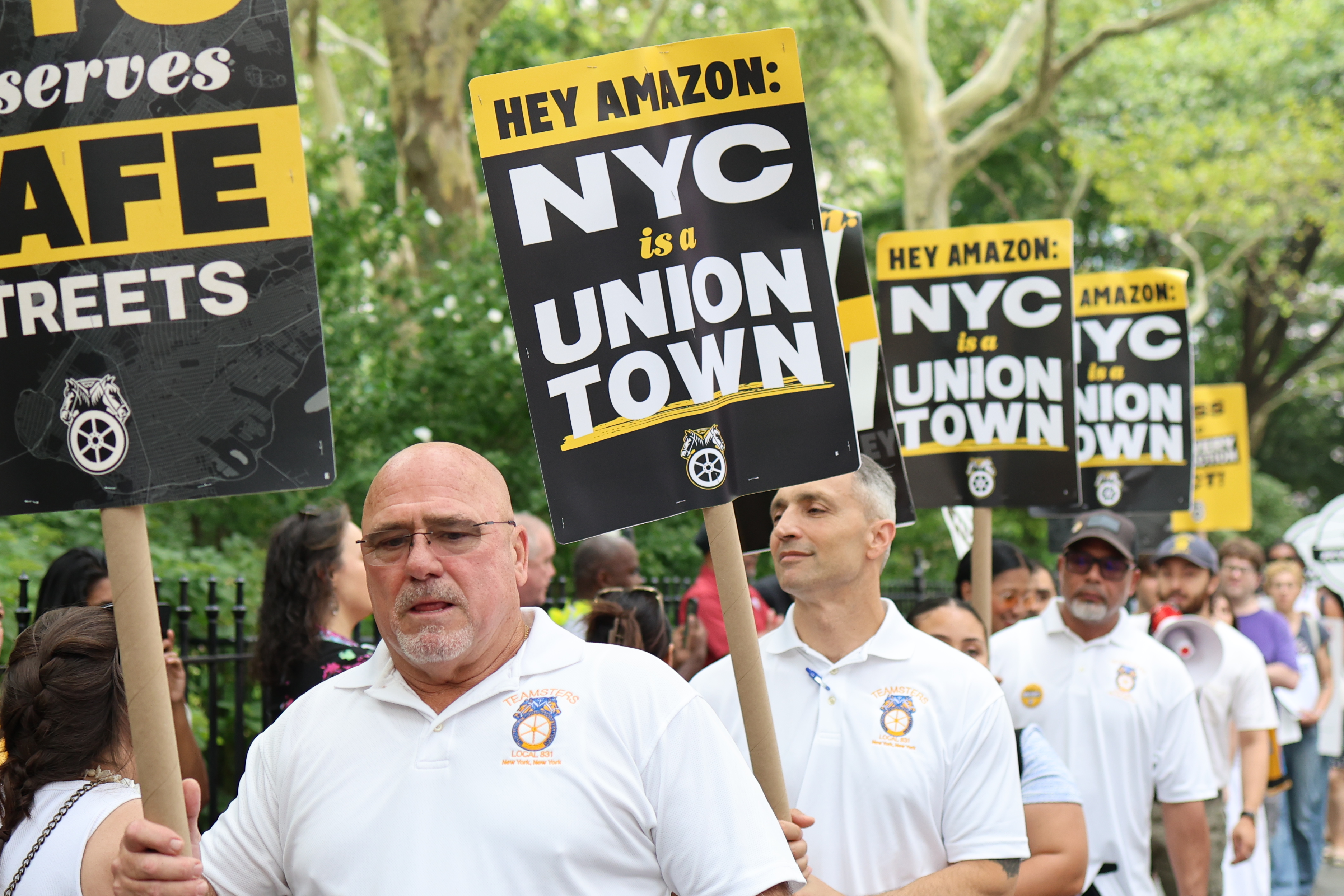
Teamsters rally at New York City Hall in support of the Delivery Protection Act.

Amazon delivery drivers wear Amazon uniforms, drive Amazon-branded vans, and deliver Amazon packages. But Amazon says they aren’t Amazon employees. A new bill backed by Zohran Mamdani would change that in New York. (Courtesy ALIGN)


When Latrice Johnson learned that her brother had died, she was delivering Amazon packages in New York City. The next day, an Amazon manager gave her contact information for a grief counselor. Johnson called and spoke with the counselor, only to get another call telling her she wasn’t eligible for the service. She didn’t work for Amazon.

Johnson delivered Amazon packages for two years out of DBK4 in Queens. Unable to afford more time off after her brother’s death, Johnson went back to delivering packages. As she testified before New York City Council, she sometimes cried as she made her stops.

On Thursday afternoon, Johnson was outside the gates of New York City Hall with the Teamsters, pushing for legislation meant to do away with that distinction. The Delivery Protection Act (DPA), introduced by City Council Member Tiffany Cabán, would require delivery companies to directly employ the drivers and warehouse workers doing their core work, as well as set licensing, safety, and training requirements for last-mile facilities. Three days earlier, Mayor Zohran Mamdani endorsed the bill. More than thirty council members are signed on as cosponsors, though Speaker Julie Menin, who supported an earlier version, has not yet backed the latest version.

“Corporations like Amazon build billion-dollar business models by insulating themselves from accountability through a system of exploitative subcontracting,” Mamdani said in announcing his support for the legislation. “As last-mile delivery centers have exploded across New York, so too have traffic accidents and worker injuries. The Delivery Protection Act is commonsense regulation that protects delivery workers, safeguards the communities where these facilities operate and ensures that the corporations benefiting from workers’ labor are responsible for the consequences of their business practices.”

Latrice Johnson speaks in front of New York City Hall.
Latrice Johnson, a former delivery driver for one of Amazon’s Delivery Service Partners, speaks in front of New York City Hall in support of the Delivery Protection Act. (Courtesy ALIGN)

Amazon delivery drivers wear Amazon uniforms, drive Amazon-branded vans, and deliver Amazon packages. But the names on their paychecks belong to smaller contractors, known as Delivery Service Partners (DSPs). That distinction has become central to the Teamsters’ attempts to organize Amazon drivers. The union has gone to the National Labor Relations Board (NLRB), arguing that Amazon exercises enough control over drivers to be considered a “joint employer” — and is thus required to bargain with them. Amazon maintains that the DSPs are independent businesses.

Amazon has spent more than $5 million to try to defeat the legislation. Between February and mid-May, Amazon made five payments totaling $5,001,377 to the Five Borough Jobs Campaign, a business lobbying coalition affiliated with the Real Estate Board of New York. From March through June, Five Borough Jobs reported spending $4.7 million under the name New York Delivers.

New York Delivers has put the money into television and social media ads as well as lobbying, often featuring DSP owners and workers who say the bill threatens their businesses and jobs. One Facebook ad drew more than a million views over several days in May. The campaign also says the DPA would cost the average New York household $664 a year. That estimate comes from AKRF, a consulting firm Five Borough Jobs paid $52,500.

The stakes for Amazon go well beyond New York. The DSP program is central to its delivery operation: Amazon says it has created hundreds of thousands of driving jobs through thousands of contractors around the world. The arrangement puts that workforce at a legal remove from Amazon, allowing the company to disclaim responsibility for wages, injuries, and other basic conditions of employment.

It has also proved a formidable obstacle to unionization. When DSP drivers organize, Amazon can argue that it is not their employer and has no obligation to bargain with them — precisely the question workers organizing with the Teamsters are now fighting over at the NLRB.

Cabán, who has been working on the legislation for more than four years, pointed to the spending when I asked her outside city hall why Amazon was fighting the bill so aggressively.

“It’s a record,” she said. “They’ve never spent so much money lobbying for or against the bill in New York State.”

Julie Su, Mamdani’s deputy mayor for economic justice and the former acting US secretary of labor under President Joe Biden, called Amazon’s arrangement “a business model built on getting all the benefits of labor while disclaiming any responsibility for it.”

“It is an end run around a century of labor protections that have been fought for and won,” she said, a means “for the company at the top, Amazon, to say, ‘We get to dictate all the terms.’”

“We get to say what you deliver, when you deliver, how fast you deliver, and what you wear when you deliver it,” she said, describing the company’s position. “But when something happens to you, you don’t get paid what you’re supposed to get paid; you get injured on the job, which is very commonplace, they take no responsibility for it.”

Johnson, the DBK4 driver, and her coworkers later began organizing with the Teamsters. Last year, Amazon terminated its relationship with the DSP that employed them, leaving more than one hundred drivers without jobs. Johnson and the Teamsters say Amazon terminated the contract in retaliation for their organizing; Amazon has denied retaliating against workers for union activity.

New York City Council Member Tiffany Cabán speaks at a rally outside of New York City Hall.
New York City Council Member Tiffany Cabán speaks outside city hall in support of the Delivery Protection Act. (Courtesy ALIGN)

“I was laid off last year, back in August, with the rest of my coworkers,” Johnson told me. “The whole DSP was laid off, over one hundred drivers, and we know that it was retaliation for trying to organize the workplace.”

“It definitely proves that Amazon has that power to just get rid of us,” she said.

Johnson said direct employment would also make a difference when drivers get hurt. “Amazon can back away and say we don’t have anything to do with it,” she said. “That worker who got hurt has no help and is out of work with no pay.” For a driver, she added, “I just bust my ass working and delivering all these packages for all these months or years, and I get nothing.”

“Isn’t it crazy in this day and age, that you’re working for Amazon, but Amazon says you’re not working for them?” Vinnie Perrone, president of Teamsters Local 804, told me. Having the drivers become direct employees, he said, “would be a tremendous help.”

Local 804 represents United Parcel Service (UPS) workers, whose jobs offer Perrone a point of comparison. “They don’t want a unionized workforce. It’s very simple,” he said. “If UPS could avoid a unionized workforce, they would do it in a heartbeat.” But for unionized UPS members, he said, “a fair day’s work encompasses your salary and your benefits — and Amazon doesn’t want to pay.”

Amazon says the more than forty DSPs operating in New York City are independent small businesses, employing more than five thousand people whose jobs would be threatened by the bill. The company argues that direct employment could raise delivery costs and put the contractors themselves out of business. Christine Chan, whose Harlem-based Highgate Logistics employs about 175 people delivering Amazon packages by cargo bike, told the New York Times, “You’re betting that Amazon is going to employ these people directly. I’ll take the other side of that bet.”

Deputy Mayor Su argued that Amazon’s accounting leaves out costs New Yorkers already bear. “Amazon has spent a ton of money on supposed data about the costs,” she said. “New Yorkers are already bearing the costs of Amazon’s business model.” She pointed to injuries to workers and pedestrians, but also to the DSP owners Amazon describes as independent small businesses. They are, Su said, “completely under the thumb of Amazon.” If a DSP wants to give drivers time to rest because of the heat, she said, “Amazon tells them no, and even has the power to cut them off.”

Amazon has also threatened to move delivery facilities outside the city. In testimony to the city council, the company said passage would force it to consider “the potential for relocating operations and delivery facilities outside of New York City.”

Teamsters and local activists rally outside New York City Hall in support of the Delviery Protection Act.
Teamsters and local activists rally outside New York City Hall in support of the Delivery Protection Act. (Courtesy ALIGN)

The Mamdani administration disputes the premise that moving a facility across the city line would necessarily allow Amazon to preserve the prior employment arrangement, pointing to language in the bill defining “core delivery services” as transporting and delivering goods “to consumers in the city.” But other provisions refer specifically to last-mile facilities located “in the city,” leaving some room for interpretation as to whether Amazon could avoid the direct-employment requirement by moving a facility to New Jersey or Long Island.

Theodore Moore, executive director of ALIGN, a New York coalition of labor and community organizations that works on workers’ rights, environmental justice, and corporate accountability, was skeptical of the threat for a more practical reason.

“This is New York City: Amazon is here because the business is here,” Moore said. “These are last-mile delivery facilities. ‘Last mile’ is the key. They need to be as close to the door as possible.” Moving further away, he said, would mean spending more on gas and tolls, and taking longer to make deliveries.

Cabán pointed to the workers outside city hall. “It’s a lot of black and brown workers just trying to provide for their families,” she said. “They want to go to work and not come home hurt, and they want to go to work and know that they have their job the next day.” New Yorkers are on pace to receive roughly a billion packages this year, around three million a day.

“A person has to deliver them,” she said. “And if Amazon doesn’t want to do it, certainly somebody else will. But the entire model hinges on being as close to the consumer as possible.”

“It is an age-old argument by corporations who have profited massively off the backs of exploited workers, to say that working people only have two choices: a really bad job in which you’re struggling to get by, or no job at all,” Su told me of the opposition’s argument against the bill. “We reject that as a false choice.”

As acting labor secretary, Su dealt with subcontracting arrangements that allow large companies to distance themselves from the people carrying out the work. Now, as Mamdani’s deputy mayor for economic justice, she is trying to address one such arrangement through city law.

“We have a federal administration that is wholly uninterested in worker protections and enforcing laws on the books,” she said. A federal response remains important, she added, given “the sheer size and reach of companies like Amazon,” but “in the absence of that work, New York City is not standing by. We’re not waiting for someone else to act.”

“This bill gets to the heart of their business model,” Su said. “Drivers have been threatened when they speak out. They’ve been told that they can no longer work for Amazon, and the company has put a lot of money into trying to buy positive reviews from those that they control. But there’s no reason why you, a trillion-dollar company, shouldn’t have to play by the same set of rules that every other company does.”

“Everyone around the country is watching this, and this is going to be model legislation for other jurisdictions,” ALIGN’s Moore said. “They have to be worried, because that’s what we’re trying to do. We’re trying to change their model.”

“No company is above the law,” Su said when I asked how the administration would enforce the legislation against a company with Amazon’s resources. Mamdani, she said, was “taking a very strong stand. We’re going to put the full force of this administration behind getting this bill passed.”

“I just want Amazon to take accountability,” said Johnson, the former DBK4 driver. “Without us, there would be no Amazon. So respect your workers.”