Amazon’s Shameless Union Busting Shouldn’t Be Forgotten
Thousands of workers at the JFK8 Amazon warehouse voted to unionize in 2022, sparking hope that we were witnessing a turning point for workers. The egregious union busting by Amazon that followed should have been a rallying cry for Democrats. It wasn’t.
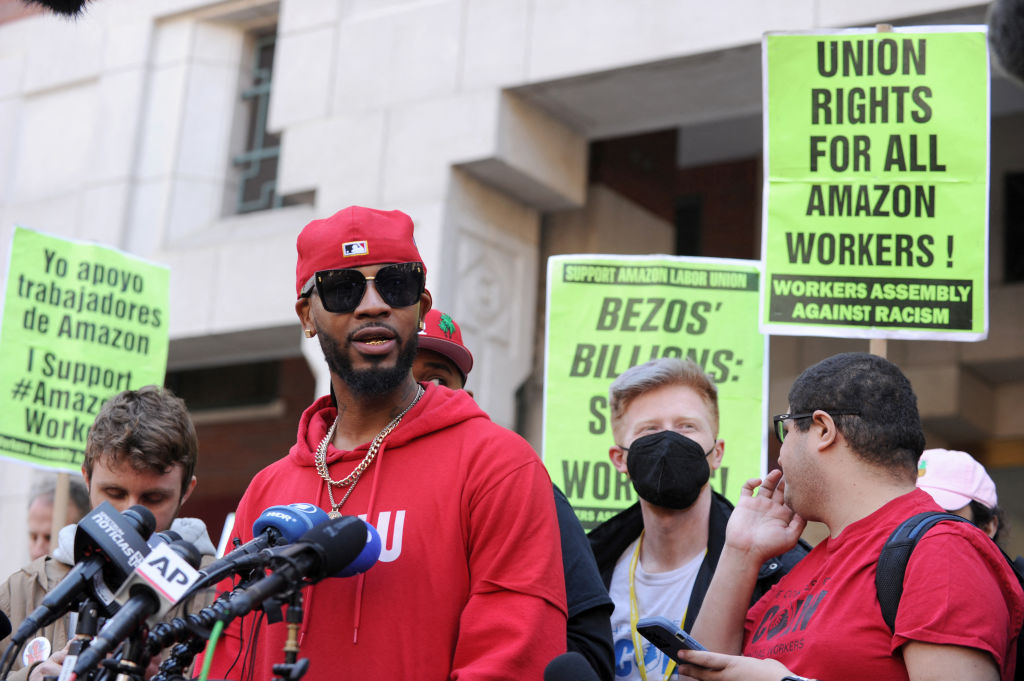
Union organizer Christian Smalls speaks following the April 1, 2022, vote for the unionization of the Amazon Staten Island warehouse in New York. (Andrea Renault / AFP via Getty Images)
Two and a half years ago, thousands of workers at one of Amazon’s giant warehouses, known as JFK8, voted to unionize. Their victory generated huge amounts of attention across the country, and suddenly, one of the leaders of the organizing drive, Chris Smalls, was everywhere. Smalls became an overnight celebrity, and he even met with President Joe Biden at the White House.
The Amazon warehouse victory created a spark of hope that we might be witnessing a turning point for workers. Of course, even at the time, I cautioned that “without a lot more pressure on Amazon, the workers at JFK8 will be waiting a long time for their union contract.” Now, two and a half years later, it’s safe to say the spark has been extinguished. What happened, and what lessons can we learn?
The short answer as to what happened is that labor law is broken. When workers vote to unionize, an employer does not face an order to bargain until it has fully exhausted all of its appeals, a process that typically takes between three and five years. And once the order comes, the workers receive no compensation for the long delay. Instead, a court will simply issue a prospective bargaining order. So, an employer that can afford the attorneys’ fees has every incentive to raise even borderline frivolous objections and keep appealing its defeats. It didn’t take any great insight to realize that this is exactly what Amazon would do.