How a Canadian Union Finally Bested Walmart
Walmart has long stymied attempts to unionize any part of its business. Which is why the breakthrough union victory won by 800 workers at a Mississauga, Ontario regional distribution center is worth closely examining.
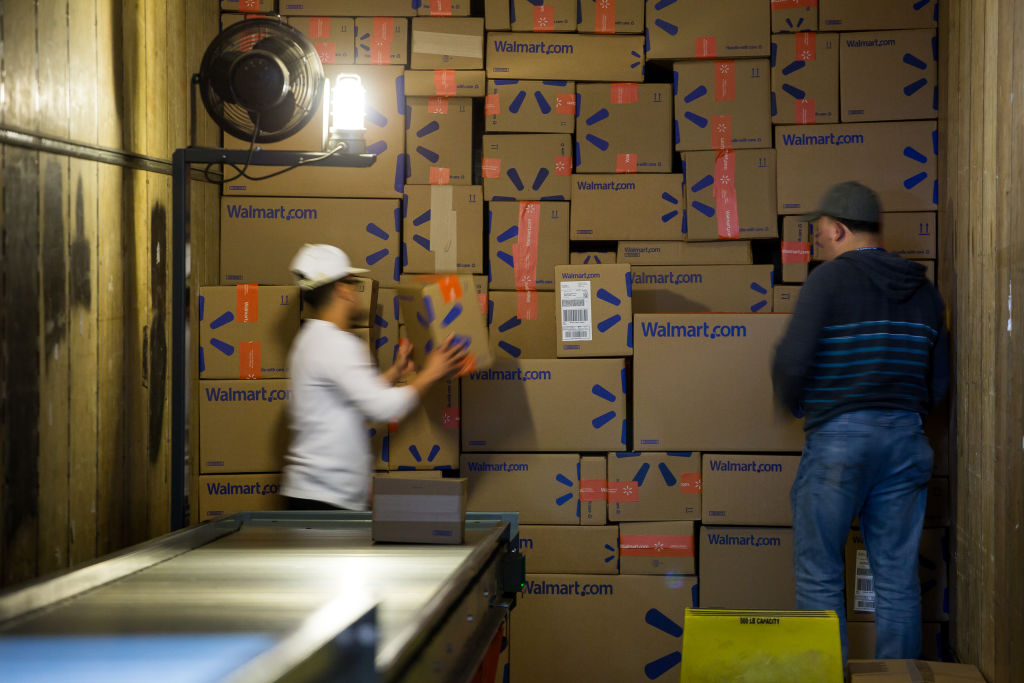
Until this year, Walmart had not put pen to paper on a union contract in Canada or the United States. That changed at a Walmart warehouse in Ontario this spring, in a union victory that should be studied by the rest of the North American labor movement. (Michael Nagle / Bloomberg via Getty Images)
In our hyperpolitical age, when mass protests come and go without much clear sense of what was won or lost, the strategies of social movements can seem quixotic, their benchmarks of success fuzzy. In the union world, however, success or failure can be measured in more cut-and-dried terms: by the ratification of a union contract. A contract between a union and an employer does not simply lay out the terms of employment at a particular worksite. It is also a symbol of the begrudging respect that an employer has for the collective organization of its employees.
Until this year, Walmart had not put pen to paper on a union contract in Canada or the United States. As the largest employer in North America (with a headcount of 1.6 million in the US alone, it is still larger than Amazon) and with annual gross profits last year of $171 billion, Walmart has tremendous resources with which to fight off unions, and has developed a sophisticated playbook for doing so. It is not surprising that the company that labor historian Nelson Lichtenstein has called the “template organization” of neoliberal capitalism should have been, for most of its existence, an impenetrable anti-union fortress.