Amazon Is Ratcheting Up Its Fight With NYC Delivery Drivers
Amazon is warning New Yorkers that a bill making it easier for delivery drivers to unionize will cost jobs and raise prices. The company has already put hundreds of drivers out of work by cutting ties with its contractors.
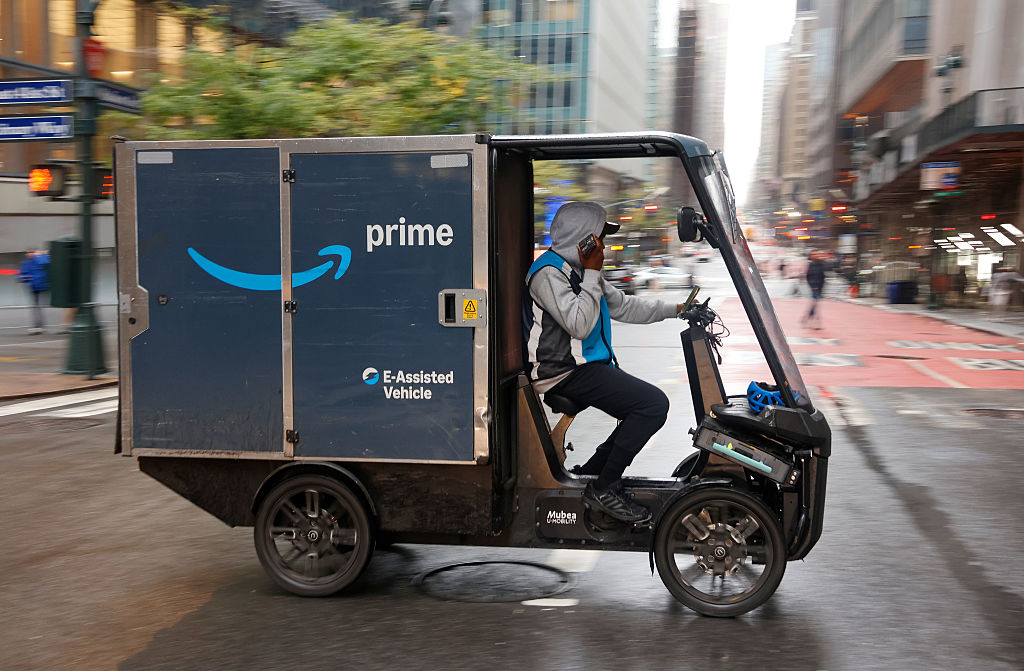
Amazon is taking the gloves off in its attempt to stop the bill pushed by socialist City Council Member Tiffany Cabán and Mayor Zohran Mamdani that would require the company to directly hire its delivery drivers. (Gary Hershorn / Getty Images)
New Yorkers opening Amazon’s app on Thursday were greeted with a warning: “NYC Council could add up to $5 per order.” A link invited them to “act now to protect low prices,” directing customers to contact their city council members about legislation that would require Amazon to directly employ its delivery drivers.
Amazon rolled out the warnings, which also appear on packages delivered in the New York area, as part of its campaign against New York City’s Delivery Protection Act (DPA), which an Amazon-funded coalition has already spent upward of $8 million opposing. Amazon is warning customers that the legislation would put small delivery companies out of business, eliminate jobs, and delay their packages. The company has not explained how it calculated the additional $5 per order.
The act’s partisans say Amazon’s threats are absurd.
“The Delivery Protection Act would require companies like Amazon to pay a $500 licensing fee every other year and comply with workplace and public safety regulations,” Councilmember Tiffany Cabán, the bill’s lead sponsor, told Jacobin. “It’s simply dishonest to claim that this bill would require them to charge consumers $5 for every delivery. New Yorkers won’t let themselves be bullied by corporations and billionaires.”
“It’s a slap in the face to hardworking people everywhere,” Tony Rosario, a New York–based organizer for the Teamsters Amazon Division, told me. “You have to have some nerve to try to blame the city council for holding Amazon accountable.” He dismissed the company’s threats to leave the city should the legislation pass. “They’re not leaving New York City,” he said. The city is largely thought to be the company’s biggest market in the country.
Mayor Zohran Mamdani also responded to the warnings Thursday afternoon. “If Jeff Bezos adds $5 to your order, it’s not because of City Council’s efforts to protect workers’ rights and keep our streets safe,” he tweeted. “It’s greed.”
Uber, Lyft, and DoorDash similarly used their apps to campaign for California’s Proposition 22 in 2020, spending more than $200 million to pass a measure allowing them to continue treating drivers as independent contractors.
The legislation Amazon is fighting in New York would change who employs its sprawling delivery-driver workforce. Cabán’s bill would require operators of last-mile delivery facilities to employ their drivers and warehouse workers directly. Amazon currently contracts out much of that work to smaller companies known as Delivery Service Partners (DSPs). The bill would also impose licensing, safety, and training requirements on delivery facilities, with protections for workers whose jobs are affected by the change.
Thirty-four of the fifty-one City Council members have signed on as sponsors, and Mayor Mamdani supports the bill. Council Speaker Julie Menin, however, has yet to bring it to a vote. Councilmembers are negotiating changes to the legislation, including whether to retain the ban on subcontracting, which Amazon is particularly determined to defeat.
When the company began planning its own delivery network in 2013, executives worried that entering the transportation business would expose it to organized labor.
“A primary concern was whether getting into the transportation business would expose them to unions,” executives involved in those discussions told journalist Brad Stone. When Amazon launched the DSP program several years later, it could run its own delivery network while leaving the drivers on someone else’s payroll.
The Teamsters have spent years fighting to establish that Amazon is a joint employer of those drivers and therefore has to bargain with their union. Amazon has threatened to challenge the DPA in court, and the bill is now fueling a steady stream of criticism in the right-wing New York Post. But the legislation could still pass without the requirement that Amazon directly employ its drivers.
The current version of the bill would spare workers years of litigation at the National Labor Relations Board (NLRB) to establish that Amazon is their employer and therefore must bargain with their union. That wouldn’t guarantee a collective bargaining agreement, but it would eliminate one of the company’s principal defenses against unionization.
Amazon has funded its multimillion-dollar lobbying and advertising campaign through the Five Borough Jobs Campaign, which operates publicly as New York Delivers. Its advertisements feature DSP owners and drivers warning that the legislation would eliminate small businesses and raise prices. Amazon says that more than forty DSPs in New York City employ over five thousand workers whose jobs could be threatened if the companies were prohibited from contracting with Amazon. The company has also raised the possibility of moving delivery facilities outside city limits.
The Teamsters’ Rosario said the concern is misplaced — and that the bill could help DSP owners too. “They’re being squeezed just as much as their employees are,” he said.
DSP owners are responsible for maintaining and repairing vehicles and bear much of the responsibility when drivers are injured or involved in accidents. Under the existing arrangement, Rosario said, DSPs serve as a “scapegoat” for the company.
Opposition to the bill includes the city’s chambers of commerce and the National Urban League, which has argued that the legislation would particularly harm black-owned delivery businesses. Amazon is listed among the organization’s highest-tier corporate donors, a category representing contributions of at least $1 million.
On November 16, the National Urban League and the Amazon-backed New York Delivers coalition threatened legal action if the bill passes in its current form. Their attorney argued that the legislation conflicts with federal and state law. An earlier memo prepared by Brendan McGuire, an attorney at WilmerHale retained by the Amazon-funded Five Borough Jobs Campaign, argued that the bill could violate federal restrictions on local regulation of motor carriers.
Menin, who supported an earlier version of the bill, has held off on backing the current one. She has raised concerns about potential job losses, higher prices for consumers, and whether the legislation would survive a legal challenge. A spokesman for the Mamdani administration’s Law Department told The New York Times that he was confident the final legislation would withstand legal scrutiny.
The Times also reported that Menin has considered a version of the bill that would license and regulate delivery warehouses without requiring Amazon to directly employ its drivers, though she has not ruled out retaining the subcontracting ban. The New York Post reports that councilmembers are considering requiring warehouse operators to own the delivery vehicles currently owned or leased by contractors. Other details are still being negotiated, including how large a warehouse must be to fall under the law. Sources familiar with the negotiations expect the text to be finalized next week.
“Direct employment is one of the most important provisions of the bill,” Rosario said. He said there had been some discussion of exceptions for truly independent contractors but was adamant that Amazon shouldn’t be exempt from the direct-employment requirement. “There’s no way they’re getting around that language,” he said.
Menin has insisted that the council will regulate Amazon while protecting jobs and consumer prices. On Thursday, she criticized the company’s new direct appeals to customers.
“It defies logic that Amazon, a $3 trillion corporation, would raise New Yorkers’ cost of living if it’s forced to adhere to basic regulations and worker protections,” she wrote on X. “We are crafting legislation that regulates Amazon and protects workers, without impacting prices or jobs.”
“If Amazon thinks this deceptive campaign will effectively threaten New Yorkers and intimidate this City Council, they are dead wrong,” she added.
The Teamsters called Amazon’s warnings to customers “extortion by one of the richest corporations in human history” and accused the company of caring about neither its workers nor its customers.
The legislation has attracted support from across New York City’s labor movement, including the Central Labor Council, the Retail, Wholesale and Department Store Union, the Hotel and Gaming Trades Council, and the New York Taxi Workers Alliance. On October 22, hundreds of Amazon workers and Teamsters rallied outside city hall, joined by representatives of other unions, Mayor Zohran Mamdani, and Teamsters President Sean O’Brien. O’Brien accused Menin of failing to keep her promise to bring the bill to a vote.
“Keep your promises; don’t fall in love with corporate America,” O’Brien said. “Speaker Menin, you need to do what the people want — the people that put you where you’re at.”
The campaign has extended well beyond the rally, with New York City Democratic Socialists of America (NYC-DSA) playing a central role alongside Teamsters Local 804. NYC-DSA has put its electoral canvassing operation to work on the bill, organizing phone banks and sending volunteers door-to-door. By October, they had knocked on more than 11,000 doors and helped bring three councilmembers on as sponsors. In Menin’s Upper East Side district alone, more than 100 volunteers knocked on 2,500 doors in a single day.
Mamdani has continued campaigning for the legislation, too. At the October rally, he pointed to the contradiction at the center of Amazon’s employment arrangements.
“When a driver wears an Amazon vest, drives an Amazon van, [and] follows a route Amazon set and Amazon insists that driver does not work for them, what is that if not exploitation?” he said.
When reporters asked Mamdani about the possibility of dropping the ban on subcontracting and passing a narrower bill, he rejected the idea.
“I don’t think that we need to have a conversation about a new bill,” he said. “I think we have all of the answers in the bill as it currently stands.”
When I spoke with Julie Su, Mamdani’s deputy mayor for economic justice and the former acting US secretary of labor, about the bill earlier this year, she described Amazon’s arrangement as “a business model built on getting all the benefits of labor while disclaiming any responsibility for it.”
“It is an end run around a century of labor protections that have been fought for and won,” she said.
Su also took issue with Amazon’s warnings that the bill would cost workers their jobs.
“It is an age-old argument by corporations who have profited massively off the backs of exploited workers, to say that working people only have two choices: a really bad job in which you’re struggling to get by, or no job at all,” she told me. “We reject that as a false choice.”
Amazon has itself put drivers out of work by cutting ties with DSPs whose employees unionized. Last year in Queens, 105 drivers at Cornucopia Logistics lost their jobs when Amazon canceled its contract with the company. The drivers had organized with the Teamsters and accused Amazon of retaliating against them. Amazon denied it.
In Palmdale, California, Amazon cut ties with Battle-Tested Strategies, a contractor whose eighty-four drivers had organized with the Teamsters in 2023. The NLRB later accused Amazon of illegally ending the contract and refusing to bargain. Drivers at another Amazon contractor in Skokie, Illinois, struck in 2024, alleging retaliation for organizing. Amazon denied retaliating against union supporters.
The DSP arrangement has also cost New York workers jobs when union organizing wasn’t involved. Last week, the company terminated its relationship with Kaizen Management Solutions, a Manhattan contractor whose employees deliver Amazon packages on electric cargo bikes. Roughly two hundred workers learned that their employment would end November 18. Amazon said it had discovered safety violations and fraud involving the recording of drivers’ hours; some workers disputed that explanation.
“This DSP model is about Amazon’s bottom line,” one worker told Streetsblog. “The model that allegedly creates jobs just laid off 200 people right before the holidays.”
“I wish I could tell you I have another thing lined up but I don’t,” he added. “They didn’t even give me a month to figure it out.”
Rosario met Kaizen’s owner, Ezra Tilaye, at a Teamsters picket outside the Delancey Street facility earlier this week. Tilaye, who is from Guyana, seemed as blindsided by Amazon’s decision as the workers. One driver Rosario spoke with had been on the job for only three days; another had just been promoted to dispatcher. Rosario took that as evidence that Tilaye hadn’t known the contract was about to be terminated. For Rosario, the layoffs made a mockery of Amazon’s campaign to defend small businesses, particularly those owned by minorities.
“Are you protecting small businesses, or do you just not care and are pretending otherwise?” he asked.
Menin called the layoffs “terrible” and said that the city would regulate Amazon “in a very significant way.”
Amazon may not need to defeat the bill outright. The majority of councilmembers have signed on, but negotiations could still strip out the requirement that Amazon employ its drivers directly. Similar legislation has already been introduced in Chicago, and worker advocates want to pursue it in other cities. What survives the negotiations in New York could shape those efforts elsewhere.