New York Is Closing In on Amazon’s Shady Delivery System
Amazon has long exploited subcontracting to avoid taking responsibility for its delivery drivers. A bill introduced by socialist New York City Councilor Tiffany Cabán would force the e-commerce giant to directly employ its drivers.
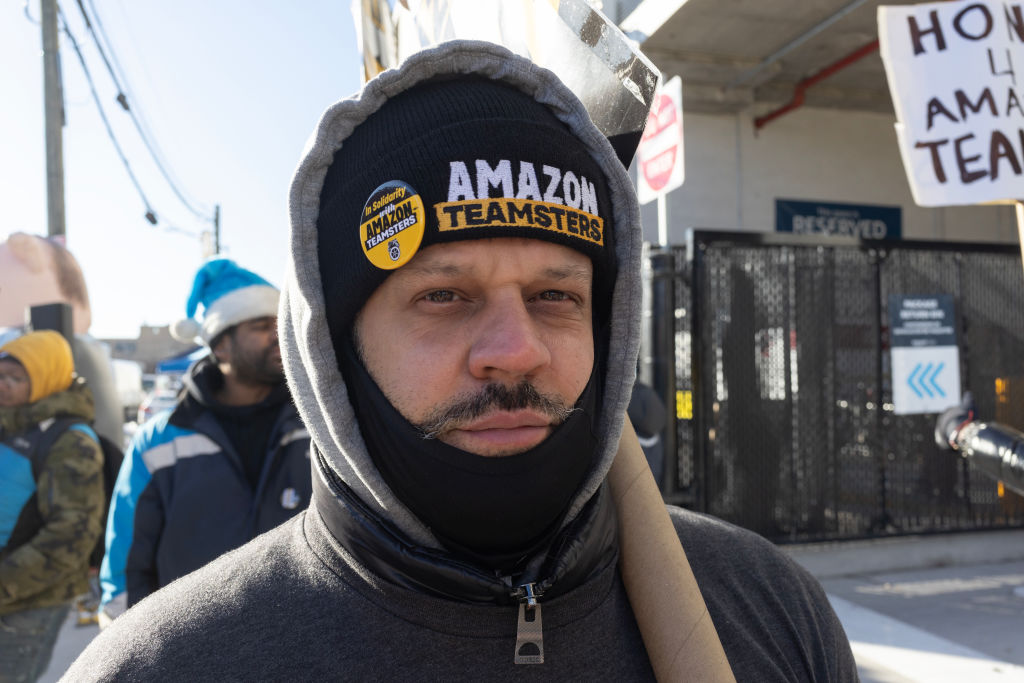
Amazon workers organized by the Teamsters walk a picket line in front of the DBK4 Amazon fulfillment center on December 22, 2024, in the Maspeth neighborhood of Queens. (Andrew Lichtenstein / Corbis via Getty Images)
Amazon delivery drivers in New York wear the company’s uniforms, follow its routes, and are tracked by its software. Yet, legally, they don’t work for Amazon. The Delivery Protection Act (DPA), a bill introduced by socialist New York City Councilor Tiffany Cabán and with a committee hearing scheduled for April 9, would try to resolve that mismatch by requiring certain last-mile delivery facilities to be licensed by the city and, in practice, forcing companies like Amazon to take responsibility for the workforce they already direct. It is the next step in a series of city laws regulating the delivery economy — following minimum pay rules and workplace standards — that have improved conditions at the margins while leaving the structure of the system intact.
That structure is not especially difficult to describe. Amazon runs a delivery network in which drivers’ working conditions and schedules are determined by the e-commerce giant, yet they are formally employed by small contractors known as Delivery Service Partners (DSPs). The company determines how the work is done; the subcontractor absorbs the liability when something goes wrong.
The arrangement has the advantage, from Amazon’s perspective, of allowing it to present itself as both central and peripheral to the job, depending on the circumstance.