Against Geopolitical Football Moralizing
Anglo-American commentary has lost its mind, blending “VAR-gentina” complaints with outrage over Milei’s cozy relationship with Trump and Netanyahu. Don’t buy the moralizing: Argentina is still worth rooting for.
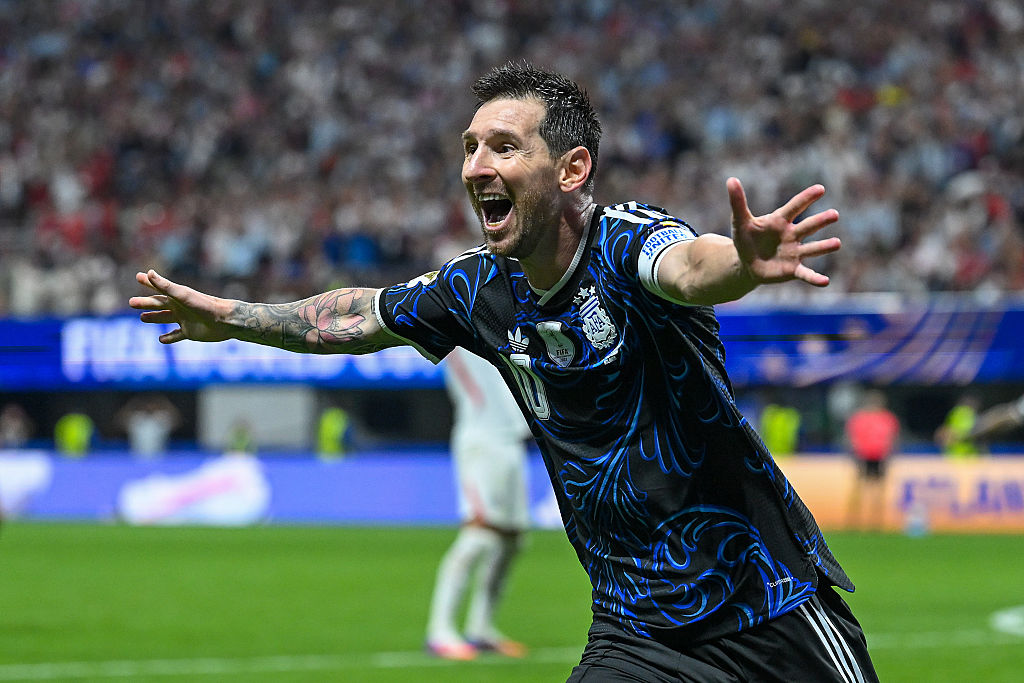
(Shaun Botterill / Getty Images)
The World Cup is an occasion for joy, wonder, and discovery — of the enthusiasm of fans, of the talents of unheralded squads, of the new prowess known favorites will deploy. But also, it seems, an occasion for many to rediscover the temptations of easy demonization and flat political generalizations. We are thrilled to see our Argentine side show again why fútbol is the beautiful game, accompanied by polemics from the usual suspects, like the UK Tory press or our traditional rivals in Brazil.
However, it’s been surprising to see the progressive media across the Anglo-American world take up the most ridiculous and unfounded claims about our country as a whole. All the lazy articles with titles playing on a certain Andrew Lloyd Webber production are definitely a sign. Anglo-American commentary has lost its mind, blending bitter “VAR-gentina” conspiracies with potted claims about race and (in-this-case-only justified) outrage over Argentine president Javier Milei’s fawning relationship with Donald Trump and Bibi Netanyahu.
Gritting our teeth and bearing it, in this vigil before the final match we dare say a couple of things. Above all, allow yourself to enjoy the game, let the beauty of it all sink in, root for whoever you want. Rewatch Cabo Verde’s Sidny Lopes Cabral score against Argentina until you fall asleep, look for new angles to discover another genius touch in the collective masterpiece ending in Lautaro Martínez’s header against England, rejoice in the naïf rowing of the Norwegians, the prodigious talents of Kylian Mbappé, the elegance of Mo Salah. Close your eyes and envision the adventures of the many players born in slums and now parading as Greek demigods. But don’t fall for the moralizing, for the flattening of the features of entire nations, for the lecturing of entire fandoms.
There are three things people should know about football before writing about football. One is how the teams play. Argentina has played an irregular World Cup, but it has also shown some of its best qualities. Though slower than in 2022, it’s still a rather offensive team, with a solid midfield and dynamic wingbacks helping in attack. It creates spaces with a wide variety of strategies, breaking rivals who have built nine-player moats, with Messi playing from the midfield and forward, on the left and right of the field and with forwards that have delivered when needed. It has shown mental and physical toughness. It’s a style that elicits admiration, respect, and fear among pretty much everybody who watches football more than once every four years.
Another aspect to consider is the communities created around football and the meaning we give to those communities, during the World Cup and throughout our lives. Within the constraints of the capitalist society in which it exists, football is a rather horizontal space of camaraderie. We play and celebrate and watch football, and then endlessly discuss how we played and celebrated and watched. In spite of the oppressive forces of capital crushing football and social life in general, football is, in many respects, a de-commodified space, without ulterior gains beyond the symbolic achievements and the reinforcing sense of belonging to a given community, whether it is a neighborhood club or the national team. More than anything, football is a space in which we happily waste our time. No wonder the places we in Argentina play football as kids (and beyond) are called potreros, the pastures where colts grew in the wild, the empty lots, interstices of the urban space that survive the swallowing power of market forces.
Yet little of this breaks through to those, on the Right and perhaps more surprisingly on the Left, who simply wish to apply familiar patterns from the Global North to unfamiliar realities from the Global South. Certain progressive tribunes writing about Argentine football read as a tragicomic version of something we have seen before, not trying to understand other realities, but insisting on fitting them into preestablished categories. Thus the theories about an imputed racial makeup of the Argentine team, flat speculations about political connections, and truly remarkable assumptions about the ability of the Argentine government or football elites to coordinate conspiracies.
Ironically, in trying to tie the players to the political visions of Milei, this top-down attempt to impose a neoliberal, northern view repeats the kind of gesture that has driven many into political indifference or even momentary embrace of the far-right movements behind Trump, Milei, and other global leaders. What some “progressives” in the Global North need to understand is that the mechanical application of US-style identity politics does piss off a lot of non-right-wing, nonracist people.
Instead of subjecting pictures of the national team to a racist one-drop rule to determine if they fit within specific notions of blackness, commentators should start by considering how deeply Argentina has been and is shaped by blackness. In a polemical and widely misunderstood article in the Washington Post last World Cup, historian Erika Edwards mounted a critical attack on the “myth of white Argentina,” stressing the longstanding and continuing presence of black populations in Argentina and how their history differed from both the US example and from popular understanding. We would add that blackness is highly polysemic in Argentina in ways quite distinct from the US. More to the point, this vast, heterogeneous and contradictory space of football in society is labeled by different groups as cosa de negros, a black thing: the mestizo origins of the players, yes, but also the way they celebrate, how people celebrate with them, the music they like.
If five million people quit work and spend one day being unproductively happy, it’s cosa de negros. If football players exhibit the habits and jargon of their modest social background, then they’re negros — but if instead they have access to fancy cars and clothes and exhibit them with pride, then they are even more negros. If blackness is defined by the oppressive weight of the white gaze, what we do around football is blackness at its prime.
Racial inequalities in our country do not, and could never, fit the US pattern. Seeing them as lesser versions of the US fits the very definition of “imperial,” the practice of “ruling over” a multiplicity of otherwise disparate cultures. This “ruling over” disregards specificities, ignores alien ways of seeing, and generally expects all this diversity to be subordinate to this monolithic dominant view. This is not an exclusive feature of right-wing ideologues; it sadly extends to some of those who would in other contexts denounce empire. This mindset completely overlooks two historical facts: Argentina has never been either a colonial power or a slave-based economy. The same applies to the finger-pointing over our players displaying a banner claiming Argentine sovereignty over the Malvinas Islands.
A final point is what we do with so much joy. A Sunday spent in the potrero is happiness. A World Cup celebration is carnival, an exception, encapsulated in itself yet overflowing all over. And yet, like carnival itself, not for a second does this wonderful distraction conceal the hardships of daily life — something even Messi talked about after the match against England. People celebrate in spite of oppression, but it doesn’t change for a second the heretical challenges against the cruelties that different forms of power exert over their existence.
Despite so much drama, there is not a single piece of evidence showing that a football victory has ever benefited those in power. The 1978 World Cup final was played less than two miles from a concentration camp in Buenos Aires, where torturers celebrated Argentina’s goals. And so did their victims, desperately grabbing those fleeting moments of happiness in the middle of their nightmare. And then they simply kept fighting, and so did their comrades and relatives. It takes more than a militant act of ignorance to dismiss those experiences and feelings as simple forms of false consciousness.
We welcome that the World Cup has prompted an “Argentina affair.” It could very well end up helping to start imagining a way out of this global right-wing nightmare: Global North liberals and radicals should stop bullying people who fight for equality differently, whose cultures are not marked by the same traumas they have. We understand that their sense of guilt significantly — though not necessarily irremediably — blinds them to the way other cultures conceive the emancipatory struggle. But we should keep in mind that the struggle for equality, at every level, is a struggle that hopes to create a community of equals, not a non-community of dispersed identity-obsessed groups and individuals.
Let’s change course: talk to everyone, welcome rebel ways of dealing with symbolic struggles — such as the ones that happen, in part, during the World Cup — do not assume people are racist just for saying that they do not want to be told how to talk or what to laugh about, understand the plurality behind the cause of equality, and make room for everyone in a broad, transnational, pluralist coalition capable of depriving neofascists of the advantage offered by our sectarian political mistakes.
And root for Argentina, if you will, for the sake of the selfless beauty the team offers to the world.