India’s “Cockroach” Protest Movement Faces State Repression
After weeks of ignored demonstrations, thousands of students, alongside parents, teachers, and supporters from across India marched on Parliament to press their demands. They were met with tear gas, police violence, and detentions.
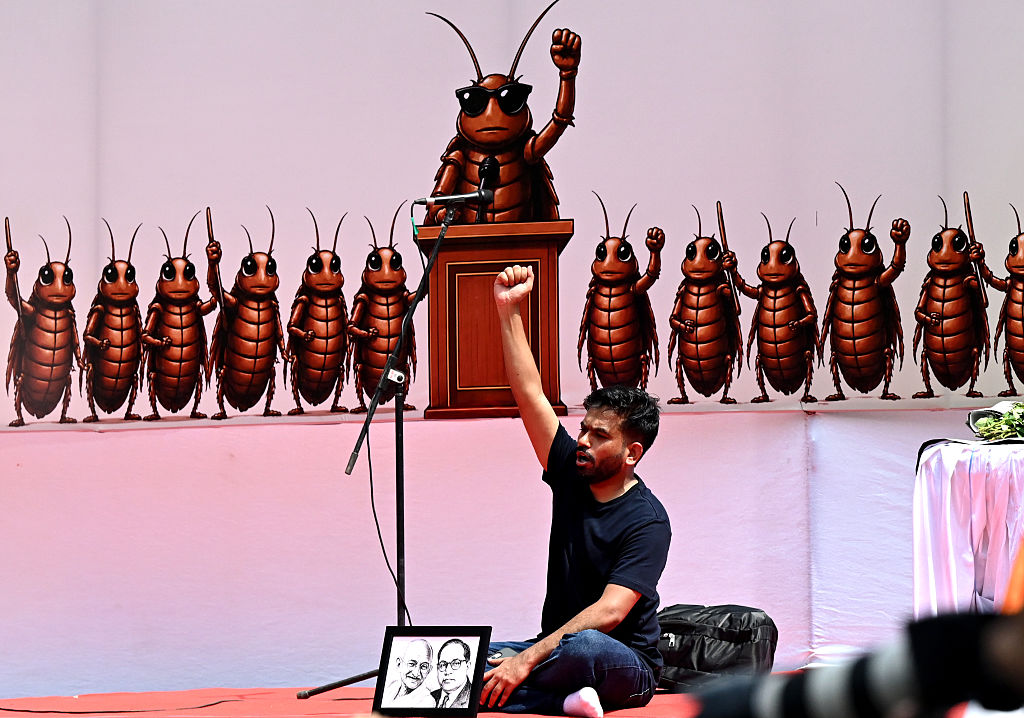
India’s “Cockroach” protest movement, sparked by leaked entrance exams, has grown from a student sit-in into a nationwide campaign to challenge Narendra Modi’s government over youth unemployment and government accountability. (Ishant Chauhan / Hindustan Times via Getty Images)
On the night of July 20, thousands of young protesters from across India slept on footpaths near the Jantar Mantar protest site in New Delhi ahead of a planned march on Parliament. The march, dubbed “Chalo Sansad,” was organized by the youth-led Cockroach Janta Party (CJP). The protest movement began on June 20 in response to growing anger among students and young people over high unemployment and leaks involving national entrance examinations, including the NEET-UG medical entrance exam. Protesters demanded the resignation of the union education minister over the government’s handling of the exam scandal, as well as compensation for the families of students who died by suicide after the test was canceled.
On July 19, the Delhi Police issued a public advisory prohibiting unauthorized assemblies, protests, and the planned “Chalo Sansad” march under emergency public order policies. Large numbers of security forces were deployed, and all of the roads leading to Parliament were closed with barricades. Mobile internet was suspended in parts of the city during the ensuing violence.
After CJP leader Abhijeet Dipke returned from the United States, the government granted the party permission to hold a protest at Jantar Mantar on June 20. What began as an authorized demonstration soon evolved into a sustained sit-in, as protesters refused to leave despite repeated orders from authorities directing them to disperse. Over the following month, the space has remained active, with participants rotating in and out. Although students formed the core of the movement, they were joined by parents, elderly supporters, and even children. Many supporters traveled from across the country to show their solidarity.
The sit-in has transformed into one of India’s largest youth-led protest movements in recent years. Outrage over alleged examination paper leaks has broadened into a wider campaign against unemployment, government accountability, and what protesters described as a shrinking space for democratic dissent.
The March
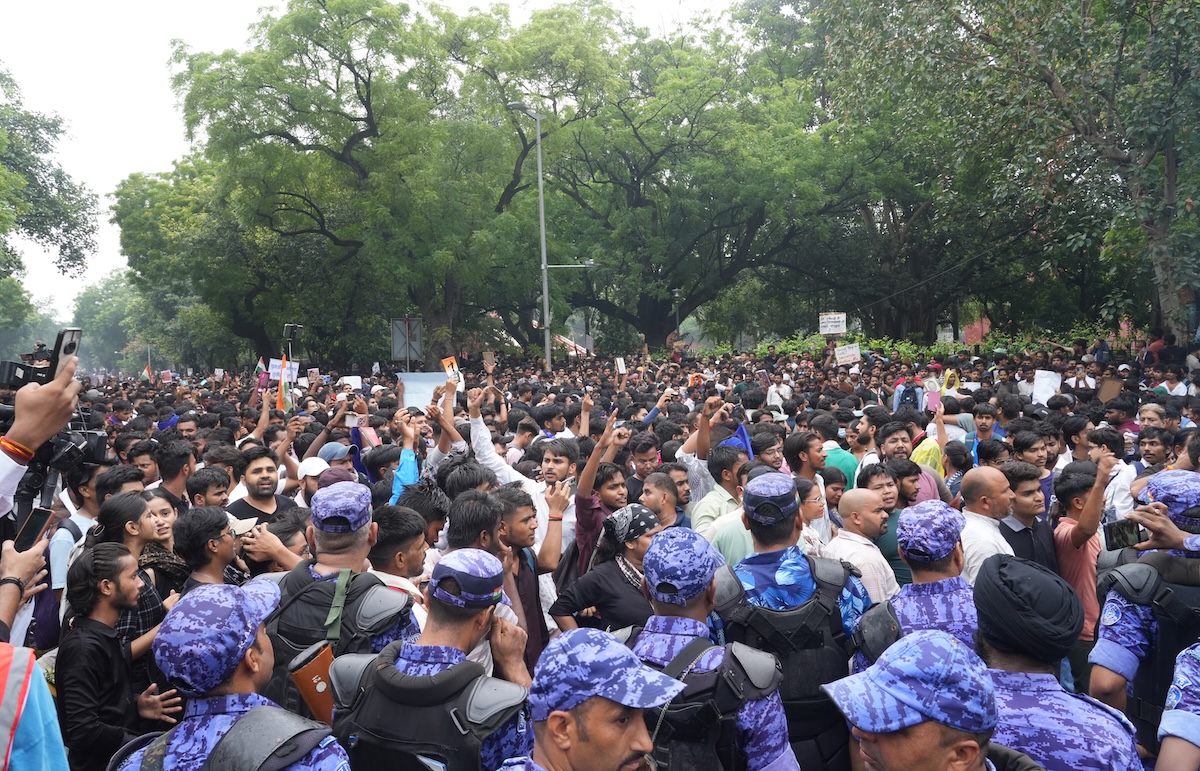
The march was scheduled to begin at 9 a.m. By then, a large police contingent had already been deployed around Jantar Mantar and along the route toward Parliament. Delhi Police were backed by paramilitary forces, including the Rapid Action Force. Roads were barricaded, officers carrying batons, shields, and tear gas launchers stood at intersections, and ambulances waited nearby.

Although police had blocked access to Parliament, protesters managed to remove the barricades and began marching peacefully toward the building. When demonstrators attempted to remove additional barricades near Parliament, police responded with baton charges, tear gas, and in some locations, pellet guns. Officers also cleared and temporarily dismantled parts of the main protest camp at Jantar Manta, injuring numerous volunteers.
Early that morning, plainclothes Delhi police officers arrived at the Jantar Mantar protest site and quickly put up white sheets around the stage to block public view. Within minutes, they forcibly removed activist Sonam Wangchuk and transported him to a hospital, citing medical concerns.

Alongside the CJP and independent activist Sonam Wangchuk, the All India Students’ Association (AISA) played a leading role in the demonstrations. Its members helped to organize joint hunger strikes and led frontline protest actions at Jantar Mantar. Many students maintained a twenty-three-day hunger strike alongside Wangchuk before calling it off following appeals from opposition lawmakers and civil society delegations.
On the morning of July 21, Aniket Patel, a twenty-five-year-old from Maharashtra, returned to the protests despite injuries he said he sustained from the previous day’s police action. He walked with a noticeable limp. His forehead and face were bandaged, and he had received four stitches in his leg after spending the night in the hospital. “I was peacefully protesting, and the police hit my head with a baton and then hit my leg,” he says.
Patel had joined the protest several days earlier to demand greater transparency in the education system and to call for the resignation of Education Minister Dharmendra Pradhan. “I was in pain and asking myself what my fault was, as I was treated like a terrorist by the police,” he says.

At a press briefing held at the Press Club of India, Neha Bora, a PhD student at Jawaharlal Nehru University and national president of AISA, spoke out against what she described as unprecedented police brutality during the protest. She thanked fellow protesters, journalists, and volunteers who stepped in to provide basic aid — water, first aid, and support — amid the chaos of tear gas shelling and lathi charges.
“We have not seen such violence in our lives on peaceful protesters. What happened in Delhi was not an accident — it was a systematic use of power against students” Patel says.
Police Violence
“This was not just crowd control. Students were isolated, cornered, and beaten,” says Bora. “Around fifty AISA activists were injured — many of them young women — with injuries on their heads, backs, legs, and feet”
Bora alleged that the police response was deliberate and excessive. She also claimed that medical access was obstructed, with officers preventing medical teams from reaching injured protesters. Among the injured, more than three individuals reportedly suffered pellet gun wounds. In one serious case, doctors advised immediate surgery to prevent permanent vision loss. Many protesters have also reportedly been detained, and there is little clarity on their whereabouts or legal status.

“We demand the resignation of the Delhi police commissioner and the education minister. We will continue this protest until justice is served. This movement will not stop,” Bora added.
One protester from Punjab, identified here as John to protect his identity, had traveled to Delhi for the first time. He said he had never seen such a massive crowd in his life.
As the crowd began marching toward Parliament, the situation suddenly changed.
“Suddenly, the police started running toward us. One officer, who was not even in uniform, struck me on the head with a baton with full force, and I fell to the ground,” John recalled.
John has not told his mother what happened, as he assured his family that he would be safe and that the police would not use force against students.
“I always believed the police were there to protect us, but here it felt like they were trying to kill us,” he said.
The Cockroach Janta Party
The Cockroach Janta Party (CJP) began as a satirical online movement on May 16, 2026. Founded by political strategist Abhijeet Dipke, it emerged in response to controversial remarks by Chief Justice of India Surya Kant, who had likened unemployed youth and activists to “cockroaches” and “parasites.” What started as a digital act of reclaiming that insult quickly resonated with thousands of young people who felt unheard and dismissed.
Within weeks, the movement grew beyond social media, drawing in millions of supporters and transforming into a symbol of collective frustration and resistance. As online engagement turned into on-the-ground mobilization, the CJP evolved into a protest movement demanding accountability, dignity, and systemic reform.

CJP spokesperson Deepak Balyan said the scale of police action came as a shock to the organizers, who had planned the march as a peaceful demonstration toward Parliament.
“We were not expecting such brutality from the police on students,” Balyan said. “Hundreds have been injured — many with wounds to their heads, feet, and arms.”
He notes that police entered the Jantar Mantar site after protesters began marching, dismantling tents and the main stage. Many volunteers, students, and even elderly people who were sitting peacefully inside, were injured during the police action.
“Our message was clear — we wanted to carry out a peaceful march to Parliament and present our demands. Our first demand is the resignation of the education minister.”