Defending Indians’ Most Basic Rights

India’s civil liberties groups are largely made up of “concerned citizens” rather than the most oppressed groups in society. Their role in defending basic constitutional rights is increasingly under attack from the ruling Bharatiya Janata Party.
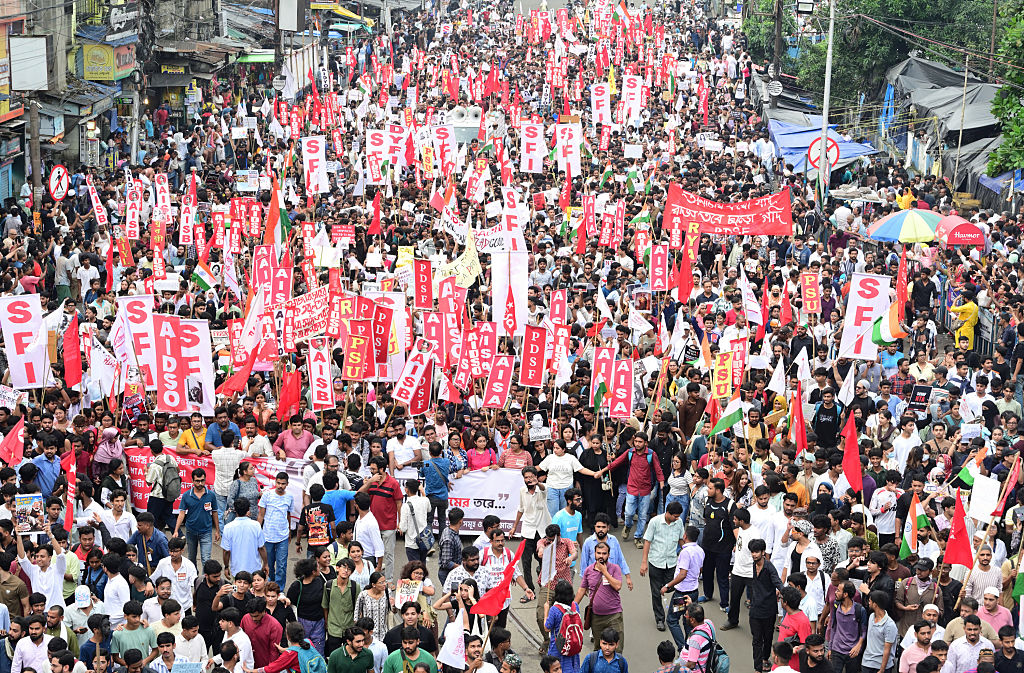
Demonstrators from various student groups, holding banners and flags, attend a protest rally in Kolkata to support the NEET protest organized by the ‘Cockroach Janata Party’ at Jantar Mantar in Delhi and the demand for the resignation of India’s education minister, Dharmendra Pradhan, on July 24, 2026 in Kolkata, West Bengal, India.

India’s recent “cockroach” movement forced the education minister to resign. It was a show of the vitality of protest in India, despite government efforts to cast its critics as “anti-national” elements. (Sumit Sanyal / Anadolu via Getty Images)


With the global rise of right-wing and far-right political forces even in countries deemed democracies, civil liberties groups are under pressure as never before. This is certainly true in India, though the success of the latest spontaneous youth upsurge, under the banner of the ironically named Cockroach Janata Party, got international headlines and provided welcome breathing space.

The protests emerged against severe educational manipulation, which damaged students’ future employment prospects. Some leaders from the ruling Bharatiya Janata Party (BJP) had to, politically speaking, tread carefully since a very substantial section of these protesting youths came from pro-BJP families. That didn’t stop BJP leaders from claiming that this movement was being manipulated by anti-national elements and groups, meaning, the more left-wing student participants and members of civil liberties groups in Delhi and elsewhere in India expressing solidarity and support. Had this movement not succeeded in achieving its key demand for official accountability, with the resignation of the education minister in late July, there is little doubt that the supposed anti-nationals would have suffered serious retribution.

This is what makes a new book-length study by Ankita Pandey about India’s civil liberties groups (CLGs) so timely. She has given us the most comprehensive and sustained study so far of these bodies that are not controlled by political parties or state authorities at either provincial or central levels. Just as the historical evolution of civil liberties activism in the United States (shaped undoubtedly by various progressive social movements and struggles) has given its CLGs a particular character, this is also the case when it comes to grasping the nature of CLGs in postindependence India.

Ally activism, or allyship, is a concept that has been around for perhaps more than two decades in the West but has rarely been used in Indian social science studies. It is not a term familiar to Indian civil liberties activists. The minimal, consensual understanding of its meaning is that it refers to the activism of relatively advantaged groups, who act together with disadvantaged/marginalized sections of society but have no “direct, personal or material stake in the cause.” This is accurate enough as a formal description of civil liberties activism in India. But a distinctive aspect is that the initiators and organizers of India’s CLGs have mainly been either self-conscious Marxists influenced by different Maoist parties and sects outside of parliament, or self-described moderate socialists. These latter have been inspired by the Gandhian tradition or by the anti-party vision of onetime communist M. N. Roy, whose Radical Humanism prioritized individual freedom, reason, and decentralized forms of democratic power and rule.

The particular manner in which Pandey has developed and applied the notion of a “politics of amplification” reflects this reality. Unlike charities and nongovernmental organizations (NGOs), Indian CLGs are not simple service providers regularly beholden to particular (often foreign) funders having their own biases and concerned not to ruffle the feathers of the powers that be. As self-financing voluntary organizations, CLGs could be said to have greater political autonomy and generally lean more to the left than their counterparts in other countries like the United States. They are unlike social movements whose leaders represent a particular social category and that must mobilize en masse to get what they want — the greater the numbers and the longer the duration, the better! The politics of amplification is very different from the “politics of representation” and direct struggle. As Pandey rightly puts it, “Allyship mobilizes credibility, not numbers.”

However, the ideological alignments of Indian CLGs do affect the way they solidarize with or relate to the oppressed and their concerns. They make them perhaps more forthright in voicing their demands on behalf of, and not just at the behest of, those who are victimized. Indian CLGs forge temporary alliances with social movements and operate over a much wider range of issues because they are event-based responses opposing different forms of state repression. Yet they have also responded to intrasociety iniquities like communal violence and atrocities perpetrated in the course of land grabbing by big landlords.

Composition, Origin, Variation

The regional and national incarnations of Indian CLGs really emerged in the late 1960s and ’70s. The member-activists of the earlier two regional CLGs in the states of West Bengal and Andhra Pradesh were, in large measure, radicalized youth who strongly identified with the Naxalite struggle on behalf of the rural poor. They sought these activists’ release from incarceration and their rights to be treated by the state as political prisoners, not criminals.

While Pandey’s book carries detailed accounts of state-level CLGs, the central focus, which also provides a template for wider overall judgements, is on two national-level bodies: the People’s Union for Civil Liberties (PUCL) and the People’s Union of Democratic Rights (PUDR), both headquartered in Delhi. The author has widely interviewed their many participants and longtime members (these bodies were first formed in 1976) and deeply studied over 250 of their histories and reports. Key here is the period of Emergency Rule (from 1975–77): a watershed moment that exposed the fragility of India’s constitutional commitment to a liberal democratic polity, and which served as great fillip to the subsequent emergence of the PUCL and PUDR.

Nested between the introduction and conclusion are five chapters that in turn explore and assess a) the membership and political trajectories of CLGs; b) how they relate to political parties; c) their operating methods and key functions; d) ideological debates within and among CLGs shaping their basic practice; and e) how as one particular embodied form of “concerned citizenship” (there are others like charities, resident welfare associations, and NGOs) they contested the state on behalf of civil society.

Who are the CLGs’ members? They mostly come from middle-class, “respectable” professions like lawyers, academics, journalists, social workers, occasional celebrities from the arts and entertainment domains, and so on. This itself lends a certain respectability to the wider public concerning their interventions. Long-standing CLGs, like some regional ones, and certainly the PUCL and PUDR, have a steadier and more regular set of activists than those one-off groups that periodically spring up in response to some dramatic turn of events, do their reports, and then fade away. These actions, too, are testimony to the existence of a wider pantheon of the politics of amplification.

Prominent scholars have characterized these CLGs as “non-party political formations,” an understanding that Pandey has rightly criticized as ignoring the more complex relationship between them and political parties. A number of party loyalists (a spectrum that includes left and far-left sects and both Indian National Congress and non-Congress oppositionists but excludes the culturally exclusivist BJP) were accepted as active members of CLGs. But for the most part, they were procedurally and numerically constrained from being able to turn them into party fronts.

Fact-Finding Virtues and a Key Difference

Fact-finding missions have been a central form of activity undertaken by CLGs. To retain their credibility, these reports — for example on unjustified police violence in Kashmir province — have had to imitate juridical processes of showing impartiality in the accumulation of material evidence, including witness recollections. Their aim is to expose deficiencies and possible cover-ups in official judgments and claims. This also allows a place for help from sympathizers both within and outside the ruling parties at local, state, and central levels.

Mainstream media have often focused on the outcomes of such fact-finding reports, either to malign or endorse them in some measure. But beyond that, such missions have helped to legitimize the testimonials of ordinary citizens, ignored by an officialdom whose upper-class and caste ties motivate it to repress the truth.

CLGs’ work has also been significantly helped by the establishment, after the Emergency period, of Public Interest Litigation (PIL). Through it, ordinary citizens and citizen groups have the standing to approach the High Court and the Supreme Court on behalf of the indigent and deprived to call for investigations and judgments alternative to otherwise official or dominant narratives. Given this “judicialization” of civil liberties activism, it is hardly surprising that some dedicated lawyers do pro bono work for CLGs and are a key component of such allyship activism.

This legalism of both procedure and practice is common to all such groups. Still, there remains an important ideological difference between the PUCL and PUDR (as well as between and, to some extent, within other groups), not only at the level of motivation but also in their basic political and advocacy thrusts. In practice, the more moderate liberal-left wing of legalism aims to get state power to behave as the existing liberal democratic constitution at its best demands. The more radical left wing seeks to create a broader counternarrative, or what Pandey calls “discursive contestation,” to persuade the public to think beyond the constitution about the need for a more “revolutionary transformation” of the social order.

Not surprisingly, the former is less prone to rationalize and in part justify the resort to violence by the oppressed or by their agents (far-left groups) to counter overt or more “institutionalized” forms of violence by social oppressors or the state. This may be the case even if this rationale is not explicitly declared by the CLG in question. To put it another way, the general literature on rights discourse has four major areas of debate: 1) the material and moral foundation for the construction of rights: universalism versus cultural relativism; 2) individual versus group rights; 3) the question of civic and political rights versus economic and social rights: Isn’t the sufficient and equal fulfillment of basic needs as important, if not more so, than equality of basic liberties?; and 4) how far to expand the domain of rights.

It is really with respect to the last two areas that differences exist, deep down, between the two currents of activism, even when they are not perceived as such.

The Concerned Citizen Under Fire

In her penultimate chapter, Pandey refers to the “concerned citizenship” embodied by CLGs. Her book deserves much praise for the new ground covered and will instill in the reader greater respect and understanding for the role that particular forms of allyship play in the defense of democratic rights and in their extension to those in India most deprived of these rights.

After her book was published, one more recent development has surfaced that obviously could not be featured in her text. It threatens to greatly accelerate the already ongoing erosion of democratic freedoms. For Narendra Modi’s government has declared that there is no single document or set of documents that axiomatically and irrefutably identify one as an Indian citizen. Even the passport will not do.

In today’s world, to be a rights-bearing person you have to be a citizen. Only then can one avail oneself of the range of rights whose depth and scale varies according to the country to which one belongs. But what becomes of the capacities to exercise positive forms of “concerned citizenship” such as civil liberties activism, when the government has the arbitrary power to question and decide one’s very status as a citizen?

So far, there has been no judicial rejection of this official presumption. It is uncertain that this will indeed happen. Now more than ever, parties, movements and CLGs need to fight together against this Hindutva-ized and thus truly anti-national government.