The Cockroach Protests Are Reviving India’s Ailing Democracy
India’s “Cockroach” youth movement has now forced the resignation of the country’s education minister. What began as a single-issue protest mobilization has broadened into one of the biggest challenges Narendra Modi has faced in power.
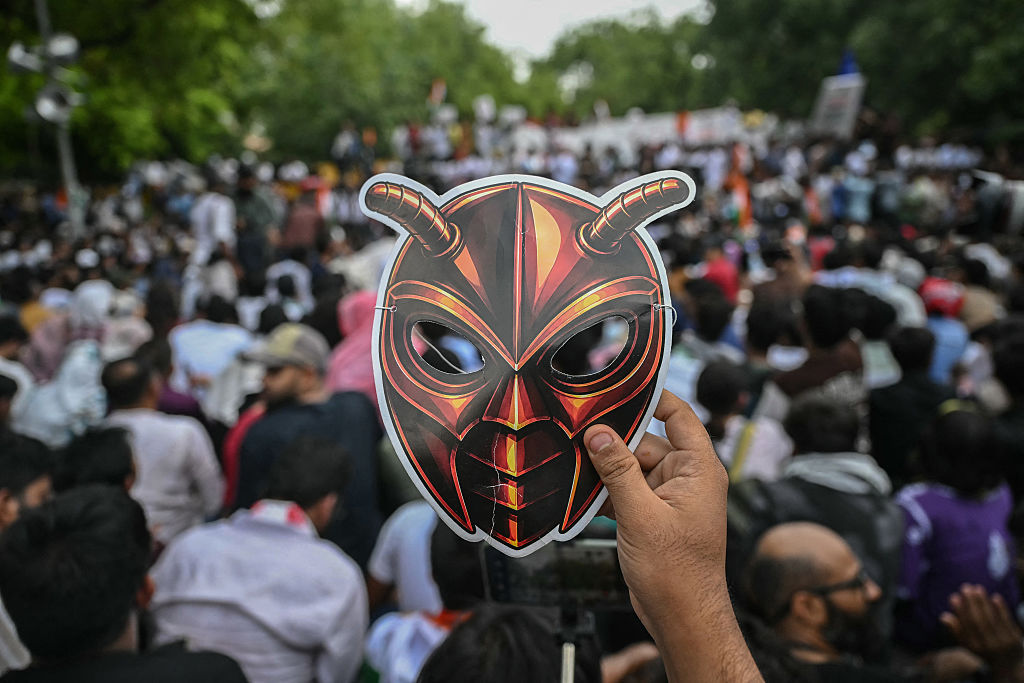
The student protests in India trace their origins to a satirical social media page created in response to a disparaging remark from the chief justice of India, who likened youth activists to “cockroaches.” (Arun Sankar / AFP via Getty Images)
The student protests in India trace their origins to a satirical social media page called the “Cockroach Janta Party” (CJP). Activist Abhijeet Dipke created the page in response to a disparaging remark from the chief justice of India, who likened youth activists to “cockroaches” for questioning the government.
What began as an online campaign soon evolved into a nationwide protest movement against the irregularities in examinations conducted by the National Testing Agency (NTA), especially the leakage of the National Eligibility-cum-Entrance Test (NEET) question papers that triggered many aspiring students to commit suicide across the country.
The agitation gained significant momentum when Sonam Wangchuk, veteran educationist and social activist from Ladakh, joined the campaign and launched an indefinite hunger strike demanding the resignation of Union Education Minister Dharmendra Pradhan. On Saturday, July 25, the campaign could claim the credit for forcing Pradhan to step down.
From Social Media to the Streets
Although the initial agitation focused on a single-point agenda, it has now snowballed into a wider anti-corruption movement spearheaded by the CJP and young people to seek accountability from the ruling right-wing authoritarian Bharatiya Janata Party (BJP) government. With tens of thousands of students responding to the CJP’s call for a march to Parliament in New Delhi on July 20, 2026, the agitation has emerged as one of the largest social movements in India during recent years.
It has garnered support from a broad spectrum of opposition parties, including those of the Left, as well as prominent public figures and celebrities. The movement has also attracted significant international attention through viral social media campaigns and extensive coverage by independent media outlets and the foreign press, on a scale not witnessed since the 2020–21 farmers’ protests.
The BJP and its supporters responded in their usual heavy-handed manner with a chorus of slander, calling the protesters “anti-national,” “foreign-funded,” “anti-Hindu,” “terrorists,” etc. When all these efforts to vilify the protests failed, the BJP resorted to police violence by forcibly picking up Sonam Wangchuk from the protest site at Jantar Mantar Road. Wangchuk was confined in a state-run hospital, isolated from family and political allies.
Following the CJP’s July 20 call for a march to the Parliament, the home affairs ministry run by Amit Shah deployed police and paramilitary forces to violently disperse the students gathered in and around Jantar Mantar Road. This involved jamming internet services near the protest site and using tear gas against those on the streets, as well as beating them with police batons, pelting them with stones, and subjecting them to arbitrary detentions.
Several female students also experienced sexual violence by the police. The use of pellet guns by the anti-riot force was reported: although the Delhi police deny using such weapons, at least two protesters were hospitalized with pellet wounds. Scores of students were grievously injured.
Dissent in the Modi Era
The crackdown was part of a familiar playbook that the BJP government has repeatedly deployed against dissent, most notably during the protests against the citizenship amendment bills in 2019–20 that sought to disenfranchise a significant section of the Muslim community in India.
This playbook involves outright refusal to engage in dialogue, sustained smear campaigns against protesters (amplified by the BJP’s IT cell), and the use of excessive police force to quell demonstrations, with the eventual arrest of activists under draconian anti-terror laws such as the Unlawful Activities (Prevention) Act (UAPA).
However, the BJP’s aggressive approach has spectacularly backfired this time around. The crowds kept swelling after the July 20 crackdown, and the CJP leadership is now demanding the resignation of Prime Minister Narendra Modi.
The BJP’s difficulty in controlling the narrative stems in part from the fact that the student movement has mobilized concerns shared by Indian youth across class, caste, and religious divides. A significant proportion of the protesters come from Hindu middle-class families that have vehemently supported Modi’s Hindutva politics.
At the same time, it would be a mistake to dismiss the current agitation as either a fleeting “Gen Z” phenomenon or a movement driven solely by middle-class anxieties. Although it shares certain features with recent youth-led mobilizations in neighboring countries such as Nepal and Bangladesh, the movement is firmly grounded in its opposition to the sweeping neoliberal reforms of the education system carried out by the BJP government.
Dismantling Public Education
While the CJP leadership has limited its demands over education to seeking accountability from the authorities, the grievances stem from the wider neoliberal policies that the BJP has pursued. The National Education Policy (NEP), rolled out by the BJP in 2020, has accelerated the commercialization as well as the centralization of education. The policy marks a significant retreat of the state from its commitment to public education, allowing corporations and large IT firms to restructure the education system.
The increasing reliance on computer-based testing and the expansion of multiple-choice examinations — including in disciplines within the humanities and social sciences that emphasize critical reasoning and analytical writing — exemplify the broader drive toward the standardization and digitization of educational assessment. NEP 2020 has also strengthened the central government’s control over educational institutions and regulatory bodies, diminishing their institutional autonomy and facilitating greater political influence over appointments and decision-making.
These developments have assisted the BJP’s attempts to revise the curriculum to perpetuate its Hindu supremacist ideology. Overall, the policy has deepened existing class and caste inequalities by making access to quality education increasingly dependent on private resources, thereby weakening its historic role as a pathway for social mobility among lower- and middle-income groups.
The union government recently published a report, after much delay, as has been the norm under BJP rule, based on the All India Survey on Higher Education (AISHE). It states that India witnessed a sharp decline in undergraduate enrollment across the country in major streams such as arts, science, and commerce between 2022 and 2024. This is particularly stark given that undergraduate enrollment constitutes 75 percent of the total enrollment in higher education, which also includes postgraduate studies, diplomas, and other certificate courses.
This period has also seen an significant increase in the number of higher education institutions participating in the AISHE survey, which indicates that there has been an expansion of private universities. At the same time, we have witnessed systematic dismantling of public institutions that not only provided subsidized education to the poor and the middle classes but were also constitutionally bound to reserve seats for the historically oppressed Dalit and backward caste groups. Combined with the rising unemployment rate in the country, these developments signal an acute crisis within the Indian economy, fueling mass resentment against the government.
Indian Economy in Crisis
The rate of unemployment is particularly high among the college-educated and postgraduate demographic. Approximately twelve million candidates applied for 8,868 job openings in the state-owned Indian Railways company in 2025. Significantly, the candidates applying for these jobs tend to be overqualified in relation to the job requirements. Of the 2.5 million applicants for the 53,000 vacancies for the position of peon in Jaipur, many were college graduates and some even had PhDs.
The unemployment crisis is further compounded by the high cost of living, hikes in gas and petrol prices, and extreme weather conditions such as heatwaves and air pollution that has made life particularly unbearable for working people. Many working-class Indians have joined the CJP protest to demand a better future for their children, so they will not have to go through the same hardships as the generations before them.
The dilution of social security programs such as the Mahatma Gandhi National Rural Employment Guarantee Act (MGNREGA) and the implementation of highly exclusionary labor codes by the BJP have left many workers, especially in the informal sector, in an acutely precarious condition and vulnerable to workplace exploitation. The government responded to recent labor unrest in the industrial townships of northern India with a similar crackdown to that faced by the CJP protest, and several youth activists and students who stood in support of the struggling laborers were arrested.
Another important factor that is driving public anger against the government and its wealthy backers is the fact that many of its leading figures have their children studying and settled abroad. The daughter of the education minister is currently a student at Tufts University, while her father is overseeing the crumbling education system at home. The Indian elite remain insulated from the harsh realities facing the country’s working people.
This is also a reflection of the larger trend of elites “exiting” the Indian economy, whether by moving abroad or through the heavy consumption of imported luxury goods that do not contribute to domestic growth and employment. The Indian government is bolstering these trends by cutting tariffs on imports of foreign goods.
For instance, the proposed Indo-US Trade Deal could result in further relaxation of tariffs on American goods by India, which are already low at 14.6 percent. The lowering of tariffs could adversely impact scores of marginal farmers and small businesses, with farmers’ groups preparing to intensify their agitation against the deal, further putting the government under pressure.
More Than a Single-Issue Protest
The CJP protests have captured the national imagination precisely because they have been successful in tapping into the simmering resentment against the BJP among youth, farmers, and the working classes, as well as indigenous communities that are facing widespread destruction of their homes and habitats due to the government’s extractivist policies. This appears to be the first time that a single-issue movement has transformed into an anti-BJP, anti-Modi agitation.
The earlier movements included the nationwide protests against the exclusionary citizenship amendments. They spread widely across the country, but could never become a full-blown anti-BJP movement. The most spectacular agitation in recent times was the mobilization by farmers against a set of proposed Farm Bills in 2020. Though they were able to broaden the mobilization by including the demands of women and Dalit workers, the agitation of the farmers did not broaden into opposition to the government itself, which the CJP movement seems to have managed.
The crushing weight of the economic distress blighting the country, with no respite in sight, appears to have brought together a large group of people whose concerns go far beyond the education sector alone. This has transformed the CJP protest into a mobilization against Modi and the BJP, severely denting the prime minister’s cult of personality. Significantly, the young participants in the movement are championing secularism by firmly rejecting the BJP’s divisive anti-Muslim politics.
The Modi government is using all the tools in its arsenal to crush the student movement. It is authorizing the police to use invasive AI-enabled surveillance for facial recognition, and threatening to cancel the passports of identified activists and detain them arbitrarily for a prolonged period.
It is incumbent upon the Indian left to unite and mobilize their cadres and trade unions to join the agitation in large numbers. It is noteworthy that the student wings of India’s major communist parties have been participants from the very inception of the movement. Only the Left can take the student movement further from its single-point agenda toward realizing its radical, transformative potential.
It is quite uncertain whether these protests can translate into tangible electoral outcomes, as was evidenced even in the farmers’ protests of 2020. Nevertheless, this presents the Left with an opportunity to embed itself more deeply in these movements, and expand their scope by pushing the struggles against the neoliberal restructuring of the education system toward an anti-capitalist horizon.