Andy Burnham’s Labour Allows the Left to Breathe, a Little

The first Labour conference under new leader Andy Burnham saw a rhetorical turn away from his predecessor’s austerian and managerial approach. Burnham has regained trade unions’ confidence, but his real policy shifts have been cautious.
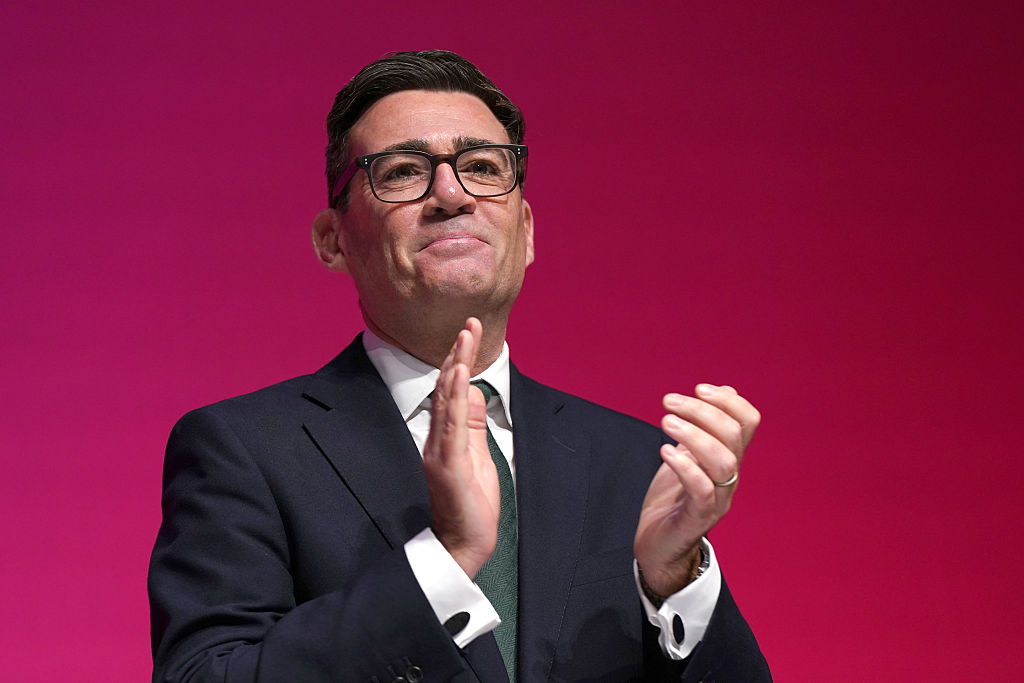
Andy Burnham participates in the final day of the Labour Party conference on September 30, 2026, in Liverpool, England.

Prime Minister Andy Burnham speaks of a break with neoliberalism and rediscovering Labour’s working-class roots. The real policy change has been more muddled, and the Left within the party is only slowly regathering its strength. (Ian Forsyth / Getty Images)


“For too long, politics has not been working for people across Britain. We need to do better, and we will.” Such was Andy Burnham’s welcome to this year’s Labour Party conference. Gemma Bolton, a left-wing member of the party’s National Executive Committee, more simply summed up the change after years of purges, suspensions and rigged candidate selections: “Isn’t it nice you can breathe again?”

This is roughly Burnham’s fortieth Labour conference, but his first as prime minister. His acclamation as party leader in July and this conference have been a break with the recent past under both Jeremy Corbyn and Keir Starmer, but in many ways represent a return to a much more traditional form of Labour politics. It’s a line often called the “soft left” or a “Blue Labour” appeal to the traditional working class but is best understood by the party’s own name: Labourism.

Conference Tradition

On one level, Labour’s annual conference is like any other in British politics. Party leaders use them to announce policy and direction for their time in opposition or in government. This provides the bulk of media analysis. But while this is important, Labour’s internal life, and by extension how it governs, can’t be understood without grasping the history of its annual meeting.

For Labour conferences are in another sense quite unique. Unlike Reform UK or the Tories’ public relations rallies, or the messy free-for-alls of Liberal Democrat or Green internal democracy, the Labour conference is essentially modeled on trade union practice. Being born of the labor movement (the party is the result of an 1899 Trades Union Congress resolution), this is no great surprise. It is, however, something of an anachronism in a country where union membership has been in the doldrums for decades.

The conference acts in theory as a sovereign meeting of the organizations that make up the Labour Party and is meant to direct the actions of its parliamentary leadership. Delegates mainly represent either local level parties or trade unions. While most uncontentious votes are settled by a show of hands, a close decision goes to a “card vote.” Then each delegate’s vote is weighted according to organizational size. Hence the Wigan Pier Constituency Labour Party, with three delegates (representing two hundred members) could be outvoted by one delegate for the Wheel Tappers and Shunters Association (representing two thousand members).

There is no official voting delegation for the Parliamentary Labour Party (PLP), but the formal subordination of MPs to the wider party belies the historical reality. Since the party’s inception, the PLP has often asserted its independence from conference decisions. As in most social democratic parties, this has often resulted in left-wing policy piling up at the conference but right-wing decisions being taken by MPs.

This tension came to a head in the 1970s, when the 1974 election manifesto (soon becoming the basis of Bennism) was largely junked by the PLP once in office. The resulting outrage among members saw the creation of the left-wing Campaign for Labour Party Democracy (CLPD). Its focus was on “power: where power is found within the party and how to achieve greater democratic control of it.” In this same period, the aforementioned “soft left” — defined by support for left-wing policy goals while also believing in deference to the (more right-wing) PLP’s independence — started to coalesce around the Tribune Group of MPs.

A high point in victories for the Left and party democracy in the 1980s culminated in Tony Benn’s only narrow defeat to Denis Healey in the 1981 deputy leadership election. As the 1980s and ’90s progressed, a succession of right-wing leaderships saw the conference’s nominal sovereignty eroded and increasingly ignored.

In the Blairite era, conferences came to resemble their Tory counterparts: that is, PR exercises for party elites and allied trades such as lobbyists and consultants. The conference itself slowly migrated from cheap seaside towns, ideal for trade unionists and constituency delegates, to big cities providing better options for New Labour charm offensives, as captured by Jarvis Cocker.

Corbynism saw a brief restoration of the conference’s vitality, with the World Transformed festival and heated contests over Brexit and the selection of MPs. Arriving as leader in 2020, Starmer’s overwhelming priority was to smash this flowering of democratic participation, and he was largely successful. Long before Starmer’s polling collapse and ignominious fall this summer, the conference had returned to a mere husk of democratic organization orchestrated by the leadership.

Enter Burnham

How does Burnham’s first conference contrast with this history?

In terms of conference official business, the CLPD/Momentum efforts to promote democratization did little better than they had over the last few years. The same was true of policy motions concerning Cuba and Palestine abroad or public ownership and National Health Service funding at home. Motions were either voted down or not heard, ruled out on spurious grounds. Committees elected by the conference produced near clean sweeps for the party’s antidemocratic neoliberal right wing.

Despite this, the organized left-wing presence on the conference floor was larger than in recent years under Starmer. In part this was due to improved organization by the traditional CLPD/Momentum organized left. It was also due to a reorientation by the soft left from the right-leaning Fabian/Brownite Open Labour to a left-leaning group called Mainstream.

Mainstream was launched at the 2025 conference by the soft-left figure and Compass director, Neal Lawson, backed by Burnham (at the time mayor of Manchester), seemingly unhappy with the existing soft-left membership organization, Open Labour. Mainstream’s position could be boiled down to a feeling that Starmer’s counterrevolution had gone too far. Starmer had run for the leadership in 2020, outwardly proposing a progressive but competent “Corbynism without Corbyn” before striking hard to the right.

This same slogan might well define Mainstream’s 2026 position of “Manchesterism,” modeled on Burnham’s record as mayor. As a policy platform, this tries to balance a “market middle” and “innovation frontier” economy with a much more radical “decommodified provision of essentials. . . .  organised around affordability, universal access, environmental sustainability, and worker welfare. This tier provides security: no one can fall below it because access is unconditional.”

Despite capturing the current zeitgeist of the party and arguably Britain itself, Mainstream has limitations — on its own terms and for the socialist left. As a faction defined by opposing “factionalism,” soft-left support for progressive policy (the “Corbynism” bit) combined with its reluctance to challenge the state/party machine head-on (the “without Corbyn” bit) leaves a political and organizational muddle.

For all the media buzz and high profile figures at its events, the soft left struggles to coherently define itself against Labour’s traditional right or left. The result is an organization with a very broad but shallow support, which struggles to take on still-dominant Blairite factions in party elections or even to settle on clear structures.

In the first two key electoral tests it has faced (Labour’s NEC and conference delegate elections) it has done little better than Labour’s much smaller and more polarizing (though politically clearer and better-organized) factions. If Mainstream remains unable to overcome this muddle, it may well fall out of the limelight much like now-dissolved Open Labour before it. While initially welcoming Mainstream’s creation, Burnham has been lukewarm about it since he became party leader.

However, the key difference in conference business compared to recent years reflects the political change Burnham represents. The parliamentary leadership has regained the confidence of the affiliated trade unions.

Historically, unions and their powerful bloc vote have acted as the support base needed by Labour leaders to block left-wing rule changes or policies emanating from members. However, as the Labour right steadily dropped its social democratic commitments just as unions needed them most, this relationship came under increasing strain. The peak of this rift saw several unions backing veteran CLPD member Corbyn for Labour leader in the 2010s (a relationship with its own discomforts).

Most unions reverted to type in Starmer’s early years as leader, but after he took office as prime minister in 2024, the relationship again began to break down amid deeply unpopular austerity measures such as the winter fuel cuts and his approach to the Gaza genocide. This year, with the exception of an overwhelming union boycott of Women’s Conference over transphobia, saw no such public disagreements. This rapprochement signifies how Burnham is trying to return to a much older form of postwar Labour politics.

The collapse of the British labor movement industrially saw its political project slacken and drift away from it. “Old Labour” became the main bogeyman of Tony Blair’s New Labour. Its modernizing image had no room for blue-collar workers. An increasingly disorganized and post-political working class made no lasting attempt to fight this drift. Corbynism, while a reaction against the neoliberal project, equally struggled to turn its close alignment with unions’ economic demands into a lasting penetration of the so-called red wall of lost Labour heartlands. The Starmerite attempt to rebuild Labour inside this literal and metaphorical constituency was labeled in the press as a “Blue Labour” strategy.

This fundamental misreading of the social sector in question reduced Labour-inclined small town factory workers and lorry drivers (workers with largely progressive values alongside more residual social conservatism than urban Labour voters) to the caricature of the reactionary, essentially Thatcherite “white van man.” The result was endless attempts to ape Nigel Farage’s Reform UK on everything from immigration and welfare to Palestine and drugs in the hope of “winning back” a right-wing party’s core vote. Nowhere was this misstep clearer than Starmerism’s relentless and bizarre focus on winning votes back from the Greens by highlighting how left wing this rival party was.

Burnhamism has seen an immediate break with this second-time-as-farce Blairism. The pledges announced at the conference by Burnham and other ministers place the party firmly within the common sense of center-left Britain. Most were relatively mild, such as commitments to more apprenticeships and the Union Learning Fund. Some had less policy impact but profound symbolic significance, like Ed Miliband’s “apology” to the public over Gaza. Burnham and Miliband also avoided the Labour Friends of Israel’s reception, while Deputy Leader Lucy Powell noticed glum faces at the right-wing-controlled Jewish Labour Movement reception.

Some commitments, such as creating a National Social Care Service, renegotiating ties with Europe, and reforms to the voting system, could be huge transformations to how the country lives and is governed. Other pledges were clear responses to trade union pressure. Transport Secretary Heidi Alexander’s announcement on “RoSCos” (publicly owned train companies) answered a long-standing campaign by the rail unions. Likewise, Louise Haigh’s commitment to a national insourcing unit took place in the hall while a joint RMT-Unison Insource Now! rally took place outside.

The details on many of these policies are vague or contradictory, largely more modest than the “Manchesterism” promised in the Mainstream/Commonwealth pamphlet, and the style is much more timid than the combative tone Burnham adopted toward vested interests like bond markets before his return to parliament this summer. The Home Office in particular remains a source of straightforwardly reactionary initiatives. It falls well short of the programs Labour fought the 2017 and 2019 elections on. Both in tone and in content, Corbynism this is not.

Burnhamism instead represents a last roll of the dice for a small-c conservative working-class politics that tries to turn the labor movement’s common sense into a national program for government. In this sense, it has far more in common with the Labour governments of 1945 and 1964 (in spirit if not in scale) than it does with any Labour project since the millennium. It looks like a return of Labourism after thirty years of Labour leaderships that have tried much sharper though perhaps more brittle projects. But will this work? And what does this mean for the Left?

So far, Burnham’s strong approval ratings suggest it is working, at least electorally. How long this will hold depends on whether it works socially when the state implements this program. Passing resemblances to Bidenism should be treated as a warning sign.

For the Left, it must be clear that this highly uneven leftward shift doesn’t deserve uncritical cheerleading. Already, MPs from the Socialist Campaign Group (SCG) have written articles pushing back against elements of the party platform announced at the conference. The Left outside of the party in social and labor movements will also likely find itself in direct conflict with the government. It is not the job of the Labour left to try and discipline these comrades at the behest of the parliamentary leadership. The SCG launching its own program at the conference was a welcome step forward.

The wider left also needs to regain some perspective. Already a joke by the SCG chair about wrapping up the organization for Burnham has led to online denunciations of betrayal. The last ten years in Labour politics have made it easy to deal in absolutes. Corbynism represented the greatest opportunity for socialism in Britain for a century. Starmerism was capital using the primary political institution of the labor movement to wage an unrelenting war on socialists.

The Labour right still retains a vanguardist adherence to a failed 2000s political project. The PLP Starmerites would have continued their headlong rush to electoral Armageddon if not stopped. Had the Left and soft left not stayed and wrestled the party back from the right, there would be no Prime Minister Burnham or Manchesterism to face down Reform UK in 2029. Even now Starmerite loyalists are getting ready to steer the new government rightward or derail it in the attempt. This is a big risk. Burnham has an insecure mandate and his “ism” is an opportunistic/pragmatic ideology. It will take a committed socialist left in Labour to make sure Burnham delivers the progressive vision he set out last week.