If Andy Burnham Fails, the Labour Party Will Die

Andy Burnham says he wants to end 40 years of neoliberalism. But even if he becomes prime minister, the Labour Party is running out of time to show it’s on the side of working-class communities.
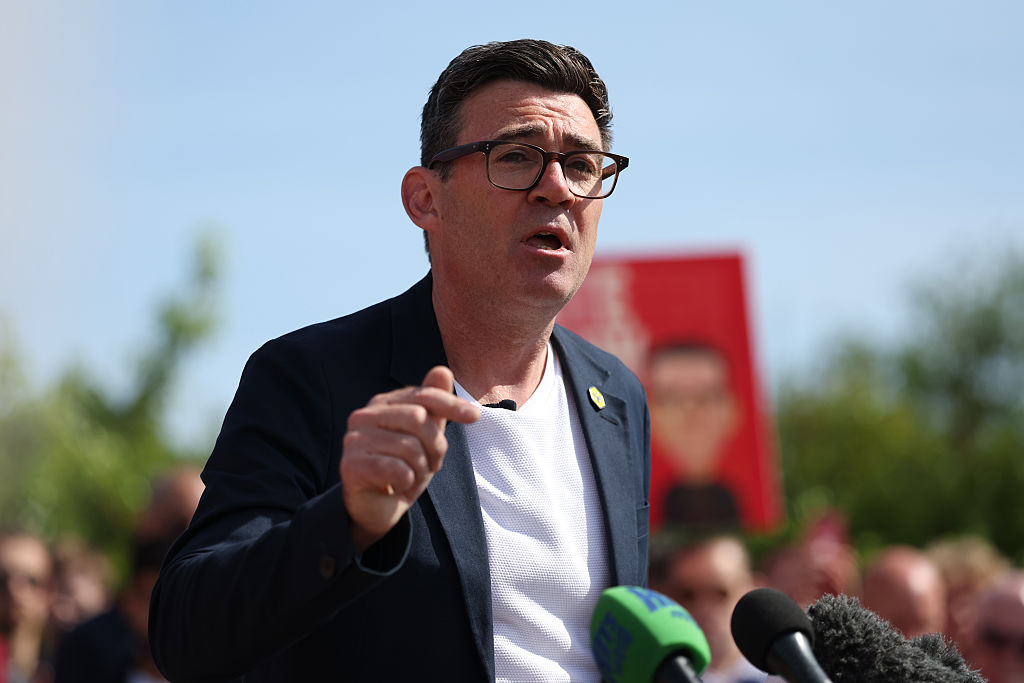
Andy Burnham speaks during his campaign launch for the Makerfield by-election on May 22, 2026.

Two recent by-elections in northwest England saw a locally rooted social democratic insurgency rally working-class voters and defeat the far right. Labour can still stop Nigel Farage, if it learns the lessons of these campaigns. (Ryan Jenkinson / Getty Images)


After weeks of aggressive briefings from anonymous Labour MPs, party employees, trade unionists and the City of London, Keir Starmer has whimpered away. Standing behind a podium outside 10 Downing Street on Monday, a poisoned-looking premier announced his resignation. His only comfort was his role in transforming the party itself, or rather neutralizing its previous leadership: he declared his pride in turning Labour from a “politically, financially and morally bankrupt” party under Jeremy Corbyn to one that “once again, stood proudly with, not against, our national flag.”

Some had still wanted Starmer to keep going. Following May’s local elections, which saw Labour’s vote collapse under the cloud of the repeatedly disgraced party grandee Peter Mandelson’s latest scandal, performatively flag-waving MPs such as Samantha Niblett and Mike Tapp vigorously defended Starmer in the media. Morgan McSweeney — Starmer’s former chief of staff, who resigned over the Mandelson affair — returned to offer strategy to the Starmerites. Supportive aides were briefed regarding Starmer’s intention to fight any leadership challenge by drawing on his record. In fact, this track sheet made him the most unpopular prime minister since polling began.

Such magical thinking finally evaporated this weekend after Andy Burnham, mayor of Greater Manchester, won an overwhelming victory in Thursday’s Makerfield by-election. With placards and leaflets encouraging a vote “for Andy — for us,” Labour Party branding was difficult to spot in the former mining area. In fact, the Labour candidate’s offer couldn’t have contrasted more with Starmer’s. In speeches, Burnham demanded the reindustrialization of northern England and public control of major utilities. In the constituency that housed George Orwell as he researched The Road to Wigan Pier, Burnham attacked Labour’s distance from working-class communities and called for an end to “forty years of neoliberalism.”

Burnham ultimately won the Makerfield vote with 55 percent support — more than 20 percent ahead of Robert Kenyon, candidate for Nigel Farage’s Reform UK, which had dominated local elections there just weeks earlier. Burnham’s success may well make this one of the most consequential by-elections in British history. This Monday, taking a privatized train to London that was so late that he could claim compensation, he made his return to Westminster.

Now Burnham is widely expected to replace Starmer as prime minister. The question is whether he can reproduce the Makerfield turnaround on a national scale and rebuild what Labour has lost.

Creating New Losers

Already, Burnham’s victory has upended established certainties in British politics. Though Starmer and his allies felt the vote most acutely and immediately, the Makerfield contest has also led to a serious crisis in Farage’s Reform UK. For years, Labour’s reluctance to associate itself with the issues of working-class areas hollowed out by Thatcherism has been the ideal breeding ground for far-right politics. With his soaring unpopularity, Starmer has been a particular gift to Farage’s party. Reform UK has easily translated anger in former Labour heartlands into votes for itself; it even recently encouraged trade unions to affiliate to it.

But Makerfield saw Reform struggle. Its candidate, local plumber Kenyon, unraveled following revelations about his misogynistic online presence. Further pressure came from Restore Britain, a far-right splinter from Reform that split the anti-Labour vote and brought heated confrontations onto the streets of the constituency. Farage failed to mask his frustration, making a direct video appeal to Restore supporters hours after the result. Anonymous briefings from Reform’s “establishment” camp urged Farage to sack spokesperson Zia Yusuf over fears he may drag the party rightward.

Such a shift would be catastrophic for Farage. Even if much of Reform’s most activist base yearns for a fascistic politics of race war and “remigration,” Farage’s deepest electoral troubles lie now with the Left. This is the second time Reform has failed to win a crucial target seat, after its recent loss in nearby Gorton and Denton, where the Green Party’s Hannah Spencer — also a plumber — defeated Reform’s Matt Goodwin. Though the demographics of the two seats differ, in each case a locally rooted social democratic insurgency decisively beat Reform and proved that the demoralization and despair on which Reform feeds can be redirected.

As the trappings of Westminster become a renewed pressure on Burnham, he would do well to remember these lessons.

The Revenge of Parliamentary Burnhamism

The new Makerfield MP’s political trajectory is well-trodden territory. Born into a working-class Liverpool family in 1970, he worked as a political adviser and held several government-related jobs before becoming an MP in 2001. A New Labour loyalist, he voted for the Iraq War and supported the privatization of the National Health Service. While representing the government at the 2009 memorial service for the victims of the Hillsborough disaster, he was heckled by the crowd. He later called it a pivotal moment, which caused him to confront how removed the Labour government was from ordinary people he had been brought up with.

After losing two Labour leadership contests to Ed Miliband and Jeremy Corbyn, Burnham left parliament in 2016 along with fellow MP Steve Rotheram, claiming Westminster’s insularity and ineffectiveness as the reason. While Rotheram stood for the Liverpool City Region mayoralty and won, Burnham became the Greater Manchester mayor.

There Burnham has positioned himself firmly on the left. He opposed the 2016 parliamentary coup against Jeremy Corbyn, identified with left-wing municipalities in Preston, Salford, and Barcelona, and defended socialist politicians like Ian Byrne and Jamie Driscoll when they were facing persecution by Starmer’s machine. He has had significant success in tackling Manchester’s spiraling rough-sleeping crisis and secured municipal control of regional bus services — a transformative act for thousands of working people.

What could a Burnham program look like? Some idea may be found in Head North, his bold (and slightly idiosyncratic) manifesto for a radically overhauled Britain. Among its demands to “rewire” the country are the decommodification of housing and health (“the right to the basics”), a nationwide industrial strategy, greatly enhanced local government powers, and the abolition of the whip system that compels MPs to follow a party line.

Many hope that definite intellectual ballast may be supplied from The Productive State by Mathew Lawrence of left-wing think tank Common Wealth. The pamphlet honestly confronts the reality that, for millions of British people, “insecurity has become a permanent condition,” with far too many basics of life — from housing and energy to water and the care system — run in the interests of aggressive profiteering.

This, Lawrence argues, creates a “privatisation premium” where companies take absurd amounts of ordinary people’s money for the bare essentials, while the state is forced to subsidize the resulting poverty through the benefits system. For any attempt at reversing Britain’s generalized social collapse, Lawrence holds, Britain’s comfortable relationship with mass outsourcing and privatization must be overcome in favor of “a state that owns, invests and provides to make life affordable.”

Given his stated adherence to Labour’s 2024 election manifesto and the self-imposed “fiscal restraint” rules introduced by Conservative Prime Minister David Cameron in 2011, one wonders how much structural transformation Burnham can realistically achieve. The bond market is certainly nervous about his chances: despite him being in contact with former Bank of England economist Andy Haldane and Goldman Sachs’s Jim O’Neill, the past year has seen investors constantly briefing journalists to stoke market fears against a Burnham premiership.

There is also another major issue. If Burnham talks of rallying working-class voters, this can hardly be done based on calls to rejoin the European Union. Burnham himself raised this idea at last year’s party conference. Yet ultimately this means focusing on a pet issue that energizes part of Labour’s activist base at the cost of badly undercutting efforts to heal the divides of the 2016 referendum and showing that Labour is not even attempting to listen to voters it has lost.

The Enemies Within

Also concerned about Burnham are the Labour right, who have despised him for over a decade due to a sense that his criticisms of New Labour and his refusal to join the attack on Corbyn represented treachery.

These range from countless extremely personalized briefings, such as when an unnamed “Labour source” yesterday called him a “snivelling little rat.” During the Makerfield by-election, Tony Blair himself accused Burnham of “playing with fire” by pulling Labour away from the center, prompting Burnham to respond that Blair “did not mention inequality once,” and that “if you don’t get how that’s driving politics now . . . then you are not understanding what’s going on.” But the anger reached a crescendo last year, when right-wingers on Labour’s governing national executive committee (NEC) vetoed Burnham from standing for the Gorton and Denton by-election. In a “show of strength” that illustrated Starmerism’s brittleness, kneecapping Burnham ensured that a vote for Labour could only be perceived as a personal endorsement of Starmer.

As a result, the Greens gained an unprecedented parliamentary victory, and 1,500 Labour council seats vanished in May’s local elections. When the time came for Burnham to apply as the Makerfield candidate, those who blocked him knew the same trick wouldn’t work twice. Too many figures in Labour now see Burnham’s positive opinion polling — and perceive him as the one survival option.

But these internal questions are not going to evaporate. Far from being committed to “Labour winning” under any banner, many in Labour have proven their fealty to an extremely unpopular, losing politics that mostly concerns shaping Labour into an organization suitable for corporate interests. Of the 2024 Labour parliamentary intake, at least seventy MPs have worked as professional lobbyists, with many working for water companies, gambling giants, and property developers. That is more than double the number of MPs who were former union officials, and a significant percentage of figures who would be worse off living in a better country.

To his credit, Burnham has surrounded himself with MPs like veteran union figure Anneliese Midgley and former Transport Secretary Louise Haigh, who was instrumental in the fight to renationalize Britain’s railways (and is said to be dealing with the applications for ministerial roles under a Burnham government). But Burnham’s apparent closeness to former Makerfield MP Josh Simons — who gave up his seat for Burnham after gaining intense scrutiny for his alleged role in organizing the surveillance and smearing of anti-corruption journalists — has raised eyebrows, as has the inference that a Burnham leadership could see the return of uber-centrist David Miliband to frontline politics.

Labour’s Last Chance

For Labour’s future existence, ironing out these contradictions is crucial. Burnham’s victory in Makerfield showed that Labour can certainly win people again, but only when it is willing to honestly confront how far it has been removed from its social base for years, and oppose how much power has vanished from the communities that created Labour. A National Care Service that would make the lives of millions unrecognizably easier, or a nationalized water industry where hundreds of pounds vanish from the bill — these are the sorts of offers that don’t need media spin or decent communications to justify. They are reforms that people will plainly experience as an obvious good.

Alongside a wealth of legal shifts to favor trade union organization that builds off of last year’s Employment Rights Act, such concrete measures could reestablish a loyal base for Labour in the decades to come. A cohesive, distinctive Labour Party that people trust and know must be the figures delivering it. In the areas where the Labour vote was once “weighed, not counted,” it’s difficult to exaggerate the disdain millions feel for a party they see as associated with Blair, Starmer, and Mandelson on their TV screens, and corrupt, bullying fiefdoms of incompetent councilors in their neighborhoods.

This sentiment has developed for decades, and several generations of working-class voters now exist who feel no organizational or emotional affinity with Labour. They have no experience of the party ever acting clearly in their interests against others, or a historic memory of when it looked or behaved differently.

This can’t carry on. Both opinion polling and electoral results have proved that people resonate with Burnham’s sentiment and vision. But Labour can’t survive on vibes alone. Should he squander such immense goodwill and prove as rudderless in acting against British decline as previous governments, Reform-voting working-class areas currently ready to give Burnham a hearing will feel a great sense of being cheated. He will find himself as hated as Starmer (perhaps even quicker), will see Labour obliterated as a meaningful electoral force, and will hand a massive majority to Nigel Farage in the next general election.

Burnham himself seems aware that this is Labour’s “last time to change.” Since failure would mean handing power to the most reactionary government in British history, let’s hope he understands this properly.