Zack Polanski’s Eco-Populism Could Do With More Socialism
A year since the Green Party of England and Wales elected Zack Polanski as leader, its membership has nearly quadrupled. His rise speaks to dissatisfaction with Labour but also the difficulty of building a deep-rooted alternative.
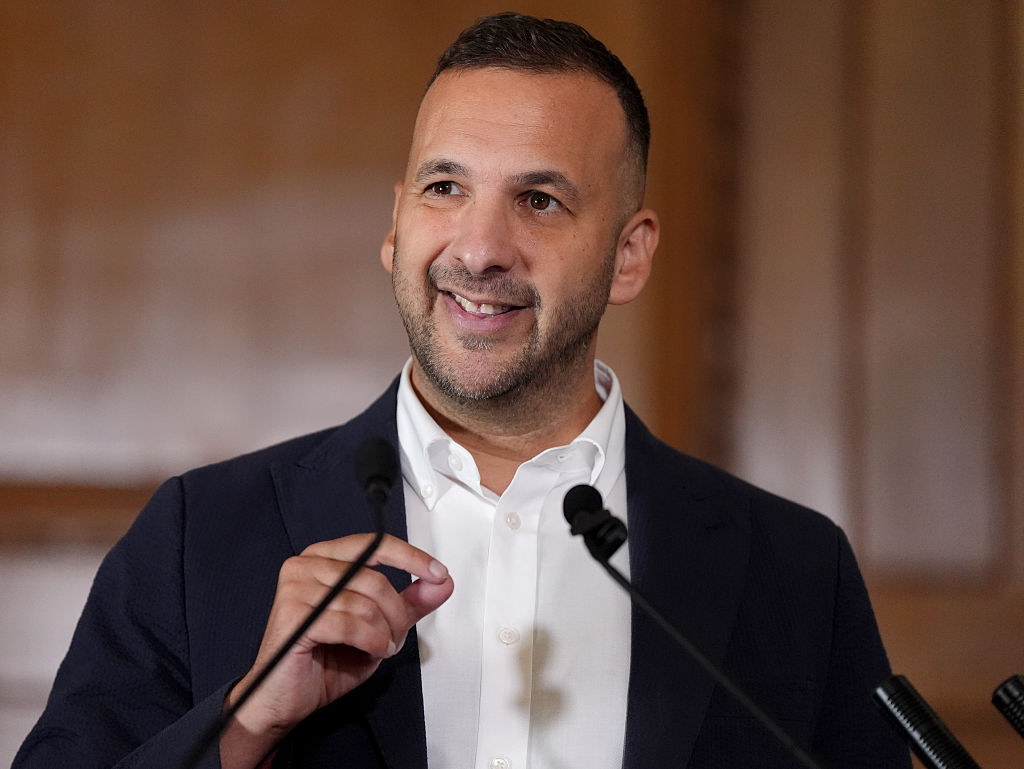
Over the last year, Zack Polanski’s Greens benefited from widespread disgust at Keir Starmer’s Labour Party. Yet with new Prime Minister Andy Burnham offering a change of tone, it’s unclear how far the Greens can displace Labour. (Jonathan Brady / PA Images via Getty Images)
The Greens were for decades a relatively marginal force in British politics, with only one member of Parliament (MP) and a modest but growing number of local councilors. However, its prospects changed in September 2025 after Zack Polanski was elected party leader on an eco-populist platform. This new leadership defined itself against Labour Prime Minister Keir Starmer, rejecting his apologia for Israel’s genocide in Gaza as well as his fiscal austerity, anti-migrant measures, and anti-protest authoritarianism.
Over the last year, the membership of the Green Party of England and Wales (there is a separate Scottish party) has surged from around 66,000 to over 230,000. This February, the Greens’ Hannah Spencer won the Gorton and Denton by-election, defeating both Labour and Nigel Farage’s Reform UK, and in May the Greens achieved their best-ever local election results. Now Polanski is running for Parliament in the Holborn and St Pancras by-election. In this contest, he aims not just to replace Starmer (who has resigned as an MP) but to consolidate the Greens’ position as a permanent left-wing opposition to the Labour Party.
Polanski himself is unusual for the extent of his political development over a short timescale. In a new book, Russell Warfield describes how Polanski began his political career by joining the Liberal Democrats in 2015, toward the end of the party’s stint enacting austerity in coalition with the Conservatives. Polanski joined the Greens in 2017 after failing to be selected as a Lib Dem by-election candidate, all the while opposing Jeremy Corbyn’s leadership of the Labour Party from the right. Elected as a London Assembly member and deputy leader of the Greens, Polanski then moved to the left and defeated the more centrist incumbents in last year’s leadership election.
In this context, Warfield’s book The Green Socialist: Zack Polanski and the Battle for Britain’s Future book is a timely contribution to understanding the Green Party as it seeks to forge a new role in British politics. Warfield is transparent about his own political commitments. A long-standing left-wing Green Party member, he volunteered on Polanski’s leadership campaign and sees the party as a vehicle for ecosocialism. The Green Socialist is thus most useful as an insight into how Polanski’s most erudite supporters think of themselves, their project, and the man currently at its center.
Optimism flows through Warfield’s analysis, but the book is also a productive entry point for considering the challenges facing the Green Party in the current political environment. While the inconsistency of Polanski’s politics may represent a genuine personal journey, it also underpins latent incoherences within the project associated with his leadership.
Polanski has inspired hope so far because he effectively reflects back to his supporters the political and moral principles that they already hold. This apparent attempt to rerun Corbyn’s Labour leadership has drawn support both from prominent figures and dedicated activists from that period, as well as a new generation not forged by that experience. For this project to succeed, they must now collectively reckon with the current incoherence of the Greens’ electoral strategy, political offer, and party organization.
Optimism
While Warfield echoes some Green members’ calls for a new focus on “community organizing” (a vague ambition that has both preoccupied and evaded much of the British left for several years), Polanski’s leadership continues to define success in terms of electoral victories. His distinct strategy has been to maximize the party’s potential with an eco-populist political offer and more sophisticated communications. Warfield embraces the necessarily difficult task of analyzing such an electoral project while it is not just ongoing but still in its very early stages.
The book went to print before the Makerfield by-election, which resulted in Andy Burnham’s return to the House of Commons as a Labour MP and his successful ouster of Starmer as prime minister. This means that now very significant context is out of scope in the analysis. Without doubt, Polanski’s bid to reach Parliament in the coming Holborn and St Pancras by-election will itself be a defining chapter in this story.
Such accounts are thus inevitably provisional and partial, and Warfield is right to historicize Polanski’s rise in order to give the reader a stronger basis for understanding events as they continue to occur. Working backward, he locates the Polanski project in a lineage of electoral advances and leftward shifts in the Greens’ recent past. This particularly includes Natalie Bennett and Caroline Lucas’s spells as leader, as well as an ecosocialist tradition in the party dating back to the mid-2000s.
However, this optimistic story of the Greens’ initially slow and steady but now accelerating advance is complicated by recent events. Burnham’s arrival as prime minister makes Polanski’s task more difficult, as he seeks to differentiate himself from an apparently authentic and relatively popular Labour leader who is prepared to criticize neoliberalism. This challenge was underlined by the Greater Manchester mayoral by-election on July 30, which Labour won decisively despite the Greens’ hubristic claims that they alone could defeat the hard-right Reform. A Polanski defeat in Holborn and St Pancras would not signal an end to his project. Yet in further slowing the Greens’ momentum, it would raise questions about whether the party can adapt to the new terrain under his leadership.
Purpose
A Polanski victory in Holborn and St Pancras, on the other hand, would likely renew the party’s confidence that it can win anywhere, especially to damage the Labour government from the left. Still, even such an outcome should not obscure the deeper incoherence that has underlain the Greens’ current electoral strategy. Within Warfield’s account, we can identify three distinct electoral aims expressed in the party: to supplant Labour; to stop Reform UK; and to represent a progressive social bloc.
Polanski is quoted in The Green Socialist as aiming to replace Labour as the main party of the Left. In this vision, the Greens see themselves as capitalizing on a broader realignment in British politics, with the old parties in terminal decline.
However, this trend is less obvious today than it appeared a year ago. Just as Farage’s Reform UK has struggled to fully supplant the Conservatives, Labour has consolidated its position by substituting the uniquely out-of-touch Starmer with Burnham’s centrist populism. This strategy mobilizes Burnham’s Northern English identity and working-class affect against the Westminster system, while offering piecemeal ameliorations to the cost-of-living crisis. Polanski has, for now, lost his monopoly on hope in British politics, meaning he is no longer able to just fill the space abandoned by Labour. Reaching beyond his natural supporters to build a diverse social coalition motivated to support his eco-populist insurgency is a more compromising task.
This tumultuous political environment further complicates the second thrust of the Greens’ electoral mission: the call to stop Farage and his Reform UK vehicle. While the Gorton and Denton by-election demonstrated the Greens’ capacity to play this role, other parties have shown they can too. As well as Labour retaining the Greater Manchester mayoralty, Plaid Cymru cohered the anti-Reform bloc in last year’s Caerphilly by-election. Furthermore, beyond specific (by-)elections, Labour has the strongest claim to the anti-Reform mantel nationally, as the only party that can plausibly incorporate both Green and Reform voters into its own coalition. Indeed, although both the Greens and Reform are motivated by an antiestablishment energy, both lack a genuinely majoritarian impulse; they each appeal to distinct social bases that are highly unlikely to vote for the other in great numbers. This puts a relatively low ceiling of support on both parties.
The Greens’ third electoral purpose, the least explicitly discussed by Warfield, thus appears to be the most viable. Labour may be the strongest electoral bulwark against the far right, but the Greens can confidently claim to be the main political opposition. While Burnham continues to tail Reform with regressive migration policies and backsliding on climate action, Polanski’s Greens can differentiate themselves as the standard-bearers of migrants’ rights, climate justice, and anti-fascist and Palestine solidarity. By consistently offering a principled alternative to Reform in the public debate, the Greens could secure a permanent place on the Left of British politics without indulging in the compromises required for outright electoral victory.
Ecosocialism
It is evident in Warfield’s account, though, that sections of Polanski’s supporters are not satisfied with a party that simply reflects progressive talking points back to a minority section of voters. Warfield, like the party faction Greens Organise (composed mostly of activists not schooled in Corbynism), is committed to an ecosocialist politics. Even though Warfield projects the label onto Polanski (including in the book’s title), Polanski prefers to describe himself as an eco-populist. In fact, I could find no public record of Polanski proactively using the term ecosocialist. This exposes a contradiction within not just the Green Party but the Polanski project itself.
This distinction between eco-populism and ecosocialism is not just semantic. For it also represents a latent tension between Polanski as the figure who has catalyzed the Greens’ rise and more politically ambitious elements of his base. If ecosocialism is an ideological politics (socialism within ecological limits, per Warfield), then eco-populism is a communication strategy (the construction of a “people” mobilized against a socio-ecological enemy, as in the call to support the 99 percent against the ultraelite 1 percent). Although they may be complementary, the one does not necessarily imply the other. Polanski’s use of eco-populism is relatively unsophisticated, deployed to signal an implicit environmentalism while mostly speaking about inequality.
Ecosocialism is laden with a greater depth of meaning, however. Warfield characterizes this as a project to build the economy within ecological limits, by discarding both the profit motive and the pursuit of perpetual growth. This implies an essentially revolutionary politics of rupture with the core logics of capitalism, even if Green ecosocialists don’t necessarily articulate it in that register. This is not to say that ecosocialists should adopt the style of unreconstructed revolutionaries. But it is necessary to politically clarify the contradictions between socio-ecological transition and capitalism, especially considering the urgent timescales of the climate crisis.
Ecosocialism simultaneously implies both a conviction regarding what must be done and uncertainty about how to achieve it, amid an unprecedented constellation of structural crises. It means offering a programmatic alternative to a growth strategy based on the combination of remilitarization, artificial intellgience, and fossil fuel production — a socio-ecologically destructive strategy to which Burnham’s Labour still subscribes. If the Greens’ current political approach is a shopping list of more or less agreeable (and sometimes contradictory) left-wonkish policies, ecosocialism implies a shift toward a program of democratic ecological planning and experiments in transition.
Organization
For Green ecosocialists serious about this politics, the key question is whether the party’s organizational structure is currently capable of developing and advancing this alternative. The answer, quite manifestly, is no.
Warfield argues in The Green Socialist that the main point of optimism is not Polanski himself but the party’s membership and democratic structures. While this is a useful corrective against a tendency to overinvest in inevitably inadequate leaders, it underplays the limitations of the party’s democracy and culture.
Currently, the Greens have a structure that allows any member to attend party conferences and vote on policy motions. While this may appear to be participatory, it only aggregates individual preferences rather than cultivating a collective democracy. Those who self-select to determine Green Party policy experience no democratic accountability, and those who cannot attend conferences have no opportunity to shape their political composition. This is not the mass deliberation needed in order to develop a shared analysis and a coherent ecosocialist program to drive the project forward.
Furthermore, the lack of a democratic whip for councilors or MPs means that they are free to ignore the party membership or prioritize local concerns over advancing collective priorities. The composition of Greens Organise means that it has not learned the most important lesson from Corbyn’s Labour. Like previously failed projects on the Left, the faction has deprioritized organizational questions rather than understanding that satisfactorily resolving them is a precondition for sustained outward-facing success. But Green ecosocialists must be prepared to confront the limitations of the party. Its democratic structures are not something to be celebrated but completely remade in service of a collective party life.