Yemen Could Be Sucked Into the US War on Iran
Yemen’s Ansar Allah movement has held back so far from full-scale involvement in the conflict between the US and its Iranian allies. But with ceasefire talks seemingly close to collapse, Yemen could be drawn into any renewed outbreak of war.
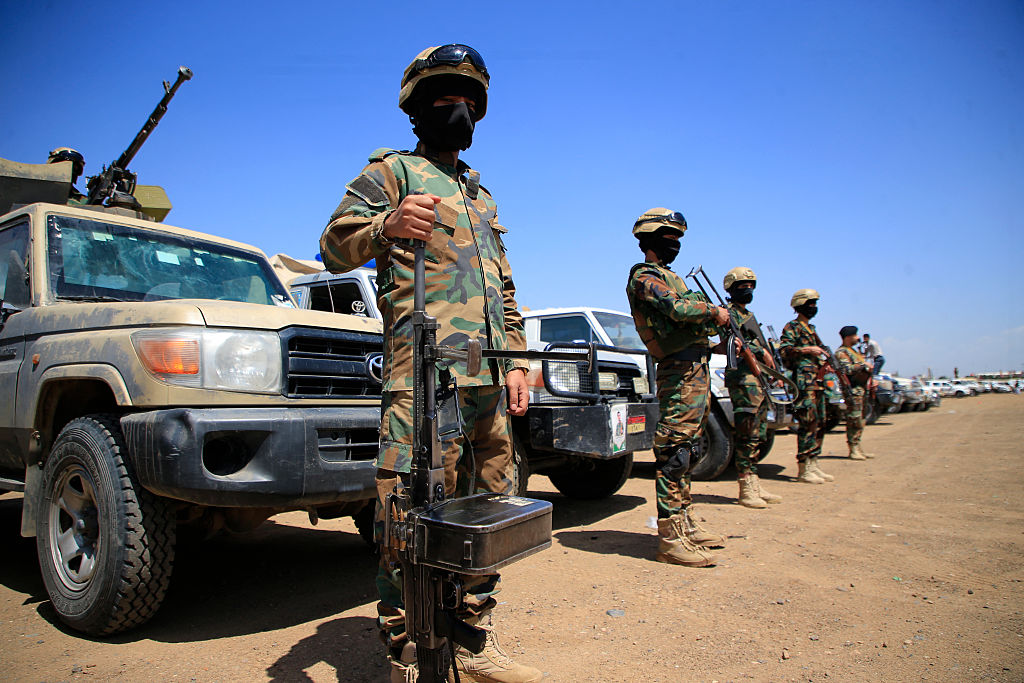
Following Israeli attacks on Hezbollah and the collapse of Syria’s Assad regime, Yemen’s Ansar Allah movement is now the strongest part of the Iranian-backed Axis of Resistance. But it has good reason to hesitate before joining the war on Iran’s side. (Mohammed Huwais / AFP via Getty Images)
As the supposed ceasefire in the US-Israeli war against Iran turns into fresh episodes of military aggression, both in the Gulf and in Lebanon, it is increasingly likely that the Bab al-Mandab, the other major strait in the region, will be involved in any renewed expansion of the war.
Prior to the declaration of a ceasefire, Yemeni involvement was minimal, with six airborne attacks on Israel between late March and April 7, none of which caused any significant damage. On June 7, however, Iran and its Yemeni allies simultaneously launched missile attacks on Israel intended to put an end to its deepening occupation of Lebanon.
In addition, both Iran’s Revolutionary Guards and Yemen’s Ansar Allah, commonly known as the Huthis, renewed their threats to carry out attacks on shipping in the Red Sea if the Israeli assault on Lebanon continues.
In recent months, there has been considerable speculation as to the reason for Ansar Allah’s limited participation. Was it because Iran was keeping its Huthi allies in reserve, or was it based on the Huthi assessment of the regional balance of power and their own increasingly complex relationship with Saudi Arabia, following events in Yemen earlier this year? An understanding of the issues involved is essential to grasp the intricacies of the situation.
Southern Questions
Significant changes to the internal Yemeni balance of power started in December 2025. The southern separatist Southern Transitional Council (STC), with backing from the United Arab Emirates (UAE), launched a sudden blitzkrieg that gave it control of Yemen’s eastern governorates of Hadhramaut and al-Mahra in a matter of days.
For a few weeks, the STC systematically ignored demands from Yemen’s internationally recognized government (IRG) and Saudi Arabia for it to withdraw to previous positions. Instead, it pursued its conquests closer and closer to the Saudi border.
This untenable situation for the Saudis led them to bomb two Emirati ships bringing military equipment to the STC in Mukalla port on December 30. This coincided with the IRG terminating its defense agreement with the UAE and giving its forces twenty-four hours to leave the country. The UAE duly complied, claiming that this was its own unilateral decision and denying that the cargo carried by the ships was military, despite massive photographic evidence to the contrary.
Early January saw a rapid reversal of STC positions with the IRG Saudi-supported forces reaching the temporary capital, Aden, by January 6. Three days later, several STC officials announced the dissolution of the council from Riyadh, where they had assembled following their rapid and dramatic change of allegiance.
Recasting the IRG
By mid-February, the transformation of the IRG was confirmed with the formation of a new government consisting of thirty-five ministers, including three women in meaningful senior positions. It also had many former STC leaders from the two main regions where there is most support for the organization.
The leader of the Yafi’ faction, Abdul Rahman al-Murharrami, formerly second-in-command of the STC, took charge of security throughout its former stronghold areas. Figures from the Dhali’i region also received numerous senior positions in central and local government, including that of prime minister.
The Dhali’i president of the STC, Aydaroos al-Zubaidi, is presumed to have fled to the UAE. From outside the country, he has addressed his supporters and organized demonstrations in his former strongholds. However, those supporters are gradually becoming less significant, even though the “dissolved” organization has reappropriated its offices in Aden and is openly active.
Security concerns in Aden remain a priority: two prominent civilians were recently assassinated. It is not clear whether responsibility for their deaths lies with UAE-supported STC elements or with other players. The proposed Yemeni South-South dialogue, promised in January, is fading away as separatist factions are becoming more numerous and divided, while at the same time losing political and military influence.
Restructuring
Military restructuring by the IRG in recent months is intended to ensure that forces loyal to Saudi Arabia are in control. Saudi lack of confidence in its Yemeni clients is demonstrated by the newly reported arrival of substantial Pakistani forces in the country, following the Saudi-Pakistani Strategic Mutual Defense Agreement of September 2025. Apart from Pakistan’s role as a mediator between Iran and the United States, supported by the Gulf Cooperation Council, this is the first practical manifestation of this updated incarnation of close Saudi-Pakistani cooperation.
The IRG is still struggling to establish itself as a competent ruling entity, partly because the restructured Presidential Leadership Council remains divided. This time, the division runs along slightly different lines, with the increasingly prominent Hadhramis calling for more autonomy for their governorate. Their claim is based on their region’s geographical position, the large area it covers, and its possession of hydrocarbon resources, while ignoring its comparatively small population (about 5 percent of the total in Yemen).
The government suffers from severe financial constraints and operational problems despite the efforts of some of its new ministers to improve governance. These issues are visible in its agreement to bow to International Monetary Fund austerity measures in return for a $1 billion loan, measures that will further worsen already abysmal living conditions for the population.
Rather than potentially maneuvering an independent path amid the competition between its two rival supporters, Saudi Arabia and the UAE, the IRG is now almost totally dependent on the Saudis, which could compel it to accept whatever deal the latter make with the Huthis. Alternatively, Saudi Arabia may support an IRG military offensive against the Huthis. The recent strengthening of Riyadh’s military control within the IRG suggests it might go for that option. For its part, the IRG is still focused on establishing effective control in the areas under its control, and defeating Ansar Allah remains a long-term objective rather than an urgent priority.
Ansar Allah
Saudi-Huthi negotiations were close to reaching agreement in late 2023. An agreement would have ensured a secure border and an end to Huthi attacks on the kingdom, whose Red Sea coast is the site of many of its more grandiose vanity projects. It would have required Saudi financing for Huthi military and civilian personnel and for the reconstruction of infrastructure damaged during the war.
Israel’s genocidal assault on Gaza interrupted those discussions. The Huthis maintained a regular flow of attacks on Israel, with 125 air strikes in 2025 alone. Although few of those attacks caused death and destruction, they sent Israelis to their shelters and were widely appreciated throughout the Arab world as a unique case of practical support for the Palestinian people. Following the formal declaration of a Gaza ceasefire in October 2025, there have been renewed efforts to revive these negotiations and the related United Nations–mediated “road map” toward an internal Yemeni peace agreement.
However, the Huthis have been weakened by the damage caused by US and Israeli strikes in 2025. The renewed US branding of Ansar Allah as a Foreign Terrorist Organization has compounded the disastrous economic and financial position of the territory it rules, which contains two-thirds of all Yemeni citizens. There has been an almost complete cessation of humanitarian support to the Huthi-ruled part of the country. Iran is also less able to provide assistance than before, with the 2026 semiclosure of the Hormuz strait and the destruction caused by US, Israeli, and Emirati air strikes.
These factors have increased popular resentment of Ansar Allah. But the Huthis are battle hardened, with a tightly controlled military, and they have the added asset of a geographical position that enables them to threaten Saudi shipping and investments in the Red Sea. The movement can also continue to rely on the deep pro-Palestinian commitment of the overwhelming majority of Yemenis, who see action in support of Palestine in a positive light while taking a different view of action in support of Iran.
This has been demonstrated by the Huthis’ earlier, limited intervention in March–April, targeting Israel directly, and by the launching of missiles against Israel in the past few days, to coincide with Iran’s offensive. Both clearly demonstrated coordination and commitment to the idea of including Hezbollah and Lebanon in any deal with the United States.
The two partners share an ideological commitment against Israel, and Iran has provided important military and economic support to the Huthis over the past decade, including parts for advanced weaponry and petroleum products. Supporting Ansar Allah has been a highly cost-effective operation for the Iranians, costing about $300 million annually or less. Following Israeli attacks on Hezbollah in Lebanon and the collapse of the Assad regime in Syria, the Huthis are now the least damaged operational entity of the Iranian-backed Axis of Resistance.
In the current Gulf war, the Huthis have threatened Red Sea shipping but carried out no attacks to date, only taking preparatory measures in anticipation. Getting involved militarily is a major risk as it could jeopardize the incipient renewed negotiations with the Saudis, at a time when Saudi control over the IRG is stronger and might lead to an offensive against Ansar Allah. It might also provoke the United States, as it would break the May 2025 ceasefire agreement that ended fifty-two days of intense US bombing of Yemen.
Saudi Strategies
Having failed to prevent the United States from joining Israel in its war against Iran, despite the massive bribes offered to Donald Trump on his visit last year, the Saudis are now trying to reduce the damage to their economy and future plans by diversifying their international alliances. This includes the aforementioned security agreement with Pakistan as well as the widely mentioned cooperation with Turkey and Egypt.
However, they will remain trapped in dependence on the US for military equipment and support in spite of increasing arms purchases and agreements with other states, ranging from China to several European countries. Alongside other Gulf states, they are currently concentrating on support for mediation to prevent the resumption of fighting. Trump’s unpredictability and the determination of the Iranians not to allow him to claim an imaginary victory mean that prospects for a rapid solution are low.
Economically, in the long term, the regime is now focusing on the remaining element of Neom, its port and industrial city, having indefinitely postponed its more fanciful projects. In the short term, it has reactivated its 1980s east-west pipeline which now carries close to seven million barrels of oil per day. Most of this is exported eastward via the Bab al-Mandab and is therefore vulnerable to Huthi threats.
Yemen is thus at the core of the problem, and the Saudi regime is well aware that its Yanbu Red Sea port could be a prime target for the Huthis. The immediate issue for the Saudis in Yemen is whether to reach agreement with the Huthis and then push for a lasting Yemeni “peace agreement” with UN mediation, or to support the IRG in military confrontation with the Huthis.
The Red Sea and its riparian states are increasingly important to the Saudis, particularly as the region has become a major site in its ongoing and worsening rivalry with the UAE, now visible in Sudan, Somalia, and Ethiopia as well as Yemen. Its prominence has expanded with the Iranian-Huthi threats to navigation and the close ties between Israel and the UAE that challenge Saudi leadership in the region.
Humanitarian Disaster
Coming on top of twelve years of war and insecurity, the Iran war has further worsened living conditions for Yemenis. In the IRG-controlled area, by mid-April the price of fuel had risen by 20 percent and that of cooking gas by 26 percent in a country that imports 90 percent of its staples.
More than 22 million people are in need of urgent humanitarian assistance, and millions have now sunk to “emergency” levels of food insecurity. But the 2025 UN Humanitarian Response Plan received funding commitments that covered just 29 percent of what was being sought. The reduced 2026 appeal was financed at a mere 14.5 percent by June 8, nearly halfway through the year.
It is thus unlikely that even the nine million people who have been prioritized for support will get any relief from hunger, lack of water and sanitation, and inadequate (or nonexistent) medical and education services, let alone the other 12 million people who are officially “in need.” With this abyss between humanitarian needs and funding, it is not surprising that the UN has now recognized the threat of famine. It is particularly acute in Huthi-controlled areas where support has effectively been halted for close to two years.
In this context, regardless of who is in control anywhere in the country, the last thing Yemenis need is the renewal of conflict in the Red Sea, which would almost certainly bring about further death and destruction from Israeli and US attacks should the Bab al-Mandab be closed. The lack of any prospect of a political solution further alienates Yemenis from their rulers.