Yes, Workers Want Progressive Economics
But progressives need to be careful about how they pitch their appeals to workers.
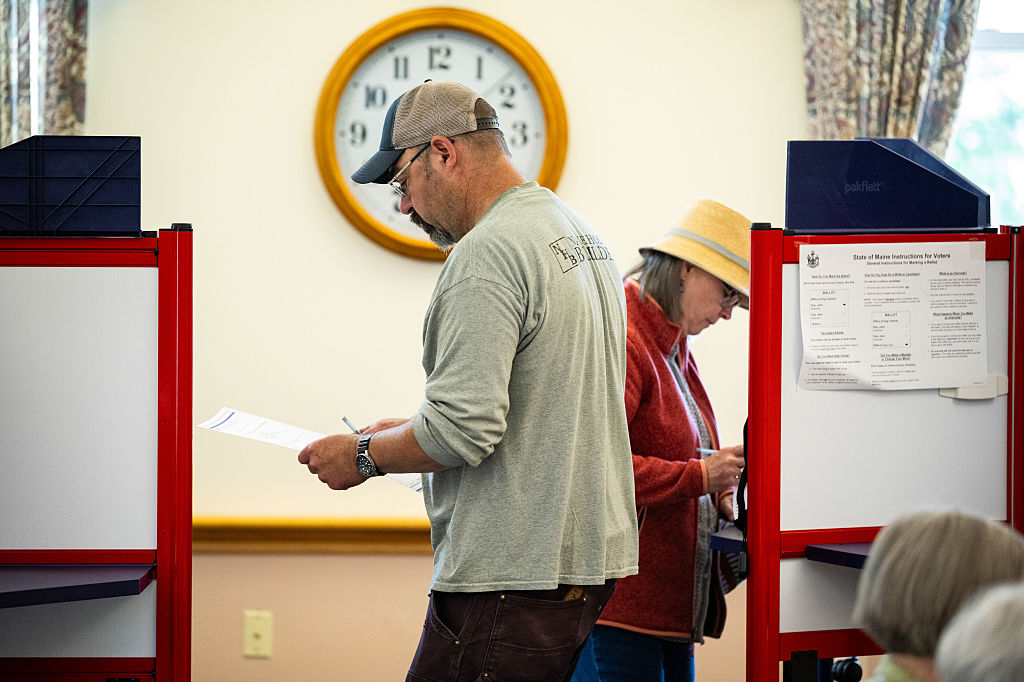
The gap between workers and Democrats isn’t about progressive economics. Workers love expanding Medicare — they’re cold on “bigger government.” The lesson for the Left is in the framing. (Graeme Sloan / Bloomberg via Getty Images)
The basic wager of economic populism is that the far right can only be stopped in the long term by enacting epoch-defining changes to our economic system — changes that give all working people a shot at a stable, middle-class life. If progressives hope to build the durable majoritarian coalitions needed to make that happen, they will have to deliver material improvements to working people’s lives, so ordinary Americans will once again feel that their lives are better than their parents’ were. All of which means thinking big. Very big.
But what if workers don’t actually want what progressives are offering? In a recent piece for the Conversation, Nicholas Jacobs argues the Democratic Party has moved so far left of working-class voters on economics that “on every major plank of the progressive economic agenda, Democrats are now substantially to the left of the workers they claim to champion.”
The Center for Working-Class Politics (CWCP) retested Jacobs’s economic claim using a much-wider evidence base and distilled the results into two heat maps below. Our analysis incorporates a range of economic items from eight high-quality surveys from 2024 and 2025: the American National Election Study (ANES), the Cooperative Election Survey (CES), the General Social Survey (GSS), Pew, AP-NORC VoteCast, and Gallup.
At first blush, Jacobs’s account is obviously correct. Across the forty-four bread-and-butter economic questions the CWCP analyzed, Democrats were more egalitarian than the working class — defined as individuals without a four-year college degree who fall in the bottom half of the household income distribution — on nearly all of them, with an average gap of 15 points. So Jacobs is right that Democrats are more economically progressive than the undifferentiated working class. But that’s hardly surprising: identifying as a Democrat is itself a marker of left-leaning politics.
What’s more, the fact that Democrats are generally more progressive on economics than workers obscures two crucial facts, both visible in the heat maps below. First, working-class Americans are not against expanding government programs across the board. By some measures, they are as supportive as Democrats — or more so — of expanding popular existing programs like Social Security and Medicare. Democrats and workers hold virtually identical views on incremental funding increases for Medicare, schools, and infrastructure, and the working class is actually more progressive than Democrats on Social Security generosity.
That said, working-class Americans are less enthusiastic than Democrats about expanding the role of government and creating sweeping new programs. Democrats outpace workers most dramatically on business regulation and on abstract “bigger government” and “reduce inequality” framings, as well as on marquee progressive policies like a federal jobs-and-income guarantee and government-versus-private health insurance. Both of those last two come with caveats. Average support for a federal jobs guarantee is substantially higher when it isn’t paired with an income guarantee. And on health insurance, roughly 20% of working-class respondents said they had never thought about the question, while support swings widely — often to majority levels — depending on how it’s framed.
These gaps say as much about the importance of framing and messaging as they do about any supposed working-class aversion to progressive economics. If progressives build their proposals around expanding programs that working Americans already know and trust — expanding Medicare, say, rather than replacing private insurance — and if they root their appeals in values workers identify with — think of how Social Security’s popularity rests partly on the sense that workers have paid in and aren’t taking a handout — they stand a far better chance of success.
Second, while middle-class Americans are clearly more progressive on most economic issues, the working class still holds strongly progressive positions across a wide range of them: a higher minimum wage (58%), expanded Medicaid (about 78%), paid leave (66%), stronger unions (about 60%), and higher taxes on corporations and top earners (57 to 69%). All told, the working class shows majority support for the great bulk of the policies we examined — 33 out of 44.
Working-class support fell short of a majority on three basic kinds of economic policy. The first involves framings of the role of the state that play into Americans’ fear of big government: “regulate business” (33%), “reduce income inequality” (42%), and “bigger government providing more services” (48%). Along the same lines, just 32% of workers opposed repealing Trump’s 2017 tax cuts — which they may have benefited from or believed they had. But when the tax story is told in a more populist register — making the wealthy pay their fair share, rather than threatening to strip middle-class Americans of their cuts — a substantial majority of workers back progressive tax policy. Workers were similarly cool toward sweeping or abstract versions of goals they strongly support when those goals are framed in familiar terms or tied to programs they already trust, like expanding access to government-provided health insurance: just 45% of Americans preferred government-run over private health insurance, while 78% were for expanding Medicaid and 66% for expanding Medicare.
The second kind of unpopular policy relies on the stigmatized language of “welfare.” More welfare spending draws just 25–29% support, and “aid to the poor” lands in the low 40s. In the same vein — and consistent with the idea that workers warm to progressive policy when it’s tied to earned benefits and hard work — only 43% of working-class Americans opposed Medicaid work requirements.
The last kind concerns trade. Perhaps surprisingly, given President Donald Trump’s apparent conviction that tariffs are a winning issue with the working class, several protectionist policies drew less than majority support among workers: 49% favored higher tariffs on imports, 34% backed tariffs on all imports, and just 11% flatly opposed free-trade agreements (though more than 50% said they neither supported nor opposed them). So while trade is indeed one of the areas where workers are more egalitarian than Democrats, they’re generally skeptical of the key protectionist measures.


In short, there’s little doubt that Democrats are more economically egalitarian than the working class on most bread-and-butter issues — but that does not make the working class economically conservative. Working-class Americans hold majority positions across a wide range of progressive economic policies, from a higher minimum wage to expanded Medicaid to higher taxes on corporations and the wealthy, and they are more egalitarian than Democrats on Social Security and trade.
The real gaps between workers and Democrats are concentrated in the most abstract and far-reaching versions of these policies and in framings that don’t connect with core working-class values — not in any general resistance to progressive economics. Progressives have a genuine opening to build a broader coalition behind long-overdue reforms for working Americans. They just have to take workers’ values seriously — including on the social and cultural issues that, as Jacobs rightly notes, divide workers and Democrats far more sharply than economic ones — and think strategically about which progressive policies and framings will land most effectively with the working class.