Troy Jackson’s Politics Are Rooted in Maine Logger Struggles

Maine Senate hopeful Troy Jackson’s history is a case study of something the Left often discusses but rarely sees: a working-class politician who emerged from workplace organizing struggles and used his power to advance pro-worker policies.
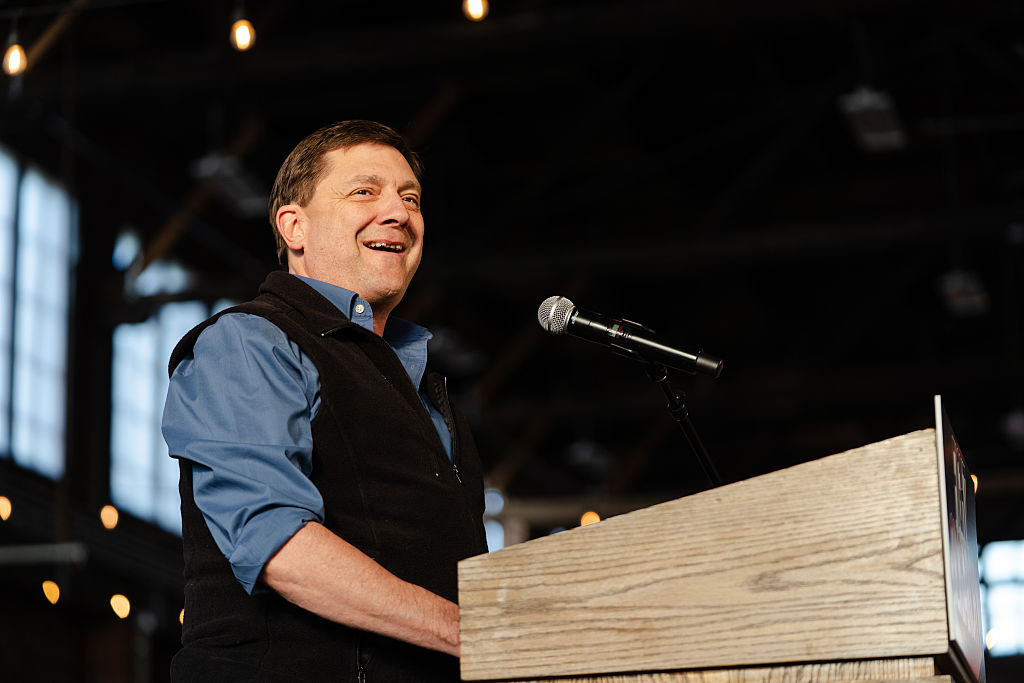
Troy Jackson speaks during a political event in Portland, Maine, on May 25, 2026.

Troy Jackson is currently vying to become Maine’s Democratic Senate nominee in the wake of the Graham Platner scandal. Jackson’s history as a fighter for the state’s loggers is a long one. (Sophie Park / Bloomberg via Getty Images)


Graham Platner’s shock exit from the Maine Senate race he secured the nomination for just a month earlier has set off a scramble among the state’s Democratic officials for not just who will replace the scandal-plagued former candidate on the ticket, but who can tap into the same well of voter disenchantment and progressive enthusiasm he had channeled. Among the eight names in the running, the Left is coalescing around one in particular: the state senate’s former Democratic leader, Troy Jackson.

Jackson — a former Republican who consistently and easily won office in the red, Donald Trump–voting district he spent his whole life in — will have a compelling case to make for being the best suited to succeed Platner, whose appeal rested on both a fiery anti-oligarchy message and an image as an authentically working-class Mainer. Jackson’s origin story as a politician is rooted in his and other Maine loggers’ struggle for better pay and working conditions, one waged against both the state’s largest corporate landowner and a bought-and-sold political establishment in Augusta, the state capital.

That worker organizing effort ultimately led Jackson to run for the state legislature and use his seat to coordinate with his fellow loggers to win collective bargaining rights for long-exploited forestry workers — all as his prospective Republican opponent, Susan Collins, sat on her hands. If Platner’s campaign offered the unique promise of an average working Mainer taking on the establishment and winning, Jackson will have a strong claim to make that he has already done exactly that.

Blockading the Border

It took until 2019 for the workers who cut and harvest trees and the truckers who transport the wood to have the right to collectively bargain in Maine. Until then, the state’s loggers and wood haulers were barred from doing so by federal antitrust law, because, as mostly independent contractors, it would supposedly constitute price-fixing. It was a technicality that employees across many agricultural sectors had run headfirst into over the years, leading the Maine state legislature to carve out exemptions from antitrust law for an ever-expanding list of workers.

Having become president of Maine’s state senate the previous year, Jackson swiftly turned to make sure woods workers were made part of that list. At the close of March that year, flanked by a group of loggers risking a blacklist from the state’s large landowners, the logging companies, he introduced a bill to create that exception. Less than three months later, it became law — a victory that was the culmination of decades of struggle by Maine’s forestry workers to get a fair slice of the profits increasingly hoarded by the state’s corporate mills and landowners.

Over 1998–99, Jackson had been one of a trio of loggers in Maine’s overwhelmingly rural, long-declining Aroostook County who had led a series of work stoppages trying to win more jobs and better pay. At first aimed squarely at the Maine logging industry’s use of foreign labor, the stoppages kicked off years of agitation by loggers that would ultimately turn its sights on corporate exploitation of workers and their lack of rights to resist it.

What drove the loggers to begin with was the hiring of Canadian loggers from just across the border who could work via a “bonded labor” program that let them enter and work in the United States for a specific employer until they had completed the job they had been hired for. The program had been a sore spot for Maine loggers ever since it had been created in the 1940s because of how it undercut American loggers. “I am not anti-Canadian — most are decent, hard-working people — but the fact remains that they have our jobs and are keeping prices down,” Jackson wrote in a December 1998 op-ed.

That was two months after he and ten other loggers from the Allagash and Fort Kent areas had clogged a border crossing into Quebec with their pickup trucks, demanding an injunction on any more bonded workers and jobs for American workers, and stranding dozens of Canadian loggers and Maine truckers hauling lumber to Canadian mills in the process. When the Canadians looked to get in through an alternate path, Jackson and the other loggers expanded the blockade to two more border crossings.

“I am a father of two small children whom I love dearly, but soon I will have to return to the border with the knowledge that in doing so I will be arrested,” Jackson wrote. “I am willing to commit to this in order to get people to realize just how serious I believe this problem to be.”

Jackson had seen firsthand how work for Americans in the logging industry, virtually a way of life in remote northern Maine, had deteriorated over the decades, and the role the bonded labor program had played. First meant to let the industry dip into the Canadian workforce when there weren’t enough American workers to fill jobs, the program slowly morphed into a way for employers to undercut American workers. Since Canadian loggers didn’t need health insurance, thanks to Canada’s universal health care system, and were willing to work for lower wages because of the weaker Canadian dollar, they had a built-in advantage over US workers.

Years later, Jackson would describe to Beacon, an independent outlet in Maine, how, as a twelve-year-old boy, he had watched firsthand a landowner use the threat of bonded workers to intimidate more than a hundred loggers who were threatening to strike after he cut the prices he would pay for their wood.

“He didn’t get out and ask, ‘How do we resolve this?’ Or, ‘I know it’s a big cut.’ He just said, ‘If you don’t go back to work in the morning, I’ll replace you all with Canadians.’ That was the whole negotiation,” he recounted.

A few weeks after their first blockade, Jackson’s father told the Bangor Daily News how his truck had been sitting in his driveway for nine months because he had no work, and how he and Jackson had had to sell a $300,000 piece of machinery they couldn’t use but were still spending thousands of dollars on in monthly payments. “Come with me, and I will show you machinery owned by Canadians, and it’s in the woods working,” Jackson told the paper. The following year, he described helping several friends pack up and move because of a lack of jobs.

What Jackson and other loggers saw around them and felt in their own lives made them leery of assurances by officials and employers that bonded workers weren’t affecting Americans’ jobs, and that landowners were not breaking the law by using them, as the US and Maine departments of labor (DoLs) determined after an investigation prompted by the original blockade.

They were equally unimpressed with the meetings they won with Maine officials and, eventually, with the state’s contractors and landowners too, all together in one room for the first time over two days in February 1999. Despite a lengthy list of items the state and federal DoLs agreed to investigate, the thirteen hours of meetings ended with Jackson storming out after an official representing Maine’s largest landowner spoke for the first and only time during closing statements, when he couldn’t be questioned.

So Jackson continued to evangelize about the plight of Maine loggers, serving as a panelist on the subject at the University of Maine and giving state labor department officials a tour of the woods. A year to the day after the original weeklong blockade, frustrated with how little had been done, he helped lead a second blockade of the Quebec border, which this time saw state police sent to escort them out. “We took the only option they gave us,” Jackson said.

Deciding further action at the border was a bust, Jackson and the other loggers took their protests to the doorsteps of government officials, telling the press that “our problems are with landowners and the Department of Labor, not with the police at the border.”

“We’re here because, legally and morally, the state and federal governments should be doing something to protect us,” Jackson told people who had gathered at the state DoL in November 1999, warning that “they’re killing our town, they’re killing northern Maine.”

The official indifference to their plight seemed borne out by a series of releases by the state DoL, including a study that dropped that same month. It concluded that Canadian workers were not having a downward effect on American loggers’ wages, except for “in isolated labor markets in far northern Maine, primarily in and around the St. John Valley” — in other words, in the exact geographic area that Jackson and the other loggers lived and worked.

“Are we not considered Americans here in the St. John Valley?” one of his fellow protest leaders bitterly remarked. “Maybe the solution is to declare the St. John Valley a third country.”

Decades of Decline

But for all the focus on the bonded worker program, the loggers’ struggles went much deeper than the use of foreign workers. One factor was the industry’s shift decades earlier from treating workers as wage-earning employees to independent contractors, leaving them suddenly bereft of benefits and having to cover expenses like machine upkeep and workers’ compensation.

As a result, Maine loggers complained at a January 2000 summit, business costs had doubled while their wages had flatlined — all as the wood-buying companies still exerted minute control over virtually every part of the “independent” contractors’ work. Under those conditions, working at McDonald’s was a better deal, one contractor charged.

“There is only a shortage of American workers willing to work at the landowners’ and contractors’ offered prices,” environmentalist Mitch Lansky said later that year at a tense seven-hour meeting held by the Maine DoL about its November 1999 study, disputing employers’ claims that they had to hire Canadians because Americans simply refused to work. “If wages were high enough to make a decent living, Americans would return to the woods.”

The fact that employers were able to get away with this was a product of another shift: namely, as that same study had determined, that there was a “concentration of landownership in northernmost Maine among relatively few large landowning companies.” As a result, the study had concluded, loggers’ bargaining power was weaker, and there was a “double squeeze” on both logging contractors’ profits and loggers’ wages.

That shift had gotten markedly worse over just the year before the report came out, after the New Brunswick–based conglomerate, J. D. Irving Ltd, became the state’s largest landowner by buying up nearly a million acres of northern Maine forest land. A year later, the Professional Logging Contractors Association of Maine reported that since the purchase, the rates contractors were getting had been cut 25–30 percent.

“They’re kind of creating a situation that the Americans can’t work here because we can’t afford to,” he said, predicting that they would then turn to Canadian bonded workers, “because they’ll say that nobody around here wants to do the job anymore.” He spoke to the paper anonymously, as all the contractors did, fearing retaliation since Irving was “going to be the only game in town,” as one put it.

Another contractor later charged he had had his contract withdrawn after complaining publicly about Irving’s prices. In the years ahead, the contingent of American loggers — some of whom came from generations of lumberjacks, including one of Jackson’s fellow protest leaders — permanently leaving the industry grew and grew.

Jackson, who had regularly stressed that his protests were not “anti-Canadian,” subtly shifted the target of his ire, even as he remained critical of the bonded labor program. He increasingly took aim at what he called “the sale of most of northern Maine to corporate Canada” in his public rhetoric, and condemned Irving’s “financial slavery,” charging that “the state is in the landowners’ pockets.”

In a February 2000 op-ed for the Bangor Daily News, he praised an earlier report by the paper examining the Irving family’s domination of the Canadian province of New Brunswick just over the border, and how local officials there had “pandered” to the firm by skipping an environmental assessment to approve one of its projects.

“It would seem to be a natural presumption that Irving would have the same practices in other industries, in other countries,” Jackson wrote.

The protests and blockades had seemingly hit a wall in terms of what they could achieve, partly thanks to Maine politicians who, in Jackson’s estimation, said the right things but offered no substantive help at all. So he decided on a new course of action: to join them.

“I thought maybe if I come down here and change people’s minds, we’d have a better chance,” Jackson later said.

Running for office later that year as a Republican, he criticized Irving and pointed to the DoL study’s findings that landowners’ profits had risen 169 percent over the previous quarter-century, while total wages had dropped 20 percent.

Woods and Halls

It took Jackson’s second tilt in 2002 to win the seat for Maine’s 151st District, one of the state’s largest and most remote. He had quit his job with a land developer to plunge full-time into campaigning, reportedly visiting 98 percent of the homes in the district, and declaring that he would “remind people in Augusta that we do exist up here, that we have been unfairly treated” by politicians if he won.

Jackson had already played a direct but small role in the push for legislative solutions to the crisis facing loggers. The blockades and protests had spurred the state legislature to create a roundtable committee to draw up recommendations for lawmakers, whose roughly dozen members Jackson had been a part of. Once elected, he could continue the fight from within the halls of the state capitol.

Jackson, now an independent, submitted five bills identical to the roundtable’s recommendations on wages and conditions in the forestry industry to be considered by the next legislature. Members of the state legislature’s labor committee told the press they knew of no other bills that had been submitted on the matter. That December, Jackson arranged a meeting with dozens of loggers to discuss with them his legislative push.

They would all, in the end, coalesce around one demand in particular, and the bill that would make it law: LD 1318, which aimed to extend collective bargaining rights to loggers and wood haulers, and create an arbitration board to settle disputes. “Although this stems from legislation proposed by us, this was actually born after the blockade of roads we did on the border,” Jackson told the press.

What followed for the next year was what we would now call an inside-outside strategy. In Augusta, dozens of loggers and truckers made the pilgrimage to testify about how dismal their working conditions had become and to lobby lawmakers to advance the bill, hoping to counteract the fierce and well-funded lobbying campaign against it from Irving and other landowners. Meanwhile, back in the woods, with Jackson’s encouragement, loggers and wood haulers formed an organization, the International Loggers Association (ILA), and planned a strike in response to Irving’s lowball rate offer for their new contract.

“Organizing may be the way to go anyway. Whatever needs to be done has to come from you guys. I will do whatever you guys need me to do,” Jackson told the loggers, warning them that the company would try to pit workers against each other.

In January 2004, the loggers voted 47–3 to launch a work stoppage that raised alarms by exacerbating a work shortage in the industry — a fact that Jackson and others claimed bitter vindication over, having said for years that loggers were being driven out of the industry and region by poor wages. Nearly three weeks later, they voted to end it, partly on the condition that the governor John Baldacci, who opposed the bill, not veto LD 1318, which he refused to agree to.

Meanwhile, Irving strong-armed the loggers, giving them an ultimatum to either take their contract offer or lose their jobs, peeling off some of the strikers and luring them back to work. “These woods workers need the legislation that is pending in Augusta,” Jackson commented, pointing to “heavy-handed tactics” by the firm.

That opportunity came a few months later. Jackson — who continued to work as a delimber, getting up sometimes at the crack of dawn to work a twelve-hour day in the woods, and driving four-and-a-half hours to spend the work week in Augusta — served as one of its leading champions in the state legislature. He helped tweak the bill to make it easier to pass, limiting it to apply only to landowners who owned more than one hundred thousand acres, and later to four hundred thousand, effectively applying to only three companies; he switched to become a Democrat, owing to the party’s overall support for the bill; and he spoke with Baldacci, convincing the governor, in his telling, to sign the bill when he confessed his fears that if it failed, he would end up costing people their jobs.

“I remember one lobbyist telling me that ‘everyone in the building was working against you,’” Jackson later recalled.

The loggers, meanwhile, took advantage of the seasonal lull in April to lobby for the bill in Augusta, more than two dozen of them holding meetings in lawmakers’ offices and stopping legislators in the hallways, and even holding a sit-down with the governor to make their case. In the end, the bill passed the state senate, where it had previously died, by one vote, and was signed into law by Baldacci. Jackson was convinced the loggers’ presence is what tipped it over the line.

At his request, the governor waited for Jackson, en route to the capitol, to do the signing, so that he could do it with a special pen he was bringing: one gifted to Jackson by his father-in-law, made from bird’s-eye maple harvested from the North Woods by an Allagash logger. Two years later, Jackson endorsed Baldacci for reelection, saying that whatever their differences, he had sided with “everyday working people” over big money when it most counted.

The Politicians Who Didn’t

One of the ironies if Jackson takes the Democratic nomination is that he will be challenging and even serving alongside lawmakers who he and other loggers regularly criticized for not lifting a finger to help them. The blockade had come about in the first place, Jackson had charged in January 1999, because the offices of Susan Collins — his potential general election opponent — and other top elected officials refused to meet with the loggers on three separate occasions.

When the blockade finally won them meetings with Collins and, later, a representative from her office, Jackson and the loggers were left underwhelmed by her opposition to their work stoppage and promise to simply look into the matter. “Shame on our hard-working politicians for hiding like cowards in the shadows or saying there is nothing they can do,” he wrote in February 2000.

“You couldn’t get anyone on the federal and state level to do anything about it,” Jackson recalled after winning his first election in 2002. “If you ask our congressional delegation, they say it’s a state issue, referring you to the Maine DoL to file a complaint. This is the treadmill Maine loggers have been on for at least thirty years,” he complained in June 2005, as he pushed legislation to even the playing field between American and Canadian loggers.

Jackson was equally scathing about then-Governor Angus King, now the independent senator for Maine, who Jackson will serve alongside if he wins the Senate seat. King “seems to be blind to what is going on in northern Maine, or maybe he just doesn’t want to get his hands dirty,” he complained. He “says we need to be patient, but I don’t think he has been out of work for a year and worries about providing for his children,” Jackson wrote.

In contrast to Baldacci, who remained relatively active in response to the loggers’ complaints despite his pro-business bent, Collins largely excused herself from the whole matter after giving the loggers a couple of meetings. Other than backing emergency relief for loggers for natural disasters and during the pandemic, there’s nothing in the public record that suggests Collins remained engaged in efforts to improve their working conditions — though in 2022, she did introduce a resolution recognizing October 12, 2022, as “National Loggers Day.”

As Jackson told the Bangor Daily News in December 2002, it was the futility he felt meeting with such officials in the 1990s that had, ironically, shaped how he operated as a politician. “I want to listen to what the guys have to say tonight,” Jackson said about the meeting he had arranged with the loggers. “A lot of times when these guys talk to people who say they are going to help them, well, they just don’t believe it.”

The Long Arc

As the fact that it would take another fifteen years for Maine loggers to get full collective bargaining rights suggests, the passage of LD 1318 in 2004 would ultimately be a dream deferred. One of the conditions of Baldacci’s signature was to narrow the legislation further, so in the end it effectively only applied to a single company: Irving. Soon after, Irving exploited a loophole in the law to avoid arbitration over its rates, forcing the loggers and lawmakers back to the drawing board.

The 2019 law would be the culmination of many more years of organizing by Maine’s loggers and persistence from Jackson, who continued to advocate for the industry’s workers in Augusta, and to push for more aggressive government action to help them. Sometimes those efforts were successful, like a 2005 law that made employers show proof that foreign workers owned equipment before they hired them. Sometimes they weren’t, like when Maine’s previous self-styled right-wing “populist” governor vetoed Jackson’s bill in 2017 that would have incentivized the state’s employers to offer jobs to Maine and US workers first, before foreign ones.

In any case, Jackson’s history is a case study of something today’s American left has often talked about but less often seen: a genuine working-class politician who emerged from the struggle of workplace organizing; who sought to use his position in power to advance the goals of his fellow workers; and who had a vision of how workers’ movements and their allies in elected office can work in concert to do it.

The Graham Platner saga is a sad situation on many levels. But if it opens the door to a version of that at the federal level, it would be a considerable silver lining.