The White House Was Never Really the People’s House
Popular access to and control over the White House has reached historic lows. There are grander spatial testaments to democracy to be seen in Washington, DC.
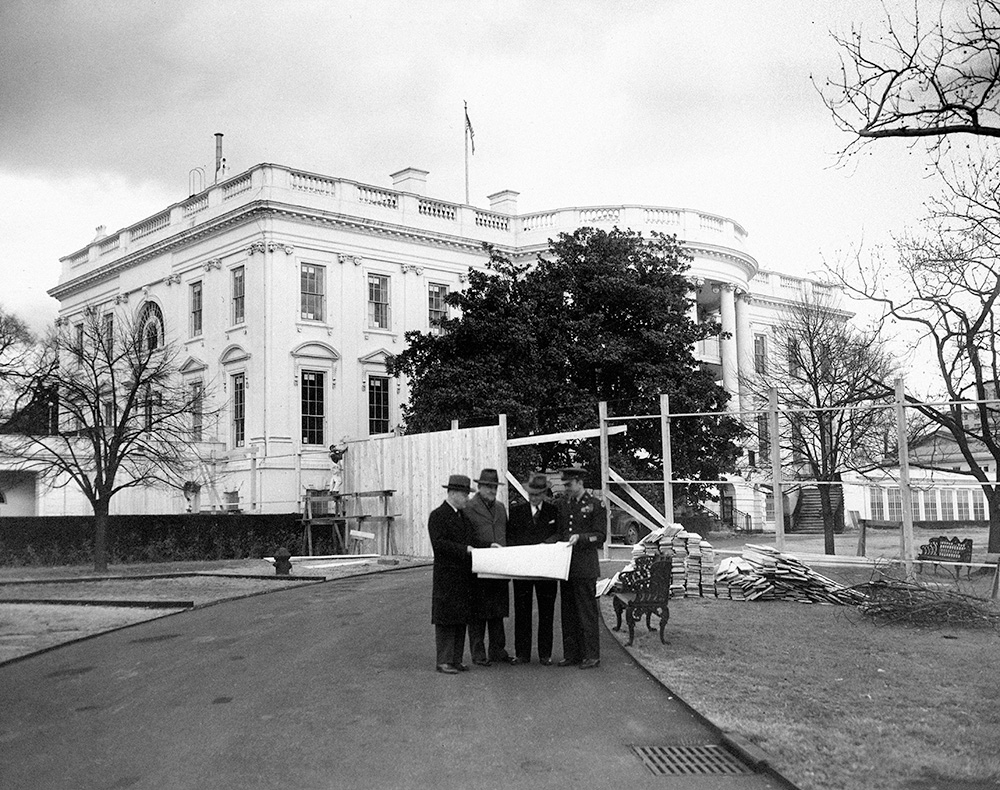
Much as there’s no real, authentic American democracy to go back to, there’s no real White House, only a series of rebuildings and modifications, a copy without an original. (PhotoQuest / Getty Images)
When Donald Trump proposed to demolish the East Wing of the White House, then unveiled his vision for its new ballroom, a nightmare world of gilding, drapes, and chintz straight out of a Dubai hotel room, there was considerable horror. Yet again, this man was going to desecrate one of our great symbols. It would be a permanent manifestation of that infamous photograph in which Trump grins before a White House dinner table filled with McDonald’s takeout. Presumably, he was now no longer desecrating but destroying the White House itself, designed in 1792 by the Irish architect James Hoban as a deliberately modest contrast with the palaces of Europe’s autocrats.
But he wasn’t; Trump was destroying a 1942 building, added partly to conceal a bomb shelter, just one of the dozens of additions and ancillary structures added to the residence over the many years of its existence. Much as there’s no real, authentic American democracy to go back to, there’s no real White House, only a series of rebuildings and modifications, a copy without an original.
The White House is, along with the US Capitol, the great monument of the United States’ particular brand of neoclassicism, the architectural cult that gripped Europe in the late eighteenth century as ever more remnants of Ancient Greece and Rome were unearthed and studied. There’s a received story about American classicism, and like many myths, it draws on enough truth to make it plausible; it is easy to collapse it all by pointing out that, here, history rhymed — one slave state with an elite democracy at the top was inspired by two more, from two thousand years ago and many thousands of miles away. But there’s some accuracy to the tale in which American architects in the late eighteenth century, many of them born in France, Britain, and Ireland, rejected the colonial copies of London churches and East Anglia guildhalls that had hitherto dominated the colonies in favor of the architecture of republicanism (from Rome) and democracy (from Greece). French-trained town planners drew up a multitude of new cities, with their prime achievement being Washington, DC, itself, its boulevards and grids a spatial manifestation of the Enlightenment.