The Search for a Revolutionary Architecture
After the French Revolution, the architect Étienne-Louis Boullée produced wildly ambitious building designs that were never realized. His ideas influenced both the Right and the Left — and raised the question of whether a revolutionary architecture is possible.
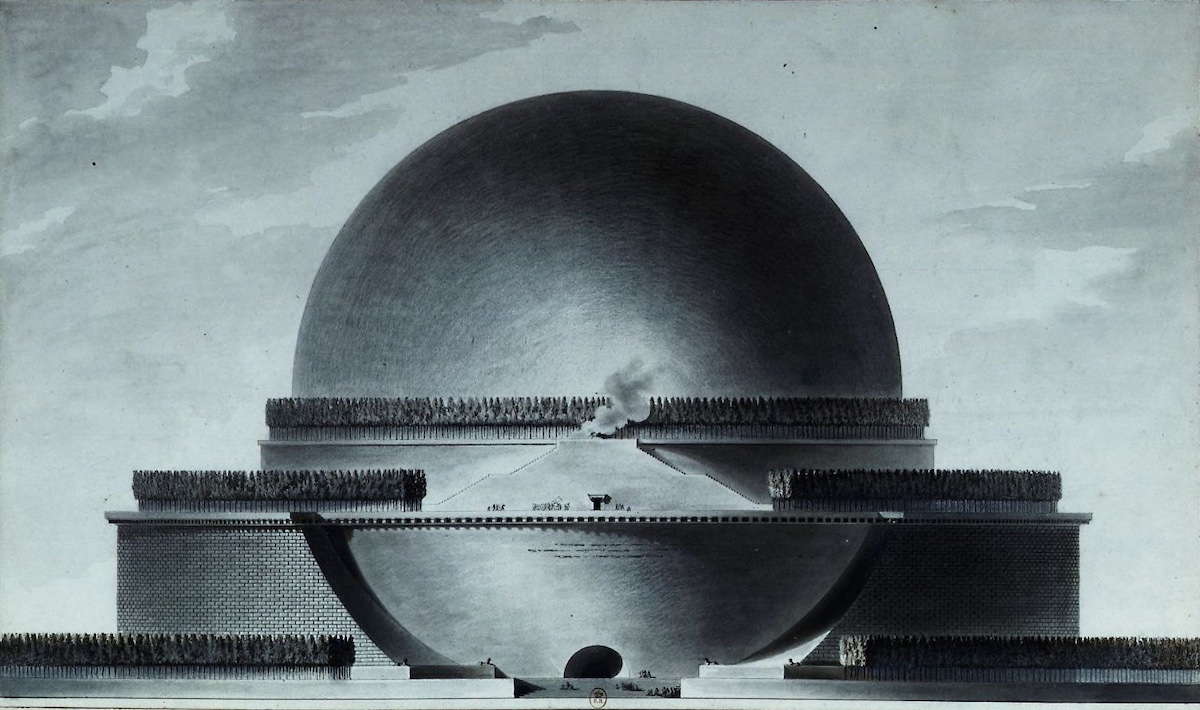
A sketch of architect Étienne-Louis Boullée’s plans for Cenotaph for Isaac Newton, 1784. (Wikimedia Commons)
Étienne-Louis Boullée, born in Paris in 1728, is remembered as one of the greatest architects of all time, even though the majority of his most iconic designs were never actually constructed. Steeped in the neoclassical style, which emerged in Rome but matured in France in the years leading up to the French Revolution, he began teaching at the prestigious École Nationale des Ponts et Chaussées when he was only nineteen years old. His income secured through teaching, Boullée was able to devote himself to theoretical questions about the nature and purpose of architecture, questions working architects — bound by spatial and financial limitations, not to mention the tastes of their clients — could seldom afford to ask.
Grand Designs
Boullée grew up in a time that saw extensive debate over the relationship between architecture and other art forms, with some wondering if it ought to be considered an art at all. In his 1746 treatise The Fine Arts Reduced to a Single Principle (Les Beaux-Arts réduits à un même principe), the philosopher Charles Batteux argued that the imitation of “la belle nature” was the object of all artists except the architect. The primary function of a building, Batteaux argued, was not to evoke an emotion or convey an idea but to provide a service. Functionally, architecture was more akin to a bed or a couch than a painting or a poem.
Boullée disagreed. In his essay Architecture, Essay on Art (Essai sur l’art), which remained unpublished until 1953, he imagines what the art of architecture could accomplish if its practitioners consider not only the function of a building but its cultural significance. “To give a building character,” his essay reads, “is to make judicial use of every means of producing no other sensation than those related to the subject.” Funerary monuments, in addition to housing the dead, should induce feelings of “extreme sorrow,” something Boullée’s designs achieve via their use of light-absorbent materials, shadows, and bare walls, creating “an architectural skeleton” similar to the skeleton of a tree in midwinter. His source of inspiration was the Egyptian pyramids, which “conjure up the melancholy image of arid mountains and immutability.”