Trump’s Authoritarian Architecture Begs for an Alternative
Donald Trump’s victory arch is so ugly and uninspired, so befitting his cynical, corrupt, tacky presidency, that it might actually offer us an opportunity to seriously consider something more befitting a just and democratic society.
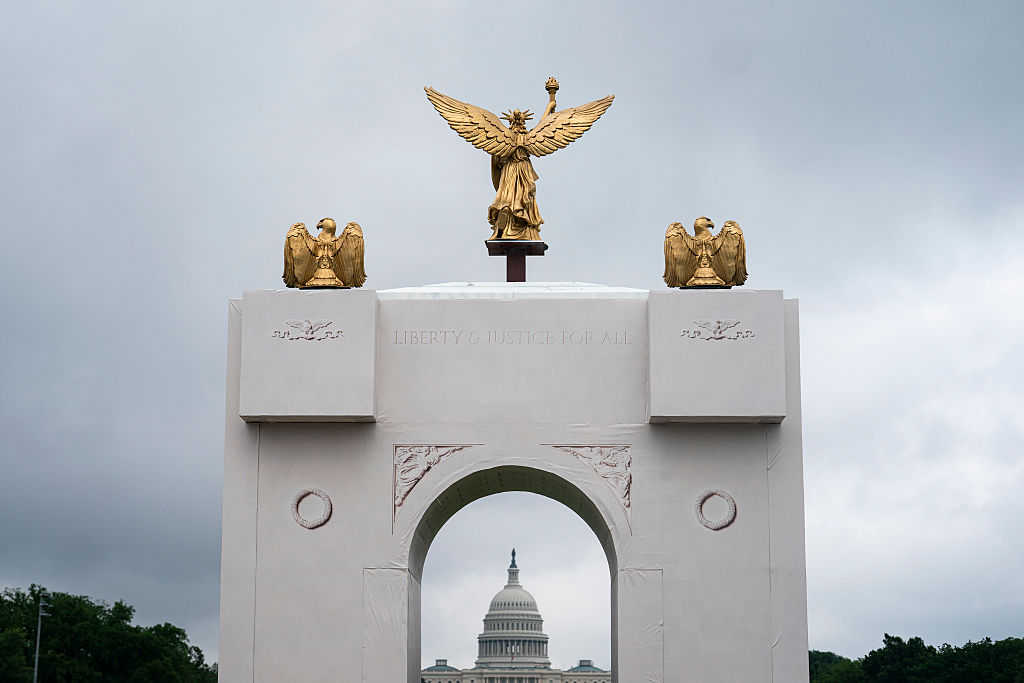
The Triumphal Arch proposed by Donald Trump has been rightly condemned by architectural critics. But that opposition has not posited its own vision of what contemporary, democratic American monuments to the nation could look like. (Al Drago / Getty Images)
Upon walking through an entrance of a mock-up model of Donald Trump’s proposed United States Triumphal Arch, a visitor could plainly see it was already falling apart. The miniature triumphal arch at the Great America State Fair, which took place June 25 through July 10, offered a sorry attempt at grandiosity. Looking more like an oversize board game token than a scaled-down future national monument, the arch looked more than a little clunky, painted a dull gray and showing its panel seams inelegantly. The gold eagles and Statue of Liberty reproduction at the top looked flimsy, and the main mass was adorned only with a few glue-on wreaths, decorative panels, and four bulky protuberances.
On the 250th birthday of the United States of America, the awkward portal opened to a hastily devised vanity fair whose exhibits on states, territories, and big businesses were pumped up by flags, empty slogans, and depictions of famous residents while providing hardly any flavor of who calls the nation home today. The Great America State Fair offered the viewpoint of a presidency not interested in Americans but just a shambolic performance of imperial unity through cheap, largely meaningless attractions. The United States Triumphal Arch, unironically pitched by Trump as a monument to military victories amid the US’s failure to end the US-Israeli war with Iran, is a much more expensive and enduring version of the same vapid commemorative spirit.
A Fitting Monument to Trump’s Governance
The original proposal came from right-wing anti-modernist critic Catesby Leigh, who garnered the support of developer Rodney Mimms Cook Jr, Trump’s pick to head the United States Commission on Fine Arts. Poised to stand 250 feet tall atop the Arlington Memorial Bridge between the Lincoln Memorial and Arlington National Cemetery, the arch has ignited outrage from historic preservationists, architects, and historians as a visual offense and violation of historic viewsheds in the Capitol. Some have even compared the arch to Albert Speer’s proposed German Arch of Triumph, which would have been a 400-foot symbol of the Nazi victory in World War II that never came.

Trump’s victory arch deserves scorn, but its ahistoric vision and banal aesthetics hardly make it a new fascist icon in the making. Its Roman victory arch form is a repeated trope around federal monuments in the District of Columbia, and its actual inscriptions and symbolic details are scant, trite, and boring: the large gold Statue of Liberty flanked by gold eagles, some bland patriotic slogans, a few decorative panels. Four golden lions on plinths at the base have been removed from the design by its architect, Nicolas Charbonneau of Harrison Design.
Instead of authoritarian grandiosity, the Trump arch is about as meaningful as any of the replicas of the Seven Wonders or the Manhattan skyline found at casinos in Las Vegas. The arch is patriotic plop architecture, intimating that the United States is in a renewed era of imperial power but disclosing in its own details that even the elites of the empire cannot rouse any original or contemporary statement about the nation they control. It is a perfect monument to the diminished, hollow, antidemocratic state that Trump has delivered.
Opposition to the arch, like opposition to the White House ballroom, lands righteously hard on demanding approvals be stopped or slowed. But so far, that opposition has missed the chance to match indignation at Trump’s arch by positing a vision of what contemporary American monuments to the nation could look like and what processes we would need to establish to develop architecture of, by, and for the people. Instead, the big blowups over Trump’s remaking of DC have ended up mired in regulatory procedures controlled by bodies whose members are hand-picked to speed the plow for the president.
The United States Commission on Fine Arts granted the arch preliminary approval in April and final approval in May. DC Preservation League Executive Director Rebecca Miller correctly noted that the commission acted with a “desire to move things at a pace where the public doesn’t have an opportunity to participate.” Despite the commission receiving around 600 comments from members of the public that were 99.5 percent opposed, the commission unanimously approved the design. Vice chair of the commission and architect James McCrery, once the lead architect for the White House ballroom, lamely offered that the public should bring their objections to “proper venues,” despite the fact that the public has a right to offer comment and the Fine Arts Commission is obligated to take public comment into account.
One of the last hurdles for approving the arch, assuming that Congress will continue to avoid asserting any power, was a July 9 vote of the National Capital Planning Commission on final approval, which passed unanimously. The commission acted despite the lack of resolution on whether the arch’s height violated the District of Columbia height limit on buildings. The commission already voted nine-to-one to grant preliminary approval in June. For weeks leading up to these votes, the National Trust for Historic Preservation gallantly rallied its members to submit comments in opposition, depicting the Arlington Bridge as “one of America’s most sacred landscapes.” Now the National Park Service is undertaking review, including a public comment period through the end of July, but that review likely won’t stop the project.
It is debatable, though, that other aspects of the DC symbolic order should be seen as sacred — and, if so, that that status excludes the values of many Americans whose lives and positions are not represented in the repeated neoclassical buildings and monuments of the capital. The enmeshment of the original construction of the capital’s landscapes and buildings with slavery already presents a problem for narratives that assert that Trump is “spoiling” a perfect and egalitarian District of Columbia. Architectural critics fussing over the details of the Triumphal Arch without dissecting the history of its form are wistfully creating their own comforting, vacuous dream of America.
If Trump’s arch is taking its cues from the 164-foot Arc de Triomphe (1836) in Paris, that arch’s establishment by Emperor Napoleon is relevant. Napoleon abolished freedom of the press, imprisoned his opponents, ended republican representative rule, reestablished slavery, and smothered civil rights for women and children, among other acts that Trump may well dream of emulating. The Arc de Triomphe design derives its formal model from the much smaller fifty-foot Roman Arch of Titus (circa 81), located on the Via Sacra near the Colosseum in Rome. That arch directly inscribes Titus as a deified human, which Trump attempted at the Kennedy Center but has failed to propose on his arch. The Arch of Titus also was the site of the “oath of submission” that Roman Catholic Pope Paul IV (1555–59) forced Jewish elders to offer to the church — a supplication that involved kissing the feet of newly elected popes.
A Moment Begging for Architectural Alternatives
We may be quite fortunate that Trump’s architectural imagination is so mediocre in its B-grade imperialist fantasies. There is little chance that Trump’s final years in office will craft a symbolic order in DC that will captivate and amaze Americans — quite the contrary at the moment, given his rock-bottom popularity. Thus the window is open to alternative claims on the capital, not just the politics of refusal.
How would a real architecture of the people, or even a socialist design agenda, devise a new monument in the nation’s capital while avoiding gestures toward past imperialist and oppressive regimes and their styles? One possible path can be found in the new book Antifascist Architecture by Andrew Santa Lucia and Daniel Jonas Roche. The book inventories designers and architectural projects that have presented alternatives to fascist systems of architecture while denouncing the lingering influences of those systems on the built environment. It is the kind of wake-up call Americans need as Trump’s wannabe fascism continues to flood the public discourse.
Santa Lucia and Roche include a chapter on the Yugoslavian architect Svetlana “Kana” Radević that suggests what a monument of the people could look like. Radević designed the Monument to the Fallen Soldiers of Lješanska Nahija, completed in 1980 in Barutana, Montenegro, as a memorial to fighters who had died in what was remembered at the time as the three wars of liberation (the First Balkan War, World War I, and World War II) that had made the pan-Slavic socialist republic of Yugoslavia possible. An abstract forty-foot concrete sculpture — which can be viewed as either a flame or a fist — anchors a site whose other commemorative forms were built in local stones. The memorial commemorates ordinary people who struggled to make a state that would protect them, avoids the precedents of neoclassicism that would interject previous oppressive regimes, and connects to the local ecosystem in materials.

Radević did not conjure this socialist form that simultaneously was of its time, place, and people from the void. She grew up as a child in a Yugoslavia that had been erecting monuments (or spomeniki in the Serbo-Croat language) to the common people that had built the state since the founding of Yugoslavia in 1946. These monuments reflected a popular, not dictated, image of the nation’s values.
New monuments need to be democratic in their process of design, derived from decisions antithetical to Trump’s stacked-deck authoritarian moves. Common people should serve on design commissions, and designers should not have to bring elite publication references and foundation-supported portfolios to participate in design. Aesthetically, Americans could find a unique artistic language that speaks to ordinary people struggling to make sense of the nation at its semiquincentennial. Beyond the banal imperial monuments of the president and the false hope of resuming norms asserted by his critics is a space in which new American monuments may find their forms.