The Soviet Union’s Glimpse of an Architecture for the Many
For all the Soviet Union’s faults, by traversing its vast architectural landscape, we can get a glimpse of what a built environment for the many, not the few, could look like.
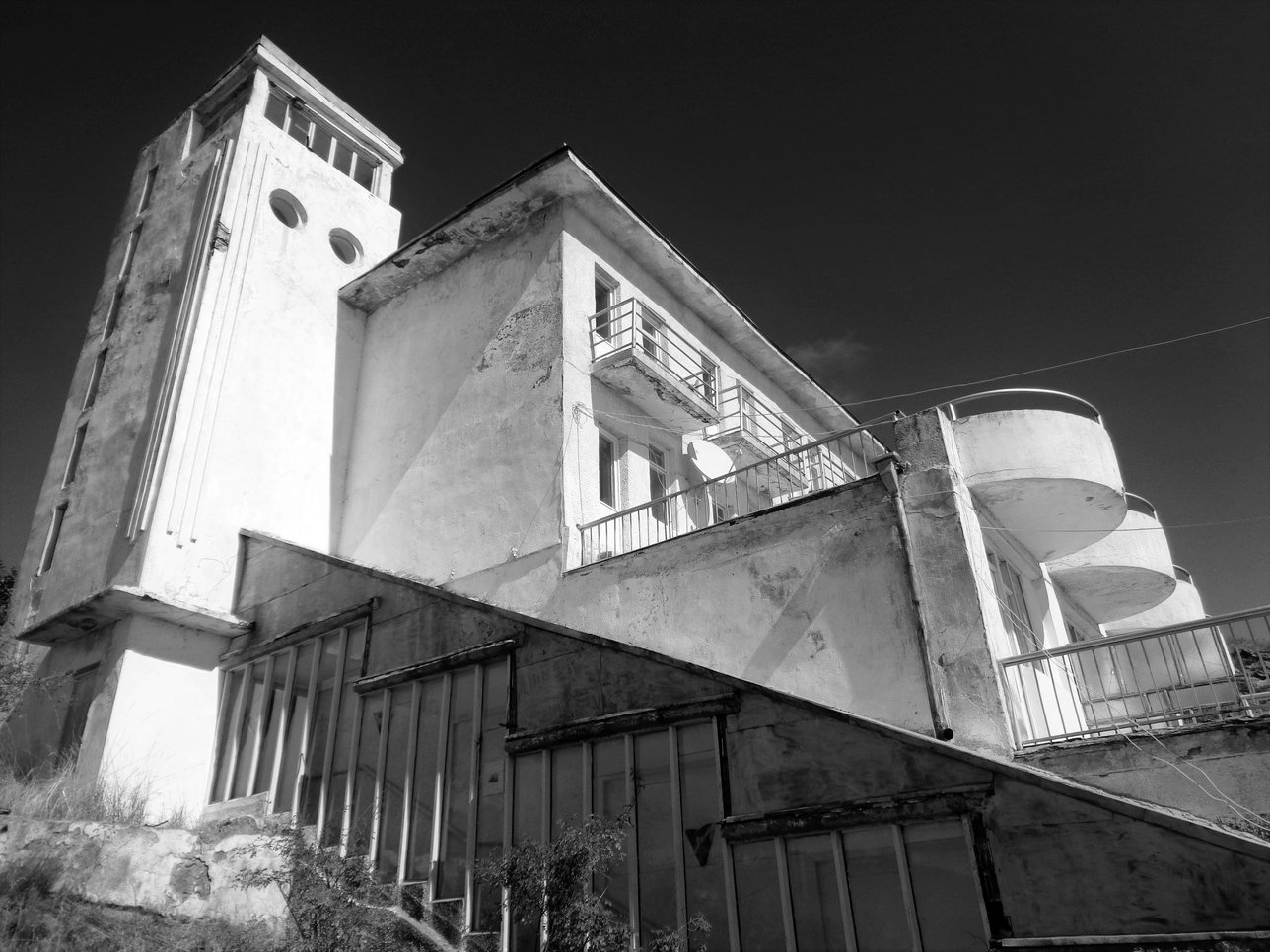
The Lake Sevan Writers’ Resort.Courtesy of Repeater Books
The Adventures of Owen Hatherley in the Post-Soviet Space doesn’t really have a conclusion. It ends quickly, contrasting a stereotypical idea of the Soviet Union with the much more complex and nuanced reality through which we have just traveled, with Hatherley, through space and time. Reading the book, I imagined Hatherley himself, illustrated in a blue-and-red cosmonaut suit on the book’s cover, not walking but rather floating through this fuzzy post-Soviet space wearing a diving-bell-style helmet, taking down notes about what he sees on a little yellow pad so he can relay it all to us in his straightforward and incisive style.
Adventures has no conclusion because it doesn’t need one. Hatherley tells us that the book is intended to be a guide — not to be read on its own, but rather to be used by visitors to shape their trips to the cities in his log, perhaps hanging out of a traveler’s back pocket or, more realistically, since the book is two inches thick, peeking out the top of a backpack. Adventures “is intended to be useful both to visitors, for whom this will tell them things they do not know, and to curious citizens, who will find an interpretation of what they do already know, which they may or may not agree with.”
But the book isn’t a guidebook in the traditional sense, with practical tips on public transportation or restaurant recommendations or tiny out-of-scale maps with cartoony illustrations of all the sights to be seen. Nor is it a straight history book — there is no chronological or argumentative thread to hold it all together, just a loose agglomeration of stories, histories, and vignettes, accompanied by Hatherley’s own photos, which he describes, borrowing from John Berger, as “simple memoranda.” The book is divided into an introduction and four sections, each subdivided into chapters that correspond to a city. It’s unconventional, perhaps fitting most neatly into the genre of travel writing done by the likes of Alexis de Tocqueville and Victoria Ocampo.