Dutch No-Nonsense Neoliberalism Is, Indeed, Nonsense
For decades, the Netherlands’ “no-nonsense” model of neoliberalism has been the poster child for free-market reforms. Yet for all the rhetoric of national unity, this model has forced long periods of austerity and the organized looting of public services.
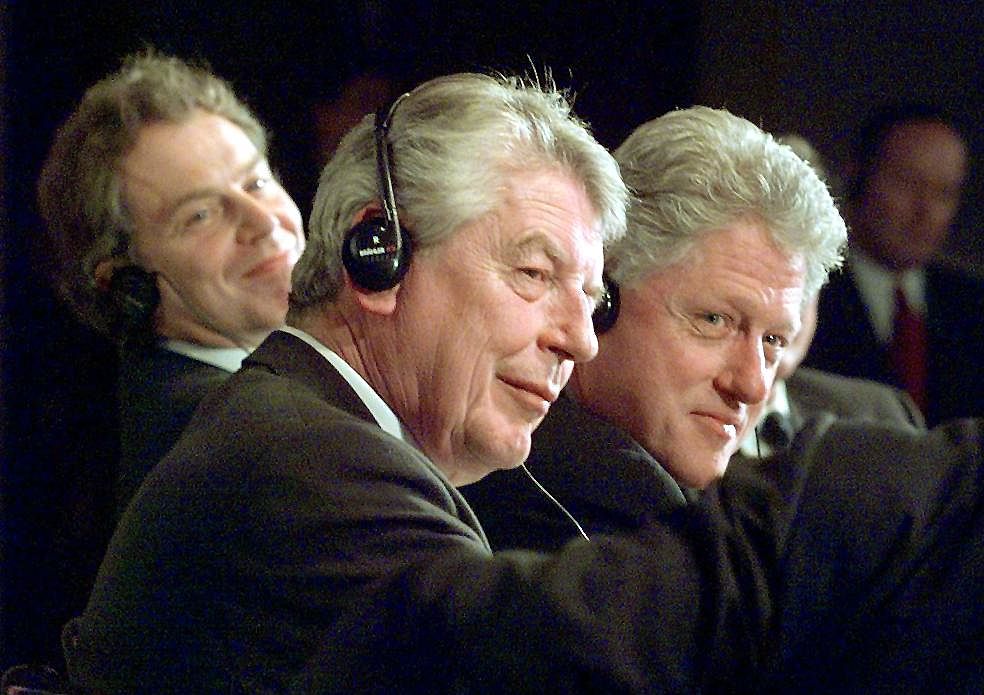
British Prime Minister Tony Blair, Dutch Prime Minister Wim Kok, and US President Bill Clinton attend a meeting of the “Third Way” on April 25, 1999, in Washington, DC.
“It’s about how Dutch politicians on both sides of the political spectrum implemented neoliberal reforms and austerity measures between the 1980s and now,” I tell a friend who asks what book I’m reading. Although he’s college educated and works for a real estate firm in Amsterdam’s financial district, the look on his face tells me he doesn’t quite know what I’m talking about. I share some more names and details he might recognize — Wim Kok, corporatism, Wassenaar Arrangement, the eurozone crisis — until, finally, he nods his head. “Right,” he says, “the polder model.”
This small interaction is itself an affirmation of what the book — No Nonsense: A History of the Dutch Neoliberal Turn, by University of Amsterdam sociologist Merijn Oudenampsen — is trying to say. Originally published in 2022 and recently translated into English, it’s the second half of a larger history of Dutch political economy written alongside historian Bram Mellink. It insightfully traces how the Netherlands developed from one of Europe’s most robust and ideologically committed welfare states into what French author Michel Houellebecq famously (and not altogether unjustly) described as more of a business than a country.
Similar to other critical texts on the subject – such as Sebastián Edwards’s The Chile Project – Oudenampsen’s research shows that, in a free and fair democracy, neoliberalism can survive politically only by disguising itself as the very thing it aims to undermine: shared prosperity. He also explains why, in the Netherlands as elsewhere in the world, the various far-right movements that arose in neoliberalism’s wake (Geert Wilders’s Party for Freedom, MAGA, etc.) are not a response to the neoliberal project so much as its continuation.
Unique to No Nonsense is its investigation of how, unlike in Ronald Reagan’s United States or Margaret Thatcher’s Britain, privatization and budget cuts somehow managed to be seen as wholly depoliticized issues, actively pursued by conservatives and progressives alike. Pretending to rise above party lines and put history behind them, various generations of Dutch politicians have treated neoliberalism not as an ideological weapon, but a pragmatic, technocratic, “no-nonsense” solution to purely economic issues.
Ironically enough, this they did — and continue to do so in spite of some of the economic indicators they claim to pursue, like raising GDP. As Oudenampsen stresses, Dutch society’s trust in and support for neoliberalism, both in parliament and on the streets, rests not on researched facts but convenient and persistent mythmaking. Specifically, it rests on false memories of a fruitful, mutually beneficial alliance between government, business, and labor unions that all too many people proudly refer to as the “polder model.” This model has indeed redefined the Netherlands, but not — as many still suppose — for the better.
A Reassuring Myth
The story of No Nonsense more or less begins in the 1970s, when Dutch economists — inspired by Milton Friedman’s Chicago School — took issue with the government’s attempt to combat high inflation, rising unemployment, and slowing economic growth through public spending, which had been the dominant course of action since the end of World War II. Energized by Reagan’s presidential victory, an advisory group to the Ministry of Economic Affairs headed by a former Royal Dutch Shell CEO proposed going the opposite route: deregulating the labor market, cutting back on welfare spending, and privatizing “nonessential” parts of the public sector.
The group’s plans came to partial fruition with the Wassenaar Arrangement of 1982, when unions agreed to wage reductions and — ultimately — a gradual decentralization of the Dutch labor market. Policies of deregulation, austerity, and privatization introduced under center-right Prime Minister Ruud Lubbers (1982–1994) carried over into the cabinets of Lubbers’s successor and former rival Wim Kok, who after serving as a stalwart union leader became head of the Dutch Labor Party (PvdA).
Taking the Third Way alongside Tony Blair and Bill Clinton, Kok’s tenure as prime minister (1994–2002) saw the Labor Party attempt to reconcile social justice with fiscal discipline, placing emphasis on the latter. But where Lubber’s achievements were mixed, restoring business profitability while failing to reduce unemployment, Kok’s so-called purple cabinets — in which Labor governed alongside the conservative People’s Party for Freedom and Democracy (VVD) — coincided with growth levels not seen in decades.
The myth of the polder model — coined in 1995 by a former president of chemical giant DSM — attached Third-Way corporatist relations between capital and labor “back to the illustrious Dutch Golden Age,” when citizens and farmers “had to achieve a workable consensus” to protect their low-lying land from flooding. In the Netherlands, the metaphor further softened and institutionalized neoliberalism by developing into a core part of national identity: to this day, the Dutch often describe themselves as direct, levelheaded, and frugal. Their country, they like to think, is far too small for big ideas, socialism and neoliberalism included.
In truth, the polder model — which still surfaces regularly in everyday conversation and high-school textbooks — no more reflects reality than the Efteling, a Dutch amusement park with fairy-tale themes. For starters, the metaphor is a product of historical revisionism. Pushing back against economic historians who overgeneralized and cherry-picked their way through the past, academic specialists have long since pointed out that water management in the seventeenth-century “Golden Age” was not egalitarian but “deeply oligarchic and often conflictual.”
The same goes for the 1980s. Unions did not embrace the supposedly harmonious Wassennaar Arrangement of their own volition. Rather, they were left little choice in the matter, after conservative Premier Lubbers threatened them with state-imposed wage measures. While Kok has since been painted as a conciliatory figure, he too was initially skeptical of the arrangement, later noting that “risks were certainly not shared in equal fashion” by employers and employees. It’s also worth repeating, as Oudenampsen does, that the first discussions that ultimately led to the arrangement — those of the Wagner Committee — had taken place in the private home of one of the world’s biggest oil tycoons.
Most significantly of all, the polder model attributes the economic boom of the 1990s to the wrong causes. It was not wage reductions or budget cuts that produced the “Dutch Miracle” — these had already been in place a decade prior, during which they accomplished little in terms of driving growth. Rather, as No Nonsense argues, the key factor was the rising (and, at first, largely part-time) participation of women in the labor force, which greatly stimulated both supply and demand. In fact, this shift was itself limited by neoliberal market reforms replacing full-time jobs with part-time and flexible contracts.
Doubling Down on Austerity
Wrapped up in the polder model myth, the Labor Party continued to support no-nonsense neoliberalism during the cabinets of Jan Peter Balkenende (2002–2010) and Mark Rutte (2010–2024), at times running ahead of its conservative coalition partners. Heeding Obama Chief of Staff Rahm Emanuel’s advice to “never let a serious crisis go to waste,” PvdA leader and finance minister Wouter Bos argued that the 2008 financial crisis, during which he oversaw the bailout of Dutch banks, warranted little more than a “sympathetic re-appraisal” of past fiscal policy. A staggering 20 percent budget cut was added to the list of possible responses, and though not chosen, those responsible later said it served the purpose of pushing decision-making in this general direction. All the while, a minority of critics complained that — once again — ideological matters were being treated as though they were purely practical, “to be resolved by bureaucrats” rather than debated in parliament.
Replacing Frits Bolkestein — another Shell executive — as leader of the VVD, Rutte naturally didn’t see a need for course correction, either. “We have to cut our way to growth,” he announced in a policy statement issued upon the formation of his first cabinet. Formerly a human resources manager at Unilever, Rutte’s tenure took the treatment of politics-as-business and business-as-Dutchness to new heights. In what is perhaps the most succinct expression of this mentality, Finance Minister Jan Kees de Jager once rationalized his assertive push for EU-wide fiscal tightness by saying: “I am Dutch, so I can be blunt.”
To the surprise of onlookers, the financial crisis did not result in a return to the Keynesian welfare state but a doubling down on austerity. Oudenampsen credits neoliberalism’s unlikely survival to the arrival of a convenient scapegoat in the form of the ensuing eurozone crisis. Just as Kok’s generation had misattributed the Dutch Miracle to the polder model, so Rutte and many of his contemporaries blamed Greece’s looming bankruptcy on that state’s own squandering of funds, rather than the unilateral monetary constraints to which it was bound:
Due to the no-bailout clause and the prohibition of monetary financing in the Maastricht Treaty, the European Central Bank was unable to act as a lender of last resort, and this absence of a failsafe undermined the confidence of investors. . . . The crisis was now reframed by European politicians and economic policymakers as a “sovereign debt crisis.” While rising public debt had been a result of the crisis, it was now presented as its root cause.
The EU leadership responded to the crisis by urging its member states to embrace austerity. “Stimulate No More,” read the headline of an opinion piece by the erstwhile European Central Bank president, Jean-Claude Trichet, published shortly after the 2010 G20 summit in Toronto, “It is Now Time for All to Tighten.” In the Netherlands, the VVD and PvdA both appealed to past achievements of the polder model. Even though the current situation was, as Oudenampsen notes, very different — this time around, wages and inflation were already low — the cabinet felt certain that the strategies that had been employed back in the 1980s would work again today. Then as now, though, they warned people that their medicine was going to taste bitter.
As before, the coalition fired civil servants, cut unemployment and disability benefits, increased health care deductibles, and sold parts of its social housing stock to the private sector. The cabinet also lowered mortgage tax reductions, increased value-added tax, and even defunded domestic, youth, and elderly care. And, as before, “the cuts turned out to be a dramatic exercise in self-harm, dragging the Dutch economy into a double-dip recession.” At present, “estimates of the economic damage of austerity under Rutte range from 7.5 per cent to 10 per cent of Dutch GDP, with an extra 365,000 unemployed and long-term damage to the public sector.”
The effects of the Dutch neoliberal turn can be seen across the world. For decades, the polder model has been the clog-wearing poster child for free-market reform — a disarming disguise that allows its wearers to infiltrate places where they would otherwise be unwelcome. As Europe’s fiercest fiscal hawk, the Netherlands also played an integral role in weaving neoliberal ideals into EU’s DNA, and staunchly supported detrimental austerity measures in countries like Germany and Greece.
Echoes of Dutch no-nonsense rhetoric can be heard in the voices of many world leaders, from Angela Merkel’s frequent usage of the word “alternativlos” (without alternative) to Blair waxing poetic about the “liberating effect of shedding one’s ideological feathers.” Though US politics is surely ideologically divided, the businessification of governance has found a deserving host in Donald Trump. Since his first election in 2016 he has presented both his bluntness and billionaire status as giving him an edge over the political establishment.
More for the Army, Less for You
As the current secretary general of NATO, Rutte — after years of cutting back his country’s own military budget — is now calling for increased defense spending across the EU, a demand which in the Netherlands is being used to justify gutting what little of the original welfare state still remains. Fittingly, the coalition agreement of the current cabinet — which proposes raising health care premiums, halving unemployment benefits, and linking the retirement age to average lifespan while also introducing a new “liberty contribution” tax — mentions the word “polder” when calling on the country to “relearn the art of cooperation” that has served it so well in the past.
As during the signing of the Wassenaar Arrangement, the authors of the agreement make it sound as though hierarchy is horizontal, and all parties involved are standing on equal footing. But as University of Amsterdam professor of financial geography Ewald Engelen pointed out earlier this year, two-thirds of “liberty contributions” are expected to come from citizens, not corporations. Always, neoliberal reforms and budget cuts work not one but two ways: austerity for labor and an “extravaganza for capital.”
While all this is happening, the country’s biggest left-wing parties, PvDA and GroenLinks, are preparing to merge into a single entity: Pro, for Progressive Netherlands. Crucially, the new name will not be accompanied by a change in direction. Speaking to Dutch periodical De Groene Amsterdammer back in late 2025, policy advisers said they are trying their best to “stay clear of big words like neoliberalism” in their campaign messaging — a rule which also applies to socialism.
Having read all this, such comments should set off instant alarm bells. As No Nonsense shows, the Dutch turn is as much a triumph of capital as it is a failure of organized labor, which abandoned its historic socialist ideas.
Moreover, Oudenampsen’s work suggests that neoliberalism in the Netherlands has endured and thrived in large part because people refuse to call it by its name. Contrary to what the official polder mentality would have its citizens believe, big words aren’t always meaningless; if you don’t know what neoliberalism is, you won’t recognize it when it is served up in different forms, like authentic Dutchness or technocratic penicillin.