The Netherlands’ New Era of Militarized Neoliberalism

The new Dutch government’s program splurges on the military while cutting the welfare state. With most NATO members committing to similarly high defense spending, working-class Europeans are forced to pay the costs.
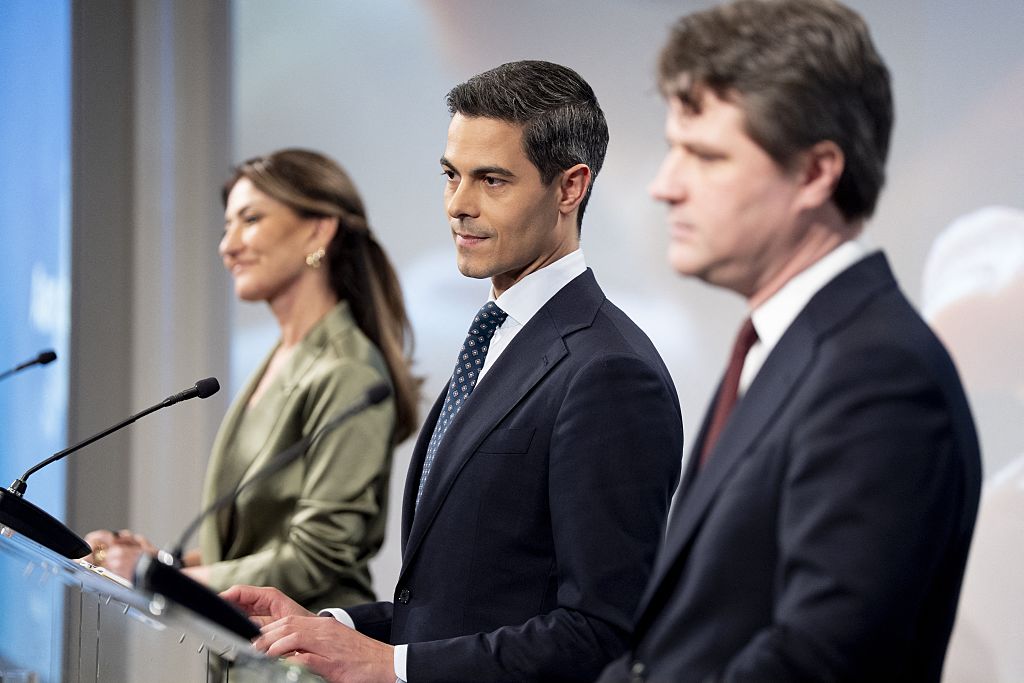
The rise of Rob Jetten’s liberals in the recent Dutch election was widely cast as a victory for the center left over the far right. Yet Jetten’s government program amounts to boosting military spending while cutting the welfare state. (Jeroen Jumelet / ANP / AFP via Getty Images / Netherlands OUT)

It was always a pipe dream to expect that ramped-up defense spending would not eat into other budgetary items. It was always clear that more bombs would mean less hospital beds and would permanently embed austerity in state budgeting.

For high-tax, high-spending states, with no monetary sovereignty and high levels of public indebtedness, as is true for almost all of the European Union’s member states, budget constraints are hard indeed. Taxes cannot be raised with impunity; debt financing quickly spirals out of control through the doom loop of rising interest rates; while cutbacks on cherished items such as education, welfare, health care, and public housing come with high political costs.

This was, however, precisely what the Netherlands’ political leaders hid from voters, during the first of a series of elections held in Europe under the shadow cast by the new Donald Trump military-spending norm. Since the NATO meeting in The Hague last June, almost all member states are committed to splurging 5 percent of GDP on the military and related costs.

In the Dutch elections last October 29, there were many issues that required urgent political attention: health care, infrastructure, an unsolved nitrogen crisis, a stalling green transition, a housing crisis, the soaring cost of living, and declining political trust. In truth, amid rising political fragmentation and right-wing populism, the campaign was dominated by migration: many blame all social ills on the influx of “refugees,” whose imagined numbers are widely inflated.

Yet noticeable for its absence was any serious discussion of the long-term budgetary consequences of the Trump norm. After all, this boils down to a near doubling of annual defense spending from €22 billion in 2025 to well over €40 billion in 2035, by which point it is meant to have reached 3.5 percent of GDP. In an economy with a size of approximately €1 trillion and state expenditure to the tune of half of that, these are sizable sums indeed. They either require much higher taxes or sizable cutbacks on other items, or a combination of both. Where debt and deficit spending is prohibited, it means permanent austerity.

Atlanticist Assumptions

In a democracy worth its salt, this would have been widely discussed in one of the many TV debates preceding the elections. Yet the only moments when issues of war and peace were discussed was in the quizzing of the leader of the Socialist Party, this being the only political formation aside from the far-right Forum for Democracy that explicitly rejected militarization. Here the tone of questioning suddenly became patronizing, as if rejecting the Trump norm immediately disqualified anyone from political office and hence from serious consideration.

If the media’s job was to inform Dutch citizens, then it failed the public spectacularly.

It signals how strong the hold of the dominant NATO narrative on the Dutch chattering classes is. As a maritime trading nation, Dutch elites have always been marked by a strong Atlanticist orientation. The country’s intellectuals and academics are strongly embedded in English-speaking networks, and Anglo-American media set the tone for most of the Dutch press.

The fact that the longest-serving Dutch prime minister, Mark Rutte, had seamlessly moved from The Hague to Brussels to head NATO — allowing him to use his still hot connections in Dutch media, politics, and corporates to influence Dutch decision-making — only reinforced this Atlanticist bent. He has helped make the Netherlands into one of the most loyal members of the “Coalition of the Willing.”

New Coalition

The elections brought a head-to-head between Geert Wilders’s right-populist Party for Freedom (PVV) and the social-liberal, more elitist outfit of Rob Jetten (D66). Jetten, many accounts highlighted, is youthful and gay, with the looks of John F. Kennedy and Justin Trudeau thrown together. Whereas Wilders’s ticket was predominantly about restraining migration, Jetten’s was all about “getting things done.”

This theme reflected widespread disaffection with the preceding coalition, in which Wilders’s PVV was the largest force, over its lack of accomplishments as a result of internal strife among the four coalition members. In the ensuing battle for the top spot, the newly merged Green-Left outfit (GL/PvdA) of Frans Timmermans, the former European commissioner responsible for the European Union’s Green Deal, fell by the wayside, as did its leader. While much was expected of this electoral vehicle, its leader Timmermans had to leave politics right after election night.

While Jetten’s narrow victory was widely applauded by social-liberal media as proof that it was after all possible to beat the “populists,” in fact his victory was the weakest for any top-ranked party in Dutch history (taking just twenty-six seats in a 150-seat parliament). The entire space calling itself left-wing, with twenty-nine seats, was reduced to its smallest numbers yet, and the far right reached its highest level ever with no less than forty-five seats, albeit distributed over five outfits. In other words, what was celebrated as a social-liberal victory was actually a further hollowing out of the center and a sharp turn to the grim right.

Coalition negotiations in the Netherlands tend to be complicated and lengthy. In this case, an agreement was reached just three months after the elections. The new government is a pact among three parties: Jetten’s D66, Henri Bontenbal’s venerable Christian Democrats (CDA), and the People’s Party for Freedom and Democracy (VVD), formerly headed by Rutte and now by Dilan Yeşilgöz. Representing a mere sixty-six of 150 seats and thus dependent for parliamentary support on what is formally the opposition, this is a unique political experiment that, given increasing political fragmentation in European proportional-democratic systems, may well become the new normal, both in the Netherlands and elsewhere.

Getting On With It

Key for what to expect from any newly minted coalition is the so-called coalition agreement that was made public in late January. This is a document that carries a title and an introduction, spelling out the spirit of the coalition, followed by a detailed description of the measures to be taken. It is bookended by a tabulation of the financial consequences of those measures, quantified, as is customary in the Dutch budgeting system, as deviations (above and below) from long-term budgeting, for the next four years (2026–2030), or what is called in Dutch parlance the “basic path.”

Get On With it!”  is its title, and “Building a Better Netherlands,” or “MAGA for the Polder,” is its subtitle. While the introduction talks of the wish to finally solve long-standing policy problems in housing, the environment, and migration, the financial fact sheet at the end tells a different story. For the big-ticket items listed here, running into billions of euros, are all related to defense and geopolitics, whereas the remaining items either run into millions of euros only; are covered by earmarked, off-balance-sheet funds that should be applied for voluntarily (winding down the excessive livestock industry, for example); or are simply left unfunded (like tackling electricity shortages).

First, there is the rapid stepwise increase of defense spending, which is rightly on top of the list, and projects additional spending of cumulatively €23.2 billion, with the aim to add further annual spending to the tune of €19 billion, to reach 3.5 percent of GDP in 2035 — all measured in current euros. Crucially, this comes on top of the €22 billion annually the state already spends on defense, implying that in 2035 it projects to spend €41 billion annually on weaponry, turning it into the fourth-largest item on the budget, after health care, welfare, and education. On top of this comes a separate geopolitical item of €9 billion, which is meant for financial and military aid for Ukraine, making a grand total of €32.2 billion of extra expenditure over a four-year period.

Of course, financial backing for these new items needs to come from somewhere. Here militarization meets neoliberalism, as the coalition uses geopolitical insecurity as a rhetorical lever to uproot the welfare state. Individual health care contributions will increase to the tune of €4–5 billion per year; unemployment benefits will be halved from two years to one, which contributes another €3 billion; the retirement age will be fully linked to life expectancy in 2033, which funds a further €3 billion. Pay more, receive less, and pay longer: such is the thrust of militarized neoliberalism.

The remaining shortfall of nearly €10 billion will be covered by a newly introduced tax, which, following earlier suggestion by the Christian Democrats, is presented as a “liberty contribution” — a throwback to the US liberty bonds raised between April 1917 and September 1918 and similarly meant to express, and perform, national solidarity in the face of geopolitical danger. “Contribution” sounds voluntary — but in this case, it’s mandatory. And while both capital and labor are presumed to have a similar interest in geopolitical security, ultimately it is labor that has to bear the brunt of this burden, for it is charged two-thirds of the €5.1 billion that this “contribution” is supposed to generate annually.

Extravaganza (for Some)

What we have here perfectly fits the description of neoliberalism provided by Melinda Cooper’s 2024 book, Counterrevolution. Neoliberalism is conceptually misunderstood if it is defined as “less state and more market.” The subtitle of Cooper’s book refers to “Extravaganza and Austerity in Public Finance”: and in the contemporary Dutch case too, the cutbacks on welfare are only part of the story. The other part is the extravaganza for capital: through generous depreciation and amortization schemes; tax deductibility of interest payments and losses; or through public procurement, state guarantees, and other forms of public risk-sharing.

Until 2008, this was backed by a story of “trickle down”: even the poorest of the poor would benefit from the rainmaking of the richest of the rich, who should thus be publicly helped out as much as possible. Even the bulk of the European left backed this herbivore form of neoliberalism. The banking crisis showed it was a scam. Hence the need for a new storyline. Vladimir Putin’s invasion of Ukraine provided the golden opportunity to construct a new one, based on the mirage of the “eternal enemy,” whose defeat requires perennial militarization.

The twenty-eight EU member states plan to spend €6.4 trillion on arms over the coming decade. Small wonder that the share prices of the global armament industry are at an all-time high. This is an extravaganza, indeed!

And the Dutch press so far? It has done its utmost to cover up this game changer in the history of neoliberalism: either by sidestepping the issue in toto, or by failing to highlight the link between cutbacks on welfare and the uptick in defense spending, and even by misleadingly printing graphs that only show the additional amounts of defense spending, not the total amounts. €19 billion is easier to stomach than €41 billion. Facts are visually arranged in such a way that the absurdity of it all remains hidden: all for the greater good of our security and freedom — such is the hold of the politics of geopolitical fear over the minds and hearts of the Dutch chattering classes.

Don’t expect voters to be so in thrall though. Once the true costs of militarized neoliberalism become clear, the political shit will hit the fan. First in the Netherlands, where the loyal opposition will find it hard to sell highly unpopular welfare cuts to their voters, who will hence start to question the geopolitical narrative NATO has so effectively constructed. They will surely be followed by voters elsewhere in Europe, where Atlanticism is less deeply rooted. Those who think they can push this agenda without a fight shouldn’t be so sure.