Donald Trump Helped Colombia’s Far Right Win
Far-right candidate Abelardo de la Espriella eked out a marginal victory over his left-wing opponent Iván Cepeda in Colombia’s presidential race after crude election interference by the US government. The outcome is a major threat to democratic rights.
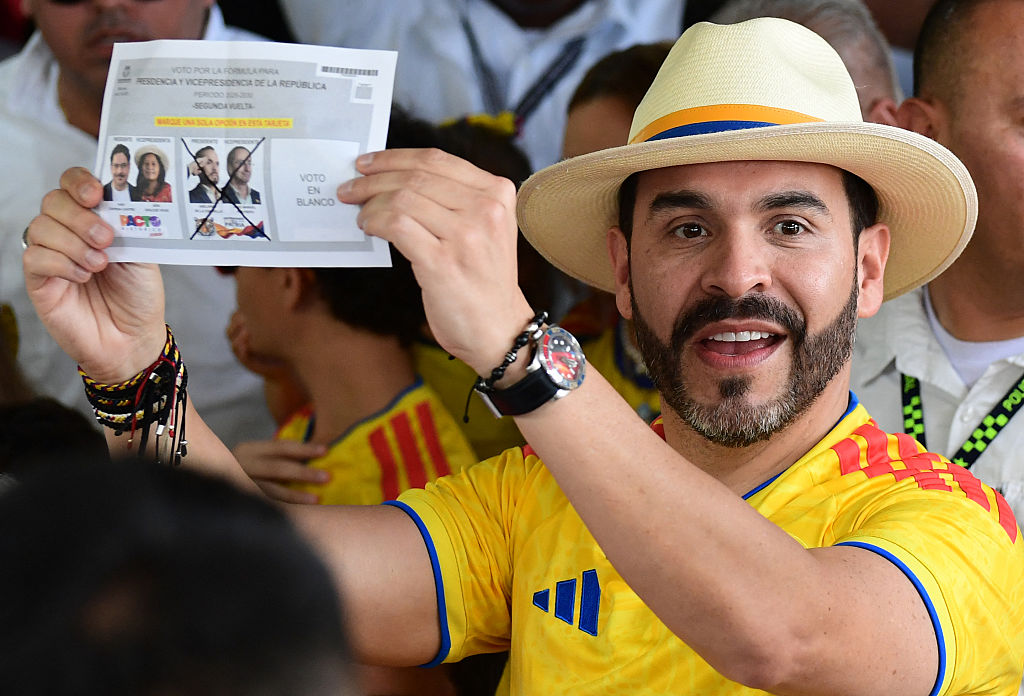
The wafer-thin election victory of Abelardo de la Espriella is a disaster for Colombian democracy. In the name of “law and order,” Colombia’s new far-right president wants to return the country to its darkest days of mass killing and political terror. (Jaime Saldarriaga / AFP via Getty Images)
After polls closed in Colombia’s presidential runoff on Sunday afternoon, leftist candidate Iván Cepeda convened his most die-hard supporters for his campaign’s closing ceremony at a packed theater in Bogotá’s Chapinero neighborhood. They had hoped to be celebrating a clear left-wing victory that night. However, as the pre-count bulletins trickled in, it became clear that the election was very close. With 99 percent of votes counted, Cepeda trailed his far-right opponent Abelardo de la Espriella by less than 1 percent — not even 250,000 votes out of more than twenty-five million cast.
When the pre-count results were clear, Cepeda quickly took to the stage to calm anxieties with a speech that emphasized the need to count every vote at thirty-three thousand polling stations before conceding the election. He also stressed the need for a government that looks to unify the nation, and the fact that his campaign brought in over a million new voters. He closed by quoting the murdered Chilean President Salvador Allende: “History is ours, and it is made by the people.” After the speech, the crowd erupted in applause and chants of “Cepeda Presidente.”
A few hours later, Cepeda’s rival de la Espriella, donning the Colombia soccer jersey that his campaign appropriated as a symbol, took to the stage in the coastal city of Barranquilla to give a speech that can only be described as pure spectacle. While speaking from a bulletproof box, surrounded by a giant projection of himself giving a military salute, de la Espriella spoke of the need to reconcile differences and guarantee the rights of the opposition while issuing subtle threats to those who planned to peacefully protest against his government.
However, de la Espriella dedicated the greater part of his speech to the law-and-order discourse that has dominated right-wing campaigns throughout the region while attacking the Colombian peace process and the efforts of Gustavo Petro’s administration to neutralize criminal groups through dialogue. Despite having issued a statement one day earlier threatening members of Congress who planned to vote against his neoliberal agenda, de la Espriella closed the speech by emphasizing his commitment to the Constitution and to governing for all Colombians.
Legal Obstacles, Violent Rhetoric
Later that night, supporters of Cepeda took to the streets to protest what many viewed as an election stolen from them by the elites who had ruled Colombia until Petro was elected in 2022. The protests took place in cities throughout Colombia, including the capital, Bogotá, where hundreds of people gathered outside the National University of Colombia and Corferias, one of the country’s largest voting centers. Lawyers accompanied the protesters to begin the process of scrutiny and ensure that the recount accurately reflected the true results of the votes cast in Sunday’s election.
At time of writing, the vote scrutiny is still taking place. But it is clear that many Colombians feel the electoral climate was hostile to Cepeda’s campaign from the beginning, due to bureaucratic hurdles that were not applied evenly to all candidates, a political system with entrenched corruption, and the open interference of US President Donald Trump and the most reactionary sectors of his government.
From the beginning of the race, the Pacto Histórico, the left-wing party that backed Cepeda, faced hurdles that the Right did not encounter. Last year, the party had to overcome legal obstacles as it transformed itself from a coalition to a formal party. The National Electoral Council, the country’s electoral body, initially prevented all of the component parties from consolidating into a single party due to a complicated, bureaucratic process that dragged on for months.
Once the legal battle was over and the party was finally consolidated, it was prevented from participating in an interparty primary with other parties on the left and center left. In contrast, other parties on the center right were allowed to hold interparty primaries. This legal hurdle prevented the campaign from gaining momentum and incorporating voters who may have voted in the centrist primaries.
Cepeda’s supporters have also highlighted the corruption and threats of violence that are endemic to the Colombian political system. On Sunday, there were allegations of vote-buying in various parts of the country. This practice has unfortunately been normalized by many of Colombia’s right-wing and traditional parties. There were also reports of irregularities at voting stations in Colombia’s embassies abroad, where witnesses observed the use of fake IDs by potential voters and pressure from de la Espriella’s campaign outside voting stations in the United States, where the right-wing candidate won 80 percent of the vote.
De la Espriella’s rhetoric was aggressively provocative: he promised to disembowel the left and openly celebrated the paramilitary groups that killed nearly one hundred thousand people in the country’s armed conflict. De la Espriella also received the endorsement of the country’s largest illegal armed group, the Ejército Gaitanista de Colombia, also known as the Gulf Clan.
The US State Department has designated this right-wing paramilitary and drug-trafficking organization a terrorist group. It is one of the main successor groups to the paramilitary alliance that de la Espriella represented in his career as a lawyer. The organization exercises territorial control in towns throughout the department of Antioquia, a department that was key in ensuring de la Espriella’s victory in the pre-count on Sunday.
US Intervention
Bureaucratic hurdles, corruption, and hostile rhetoric have occurred in some shape or form during previous elections. However, the hyperaggressive intervention of Trump’s State Department is unique to this one, forming part of the “Donroe Doctrine,” a new pattern of open US intervention in the region.
The Donroe Doctrine has materialized in the shape of open support for right-wing candidates throughout the region and threats of brute force to impose Trump’s will. We have seen Trump’s direct intervention to support the far right in elections in Argentina and Honduras, combined with threats to seize the Panama Canal and the unprecedented illegal kidnapping of Venezuelan President Nicolás Maduro.
Over the course of June, Colombia witnessed the full effect of the doctrine on the country’s electoral process, starting with Trump’s Truth Social post on June 2 endorsing de la Espriella. The US president claimed that his favored candidate “would be tremendously successful in leading Colombia to grow the Economy, Create Jobs, Promote Trade, Stop Illegal Immigration, Crack Down on Crime and Drugs, and Restore LAW AND ORDER.” He branded Iván Cepeda as a “Radical Left Marxist” and stated that the election was “very important to the future of Colombia and its relationship to the United States.”
The post was quickly reposted by several Hispanic Republicans in the United States and right-wing Colombian politicians, and even on the X account of the US Embassy in Bogotá, which constitutes the use of US public resources for a foreign political campaign. In the days leading up to the election, Trump sent out more posts in a similar vein to keep his endorsement of de la Espriella in the Colombian news cycle.
The endorsement was part of a larger strategy by Trump and his government to support de la Espriella’s far-right agenda, which includes a laundry list of right-wing policies, from fracking in protected territories to privatization of health care, the construction of mega-prisons, and Colombia’s withdrawal from international institutions like the UN and the Organization of American States. Another key element of the strategy was a disinformation campaign led by Deputy Secretary of State Christopher Landau and de la Espriella himself to revoke the visas of anyone de la Espriella accused of manipulating the Colombian elections. This was a move used to delegitimize supporters of Cepeda without any evidence.
One of the most grotesque forms of intervention by the Trump administration was the detention of Colombian journalist and asylum seeker Franklin Humberto Coral Garrido, known as Beto Coral on social media. Homeland Security agents detained Coral on June 16, shortly after he participated in a protest organized by the Colombian diaspora in Florida against de la Espriella.
According to the New York Times, Coral was detained the same day that Secretary of State Marco Rubio signed a memo stating that his presence in the United States “undermines US foreign policy interests in Colombia’s democratic processes.” Tweets sent by de la Espriella shortly before Coral’s arrest, which alluded to impending news for the Colombian diaspora, signal that he may have been directly involved in the detention.
Since being detained, Coral has been moved around to various locations. According to his family, Coral has described physical abuse by Department of Homeland Security agents in detention and pressure to sign his own deportation order. Despite this, Colombian-born US senator and de la Espriella ally Bernie Moreno celebrated Coral’s detention: “You can’t come to the United States, claim asylum, and then act as a foreign agent . . . Have a nice life back in Colombia.”
Coral’s arrest sent a clear message to the Colombian diaspora in the United States: if you speak up against de la Espriella, you will face persecution. This is a fear that could have had real effects on turnout in Sunday’s election among the diaspora and even among those who have US visas but live in Colombia.
The Empire Strikes Back
The day after the election, President Trump proudly claimed victory: “I endorsed him. He was in tenth place, and he won the election,” adding that de la Espriella called to thank him as soon as the results came in and that relations between the United States and Colombia will now be much better. Senator Bernie Moreno also celebrated the outcome: he insisted that “ANY Colombian citizen claiming asylum should return to Colombia” and that de la Espriella will ensure their safety and security.
If the final result confirms the triumph of the far right, Colombians may face a return to some of the darkest times in the country’s history, given de la Espriella’s disdain for human rights and democratic institutions. Following Trump’s intervention this past month, the question remains: Is it really possible to hold free and fair elections in Latin America when Washington will brazenly interfere in the electoral process?