In Colombia, the Fight Is Still On
Far-right Abelardo de la Espriella topped the first round of Colombia’s presidential election. Left-wing senator Iván Cepeda is still in the race but now has to find support outside the ruling party’s core vote.
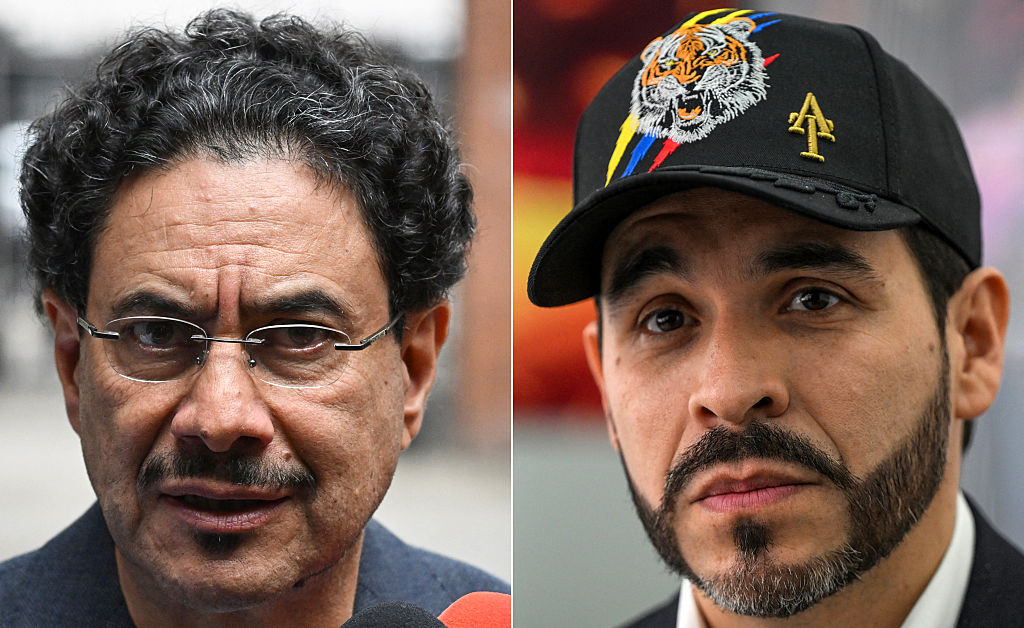
Colombia’s presidential election is set for a showdown between the Left and a far-right admirer of Trump, Milei, and Bukele. The risk is that the US government will interfere to ensure its favored candidate wins. (Luis Acosta and Raul Arboleda / AFP via Getty Images)
The far right versus a transformative left. It’s the contest that Colombia will face in the presidential runoff on June 21, and a showdown which, with various twists, we’ve already seen in countries like Brazil, Argentina, and Chile. In the first round, it was far-right Abelardo de la Espriella — an admirer of Donald Trump, Argentina’s Javier Milei, and El Salvador’s Nayib Bukele — who came in first place, with 43.7 percent of the vote. Hot on his heels is Senator Iván Cepeda of the Pacto Histórico, the left-wing alliance led until now by President Gustavo Petro, with 40.9 percent.
This first result was a disappointment for the Left, since polls had predicted Cepeda would come in first place. His campaign had even hoped to surpass 50 percent, which would have made him president in the first round, with indigenous leader Aida Quilcué as vice president. After the cold shower he got this past Sunday, all options remain open for June 21. The only sure bet is that the Colombian presidency will be decided by a handful of votes.
The Far Right Devours Traditional Conservatism
The big surprise of the May 31 vote was Abelardo de la Espriella’s performance. He managed to attract a large share of the traditional electorate of Uribismo, the tendency led by 2002–2010 president Álvaro Uribe that has dominated Colombia’s right since the turn of the century. Proof of this shift was the meager result for Uribe-backed candidate Paloma Valencia, who, having initially hoped to make the runoff, ended up with just 6.9 percent support. Both she and her mentor rushed on Sunday to endorse De la Espriella, but not all their voters will follow them in the runoff.
In an attempt to appeal to the center, Valencia moderated her positions during the campaign and chose Juan Daniel Oviedo — a centrist, openly gay politician — as her vice-presidential candidate. As elsewhere, radicalizing right-wing voters preferred De la Espriella’s harsh language and disruptive proposals — he promises to import Milei’s neoliberal “chainsaw” and Bukele’s mega-prisons to Colombia — over her balancing act.
Another new development in the first round was increased turnout, which reached 58 percent — very high by Colombian standards. The intensity of the campaign certainly contributed. Although the concept of “polarization” is sometimes used in contexts where all that really exists is a right-wing radicalization, in the Colombian case it makes sense: never before have candidates with such opposing political projects faced off in a runoff. While Cepeda has called De la Espriella “sexist, homophobic” and a representative “of Mafia fascism,” the far-right candidate labeled the Petro-backed senator a “criminal” and “FARC’s heir,” with reference to the Fuerzas Armadas Revolucionarias de Colombia, the far-left armed insurgency that gripped the country for much of the last six decades.
The geographical distribution of the electorate is similar to previous elections: the Right dominates the center of the country while the Left is stronger in the peripheries, including the poor Atlantic coast and most areas of Amazonia. However, the far right triumphed in localities with the highest “risk of control” by illegal armed groups, which have grown in recent years despite the Petro government’s attempts to negotiate with them to lay down their arms. A decade after the signing of the peace agreement between the state and FARC, the growth of other guerrilla groups, criminal organizations and paramilitaries, totalling some twenty-seven thousand combatants nationwide, has reinforced the appeal of De la Espriella’s militaristic rhetoric. He has promised to “take out” (kill) and “eliminate” criminals, and appears at his rallies wearing a bulletproof vest and enclosed in a bulletproof glass box.
The Left’s Strengths and Challenges
Despite Sunday’s disappointment, the Left can still win the presidency. One of Cepeda’s strong suits is the strength of his Pacto Histórico, which has evolved since 2022 from a coalition to a united political party. That unity already paid off in March’s legislative elections, in which the Pact consolidated itself as the country’s leading parliamentary force, improving on its 2022 results, even though it fell far short of an absolute majority.
Cepeda also has in his favor the majority support Petro has earned in the final stretch of his term, after a tempestuous presidency marked by ambitious social and environmental reform projects but also by fierce opposition from Colombia’s political, economic, and media establishment. The first leftist government in the Andean nation’s history has managed to pass major reforms in areas like taxation, pensions, and higher education. It has also made Colombia the first country in the world to halt the expansion of the oil industry, despite the importance of this sector to its exports. After four years of left-wing governance, more land than ever has been distributed to landless peasants, the minimum wage has risen, and poverty, hunger, and unemployment have decreased.
On the other hand, other important reforms, such as the attempt to reduce private insurers’ role in the delivery of health care, have been blocked in parliament. The “total peace” policy has failed, despite an initially hopeful process with the Ejército de Liberación Nacional (ELN) guerrillas. It’s an overall positive balance for the lives of Colombians — especially poorer ones — which Cepeda has been able to tout during the campaign. As in 2022, the left-right divide in the vote has a strong class alignment, with lower-income voters far more supportive of the Pacto Histórico than richer ones.
It is less clear whether Cepeda’s victory is helped by Petro’s belligerence during the campaign. On Sunday night, Petro called into question the provisional tally presented by electoral authorities. On occasions like this, the impulsive Petro seems to drag Cepeda — less charismatic, but much more measured and reflective — into a confrontational style in which the senator, known for his defense of victims of political violence and for pushing a judicial process against Uribe over his ties to paramilitaries, is less comfortable. While Petro has long been stigmatized for his guerrilla record, Cepeda enjoys an ethical image that contrasts with the aggressiveness and dark past of Abelardo de la Espriella, who served as a defense attorney for some of the country’s most bloodthirsty paramilitary chiefs, including Salvatore Mancuso, who has been accused of seventy-five thousand crimes and has admitted to three hundred murders.
Cepeda’s track record in human rights defense could help him attract the 5 percent of voters who supported centrists Sergio Fajardo and Claudia López in the first round, in addition to the portion of conservative Paloma Valencia’s electorate that feels closer to Oviedo, her vice-presidential candidate. Another challenge will be to mobilize new voters beyond the Pacto Histórico’s bedrock, which already turned out in the first round. In 2022, Petro gained 2.7 million votes between the two rounds, at a time when the previous president, right-winger Iván Duque, was highly unpopular, and the Pacto Histórico and Petro were perceived as the political expression of the massive protests that had erupted in previous years against Duque’s neoliberal policies. Today’s political context is more marked by the increase in violence in many territories (although the homicide rate has stabilized nationwide) and by Trump’s regional influence.
The Trump Factor
The US President’s shadow has been looming over Colombian politics since the start of his second term, and especially since the release of the new National Security Strategy, which aims to reaffirm Washington’s political, economic, and military hegemony over the Americas.
In January, following the kidnapping of Nicolás Maduro, Cepeda warned in an interview with Jacobin of possible electoral interference from Washington like that suffered by Honduras and Argentina. Trump went so far as to include Petro — one of the voices that has most forcefully denounced the genocide in Gaza — on the “Clinton List” of drug-trafficking accomplices and threatened armed intervention against Colombia. Such attacks make up a key part of Washington’s hegemony over Colombia, where the United States has a significant military presence and a long history of security cooperation justified by the war on drugs. Although Trump suspended his threats in February after a meeting with Petro, the specter of more or less direct intervention to prevent a Cepeda victory is very much present.
So far the State Department has only stated that it “supports the right of Colombians to freely choose the leadership of their country,” and Trump has not directly endorsed any candidate. But now that the Colombian right has regrouped around De la Espriella, open intervention becomes more likely. The ultraconservative candidate has said that as president he will “restore” relations with the United States and has asked the northern neighbor to “monitor the runoff.” News of a meeting between Republican Senator Bernie Moreno and De la Espriella and Valencia could point in this direction.
However, Trump’s overt imperialism toward the region — which even Latin American governments allied with the tycoon have suffered from in the form of tariffs and racist immigration policies — is triggering a sovereigntist backlash in Colombia that could help catapult Cepeda to the presidency. As happened before with Mexico’s Claudia Sheinbaum and Brazil’s Lula da Silva, in recent months Petro has seen his popularity rise in tandem with his confrontation with Trump. Part of that popularity has transferred to Cepeda, who in the runoff should highlight his opponent’s submission to Trump’s agenda for Colombia and Latin America.
On June 21, Colombia will decide whether to continue the path of social and environmental transformation begun by Petro or to plunge into a dystopia of militarism and social cuts. This latter course would undoubtedly worsen the country’s internal armed conflict and the social injustices that gave rise to it, even endangering Colombia’s imperfect democracy. The repercussions of either outcome will resonate far beyond this country alone.