Colombia in the Eye of “El Tigre”
On Sunday, Colombia will decide between the left-wing Pacto Histórico and the Donald Trump–backed far-right candidate. The country is only the latest target of the “Donroe Doctrine,” the conviction that Latin America belongs to Washington to run or ruin.
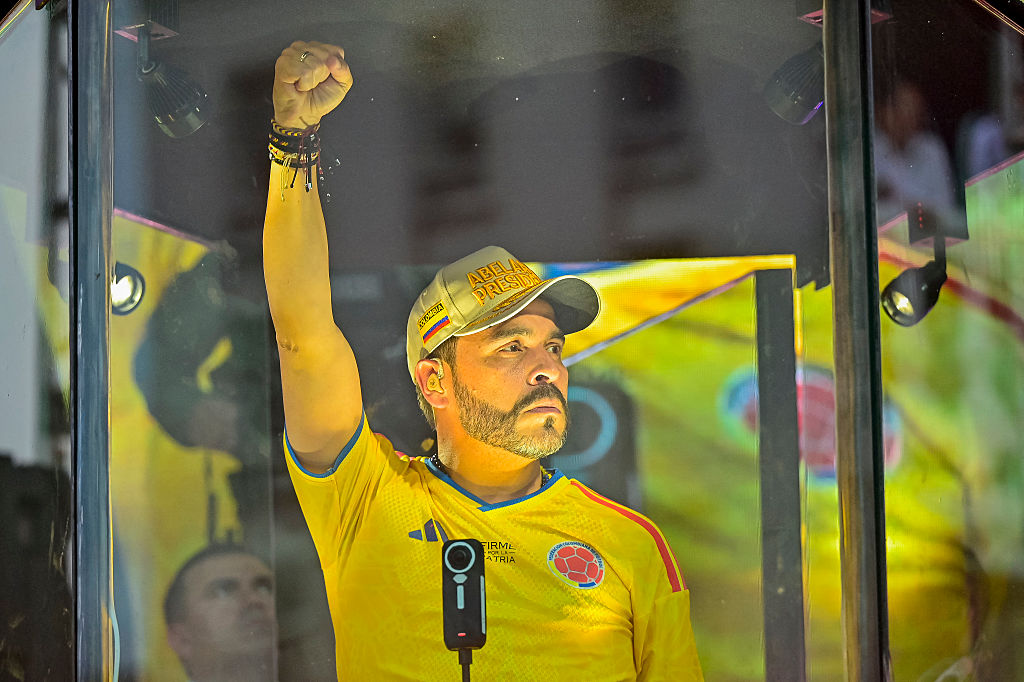
The far-right front-runner in Colombia’s runoffs this Sunday, Abelardo de la Espriella, is a cartoonishly opprobrious character, a shady lawyer with one foot in Miami. Donald Trump didn’t hesitate to very publicly back him. (Manuel Pedraza / AFP via Getty Images)
On Monday, June 8, I received terrible news from my friend Rosa, a youth activist and the founder of three community gardens in the impoverished neighborhoods of northern Bogotá. Thugs had destroyed one of their spaces, the Pollinators’ Garden in Suba.
Emboldened angry men with machetes, shovels, and axes chopped down tomate de árbol and avocado trees, multiplying banana fronds and fruit, lavender, rue, kale, oregano, basil, and many other vegetables and herbs. I wept when I saw photos of the dry brown earth where once I had walked with her and her friends through the overflowing, tangled green.
“They weren’t afraid of anything,” said Rosa (whose name has been changed for anonymity). “They did it in broad daylight.” I commiserated. “It’s as if their guy has already won,” she added.
Colombia’s second round of elections this Sunday will steer the country into one world or another: a feast of hatred, exclusion, violence, or a continuation of an imperfect progressive experiment. After the first round, on May 31, Senator Iván Cepeda of the leftist Pacto Histórico had 9.64 million votes, and lawyer Abelardo de la Espriella, a newcomer to politics with neofascist aesthetics, unexpectedly pulled ahead, with 10.31 million votes. The candidate in third place, Paloma Valencia, a traditional conservative originally favored by former right-wing President Álvaro Uribe, was eliminated.
The results shocked the Pacto’s many strategists and activists. Cepeda and his vice presidential candidate, renowned indigenous leader Aida Quilcué, also a national senator, had led the polls by a significant margin right until voting day. The next morning everyone got to back to work: labor and climate activists, Afro-descendant and indigenous leaders, feminists and queers and all their allies. The question will be whether the Colombians who brought the country’s first left-wing government to power can secure the future of their progressive project.
The far-right candidate, Abelardo de la Espriella, is a cartoonishly opprobrious character, a media-loving stuntman with dual US-Colombian citizenship. There are videos of de la Espriella bragging about blowing up cats with fireworks. He is on record for numerous vile, misogynist, and homophobic remarks. As a lawyer, he has represented dubious figures known for drug trafficking and paramilitary violence. He has lived in Miami much of his adult life. On slick social media spots, he presents himself as El Tigre (the Tiger). He has the parallel stripes of many of his kind: Nayib Bukele of El Salvador, Javier Milei of Argentina, and Daniel Noboa of Ecuador.
The Pacto candidate, Iván Cepeda, is a measured man with a philosophy professor’s air. For twelve years, he has been a senator in the Colombian legislature. His father, Manuel Cepeda, was also a senator. Cepeda Sr was assassinated in 1994, as part of a countrywide murder campaign targeting leftist politicians that, according to the Inter-American Court of Human Rights, eliminated some six thousand leaders and activists in less than a decade. Iván Cepeda became the founding member and most persistent campaigner for victims of state-sanctioned violence during the late years of the long, bitter civil war. He was himself identified as a legally recognized victim in a successful suit that in 2025 brought former president Uribe (temporarily) to justice. Aida Quilcué is also a victim of state violence. In 2008, government soldiers shot her husband to death. Six soldiers were later convicted of the assassination.
The Pacto Histórico was formed in 2021 and a year later won the presidential elections, bringing a leftist president to national office for the first time. Gustavo Petro, a former guerrilla combatant, proved to be a lively, energetic president, not afraid to take on Donald Trump and his cronies.
There have been great achievements during the four years of the Petro government: pension and agrarian reform, laws to make free university tuition permanent, protection of critically important bioregions, especially in the Amazon, and the launching of a solid international movement to divest from fossil fuels. There have also been disappointing setbacks: health care improvements were snarled in congressional red tape, and Colombia still set records for the assassinations of territorial defenders. Petro’s promise of “Total Peace” remains distant, as remnants of the guerrilla forces and many paramilitary and drug-trafficking bands still terrorize the countryside.
Closing the Ranks
The Pacto had invited me to Colombia to monitor the elections as part of the Unified International Observation Mission. Hopes were high that the Cepeda–Quilcué ticket would take the election in the first round, passing the 50 percent threshold.
On May 29, there was a cocktail party for the foreign observers’ team in the basement of a swanky hotel. I got there late. My taxi had inched through the choked streets of Bogotá, as the sun went down on an imperfect, trash-strewn city. Arriving, I found myself with a who’s who of international progressives: a leader of the Spanish Podemos; members of both the UK House of Lords and the House of Commons; representatives from Sinn Féin, the European Parliament, and the Communist Party of Portugal; and leftists from most of Latin America and the Caribbean, including Argentina, Uruguay, Chile, Mexico, the Dominican Republic, and Brazil. Everyone knew: this election in Colombia was about more than one country’s political future. Trump’s knife was out, carving up Latin America, treating the region once again as his to run or ruin. He despised Petro and was determined: Colombia would be his.
On May 31, late afternoon, the end of Election Day, the Pacto people crowded into another hotel room, a giant one. They were agitated, excited. There were no numbers yet, but it was reported that more Colombians than ever had voted. I had been pulled by one of the Pacto’s enthusiastic young volunteers through an unbelievable crowd, squeezed in between guards and a door, slapped with a thin, qualifying security bracelet, and then released into the cavernous room with all of the faithful — to wait.
The national television station RTVC was on live. Every few minutes a low, somber gong would sound. The analysts would pause, and the announcer declared the numbers of the latest poll counts. At once, it was clear: Cepeda would not claim the presidency in the first round. De la Espriella was out in front and never slipped behind, even as he never inched above 50 percent. The mood in the hotel room stayed loud, but more serious, determined not to leave without an all-out struggle.
Our group of observers declared that there had been little or no violence at polling stations (a great improvement). There were six hundred or so minor incidents of intimidation — vote buying, electricity cutting, and snarling the vote. There were irregularities — improper wearing of party colors by poll attendees — but no major visible fraud.
With almost all the votes counted, Cepeda and Quilcué appeared before the raucous crowd. Passions were high. Cepeda spoke: “It’s time to close ranks. We have three weeks left to fight for Colombia.” Aida spoke: “This is a fight for Mother Earth. For all life.” The crowd cheered wildly, then filed out, energized, ready.
The next morning, the international observation team met with Pacto officials for a post–first round autopsy. On election night, Petro (and then Cepeda) had claimed there had been a massive fraud. At this meeting, that was laid aside. What clearly happened, however, was major manipulation and undue influence from forces outside of Colombia.
We were witnessing the unfolding of a carefully crafted plan with deep roots in the Trump administration. Newly minted US senator from Ohio Bernie Moreno, born in Colombia, with deep ties to the conservative, monied class, was on the ground, orchestrating the public side of Trump posturing.
The Pacto had been victims of a massive disinformation campaign on social media and beyond. Right-wing fearmongers practiced every tactic, trotting out old tropes: The communists are coming to destroy the country. They will take away your small businesses. They are atheists. De la Espriella’s team, taking a page from Bukele’s master class in manipulation, had created two troll centers. By the Pacto’s estimates, more than a hundred thousand false accounts had been put into quick operation, spreading stories and sowing doubt.
“We played a fair game, campaigned in the old-fashioned way,” said Pacto Senator Alirio Uribe:
We had teams in every department, rallies in every major city. Tens of thousands of volunteers, youth, community leaders, activists. But in the end, we sagged. We don’t have the same means as de la Espriella. His campaign centered on hatred, violence, vulgarity, and threats. We just won’t go there.
“Colombia is a country facing the impact of Trump policies in real time,” said Ana Cristina, a Pacto activist. “Neoliberalism is dead. We are facing neofascism. Their plan has been laid out clearly. We just can’t quite believe it.”
The Donroe Doctrine
On June 2, President Trump weighed in on the Colombian elections on his Truth Social platform. “Abelardo has my Complete and Total Endorsement,” he wrote. He does not name Cepeda but calls Abelardo’s opponent a “Radical Left Marxist.” Trump said he was on the Tigre team “because of [de la Espriella’s] tremendous accomplishments in life, and his political support for me, personally.” More ominously, the meddling in Colombia is part of a renewed and reinvigorated US imperialism in the Americas.
In September 2025, the US military started its campaign of blowing up boats off the coast of Colombia, in the Caribbean and in the Pacific. At the same time, Trump declared that drug cartels would be identified as foreign terrorist organizations. Next he began to refer to President Gustavo Petro as an “illegal drug leader” (much like he did with President Nicolás Maduro of Venezuela). Then in December 2025, Trump released his National Security Strategy (NSS), calling it the “Trump Corollary” to the Monroe Doctrine, or the “Donroe Doctrine.”
The 1823 Monroe Doctrine outlined that the United States — not yet the strongest player in the continental Americas — would not meddle in European affairs. In turn, Europe would leave the Americas alone. The first major change to the doctrine, the 1904 Roosevelt Corollary, states that the US can interfere when and where it wants to, in the continents of the Americas. Which it promptly did: an invasion or occupation here, a covert regime change there, murder, and the training of murderers, disappearance, destruction of leftist and popular movements, from Guatemala to Chile. In almost every country, every region of the Americas, it has propped up local armies and oligarchs for the past 120 years.
“American policy should focus on enlisting regional champions that can help create tolerable stability in the region, even beyond those partners’ borders,” reads the new NSS document.
Quickly the plan turned to action: the invasion of Venezuela and the kidnapping of its president and his wife; the strangling of Cuba; the ongoing attacks on small boats. Trump allies in the region were emboldened: Milei in Argentina (who received a $20 billion “financial support package” from Trump), Bukele in El Salvador (ever tightening his grip on the small Central American nation, sending jurists, journalists, and human rights activists into exile, and accepting $5 million from the United States to receive “foreign hostiles” into his nightmarish mega-prisons), and Noboa in Ecuador (who directly intervened in the Colombian election, promising to punish the country with tariffs if the Left carried the day). Newer politicians — also from the far right — include José Antonio Kast from Chile, whose father was a member of the German Nazi Party, and who holds up high the until recently disgraced banner of Augusto Pinochet, and Honduras, where Trump had — also unabashedly — put his thumb on the scale of last November’s presidential election in that country, making sure his man, Nasry Asfura, won.
On March 7, 2026, all these and others, an unsurprising group of far-right Latin American leaders, met in Florida with members of the Trump team, including Secretary of War Pete Hegseth, Secretary of State Marco Rubio, and recently disgraced and now reassigned Special Envoy Kristi Noem. At the gathering Trump signed into being the so-called Shield of the Americas, also known as the Americas Counter-Cartel Coalition. The primary stated goal of the shield: combat drug-trafficking. In the actual sights of the shield are the progressive governments of Mexico, Colombia, and Brazil.
What makes the stated anti-drug goal of the Shield more than farcical — an outright outrage — was Trump’s pardoning of Juan Orlando Hernández in November 2025. Hernández, the former president of Honduras, had been convicted of trafficking more than four hundred tons of cocaine into the United States and sentenced to forty-five years in prison. At the time, Attorney General Merrick Garland said, “As President of Honduras, Juan Orlando Hernández abused his power to support one of the largest and most violent drug trafficking conspiracies in the world, and the people of Honduras and the United States bore the consequences.” So much for Trump combatting narco-terrorism.
A World to Lose
Colombians of the Pacto and beyond are giving it their all in the final round of elections on Sunday. They are also preparing for resistance in the event of a change of fortunes. They have been in the opposition most of their lives. For the first time, they have a lot to lose.
My friend and her associates in Suba organized a wake for their ravaged garden. People brought candles and poems. “I can understand organizing to fight crime. To fight the drug dealers. But who organizes a campaign to tear down food and flowers?” Rosa asked.
“Who is it that hates this life so much?”