How the Republican Party Slipped Its Leash

A strong labor movement demanded unified elites. Organized business in turn kept the GOP’s madness contained to ensure a favorable business climate. Today the Republican Party’s descent into chaos is a product of capitalist fragmentation.
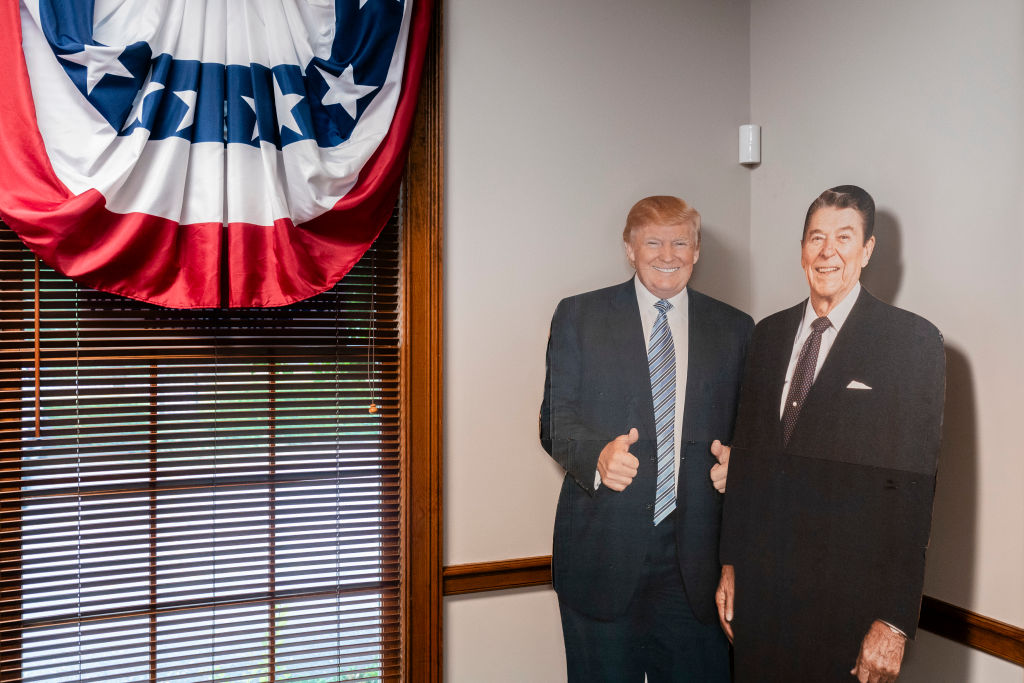
Donald Trump’s chaotic reign is the culmination of a decades-long process of organizational breakdown within both the business class and the Republican Party. (Elijah Nouvelage for the Washington Post via Getty Images)

In March 1954, Dwight D. Eisenhower was settling back into the Oval Office from a weeklong vacation at the luxurious Palm Springs ranch of California businessman Paul Helms when the rogue antics of Senator Joseph McCarthy caught his attention. In frustration, the Republican president penned Helms a letter expressing his misgivings with McCarthy’s escalating anti-communist witch hunt, writing, “It is a sad commentary on our government when such a manifestly useless and spurious thing can divert our attention from all the constructive work in which we could and should be engaged.”

In his zealous pursuit of socialist subversives, McCarthy gave exaggerated voice to the political sentiments that animated many business and conservative elites. But McCarthy, a solo flyer inflamed by his own grandiose passions and paranoias, did so without their input. As McCarthy’s demagoguery intensified, they feared he would embarrass their cause and create unnecessary political and economic turbulence. He was a loose cannon. And so, over the next year, corporate and Republican Party elites lent their unified support to the congressional censure hearings that abruptly taped McCarthy’s loud mouth shut.

Paul Heideman begins his new book, Rogue Elephant: How Republicans Went from the Party of Business to the Party of Chaos, by contrasting McCarthy’s swift disciplining by GOP grandees with the unstoppable rise of Donald Trump. Trump, too, was always controversial and erratic, spooking many in the business class and the Republican establishment. But by 2016, the ties that had bound GOP leaders with America’s titans of industry had disintegrated. There was no one to crack the whip. In fact, there was no whip at all — just a million loose and fraying threads. And a lot of anger, and a lot of cash.

The Republican Party today is a scene of utter pandemonium. It is riven with infighting, much of it falling along incoherent ideological lines, much of it downstream of the cult of personality around Trump. To the extent that an ideological project is discernible, the objective seems to be norm-breaking in an ever-rightward direction for shock value and intra-factional esteem, garnered most easily by imitating Trump’s petty vengefulness and proud amorality.

But Heideman argues that Trump didn’t create this state of affairs. Instead, his chaotic reign is the culmination of a decades-long process of organizational breakdown within both the business class and the Republican Party, resulting in a dealignment of the two that has nevertheless done nothing to blunt the power of capital.

One Big Room, Full of Big Business

Coherence is an anomaly in the history of American political parties. Before the twentieth century, American parties were “little more than coalitions of regional elites,” Heideman writes, lacking “either the programmatic or institutional foundations of leading parties in other bourgeois states.” This state of affairs changed with the New Deal, which announced the Democrats as the party of labor and its friends, making the GOP the de facto party of big business, along with social conservatives, who were the cultural enemies of labor’s friends.

McCarthy’s great error, then, was that he played the rogue at a moment of programmatic discipline. Big business militated against him through groups that existed to consolidate their interests — unified bodies like the Committee for Economic Development (CED) and the Business Council. The CED, for example, supplied financial support and personnel to an anti-McCarthy operation that collected and distributed damning information on the senator. Prior to becoming president, Heideman notes, Eisenhower had sat on the boards of the CED and the Business Council; he was their guy, and they leaned on him to do something about McCarthy.

But capitalists are not always so unified. Indeed, capitalists profit daily through ruthless competition with one another. Bringing them all to the table in defense of their shared interests — not least political stability, which keeps markets humming — requires a threat of world-historic proportions. In the twentieth century, that was the labor movement. Notably, 1954 was also the high-water mark of union density in US history. Business elites were consolidated because labor was.

Heideman notes that business coordination reached its peak in the 1970s with the creation of the Business Roundtable. In response to high domestic strike activity and political crisis, the Business Roundtable and the US Chamber of Commerce functioned as “class combat organizations dedicated to overturning the legacy of the New Deal.” And they were successful. Beginning in 1981, Ronald Reagan presided over the downfall of American labor, with enormous implications for the organizational coherence of business interests. Heideman writes:

With their immediate foes defeated, business soon found it could not maintain the unity it had found in the heat of battle. Business organizations atrophied, their members asking what the point was with Reagan already giving them everything they wanted. Organizations began fighting amongst themselves over which sectors and firms would benefit most from the largesse of their friend in the White House. In the words of one Reagan advisor, business began acting less as a disciplined political force, and more like pigs feeding at the trough.

Undisciplined by a powerful foe, Heideman contends, American business became increasingly fractured and parochial after the Reagan era. The Business Roundtable and the US Chamber of Commerce shifted from representing collective capitalist interests to pursuing narrow agendas, such as executive pay protection and corporate reputation management. This fragmentation meant business could no longer coordinate to discipline the GOP or steer it toward stable governance, as elites had previously done.

The Democrats, meanwhile, were in the process of dissolving their own political program. Emergent forces within the party agitated for abandoning the New Deal coalition, and the election of Bill Clinton signaled their victory. The absence of a clear party of labor called into question the necessity of a party of capital. So capitalists went freelance. And partisan politics went insane.

Freelance Freak Show

The Left sometimes conjures the following sketch of how American politics arrived at the present reactionary moment: the Democrats tacked center, the GOP saw an opportunity to stretch rightward, and the Overton Window shifted. This tidy account assumes the band of acceptable opinion has a fixed width — so if one side retreats, the other can advance the same distance. That is, if one side stops insisting that workers need unions (which Democrats did), the other will opportunistically start trying to prohibit them from joining unions altogether (which Republicans have).

In Rogue Elephant, Heideman proposes a more dynamic and convincing account of rightward drift. Instead of two parties gliding rightward in unison, he emphasizes how parties in general have lost programmatic coherence, allowing political entrepreneurs to rush in and fill the vacuum. At the same time, deregulation of campaign finance means that these insurgents often bring with them independent funds, especially on the Right, where business interests have the most to directly gain.

Gone are the days of high-minded business consortia conditioning the Republican Party to ensure political stability on their behalf. We’ve entered the era of the political upstart, where self-selected aspirants raise money from individual capitalists or niche sectoral associations on the promise to act in their interests, with little regard for the future. Ideological incoherence gives these political entrepreneurs an advantage: flexibility to side with a given benefactor at will, guaranteed to find justification in a grab bag of muddled positions.

Since the ascent of Newt Gingrich in particular, Heideman argues, a cycle has been on endless repeat. “Insurgents in the party, able to draw on funds from sectors of business looking to push politics to the right, challenge the party leadership,” he explains. “Eventually, these insurgents manage to take leadership and succeed in their push. Then, a new crop of insurgents springs up, and the cycle begins again.”

The compound effect is intensifying intra-party conflict and an unmitigated, accelerating rightward drift. A further result of repeated coups against party leadership has been to minimize the significance of party leadership in general. No one can trust that a given leadership clique will be on top for long.

Before Trump, these dynamics were exemplified on the one hand by the Tea Party, stoking destabilizing factional conflict with a right-populist gloss and a hard-line attitude, and on the other hand by the Koch Brothers, representing the victory of boutique, hyper-ideological billionaire patronage. In 2010, the Citizens United Supreme Court decision turbocharged this trend, opening campaign finance to individual wealthy donors in unprecedented ways that further decreased dependence on and undermined the role of political leaders in the party.

“Suddenly,” Heideman writes of Citizens United and deregulated campaign finance, “the party found itself working uneasily aside groups who commanded fiscal resources at least as great as its own.”

But these were not the class-conscious business alliances of old. They were entirely self-interested corporate fiefdoms in search of emissaries who could energize the masses. In this climate, McCarthy would have flourished, as figures like Marjorie Taylor Greene do today, despite rankling the rump party establishment in much the same way.

Heideman understands Trump’s reign as both the culmination of these dynamics and a singular next development: one billionaire-backed reactionary populist insurgent to rule them all.

Trump has managed to achieve a level of party loyalty not seen since the Reagan era, and to far surpass Reagan in the degree of hagiographic personalization he commands. His ascent demonstrated how a weakened party system and a fragmented capitalist class could no longer contain a charismatic outsider who bypassed traditional fundraising networks and party hierarchies through personal branding and constant media spectacle.

But once in power, Heideman argues, Trump’s presidency revealed the limits of that personalist model. His first term achieved major tax cuts and deregulation that gratified parts of corporate America, but his administration was otherwise marked by policy incoherence, factional infighting, and self-inflicted crises. His second term, while much more destructive than the first, is so far similarly unproductive in terms of building institutions that will perpetuate his political program, whatever that program even is, after he’s gone.

The same institutional fragility that has allowed Trump to dominate the Republican Party — its dependence on outside money, its hollowed-out organizational structure, its reliance on spectacle — has also rendered him incapable of sustainable governance. In this sense, Trump is both the logical end point of the GOP’s transformation and a warning: a party that has abandoned programmatic discipline can seize power, but it cannot effectively rule.

The Democratic Party’s decline began when it stopped asserting itself, however accurately, as the party of labor. Likewise, while Republicans remain beholden to individual capitalists, their descent into madness began when the GOP resigned as the party of capital.