Dockworkers Against Russia’s and Israel’s Wars
In Sweden, workers boycotted Russian ships in response to the invasion of Ukraine, and then did the same for Israel’s arms trade. Their action shows the power of working-class solidarity against militarism.
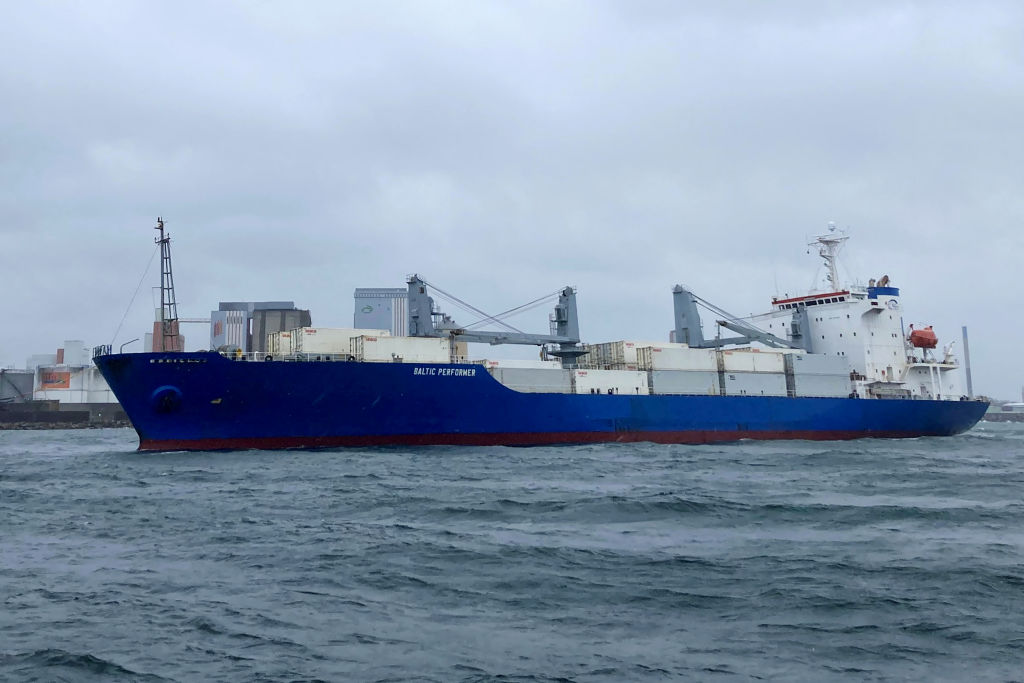
In Sweden, dockworkers boycotted shipping from both Israel and Russia. A trade unionist involved in the actions told Jacobin why workers acted, and why bosses responded with union-busting. (Camille Bas-Wohlert / AFP via Getty Images)
- Interview by
- Artem Tidva
Ahead of May Day 2022, two months after Russia’s full-scale attack on Ukraine, Ukrainian trade unionists called for solidarity with the invaded country. Artem Tidva, a Ukrainian left-winger and labor activist, addressed international unions calling for actions to help stop the Russian war machine.
In Sweden, such action was already underway. In March 2022, Swedish dockers had begun a blockade of Russian ships. This decision, supported by a nationwide vote among the Swedish Dockworkers’ Union’s approximately one thousand members, highlighted the complicity of global capitalist mechanisms in facilitating Russia’s evasion of sanctions. Yet it also met with resistance from both employers and politicians, and the union faced practical problems in identifying ships belonging to Russia.
Yet despite legal challenges, including two lawsuits, Swedish dockers continued their solidarity effort. These efforts earned support in wider society, not least thanks to Ukrainian President Volodymyr Zelensky mentioning the action in a speech.
Erik Helgeson, a dockworker in Gothenburg for the last twenty years, was one of the union activists involved. Deputy national chairman of the Swedish Dockworkers’ Union, he was fired from his port job in 2025 — this time following another solidarity action, against Israeli shipping.
In an interview, Tidva and Hegelson spoke about the Swedish actions and the role of worker solidarity in stopping the machinery of war.
Tell us about how shipyard workers’ and dockers’ unions refused to cooperate with Russian ships in 2022. How did it start, how are such decisions made, and what discussions were going on in society at the time?
The Swedish Dockworkers’ Union is a national union, with workers in around twenty ports. The initiative for the action against the Russian ships came from two smaller ports in the south of Sweden. I think it was just an organic reaction to what was happening in Ukraine and what Russia was doing. We have a long-standing tradition of action to support trade unions in other countries, but also to support human rights or self-determination.
The initiative came from the rank and file in two smaller ports, and then through their local organizations it was brought to the National Board. We called a union-wide referendum, which means that all members of the union around Sweden voted on whether to take the action. The support was very strong, so the decision was made, and we gave notice to the employers about our action. Then we faced expected but very intense pressure, mainly from the employers’ organization, but also from politicians.
What was the reaction from Ukrainians? Did you have some cooperation with Ukrainian comrades?
In those days, it was extremely difficult to stay in contact with people. Most of what we learned was which sea and river ports had been closed — either due to Russian aggression or direct bombings, such as in Odesa. Some ports, like Mariupol and Kherson, were occupied very early on. We reached out to various Ukrainian trade union comrades to ask how we could help. One smaller union, mainly operating along the Dnieper River, eventually told us what assistance would be most useful.
There were also significant political obstacles. In Sweden, two unions organize dockworkers, and we belong to different international federations. I assume this created some hesitation about whether certain unions should engage with us. Our most important breakthrough came when Zelensky mentioned our industrial action in one of his speeches as an example of genuine solidarity, while also calling on other unions to take action to stop trade with Russia. That recognition was extremely helpful. Before that, employers and politicians had tried to isolate us, portraying our initiative as destructive, marginal, or even harmful. They argued that our actions were unwanted by Ukrainian unions, businesses, society or that we were trying to “bite off more than we can chew.” But when Zelensky’s comments were in the news, everything changed. It gave us legitimacy and shifted the public debate back to where we believed it belonged. While there were endless TV debates about the military advantages of joining NATO and similar issues, trade with Russian companies was continuing — supplying both money and material to the Russian occupation forces. For us, that contradiction was impossible to ignore.
How did your management respond to this?
The employers’ organization, Ports of Sweden, represents all port companies nationally, so in the beginning most individual companies avoided commenting on the blockade directly. Everything was handled through the employers’ organization. They were very aggressive. They spoke to us as if we were little children: “This may seem like a good idea, but you don’t understand what you’re doing. This is serious, adult business — stay out of it. It’s illegal.” They filed lawsuits against the union twice.
Despite this, we went ahead with the action, which created many complicated practical issues. For example, how to deal with Russian cargo that was already in Swedish ports, and how to determine which ships should be stopped. In many cases, it wasn’t immediately clear whether a ship could be classified as Russian or not. I remember one case involving one of the world’s largest shipping companies, where we essentially ran into their tax‑avoidance structures. We identified a ship registered under a major Russian shipping company and refused to work on it. The company claimed they had acquired the vessel from the Russian firm one or two years earlier. We told them we wouldn’t handle the ship unless they could prove it was no longer Russian‑owned. That became a serious issue, because shipping companies are often unwilling to disclose ownership details due to complex registration arrangements involving places like Cyprus, the Virgin Islands, or Panama.
These kinds of practical challenges dominated the first weeks. Some local employers became extremely frustrated. Publicly they said they supported our initiative, but when it began affecting their profits — when we refused to work on ships that, for example, operated routes between Sweden and Russia . . . they became hostile. At that point, they actively tried to stop the action by any means available.
We see that many instruments of modern capitalism — such as the offshore tax‑avoidance system — are effectively helping Russia to avoid sanctions. These mechanisms haven’t disappeared since the war started; they continue to function in the same way they do for money laundering. You mentioned some tax havens. Russia also uses registrations in various African and Asian countries to conceal its so‑called shadow fleet.
Shipyard workers will tell you it’s not only rogue states or “bad” national actors using these systems. Criminal organizations and drug cartels use them, too, just like everyone else. Everyone knows these channels exist and are widely used, but nothing really changes because the same class that runs much of the global economy relies on them as well. There’s a lot of talk about tax havens and international regulation, but in practice very little happens, unfortunately.
You mentioned attempts by employers to sue the trade union, and I think there were also cases brought against you personally . . .
The case against me personally is not related to the blockade of Russian ships — I can talk about that later. The Swedish Dockworkers’ Union is the only independent, non-party-aligned blue-collar union in Sweden; we’ve had that role for over fifty years, and it has shaped a strong tradition of international solidarity actions, that means that when sh-t comes up — major political or humanitarian crises arise — there’s almost always an initiative from the rank and file.
After we gave notice about the blockade of Russian ships, we were sued twice, but those actions were against the union, not me personally. In the first instance, public support was so strong that the employers effectively backed out. However, when we continued the blockade, it increased pressure on the Swedish government to act — and it was extremely slow. While its rhetoric against Russia was strong, it did very little when it came to trade and revenue flows benefiting the Russian economy. As a result, they sued us again. This time, the court ruled against us, and we were fined, with the blockade deemed to have lasted too long — even though, in Sweden, workers have multiple legally recognized grounds for industrial action, including warning and solidarity strikes.
In 2025, following a further internal referendum, we attempted to take action against ships transporting military cargo to and from Israel, in response to the attack on Gaza and the tens of thousands of civilian deaths. And the modus operandi of the employers was kind of the same: first, they pressured the union to stop the action, and then — on the same day the court ruled that we were allowed to proceed — they dismissed me personally. But that’s not actually linked to the blockade of Russian ships, but of Israeli military trade.
I’ve seen many cases where employers try to discredit or suppress acts of solidarity. In Britain, when the GMB union organized for better wages in UK weapons‑manufacturing companies, conservative politicians and employers tried to frame this as undermining support for Ukraine.
Our union’s analysis is that many employers are using the broader context of war, national security, and military objectives to intensify their everyday attacks on trade unions.
It’s very common to invoke a different pretext — whether it’s Sweden’s defense, security policy, or even what is supposedly in the interest of Ukrainian resistance — in order to justify repression. In reality, these arguments are often just cover for something else.
That’s also how we understand my dismissal. The effort to get rid of me, and possibly other union representatives, didn’t begin with our actions in solidarity with Gaza, and maybe not even with actions supporting Ukrainian civilians. Those plans had existed for years. The wars simply provided a convenient justification to do what the employers had long wanted to do anyway: weaken unions, undermine collective agreements, and roll back workers’ rights.
This isn’t only about trade union rights. It also affects freedom of expression and democratic space more broadly.
So far, I think they miscalculated. In Sweden, business lobbyists expected deep divisions — some people backing Israel’s war, others supporting Palestinians — but the strategy backfired. It became increasingly clear to many that this wasn’t really about the war or arms trade at all. It was about union‑busting.
I see the same pattern repeating across Europe.
You said you lost one court case because the blockade lasted “too long” — what does that mean?
The Swedish Сonstitution explicitly guarantees the right to strike. But that right is followed by various legal limitations. And when it comes to so-called political action, there’s a time limit.
The law doesn’t define what that time limit is. In our case, we continued the action far longer than is usually considered acceptable.
In court, we argued that this was not a political action at all. We maintained that it was an act of solidarity with other trade unions — specifically Ukrainian trade unions. Our argument was that the Russian attacks directly affect dockworkers in Ukraine: they cannot work, they lose their income, and in many cases they lose their workplaces entirely. Under Swedish law, there is no time limit when it comes to supporting another union in an industrial dispute. For example, we are currently supporting the Metal Workers’ Union in its conflict with Tesla, and that action has been ongoing for more than a year, close to two years. However, the court did not accept our arguments. It ruled that there is a fundamental difference between supporting a union fighting layoffs or poor working conditions and supporting a union engaged in resistance against military occupation or armed attack.
I still find that conclusion very strange. If employers attack workers through layoffs or legal sanctions, solidarity is permitted without a strict time limit. But if the “employer” is effectively a state actor — like the Russian state — using military violence and killing workers, then suddenly there is a time limit. To me, that makes little sense. But that’s how the legal system currently interprets it.
What was the reaction of Swedish society and the media?
In 2022, when we took action against Russian ships, many people expressed relief that something was being done. There was a lot of rhetoric at the time about European unity, defending democracy, and standing up to Russia, yet many Swedish companies were making sh-tloads of profits by continuing to trade with Russian firms. Once employers took us to court, that contradiction manifested itself. Even right‑wing media outlets were hesitant to openly attack us. Some criticized us at first, but they quickly realized they lacked broader support — even parts of the far right were reluctant to oppose the action. It became clear that they had stepped into a situation they couldn’t easily control, and that’s one reason employers did not fully follow through on their threats at that stage.
So, the first round of the blockade lasted for one-and-a-half to two months, and the legal attacks started again a few weeks after that. We could continue quite a long time in Sweden, mainly because we had very broad public support — even from forces that normally don’t support unions or dockworkers.
Your direct, practical actions against Russian businesses came faster than EU sanctions and arguably pushed governments to act. How do you see that?
We’re a relatively small union, organizing about a thousand workers across Swedish ports. We have, through experience, learned how to handle disputes — and in Sweden, dockworkers always had a high level of conflict awareness. But we also know that what we can contribute internationally isn’t so much about the economic impact as force of example. So, I think there’s no doubt that what we did in 2022 pushed public opinion and thereby pushed the Swedish government. At some point we heard “Oh, we don’t want to do anything unilaterally. We want to wait for the EU.” But every government in Europe was saying that, and no one wanted to be the first one to quit trading with large or profitable markets.
So the fact that initiatives emerged in Sweden — and there were also spontaneous actions elsewhere, like the Netherlands — gave us a platform to say “you’re doing too little, too slowly.” We publicly called that out. In that sense, we clearly shifted the debate in Sweden and may have contributed, in a very small way, to the broader European discussion.
That’s also how we see our more recent blockade against Israeli military trade. We’re fully aware that we won’t physically stop large volumes of cargo. But by trying, we put a spotlight on deeply immoral trade that many people in Sweden simply don’t know about.
There’s a widespread belief that the Swedish arms industry only trades with “responsible” countries — or, at least, that Swedish weapons aren’t used in active wars. For many people, our actions were eye‑opening. Even when we face heavy criticism in the media or legal attacks, we still raise public awareness.
Personally, the blockade against Israeli military trade challenged my own assumptions. I initially thought Sweden was mainly exporting weapons to Israel. In reality, it’s often the opposite: Sweden is buying large amounts of Israeli military systems and paying hundreds of millions of euros in order to finance Israel’s wars.
So even if we’re not powerful enough to stop violence on the ground, taking some small amount of risk still matters. In difficult situations, that’s sometimes the only contribution you can make — otherwise they get away with doing whatever they like all the time.
This was very important for us. When we shared information about your actions and other solidarity initiatives with our comrades in Ukraine’s transport sector, they were deeply impressed. It really mattered that there are people abroad who genuinely support Ukraine’s right to self‑determination.
Russian propaganda constantly claims that it is not Russia, but Ukraine that is isolated, that we are merely a Western proxy, and that Western countries don’t truly care about the brutal Russian invasion. Against that narrative, practical solidarity and real cooperation with comrades around the world is extremely powerful.
You might know that after the Russian missile strike on the Okhmatdyt children’s hospital in Kyiv, investigations showed that some European‑made components were present in the missile. Russian opposition journalists have also reported that Russian tanks are still using European optics and radio electronics. How is this possible, and how can it be stopped?
I don’t have the technical expertise to go into details. What I can say is that there was extensive trade between EU countries and Russia for a very long time. It’s unclear how much of what we see today comes from military equipment purchased before the sanctions, and how much is being smuggled in now. I also don’t have detailed knowledge of how the so‑called shadow fleet currently operates. What we dealt with during the blockade was much more basic. For months, we focused on stopping very concrete, everyday trade flows. We refused to handle cargo that was clearly destined for Russia, even when it involved relatively low‑value goods. We turned away shipments of pig iron, and even ships carrying bananas, when we knew they were heading to St Petersburg after leaving Sweden.
By consistently increasing pressure and identifying cargo wherever we could, many Swedish companies eventually withdrew from the Russian market. They might have done so anyway, but our actions clearly accelerated their decisions — companies did not want ongoing disruptions to their supply chains.
How do you think such sanctions and economic pressure instruments can affect weapons supplies in the long term — by increasing costs to the point where continuing the war becomes unbearable for people like Vladimir Putin and pushing them toward dialogue rather than war?
Without pressure from below, trade unions that are unwilling to act will always argue that sanctions are pointless — that goods will get through anyway, that the shadow fleet exists, and so nothing really changes.
But what you can do is hunt down these supply chains and try to disrupt them. Even when you don’t fully succeed, you still create risk and uncertainty. That alone raises costs. Increasing the cost of trade may not stop everything immediately, but in the long term it discourages companies from staying in these markets because the risks become too high.
The shadow fleet clearly is a huge problem. But the fact that Russia has to operate clandestinely, hide ownership, and cover its tracks means that it pays far more for weapons and components than it would under normal conditions.
Russia will still obtain some components — even after years of war — but it will come at a significantly higher price, and that inevitably affects the economy. This is the same logic we apply to Israeli military exports. We know we cannot single‑handedly stop the Israel Defense Forces from obtaining weapons used to destroy neighborhoods or kill civilians. But by applying sustained pressure, we increase costs over time.
Historically, that’s what broke apartheid South Africa, and it’s what has weakened many regimes engaged in military aggression. It’s not the immediate absence of ammunition that changes outcomes, but the long‑term economic cost of acquiring it.
If you focus too much on achieving perfect results immediately, intercepting every particular cargo, you risk becoming disappointed and giving up altogether. A long‑term perspective is essential.
Such efforts to disrupt the economic capacity of occupation regimes also help investigators and institutions fighting the shadow fleet. Without such pressure, a few additional clandestine ships would pass unnoticed, and dictators would feel no resistance at all. When trade flows normally, it becomes easy to normalize the destruction inflicted on their own populations and neighboring countries.
Instead, we often see the opposite effect: it is more difficult for me to buy Italian ceramic tiles in Kyiv and impossible to buy a Korean LG washing machine, while people in St Petersburg do not have such problems. I cannot fly from Kyiv to Turkey or Georgia, but Russians can fly from Moscow to Istanbul or Tbilisi and then to EU countries, for example. Sometimes it seems that we are living under sanctions restrictions, even though it is not Ukraine, but Russia that is at fault for this. There was a time when the markets considered cooperation with Ukraine risky, while working with Russia had no moral consequences. People very quickly sense this hypocrisy. Nevertheless, we need realistic and achievable goals to stay motivated. What motivates you?
As a trade union, we know we cannot directly stop Russian oligarchs from buying Italian tiles. But if those tiles suddenly cost ten times more because access to markets is limited, that will eventually impact the economy — and the economy is what sustains the war. That’s our perspective, speaking from the privileged position where we are not being bombed every day. It’s not perfect, but it’s a way of thinking that motivates us to continue. Applying sustained pressure, even when results are gradual, is still meaningful, and it’s how we keep going.
You mentioned that you later refused to handle trade linked to Israel, not only weapons shipments, and that this market functions in both directions. How did the Swedish authorities react to your action against trade with Israel, and why did you decide to continue despite the consequences?
I think the current government has been extremely reluctant to take any concrete steps to regulate trade with Israel, regardless of the situation. Officials may express concern about particular atrocities or civilian casualties, even during ceasefires, but those statements don’t translate into action.
In that sense, our blockade was largely symbolic — and it came at a real cost. I was fired and am now fighting that dismissal in court. At the same time, there are ongoing attempts to weaken the union and limit its ability to carry out its core work: defending members and protecting their working conditions.
There’s not much we could have realistically done differently. For me personally, it became a moral question. If the choice is between losing my job or remaining passive while children are being killed with impunity, I’d still make the same decision. These are the times we’re living in. If we aren’t willing to take risks — sometimes on a very personal level — we won’t achieve anything meaningful.
How do you think Ukrainian and global left-wingers and trade unionists can support you — both in your personal struggle and in defending workers in your union, but also more broadly, in pushing for stronger, more effective sanctions against those who initiate and sustain brutal wars?
Regarding my legal case and the dismissal, there are two main levels where support can make a difference.
At the political and institutional level, letters of support sent to the Swedish Embassy or to the employers’ organization, Ports of Sweden, can be important — especially if they clearly condemn the dismissal and identify it as union‑busting.
At the rank‑and‑file level, support works differently and, in many ways, more powerfully. Sharing videos, statements, or updates is incredibly effective. Simply showing that people know what’s happening matters a lot. When our members see that their actions resonate thousands of miles away, it strengthens morale in a very real and tangible way.
This isn’t limited to Ukrainian trade unionists. The same applies everywhere. A short video or photo from Greek dockworkers, for example, or a message we send in return, often has more impact on the rank and file than a carefully worded letter to an embassy. Ideally, you work on both levels.
More broadly, I think the trade union movement needs to clearly understand that trade union rights are built on human rights and civil liberties — you cannot separate the two. You can’t remain passive while freedoms of speech, fair trials, or basic legal protections are being dismantled and hope that trade union rights will somehow survive on their own.
If no principles are treated as sacred — if everything becomes negotiable — then trade union rights are just words on paper, and easily taken away. We’ve seen this pattern repeatedly: first, rights are stripped from migrants, asylum seekers, or unpopular minorities; then, rights to protest or speak freely are curtailed; and eventually, the right to strike and organize is attacked.
If unions position themselves as only concerned with wages, contracts, and workplace rules — standing on the sidelines while other rights are eroded — we will find ourselves without allies when it’s our turn. And when human rights are disregarded in general, trade union rights will not survive either.
Absolutely agreed. Many rights are already written into constitutions, but they only remain guaranteed if they are actively exercised. From your perspective, what are the most effective sanctions against those who start bloody wars?
If we look at history, the working class has always found ways to resist war. These methods aren’t new, but they do need to be updated for today’s world. Still, the most effective way to stop wars, unjust occupations, and invasions is collective action by working class people. That’s how we do it. When workers refuse to comply — when we refuse to finance, transport, or handle cargo, weapons, or other goods that sustain war — we can have a real impact. That’s how the working class has helped stop a number of unjust wars in the past and prevented further slaughter of civilians.
We have to be honest as well: we’ve also failed many times. Solidarity actions don’t always succeed. But that doesn’t mean they’re pointless. They can work — and ultimately, they have to. The world isn’t moving toward a more peaceful future right now; it’s moving toward increasing instability and danger.
What you’re experiencing in Ukraine, what Palestinians are living through, and what many other people around the world already feel — these aren’t isolated situations. If working people don’t act collectively to resist war and militarism, these realities will only spread.