We Need to Move Beyond Robot Doomerism

“The robots are coming” need not be understood as heralding the apocalypse. An automated society in which states and worker-owned enterprises use technology to serve public ends while meeting individual needs is entirely consistent with the good life.
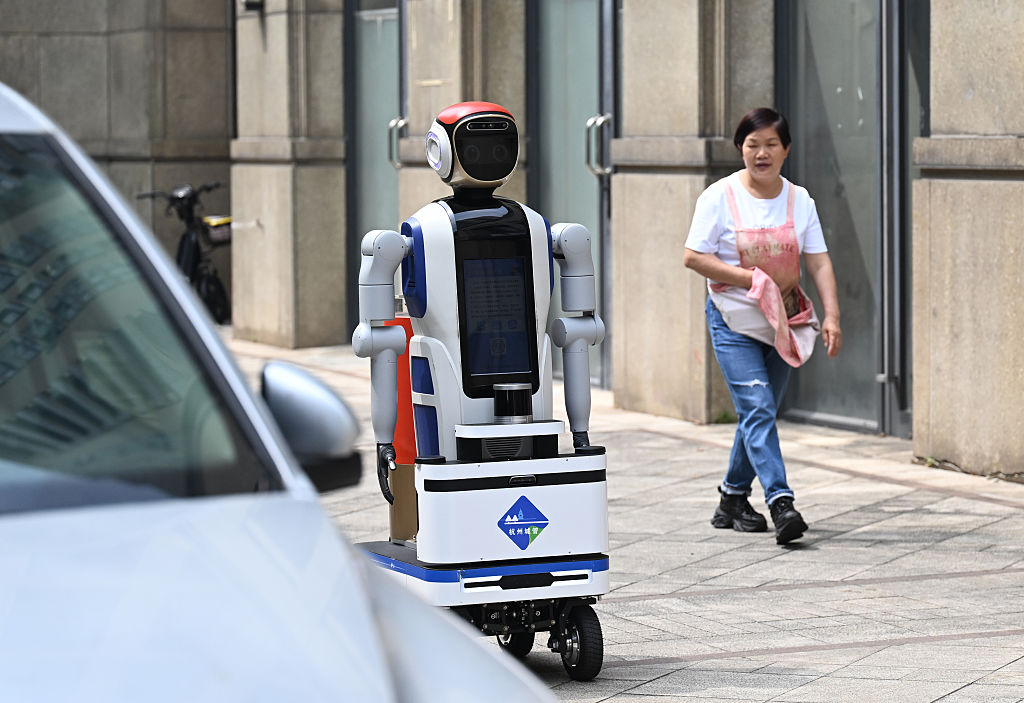
A traffic robot is on duty on the street on May 13, 2026, in Hangzhou, Zhejiang Province of China.

Fear and doomerism over new technology will only halt the real work of fighting for democratic control of it. The robots may be coming, but building a society in which automation serves the public good remains a distinctly human task. (Wang Gang / China News Service / VCG via Getty Images)


For all our concern with the rise of robotics and the threat to workers these machines pose, the robots keep coming. In Japan, the aviation industry is struggling to meet labor requirements, and one airline company is attempting to bridge the gap with “humanoid” robots that will load and unload cargo. Japan Airlines is deploying the technology at Haneda Airport with the hopes that the robots will not only meet immediate employment needs but someday take on further tasks.

One core concern on the Left about new technologies is that they will discipline and punish workers, at once diminishing their bargaining power and relative strategic position with management. In the long run, this means lower wages, poorer working conditions, and layoffs. At scale, improperly handled, the mass adoption of automation without a plan for what comes next for workers — and consumers — threatens economic decline. If no one is working, no one is getting paid. If no one is getting paid, no one is buying whatever the robots are selling, making, or servicing.

Who Do the Robots Work for?

The deployment of robots in Japan requires us to think about automation a bit differently. The country faces labor challenges arising from low birth rates and an aging population. On top of that, the airline industry — at least before oil prices spiked — was dealing with growing tourism numbers. This meant that airports and airlines were facing pressure from a shrinking labor pool alongside growing demand.

In the short to medium term, the goal of automation in this case seems less about cowing workers than meeting urgent operational needs. The machines are meant to keep essential systems running, thus keeping people employed and preventing overwork. In the long run, however, the risks of automation begin to resemble those associated with its deployment elsewhere. Here we encounter both promise and peril.

Thinking about humanoid robots unloading cargo containers or operating ground crew equipment recalls Karl Marx and what seems, in hindsight, like something more than utopian optimism — the hope that automation might free workers. In the Grundrisse, Marx argued that automation was a critical part of the postcapitalist society. If the robots were doing the labor, humans could devote more of their time to other pursuits. Suffering, as it were, would be optional. This model, however, is premised on a postcapitalist society. Outside such a model, it’s hard to see the robots as your friend.

In the twenty-first century, we face two major threats of automation. The first is the deployment of machines by industries hoping to replace workers — reducing labor costs while increasing the efficiency and scale of outputs. What becomes of the workers? That is treated as someone else’s problem: that of another industry that hasn’t automated as aggressively or, failing that, the government. The second threat comes from artificial intelligence, which is increasingly automating creative and cognitive tasks — writing, image-making, even thinking itself. This is fundamentally dehumanizing. In elite circles, there’s little talk of changing the economic systems in which these technologies are being deployed. Instead, the dominant impulse is to lean further into the capitalist mode of “creative destruction” and profit maximization.

Who Owns and Controls the Robots — and to What End?

We now face a kind of anti-theodicy: the worst of all possible worlds given the circumstances of our existence. With contemporary automation, we face a situation in which the community doesn’t own the robots, and thus we can’t collectively decide to put them to good use for public ends.

Within this paradigm, the machines are typically deployed to constrain or eliminate labor and any related activity that can be monetized, whether unloading cargo or creating an image of a sunset. And with the rise of AI systems geared toward creative tasks, janky as they still may be at, we risk alienating ourselves from the very tasks that connect us with the world around us. We are offloading acts of creativity and cognition onto machines, dulling our capacity to experience a sense of wonder but also to keep our minds sharp. In his 1985 book, Amusing Ourselves to Death, Neil Postman warned that entertainment culture was eroding public thought and discourse; today we are at risk of prompting our brains into oblivion.

None of this means that tech itself is the enemy. The problem is the social order governing its development and use, As Leigh Phillips argues, the Left should be technologically audacious and optimistic. Looking back on the genuine achievements of the pandemic era in responding to COVID-19, he writes:

The Left should be proudly flaunting the record of governments around the world in responding to Covid. It should make the case that all major technological and scientific advancements are best delivered by governments. And it should make the case that we — the people — should embrace faith in technological progress that is rooted in public investment.

A left posture that embraces technology for shared ends, both in deployment and control, is essential to navigating a future that will, like it or not, become increasingly automated. In many instances, the Left’s response to machines ought to be, “Yes, that’s what we want the robots to do.” Looking back on the history of the last four centuries, automation has yielded incalculable benefits for health, wealth, and leisure in fields ranging from medicine to agriculture and entertainment. Our lives are, in many instances, better off because of technology. In my case, having been the recipient of a lifesaving surgery as a child that relied on the technological advancements of the era, these developments were literally a case of life and death.

The Work Robots Can’t Do

The neo-Luddism or doomerism in some left circles today risks missing the procedurally generated forest for the trees. Thinking through changes to the economy and work brought about by automation, we ought to ask ourselves a series of questions while we prepare to pass judgment: Who controls and benefits from these changes and could the public put such technologies to good use? Are these developments aimed at supporting or enhancing our individual and shared humanity, or do they diminish it? Do we need this or that change? And above all, can we responsibly plan for and control these developments in a way that maintains social, political, and cultural standards, expectations, and needs?

With technological development, the details matter. The Left should not be reflexively anti-technology, but rather skeptical of how technologies are developed, deployed, and controlled — and for whose benefit. An automated society in which states and worker-owned enterprises harness the marvels and wonders of technology to serve public ends while meeting individual needs is entirely consistent with the good life. Indeed, carefully constructed, this society could be far closer to utopia than dystopia — and far better than the world we inhabit today.

But getting there requires structural changes in how we organize the economy, which requires the hard work of organizing, mobilizing, setting political priorities, reforming institutions, and winning political power. That work, machines will never be able to do. That work is, and will remain, ours.