The Poisoned Lives That US Bombs Leave Behind
Reporting from Fallujah, Jacobin documents how US-made weapons laced with toxic metals and depleted uranium have turned cities razed by war into biohazards. Soil, bodies, and whole generations are being poisoned in their wake.
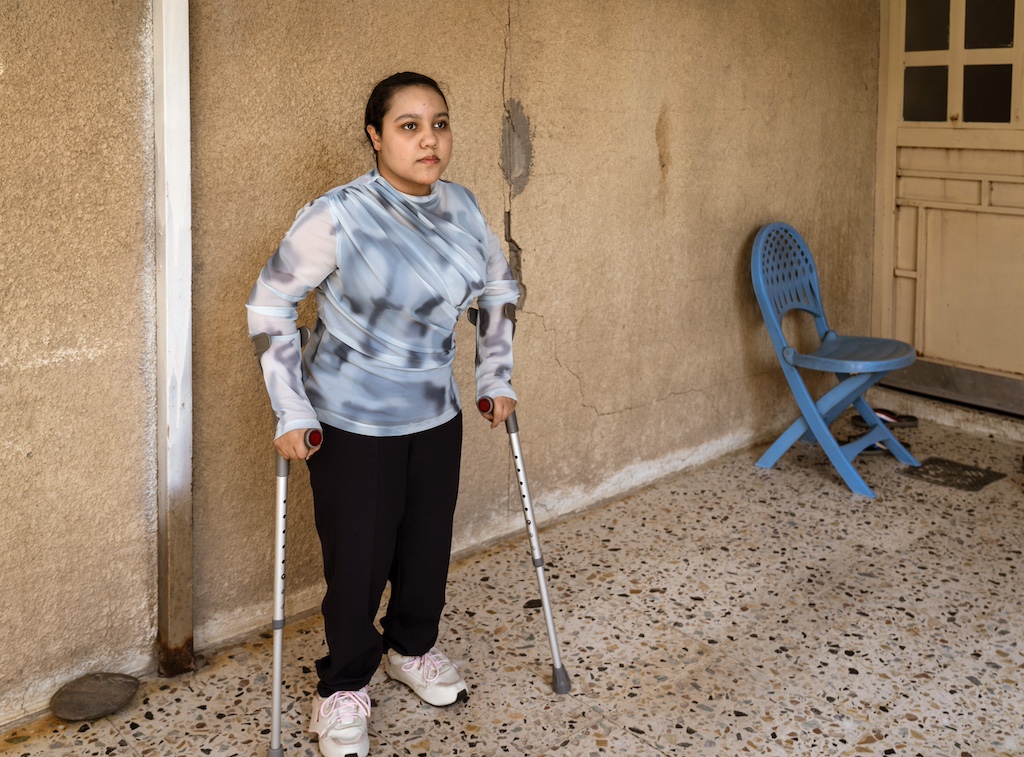
Lubna Thaer, an artist who was born with deformities, pictured outside her home in Fallujah. (Jaclynn Ashly / Jacobin)
Shukria Mahmoud, age sixty-two, was two months pregnant when the United States launched a brutal, house-to-house assault on the central Iraqi city of Fallujah in 2004 — a campaign against insurgent anti-occupation militants that left much of the city in ruins.
In the Second Battle of Fallujah that November, US forces, supported by a British battalion on the ground, bombarded the city for about six weeks. They used precision bombs, rockets, missiles, nearly one hundred thousand rounds of aircraft fire, and white phosphorus, killing hundreds of civilians.
Shukria was one of the few who escaped after the fighting began, slipping past street battles and coalition checkpoints that had sealed the city. She joined nearly the entire population of Fallujah — about three hundred thousand people — in fleeing the city, taking temporary refuge in a camp in Amiriyah, south of Fallujah.
Despite the hardship, she was overjoyed to learn she was expecting twins.

When the fighting eased, she returned to Fallujah with her family to rebuild and prepare for birth. But in labor, her joy turned to shock: instead of twins, she delivered one girl who appeared to have two heads.
The infant did not have a second head, but a fluid-filled sac that caused her skull to enlarge disproportionately — a condition known as hydrocephalus. It was one of many congenital defects that surged in Fallujah after the assault, widely blamed on toxic remnants of US weapons, including heavy metals and depleted uranium contaminating the city’s soil, water, and air.
“The doctors say that I likely got exposed to white phosphorus when I was trying to flee the city,” Shukria says. White phosphorus — a highly flammable chemical that inflicts severe and penetrating burns on contact with skin — was used by the United States against civilians in Fallujah, in violation of international law.
Shukria’s daughter, whom she named Fatema, survived for only three years.

More than two decades later, Fallujah’s health crisis endures, with high rates of birth defects and cancers continuing unabated. Experts say these illnesses reflect an invisible legacy of modern warfare that has followed US military campaigns across the globe.
Israel — fully backed by the United States — is estimated to have dropped two hundred thousand tons of bombs over two years on Gaza, one of the world’s most densely populated areas. At a far greater scale than the US assault on Fallujah, Israel has unleashed the same weapons — including white phosphorus and suspected depleted uranium bombs — poisoning the territory for centuries to come.
A fragile ceasefire has been reached in Gaza, marking a halt in large-scale fighting but not an end to the crisis. Despite the truce, hundreds of Palestinians have been killed in alleged violations since it took effect on October 10.
Amid the rubble, hunger, displacement, and sporadic violence, experts warn that Gaza’s battles are just beginning, with Fallujah’s intergenerational suffering serving as a stark warning of what may lie ahead. These contaminants may prove a more stubborn obstacle to the $50 billion redevelopment scheme promoted by Jared Kushner and US special envoy Steve Witkoff — touted as a plan to transform Gaza’s coastline — than even the enclave’s shattered infrastructure.
Poisons That Outlive War
Shukria still remembers her daughter, Fatema, with tenderness. “Even though she had these serious deformities, she was still beautiful,” she says, sitting on a couch in her Fallujah living room. “We cannot forget her.”
In 2007, when Fatema fell gravely ill, the family tried to rush her to the hospital. But that night, US soldiers, who maintained a heavy presence in Fallujah long after the 2004 battles, had surrounded their home during a counterinsurgency raid. “We couldn’t even open the door to get her out,” Shukria recalls. Fatema did not survive the night.
“Sometimes I imagine what kind of person Fatema would have become if not for these weapons,” Shukria says, her eyes fixed on the floor. “She would be a teenager now — going to school, helping me around the house. I wonder how her voice would sound and what she would look like.”

“The Americans destroyed everything in Fallujah,” she continues. “Our homes, our environment, our children’s futures.” Several of her relatives’ children were also born with severe deformities, including spinal defects that left them paralyzed, and most did not survive long.
Many young people, including her twenty-four-year-old son, are postponing marriage, Shukria says, fearful of having children with congenital defects or serious illnesses. “Everyone is scared they’ll end up with a sick or deformed child,” she explains. “It’s exhausting and expensive.”
Since 2004, childhood cancer rates in Fallujah have risen twelvefold, while birth defects have increased seventeen-fold. Although the exposure scenarios differ significantly, increases in certain childhood cancers exceed those recorded in post-bombing Hiroshima. The offspring of US military personnel who were in Iraq and Afghanistan have been similarly affected.
Research by Mozhgan Savabieasfahani, a leading environmental toxicologist known for her extensive research into the effects of war contamination on human health, attributes these spikes to toxic exposure. Her work has long traced Fallujah’s 2004 bombardment to the city’s ongoing health crises.
She found that children with defects carried far higher levels of lead and mercury in their hair, with congenital malformations — most commonly heart and neural tube defects — affecting over 15 percent of births after 2003. The miscarriage rate also rose sharply from 10 percent before the conflict to more than 45 percent; research also recorded a significant increase in infant mortality, much of it linked to congenital birth defects.
The Continuing Body Count
A Costs of War study published earlier this year found that, more than two decades after the US assault — and more than a decade after the Islamic State in Iraq and Syria (ISIS) occupied the city — Fallujah’s residents still carry the war in their bodies. Uranium was detected in the bones of 29 percent of participants, and lead in 100 percent, at levels 600 percent higher than similarly aged populations in the United States.
Soil samples from the city’s most bombarded neighborhoods also showed persistently elevated levels of heavy metals, indicating lasting contamination from military activity.
“All populations have some birth anomalies,” says Kali Rubaii, assistant professor of anthropology at Purdue University and the study’s lead researcher. “But in Fallujah, we found far higher rates of lethal neural defects — including hydrocephalus — which occur in the first trimester and are linked to weapons exposure.”
“Our research shows that living amid heavy metals and military debris is at least partly driving these spikes — the rates of which are far above average — even if it may not be the only factor,” she says.
According to experts, Fallujah epitomizes the long-term health toll of US bombardments in the post-9/11 wars, from Iraq to Afghanistan and beyond. “Lead and mercury, the two main neurotoxic metals, are heavily used in weapons manufacturing and found at high levels everywhere in Iraq,” explains Savabieasfahani.
Lead gives munitions density and penetrating power, while mercury is used in detonators to ignite the explosive charge. Both release toxic particles into the soil, water, and air when fired. US weapons, which account for 43 percent of global arms exports, also rely heavily on depleted uranium for their armor-piercing capacity. On impact, the uranium ignites into toxic dust that lingers in the environment and enters the human body through inhalation. Other toxic metals, including copper, zinc, chromium, and cadmium, are also widely used in modern munitions.
“And these metals don’t go away,” Savabieasfahani says. “They don’t break down into anything smaller or less toxic.” Scattered by wind but persistent for centuries, they ensure that, without a serious cleanup, birth defects and cancers will plague generations.
The Long Shadow of Fallujah
Saba Fayadh, age fifty-four, sits cross-legged on the cold tiles of his Fallujah apartment, arranging a scattered collection of medical documents. Nearly fifteen years ago he welcomed his first son, Abdullah, with quiet joy.

But the fatherhood he imagined was replaced by countless days, months, and years under the harsh glare of fluorescent hospital lights. “He only survived two years,” Fayadh says, his voice cracking as he passes over his son’s death certificate.
In 2013, Abdullah died during surgery in India after years of battling rare congenital heart defects — the most frequently documented birth abnormalities in Fallujah since 2004. These included gaps in his heart and arterial malformations.
The Fayadh family, rooted in Fallujah for generations, has no history of cardiac illness. Doctors in Iraq and India told him the condition was also likely caused by toxic exposure from lingering contamination left by weapons used in Fallujah.
Three years after Abdullah’s death, in 2016, Fayadh and his wife, who have four other healthy children, welcomed a daughter, Rahma. “When I saw her born, I was very happy because she seemed healthy and normal,” he recalls. That relief vanished as Rahma’s childhood also became consumed by hospital visits.

She was diagnosed with the same congenital heart defects as her brother, only more severe. Fayadh opens a thick folder of medical reports and X-rays. The records detail a grave condition made up of four interrelated defects that starve her body of oxygen. The worst is a malformed pulmonary valve, completely sealed shut, blocking blood from reaching her lungs. Holes in her heart force the organ to strain, compounding her fragility.
Despite open-heart surgery three years ago, complications have spread to her lungs and gallbladder. “Every time we treat one thing, another problem comes up,” Fayadh explains. “It’s an everyday, constant battle to keep her alive.”

Rahma, now nine, sits nearby, offering shy smiles — too young to understand the gravity of her medical conditions. “She’s still a child,” Fayadh says. “She wants to play with the other children, but we can’t allow it. Her heart is too weak. She misses a lot of school because her health is too fragile.”
Fayadh’s hands tremble as he describes the financial toll. “I sold my house. I sold my car. More than $100,000 on operations for two children. And it’s still not enough.”
He pauses, eyes fixed on the documents. “The United States — they pretend to care about democracy and human rights. But they are the enemy of human rights. They destroyed generations here.”

“And now the same is being done in Gaza — children are being killed and the futures of those not yet born are being destroyed. I fear for the Palestinians. If Fallujah has suffered this long from these weapons, what will become of them? I’d be blessed not to live to see it.”
Contaminated Earth
Fayadh’s views echo those of many experts: Israel’s bombardments of Gaza, Lebanon, Yemen, and Syria mirror US assaults on Iraq and Afghanistan in the early 2000s, relying on many of the same US-supplied weapons — most notably the two-thousand-pound Mark-84 bomb. In 2023, nearly 70 percent of Israel’s arms imports came from the United States, underscoring this continuity.
In February, Savabieasfahani led still-unpublished research at bomb craters in Beirut, where Israel admitted to dropping at least eighty tons of US-supplied guided bombs on residential buildings. The study found soil in the craters contained significantly higher levels of toxic metals such as mercury, titanium, and aluminum than in unbombed areas, along with elevated levels of radioactive uranium and thorium — measured at two and four times higher, respectively.
According to Savabieasfahani, the research strongly suggests that Israel is deploying depleted uranium munitions — linked to kidney damage, cancers, birth defects, and neurological disorders — against the countries it is now bombarding, including the besieged Gaza Strip.
“The same ammunition used in Iraq is now being deployed in densely populated areas across Western Asia: Lebanon, Palestine — especially Gaza — Syria, and Yemen,” Savabieasfahani tells me. “US weapons have effectively contaminated the entire region, and generations will certainly face elevated rates of birth defects and cancers as a result.”
Savabieasfahani warns that the long-term health consequences of Israel’s bombing campaign will far surpass what was documented in Iraq. “I’m very certain that in Gaza we will see ten times — if not more — worse congenital birth defects and cancers than we ever saw in Fallujah,” she says. “Fallujah was never massively bombarded with these weapons two years straight. It was a fraction of what we’ve seen in Gaza.”
“Israel is committing a multigenerational genocide by leaving behind a toxic legacy of a contaminated environment that will make it unfit for human reproduction.”
A US Precedent
Much like the United States in Iraq two decades ago, Israel has pursued a “maximum damage” doctrine of collective punishment, showing little distinction between militants and civilians. In Gaza, more than sixty-five thousand Palestinians have been killed, likely far more, and millions have been perpetually displaced.
“This is no accident,” says Raed Jarrar, a political analyst and human rights advocate. “For decades, the United States has set precedents that eroded respect for international law.”
For Jarrar, the connection between past and present is unmistakable. “Fallujah remains a symbol of US war crimes — an invasion that emptied the city and razed homes one after another, much like Gaza today,” he tells me. “What we see in Gaza is the direct result of decades of US breaches of international law and the destruction of mechanisms meant to uphold it. When the US got away with so much in Iraq, Israel knew it could get away with everything it’s doing in Gaza.”
The proposed involvement of former British prime minister Tony Blair in Gaza’s postwar planning has further reignited memories of the Iraq War, in which those responsible faced no consequences. Blair, a key architect of that invasion, has been tapped for a position in the proposed “Board of Peace,” prompting critics to see his appointment as a continuation of failed Western interventionism.
Residents of Fallujah say the United States should fund a comprehensive environmental cleanup to protect future generations, but despite Iraq’s efforts to seek accountability and international support, no meaningful remediation in the city has taken place.
Such a cleanup would be a monumental task requiring vast resources, explains Keith Baverstock, a radiation expert and former World Health Organization (WHO) adviser. “Long-lived radioactive materials can settle in the topsoil, where they enter vegetation and the food chain. Removing that layer is possible, but it’s enormously difficult — and then you have to figure out where to put it.”
He notes that in Fukushima, contaminated soil has been stored in large plastic containers. “But eventually the plastic disintegrates, while the radioactivity remains, seeping back into the environment over time,” Baverstock tells me.
“Once a major contamination occurs, you’re left with an almost unmanageable problem,” he adds. “These materials get into everything. Repairing the damage requires immense resources and political will — and even then, it’s still difficult. That’s why the best solution is not to create these situations in the first place.”
As for Gaza, Baverstock is grim. “With the sheer scale of explosives that have saturated such a small territory — injecting the earth with chemical toxicity from exploded and unexploded ammunition — it’s not a place where life could ever return to normal, even if remediation were attempted.”
Savabieasfahani, who has long urged the UK government to clean up areas contaminated by allied military forces, argues that stronger accountability could have prevented further devastation from US weapons worldwide.
“If the United States had been forced to clean up the damage it left in Vietnam all those years ago and confronted the cost of that destruction, maybe we wouldn’t have had Iraq — and today the United States would think twice about having bankrolled Israel’s genocide in Gaza.”
The Art of Survival
Lubna Thaer, age nineteen, has grown up in the shadow of this invisible war waged on the bodies of Fallujah’s children. Born with severe deformities in her legs and spine, she spent most of her life unable to walk. Nerve damage in her hands prevents her from lifting her arms.
After several surgeries in India, she gained partial mobility in her legs about a year ago. But her progress requires constant physical therapy, and more operations still lie ahead.

“I missed out on having a childhood,” Lubna says. She believes her condition was caused by US weapons. That knowledge leaves her angry and in pain — not only for herself, but for the many children and teenagers in Fallujah who suffer from even worse deformities and illnesses.
Yet Lubna has found her voice in art. She has exhibited in more than thirty galleries across Iraq, won prizes in Egypt, and is now a member of the Iraqi Fine Arts Association. Her paintings reflect Iraq’s desertification and the scars of war, while also reaching beyond Fallujah, drawing connections to Palestine.
“My art helps me process what was done to my community, and what continues to be done in Gaza and elsewhere,” she tells Jacobin, standing proudly before her canvases stacked against the walls of her family’s home.

“I want the Americans to know the consequences of their weapons and destruction,” she says firmly. “They must take responsibility for what they have done to the environment, to the children, and to future generations in Fallujah and beyond.”
“Instead of destroying communities and helping Israel devastate Gaza, they should use their resources to support children here with their hospital bills, special-needs education, and by cleaning up the toxins they left behind.”