Capitalism Won’t Collapse on Its Own
Capitalism’s recurring crises have long fueled predictions of its inevitable demise. Vivek Chibber explains why breakdown isn’t guaranteed — and why political agency, not historical laws, will determine what comes next.

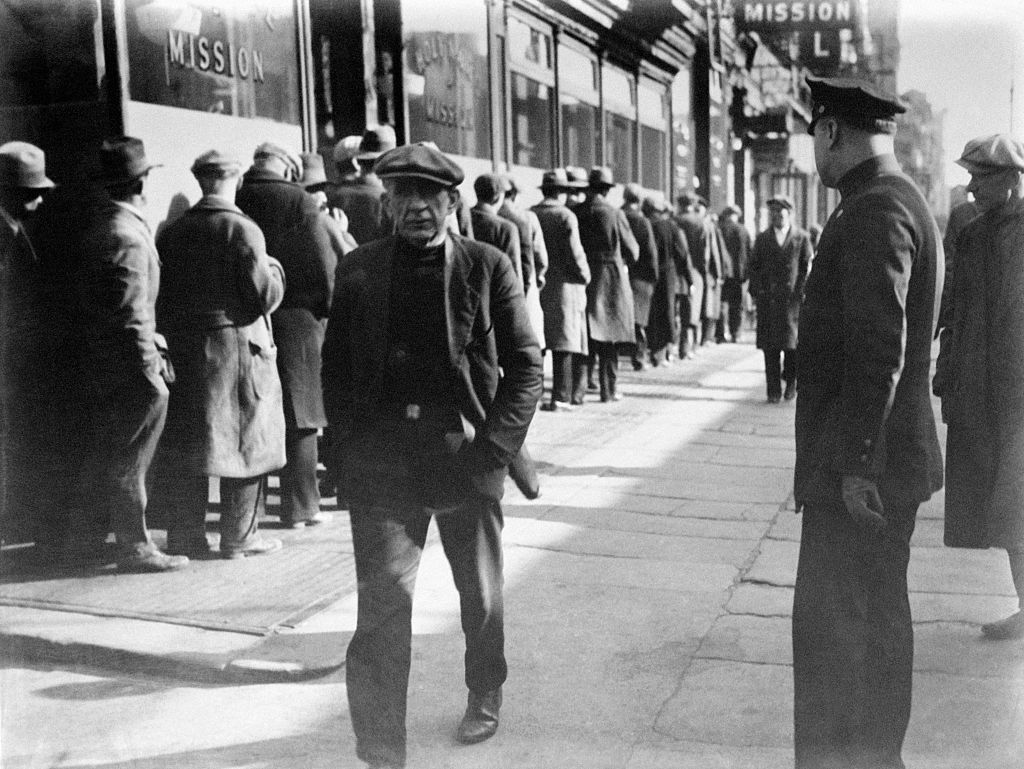
Unemployed workers line up for a free meal in Great Depression–era New York City, 1931. (Keystone-France / Gamma-Rapho via Getty Images)
- Interview by
- Melissa Naschek
Socialists have long predicted capitalism’s overthrow and replacement by a better system. But do we have any reason to believe capitalism must come to an end?
On the latest episode of the Jacobin Radio podcast Confronting Capitalism, Melissa Naschek and Vivek Chibber discuss the role of economic and ecological crises in capitalism’s possible demise. Just as it is a mistake to think that capitalism will last forever, it’s also unrealistic to think that it is destined to collapse.
Confronting Capitalism with Vivek Chibber is produced by Catalyst: A Journal of Theory and Strategy and published by Jacobin. You can listen to the full episode here. This transcript has been edited for length and clarity.
Melissa Naschek
When I was coming up on the Left, I heard a lot about Francis Fukuyama’s declaration of “the end of history.” By this, he meant that capitalism was here to stay, and there was nothing anybody could do about it. But I think that changed in the post–Bernie 2016 moment because suddenly there was hope where there hadn’t really been much before. And that brought into play all these other theories that argue the exact opposite: that not only will capitalism end, it actually has to end, that some sort of break is inevitable within capitalism.
Vivek Chibber
When Fukuyama wrote his book, there was a sense that “There is no alternative.” That the Soviet Union is gone and the only existing alternative to capitalism, at least in real life, was no longer there. And it looked like there was no other economic system that was possible.
But we are in a different world today, because even if capitalism’s end is not on the horizon, the form in which capitalism has existed for the last forty years, which is neoliberalism, is in absolute crisis. And certainly once you see that some aspects of the society around you, which seemed unshakable a few years ago, are suddenly up for grabs, and they’re melting and crumbling, it does raise the possibility in your mind that maybe you could be even more ambitious; that maybe you could actually start to think about bringing down capitalism itself.
Melissa Naschek
There’s been a consistent strain within Marxism predicting that the end of capitalism is either just around the corner or is destined by “the laws of historical motion” to end. And Karl Marx has tons of quotes that are often used to support this view, one of them being that capitalism creates “its own gravediggers” in the working class.
Vivek Chibber
Right. And he also said that there’s a kind of a sequence in history where economic systems come and go. And they fall apart and implode when they start impeding technological progress. So in his language, when the class structure, or the relations of production as he called it, become fetters on the forces of production or in technology, at that moment, these economic systems become unstable.
Historical Materialism, Explained
Melissa Naschek
So why do we have any reason to think capitalism might ever come to an end?
Vivek Chibber
Karl Marx and Friedrich Engels developed this idea that it’s not just that capitalism will someday come to an end, but that capitalism is merely the latest economic system in a list of systems that have come to an end. And that there’s a pattern across different economic systems such that when they do fall apart and are followed by a new one, it’s always governed by the same principles. It’s a very powerful theory, right or wrong. It’s one of the most elegant theories social science has ever produced.
What the theory of historical materialism basically said was that, across history, you have not just one economic system. . . Capitalism hasn’t always existed. It’s a very recent economic system. It really came about in the 1500s and 1600s.
Melissa Naschek
Right. And this is an important part of Marx’s theory itself, the fact that capitalism actually has a distinct beginning.
Vivek Chibber
Yeah. The idea is it has a birth date and it has an end date as well. And that is an incredibly bracing idea — that it isn’t inevitable. It’s the opposite of Fukuyama. Fukuyama says, “Well, now we are in it for the long run. There was this illusion that there was some alternative to it, but that’s over.”
What Marx and Engels were saying is that, in fact, every system has a time stamp on it and it’s going to come to an end. Roman slavery came to an end, feudalism came to an end, and capitalism, like them, will come to an end. But they also argue that not only will it come to an end, it’ll do so for the same reasons that slavery ended and that feudalism ended.
Melissa Naschek
What does that mean?
Vivek Chibber
The theory of historical materialism argues that there is a logic that governs the ebb and flow of economic history.
So the idea is that there is a continuity in human history, which is that human beings continually develop their technological and economic efficiency. And they do it because it frees them up from labor. It gives them a higher standard of living; they appreciate that higher standard of living, and they appreciate having to work less. Marx and Engels thought this was an inbuilt drive in human nature.
Now, in any given economic system, the institutions of the economy — such as the class structure, the ways in which commerce is carried out, the ways in which banking or money is organized — all of it is governed by this logic: People will abide by an existing set of institutions as long as it feeds their desire to continue to improve their standards of living.
And when it ceases to do so, it unleashes a series of crises in that society because people start pushing against the barriers of the existing institutions saying, “This isn’t really working for us anymore.” So slavery at some point became — Marx is ambiguous on this — either unproductive or not sufficiently productive to make people happy.
Melissa Naschek
This is the notion of fetters. It’s that barrier that you’re describing.
Vivek Chibber
Exactly. And what happens is that because economic institutions are no longer promoting growth, the battle between classes intensifies, because the economic pie isn’t expanding. And because the battle now intensifies, during the course of that battle, people start reaching for alternative ways of organizing institutions. And through some mysterious process, maybe trial and error or maybe through warfare, a new economic system comes about that people find is more congenial to their material interests, to their desires. And that creates a stability.
How does it make it stable? Well, the ascendant economic system reduces the amount of conflict in society because the new ruling class can now preside over more productive economies and can, through its exploitation of people, also raise their standards of living.
Melissa Naschek
Yeah. It sounds like a natural selection argument in that there’s this assumption that people want a better, more productive economy because it’s going to provide them with a higher standard of living. Therefore, the institutions that continue to promote that increasing level of quality of life are going to be selected for.
Vivek Chibber
Yeah. And Marx had to marry that to his other proposition, which is that “the history of all hitherto existing society is the history of class struggles.” So if classes and class struggle are the engine that drives this stuff, but at the same time, it’s this individual desire for improved standards of living, how do the two come together?
The way they come together is that the new class that comes into power — let’s say, the feudal nobility which came into power after Roman slavery — that new class is going to exploit peasants, just the way the Roman slave owners exploited slaves. But because the economic pie is now expanding faster than it did during Roman times, the peasants and the laboring classes, even though they’re still being exploited, are going to have higher standards of living than the people of the laboring classes had in the preceding mode of production.
So while exploitation is still going on, the class struggle, through some kind of selectional process, put into place an economic system in which the level of conflict is now reduced. And so you get economic stability. And now this economic system goes on for centuries and centuries until it also starts becoming a kind of a block to further development that unleashes a new intensified cycle of class conflict, at the end of which you stumble into, in some way, a new economic system. And now you have capitalism.
The claim is, at some point, capitalism will also become a system in which class relations, capital and labor, become obstacles to technological progress and economic growth. And that will unleash class struggle. And through that, you will get the onset of, hopefully, socialism. That was Marx’s idea.
So the same logic is governing the transversal from one economic system to another across history. And that, Marx said, makes it inevitable. Because every economic system, at some point, is going to become something that is not developing sufficiently fast to abate and to limit conflict. And when it’s unleashed, you get the conditions for a new economic system coming up.
The generation of Marxists in Marx’s time, in Vladimir Lenin’s time, all the way into the 1940s and ’50s, at least give lip service to the idea that they are aligned with the forward march of history, and therefore they are helping push history faster along these grooves in which it’s already set. That was the idea.
The Politics of Capitalist Rupture
Melissa Naschek
So do you think that this theory actually motivated political action by figures like Lenin and other people who were invested in and researching this theory? Does it relate at all to the Russian Revolution or anything like that?
Vivek Chibber
Well, it’s a funny thing. When you read deeply into the debates they’re having in the early 1900s and going all the way up until 1917, it doesn’t come up very much.
Let’s take a caricatured view of this. Suppose Lenin and [Leon] Trotsky are sitting around and they say, “Look, are we going to have this revolution or not?”
Melissa Naschek
Lenin and Trotsky have a podcast.
Vivek Chibber
Right, so they’re sipping their vodka over the Volga. And in the discussion, Lenin says, “So, Lev, what do you think? Are we going to have this revolution?” And Trotsky says, “I don’t know, sooner or later. I mean, we know it’s going to happen. So why bother so hard? Why do we have to work so hard?”
But when you look at their debates from 1902 onwards, when the Bolshevik faction is formed and they’re debating the Mensheviks and they’re having all these arguments, it’s all in this context of feeling that, if we get this wrong, we won’t recover. If we don’t build the right party, it won’t work. If we don’t have the right strategy, the right tactics, we’ll be decimated. And once we’re decimated, we won’t get this chance again.
You don’t get the sense that anybody’s working with a sense of inevitability, right? So in that sense, you don’t see it very much.
And in fact, what they’re imbued with, I think, is something that’s quite the opposite, which is that here in Russia, we might have a revolution way before we’re supposed to.
Marx’s theory said that revolutions should occur in the more advanced capitalist countries that are ready economically, with an economic foundation that could be the basis for a viable socialism. Russia was in many ways the last country where that should have happened because it was the most backward country in Europe.
Now, Marx understood this in his last years and he tried to figure out how the Russian socialists and the anarchists might be able to build on the institutions of a backward Russia, but he never for a moment thought it would be a cakewalk. He knew that the backwardness of the country would be an obstacle.
What I think was really worrying the Russian Marxists was that, far from being inevitable, they were in a situation where the revolution shouldn’t have happened at all. So if you’re working with a theory of history that says that events are going to move along as predicted, Russia shouldn’t have been in a revolutionary situation to begin with.
Now, they came up with their theories to explain why that was happening. But for our purposes, were they motivated by this sense of inevitability? I don’t see it. I can’t see it.
On the other hand, I do think it mattered in one respect, which is that I think that for the leadership of the party, feeling that even while this or that country at this or that moment might be an exception — like Russia was an exception — and that revolutions might occur out of sequence, they could see these as momentary perturbations. That, in the end, Marx basically had it right; that there is going to be this arc in which all the countries fall into line, but he might have gotten the sequence wrong.
I think that did matter for them to some extent. It didn’t matter in 1917–18. It didn’t matter in 1905, when they were in the throes of revolutions, but it probably mattered to them in between the revolutions.
There was this period from say 1907 to the 1910s when things looked really bleak in Russia. They’d been defeated in the 1905 revolution. They were discouraged. And, I don’t have direct evidence of this, but you get the sense when you read their letters and their correspondence that they’re feeling, “Yeah, things are bad now. It’s bleak, it’s bad, but we are on the side of history, or history is with us and we just have to hang on. We have to marshal our forces because sooner or later things will come back in line again.”
Ironically and oddly, I don’t think it mattered to them much in the revolutionary moments when they’re actually organizing themselves. At that moment, they’re overtaken with minutiae — tactical issues, strategic issues, military issues. I think it did matter in between when they were demoralized and you need something to hang on to.
That, I think, is where a feeling of inevitability to history did have some motivational force for them and probably played a role in their being able to survive through very hard times.
Reaching a Breaking Point?
Melissa Naschek
You described the theory as “elegant,” but you’ve also expressed some skepticism about it. What are the components of the theory that you think are strong and then where are your criticisms of it?
Vivek Chibber
Well, if you just take the theory at its most basic level, I think there’s a plausibility to it.
At a very basic level, it’s saying human beings are motivated by their material interests, that once they achieve a certain level of development, they’re going to tend to hang on to it, even with classes and class struggle and all that sort of stuff, that therefore there’s a kind of a direction to history.

Total output of the world economy in logarithmic scale. Data sources: Eurostat, OECD, IMF, and World Bank (2026); Bolt and van Zanden — Maddison Project Database 2023; Maddison Database 2010 — with major processing by Our World in Data. If you played human history over again a hundred times, each time the slope of technological development would be positive. It wouldn’t be this loop the loop or a random walk where it develops and it falls back, then it develops and it goes back to zero, things like that. There might be short periods of decline, like there was after the fall of the Roman Empire, but it picks up again and it starts moving forward again. I think that makes sense.
That’s a very weak thesis, not trivial by any means. But it’s a weak thesis.
On top of that is a stronger thesis, which is that not only that history moves along a kind of a directional line, but that economic systems come and go precisely when they become unable to keep technological dynamism moving at a certain rate.
Melissa Naschek
Right, and this is the part of the theory that really leads to this conclusion that capitalism must have a breaking point.
Vivek Chibber
For that to happen, you need two things. Firstly, you need to have empirical evidence that when the Roman Empire fell, it was for this reason, that when feudalism came to an end, it was for this reason. Secondly, you have to show that whatever replaced it, replaced it for that reason. You have to show that it replaced it because of some role that class and class struggle played in it.
There’s a lot of debate around this. My view is that the evidence for this is very, very weak. I think it’s very hard to show that the Roman Empire fell because it was no longer moving technology forward, or that feudalism fell because it was no longer moving technology forward. It’s also very hard to show that the class conflict that was unleashed at the end of these things was in any way preordained to result in the way that it did. I think it’s perfectly feasible that what replaced the Roman Empire could have been something that kept the same level of economic development for centuries onward.
So among Marxists and non-Marxists who have paid attention to this theory, myself included, the general idea has been that the strict version of Marx’s account of historical change and historical development is probably not sustainable.
Now, when we come to the idea of capitalism breaking down, and socialism replacing it, there’s a particular difficulty, which is: Within this idea that capitalism will come to an end when it’s becoming obsolete or when it’s becoming, as Marx said, a fetter on technological development, what is the mechanism by which it’s going to break down, or by which it’s going to be replaced by socialism?
Melissa Naschek
And, like you said, this theory provides a very logical flowing answer, which is that it will break down when the institutions that support it are no longer promoting technological development.
Vivek Chibber
Right. So now, this is a little bit technical, but let me just lay it out.
Marx and Marxists say that the economic system will become unstable when the existing property relations — the class structure — become blocks on its further development. The language they use is “fettering,” as in when the relations of production fetter the further development of technology and the productive forces.
Now, there are a couple of ways in which you can understand what it means for the economic institutions to fetter the further development of technology. One is an absolute sense and one is a relative sense.
In the absolute sense, technological growth will just stop. This would mean capitalism just kind of breaks down like a car engine breaks down. And when the car engine breaks down, you’ve got no choice but to replace it or rebuild it with something better.
Now, the other way in which you can understand fettering is a relative sense, which is that there is still positive economic growth and technological development, but an alternative system might be able to do it better.
Melissa Naschek
This is sort of like opportunity costs.
Vivek Chibber
Yes, exactly. There’s something better that you could have. The grass is greener on the other side. And so that other system becomes attractive.
Let’s just examine both of these.
If we look at the first one, which is the idea that capitalism will come to an end because economic growth will stop, not only is there no evidence that that’s ever going to happen, we can’t even devise an economic model that would tell us what that might be.
There have been, in Marxist economics, some attempts to build a model that would show this breakdown of capitalism. And ironically, they’re called breakdown theories of capitalism.
A very famous proponent in the 1930s was a guy named Henryk Grossman. And the basic idea was that, for reasons that we don’t have to go into, the amount of surplus and surplus value that economic firms are producing starts being squeezed to the point where the profits that are coming out of production are no longer sufficient to even be reinvestable. And so, capitalists run out of money to reinvest in their production, and at that point, you have the engine breaking down. And workers will essentially say, “Well, listen, the only way to keep this thing going is to, we keep the factories, but under entirely different rules. The rule now is no private property. We’re going to run them under what you might call socialism.”
Very interesting theory, but the model can easily be shown to be based on outlandishly unreasonable assumptions. And so it didn’t really find much traction.
And in our historical experience, we’ve also seen that it’s never happened that an economic crisis leads to freezing of economic growth, zero growth.
In fact, what happens is there are lots of economic crises in capitalism, and those crises are generated by the internal dynamics of capitalism itself. They’re not just accidents. They’re not just exogenous shocks. They’re internal to capitalism.
But Marx was at pains to show, and there are lots of contemporary economic models that also show, that the crisis is like a virus. It’s not a terminal virus. It doesn’t kill the system. What the crisis does is it roots out all the weak elements in the system. And, like a virus, it has an end date out of which the system emerges stronger and at least viable. So crises come and go. And after each crisis, economic accumulation and profitability and economic growth starts again. It commences again.
Melissa Naschek
But listening to you describe this, it does raise the question of why, if capitalism is just going to collapse in on itself, does that mean that it would be replaced by socialism specifically?
Vivek Chibber
That’s a separate question. And we can say that that is a further challenge to the theory. And Lenin and Rosa Luxemburg used to say that in these moments of crisis, you shouldn’t assume that it’s going to be replaced by socialism. It could also be replaced by something worse. Their slogan was “socialism or barbarism,” right? But we haven’t even gotten there yet.
The first question is, is there any reason to think that the system will come to a screeching halt and break down on its own so that you basically are left with an open door to coming up with a new system? And there really isn’t.
Now, let’s look at a second alternative, which is this relative fettering. That’s certainly feasible. It’s certainly feasible that capitalism can keep chugging along crisis after crisis, but growth can be slow — positive, but slow. And if growth is positive, but slow, you can think of an alternative way of organizing your economy where it will be positive, but fast. So it’ll be preferable to capitalism. That kind of fettering is easily imaginable.
Now, does that save the idea that the end of capitalism is inevitable?
I don’t think it does for the following reason: Even if you can imagine a better system, the transition to that system may not be costless.
So suppose when capitalism is chugging along, but at a slow pace, we talk to all the workers in the general population and we say, “Hey, look, a better system is possible.” And that might be attractive to them. But to get to that other system requires decades of bloodshed, huge military battles, failed revolutions, try and try and try again. Sure, the theory says, at the end of all that, you might end up with socialism, but for a rational person, they might say, “Hey, this could involve three generations of conflict or one generation of very bloody conflict, and I might not make it. Or my family may not make it.” So unless you know that you will be among the winners, why would you undertake all these risks?
To give you an example, you could say that under Salvador Allende in Chile in 1973–74, they conceived of socialism as an alternative, but they were beaten by a very bloody counterrevolution organized by the CIA and by Augusto Pinochet. And that was enough to actually demoralize and dissuade two generations of Latin American revolutionaries and socialists, that this is not something we can win.
So even if you can imagine a better system, even if you know that it might be a preferable system, it is by no means clear that the costs of getting there will be such that you’ll find it feasible to take on those costs and to take all those risks. And so there might be this kind of moat that separates your economic system from the alternative one. And you might find that you’re much better off with the certainty of fixing this system, of getting the engine going again, even though it’s not ideal, because at least you’re making ends meet, and at least you’re doing okay for yourself as opposed to being slaughtered or executed or wiped out in a counterrevolutionary coup.
If that’s the case, the mere possibility of an alternative system does not guarantee that you will end up in that alternative system. It comes down to the organizing, the agency, the strategic vision, and the degree of confidence you’ll have that you can actually achieve it with acceptable costs, with costs that you can actually absorb.
And if that’s the case, I don’t think there’s much of an argument for the inevitability of socialism or for the inevitability of capitalism’s end.
All you can say is capitalism becomes vulnerable at certain moments. A door might open up at certain moments, but your ability to take advantage of that vulnerability, your ability to take advantage of the opportunity entirely depends on the balance of forces, on your strategic capacity, on the resources you have available to you. And more often than not, it’s going to be lined up in such a way that it makes more sense not to do it.
Never Let a Crisis Go to Waste
Melissa Naschek
You mentioned crisis theory and this kind of subsection of the theory called breakdown theory, which predicted the eventual arrival of a crisis so massive that it will end capitalism as the historic mode of production.
But one of the most important contributions that Marxists have made to political theory is this idea that capitalism is a system that is characterized by recurrent, unavoidable crises. So if we’re rejecting this inevitability thesis about capitalism’s end, are we also challenging that aspect of crisis theory as well?
Vivek Chibber
No, and it’s a very good point. What I’m skeptical about is what’s called breakdown theory. And that had a very specific mechanism that we don’t need to get into. It had to do with the rate of profit falling to the point where it doesn’t generate enough revenue, enough surplus value to even be able to fund capital accumulation. We have to separate the fact of crisis from explanations for why it happens.
One of the great insights that Marxist economics had — and there are versions of Keynesianism and even some versions of mainstream theory that will say this — was to recognize the empirical fact that capitalism systematically has this recurrent vulnerability to economic slowdowns and what we call depressions.
When Marxists talk about crises, what they really mean is what in everyday parlance we call an economic depression. And capitalism has had economic depressions every few decades for all of its history.
So when something happens in a recurrent fashion, and we’ve had seven or eight of these in a three hundred year period, it’s a pretty good indication that there is an internal engine to the system that is propelling it into crises at a regular rhythm. That’s an empirical fact.
Then the question is: Why does it happen? For our purposes in this conversation, we don’t have to land on a particular theory of why it’s happening. What we need to probe is, if it is the case that capitalism does have this tendency toward recurring economic crises, toward depressions, what does it mean for our desire or our ambition toward building socialism?
There’s this tendency among Marxists and among socialists generally to run together two distinct things, which are economic crises and political crises. The idea is that once you have an economic crisis, it unleashes the political crisis. By political crisis, we mean the breakdown of state order, the breakdown of the army, the breakdown of class rule, and the opening of the door to something new: a new political system, a new form of state, a new form of rule.
And what I’m saying is that, not only is breakdown theory wrong, we should also be skeptical that the mere fact that there’s going to be an economic depression is going to lead to an alternative political system like socialism or something like that.
What we’ve seen over the course of capitalist history are two things. Firstly, you’ve had lots and lots of economic crises, and almost never has the economic crisis turned into a deep political crisis. Why? The basic reason is that the crises are always temporary. They last a few years. The longest one has lasted about fifteen years, and that was at the end of the nineteenth century.
Secondly, because capitalism has the resources for recovery from these crises, it gives people two alternatives. One alternative is you take all those huge risks, leap into the dark, and try to overthrow the system. And we already said how that could actually result in catastrophe for them. The other alternative is you try to cobble together a revived capitalism out of the crisis that allows you to get a job again, that allows you to have housing again, that allows you to get some kind of decent life for yourself again. That’s a much less risky proposition than trying to overthrow capitalism.
Because of that, ruling classes find that they are able to ride out the crisis and consolidate a new cycle of growth and accumulation inside the same economic and political system. So the economic crisis occurs, but it doesn’t typically unleash a political crisis.
Well, then what’s the point of having an understanding or recognition of economic crises? Even though the crises don’t automatically open the door to socialism, they do open a door. They do unleash the possibility of intensified conflict, intensified strife. Why? Think of the Great Depression. What happened in the Great Depression? Well, you didn’t really get socialism out of it. What you did get, though, was social democracy.
All across the developed world, the Great Depression led to huge strikes, huge labor mobilization. That labor mobilization a lot of times had the aspirations of socialism, but states didn’t break down. Remember from our discussion of revolutions, I said, you can’t just make a revolution. Largely revolutionary openings happen. And the classes or the political parties that are organized well enough can take advantage of it.
Economic crises don’t even create revolutionary situations. They just create political instability. That political instability though, does create an opening for things to happen.
Typically what’ll happen is you’ll be able to get some kind of advantages for yourself, your labor movement. You’ve been able to set up welfare states. You can set up social democracy, build more unions because people are agitated, they’re angry, and you’re able to take advantage of it. There have been occasions when it went further, like during World War I: there was a deep economic crisis coming out of it, and that did create revolutionary openings.
The point is there’s a common thread here. Economic crises do create political opportunities. What I’m saying is they don’t have to be revolutionary opportunities, but they are opportunities for other things, like building trade unions, like building the welfare state.
So when you compare economic tranquility and lots of growth with economic breakdown and economic crisis, that crisis situation is still important for making political gains for the Left, if it’s organized well enough to take advantage of the situation.
That means that if you’re trying to devise a political theory for yourself, a long-term political strategy, it makes sense to know that there are moments in capitalism’s history when it’s politically weak, and that political weakness arises out of economic weakness. That economic weakness is expressed in moments of crisis.
So having a theory of crisis, or at least having the expectation of crisis, even though you don’t know what’s driving them, knowing that they occur, gives you a motivation to organize yourself politically so that when that opportunity arises, you can take advantage of it. And for that, it turns out crises are important. A recognition of them is important, even though you reject the idea of an ultimate breakdown of capitalism through the crisis.
Melissa Naschek
Has the Left always benefited from economic crises?
Vivek Chibber
No, and this is why I raised the point of organization. I’m glad you brought this up.
Crises create opportunities to change things. Economic crises create opportunities to change things politically. Whoever changes it, though, will be the party, the class, the social force that’s better positioned to do so.
So if the Left and the trade unions are not well organized, in moments of economic crisis, it’s a huge opportunity for the Right. It’s a huge opportunity for capital. Rahm Emanuel famously said, “You never want a serious crisis to go to waste.” Now, he wasn’t a socialist. He wasn’t saying it from the standpoint of socialism. He was saying it as a representative of the ruling order.
When a crisis comes, for them, it means they can take more away from unions, from redistributive programs, from social programs. They can actually cut them down saying, “Hey, we don’t have the money for anything.”
Melissa Naschek
Right, because as much as it’s a political opportunity, it’s a political opportunity for both sides.
Vivek Chibber
Exactly, for both sides. That’s why for the Left, it’s a bad sign if the crisis is the first time you’ve noticed that we should get our act together, because by that time, it’s too late. What you have to be doing is building your organizational capacity in between the crises.
This is why we’ve been saying, and the current Bernie left has been saying, nothing is going to move forward until you have a well-organized working class, a well-organized labor movement, because those are your cavalry. Those are the forces that are actually going to be able to take advantage of economic opportunities when they present themselves, and if you don’t do it, the other side will.
The Climate Crisis and Socialism
Melissa Naschek
You’re arguing that crises do not automatically mean the end of capitalism, but for the most part, we’re talking about economic crises. There’s a whole other realm of crisis that we haven’t talked about, which is environmental crisis and the current climate apocalypse that’s hanging over us. Doesn’t that mean that capitalism will have to end in order to stave off the climate crisis?
Vivek Chibber
I don’t think so. I wish. I would like to be able to say that the impending climate crisis will motivate people to reach for another system or to say we’ve had it with capitalism, because capitalism might actually end up undermining humanity itself.
Melissa Naschek
I think there are people who have been radicalized basically on those grounds.
Vivek Chibber
There’s no doubt about it. And let me just say, I think they’re right that capitalism is running humanity into the ground, and it is destroying the environment, and it is generating climate change. But the basic problem still remains. And in many ways, it’s even worse when it comes to the climate crisis.
The first problem is this: If you’re actually going to say, “The climate crisis is so bad that I want to now fight for a different system,” the issue is that it’s a question of time horizons.
Even at its worst, the climate crisis is going to unfold over the course of decades, but a revolutionary upsurge to try to end capitalism will unfold over the course of a few months and years. Now, remember all the costs, all the risks, all the bloodshed that could come with that.
So if you’re going to say, “Well, the climate crisis is the reason I’m going to fight for socialism,” most people are going to say, “Look, if I fight for that socialism now, I’m going to end up dead now. Whereas I know that even if climate change keeps unfolding, it’s going to be generation, two generations, three generations.”
Even if you think it’s just a couple of decades away, it still doesn’t change anything. The one process is unfolding at a much slower pace than the other process — the second process being trying to overthrow capitalism. And so there are two costs. One cost, which is incremental, slow, and potentially absorbable. The other cost that’s immediate and catastrophic. A reasonable person is going to say, “I will opt for the longer, safer route.”
Now comes a second point, which is that even while capitalism is destroying the environment, it is also generating technological change internally that is slowing down the pace of climate change. Or if it’s not now, it could.
Suppose you have something like the green transition. The green transition is not a socialist program. It is a social democratic program that keeps private property intact. But if it’s actually a transition, meaning there’s going to be a transition to an environmentally sustainable capitalism. Well, then there’s even less reason to want socialism.
Consider that people will already say, “I’m not going to put my life at risk or my well-being at risk right now for something like the fight for socialism when the alternative to it involves much slower, absorbable costs.” And then, when you say to them, “Within eight or ten years, we might actually be able to reform capitalism to the point where it becomes environmentally sustainable,” now there’s even less reason for them to opt for the fight for socialism.
Melissa Naschek
I imagine that even if there are capitalists who don’t support any changes [toward a green transition], in theory, everybody would like to be on a habitable planet, right?
Vivek Chibber
Well, capitalists just want to make a profit. And if they can make profits through environmentally sustainable enterprises, they have no problem with that. So the only question is, can capitalist technological change generate the sorts of technologies that will be less destructive of the environment or even neutral with respect to the environment? We don’t know. We honestly don’t know.
And this is why a lot of climate catastrophism turns people off because it’s telling them, “There’s nothing you can do. You’re going to die,” which people kind of shrug and go, “Well, what’s the point then?” They throw up their hands, and say, “Well what can I do?”
And the other thing is that, before our eyes, there are enormous technological changes taking place that are having an effect in slowing down the rate and the pace of climate destruction. And that is going to have an effect on people’s willingness to take up these enormously costly political ventures, like trying to bring about socialism.
So that means then, that I think climate change should be one of the things that goes into a socialist program, but it is not going to be a magic wand. It’s not going to be something that you say, “Look, dude, unless you do this right now, we’re all going to die,” because that catastrophist version of climate change is paralyzing.
Melissa Naschek
Yeah. I think it also ignores a key component of what the Marxist argument has always been for socialism, which is that the reason that a socialist argument can be persuasive in the first place is because people’s daily experience is of being exploited and oppressed, and of their quality of life and their freedom basically being taken away by their boss. So it’s not like you need to add on this other element of, “Oh, by the way, you’re probably going to die in thirty years.” The point is that people are suffering under the system now. People are already in pain now. And so that is the basis for organizing.
Vivek Chibber
One hundred percent. I agree. I don’t think they need an additional motivation. What we need is to take the level of unhappiness and frustration and anxiety they have now already without climate change considerations and turn it into a material force for them.
But my point is, I think climate change . . . of course, we all agree it’s very important. And we probably have to acknowledge that it is motivating a lot of people to become politically active, but it is not going to be this elixir that induces people or persuades them to take the sorts of risks or incur the kinds of costs that normally they would be unwilling to do. And in fact, I really think that because of the pace at which it’s unfolding, everybody’s automatic reaction is, ‘Well, that’s down the road. What I’ve got to worry about is the here and now.’
All of which means that the hard, everyday work of organizing people, getting them together, getting them into unions, getting them to a political party, making them more inclined to fight is something that’ll be aided and abetted by the anxieties around climate change, but it won’t give us a trump card where we can dispense with all this hard work.
Socialism Without Guarantees
Melissa Naschek
I think you’ve put a pretty good nail in the coffin for these “inevitablist” arguments about capitalism. Do you think that this will serve as a call to action or do you think that potentially it’s a bit discouraging to hear that there’s nothing in the system that will end capitalism for us?
Vivek Chibber
Let me go back to what I said about the Russian revolutionaries, although it equally applies the Vietnamese and the Chinese, which is that, when you go back and you look at them in the historical record, you don’t find much evidence that this inevitablist, deterministic account of history really is what kept them going. In moments of despair, I think it did have something for them, as I said earlier, but really what it was, was peasants wanting lower rents, sharecroppers wanting better deals for themselves, workers wanting to take over their factories and lead better lives for themselves. It had to do with the everyday experiences of being exploited, the everyday experiences of being oppressed.
Now, I think for the leadership and the cadre that sit around and think in big ideas and big terms and try to devise strategy, it was there, it was somewhere. But suppose you took it all away and you told them what Marx said in the manifesto: history is just a history of class struggle. That’s all. It’s just class struggle and there’s no guarantees. Maybe you’ll win, maybe you’ll lose. Would that have had the effect of making them go, “Well, now I don’t want to be part of this?” Absolutely not. There’s no reason for that.
So my view is that if you take away the sense of inevitability, the determinism, it probably has an effect around the edges for some people, no doubt about it. But it was always massively outweighed by other considerations anyway, if we’re talking about people’s motivations.
If we’re worried about people losing force, losing their motivation to struggle, if you tell them, “Hey, it’s not guaranteed,” I don’t think that’s much of a concern because when you’re actually in the thick of a social movement, you’re not ever going to say, “I’m immortal. I’m not going to die. I’m going to walk into these bullets because I’m going to win anyway.” You fight the way you fight.
So is it possible that capitalism could go on forever? Well, I don’t know about forever. That’s a long time. But for the next few generations, absolutely.
Capitalism has shown itself to be an incredibly resilient system. There’s no sign whatsoever that it’s losing its dynamism per se. It’s still the most dynamic system we’ve ever seen. It goes through ups and downs. We’ve gone through a particularly sluggish couple of decades recently, but that’s “sluggishness” compared to the previous decades. That sluggishness has still allowed standards of living to still generally go up even though the distribution has been bad. There’s no reason to think that’s going to end anytime soon.
That means that fighting for a transition to socialism is up to us. It comes down to: Can you take advantage of openings? Will you be well-organized when the economic crisis comes? Will you be able to draw people to your program? Will you be able to inspire them and give them a sense that we could win without having these backroom guarantees that the inevitability theories provided?
If you can do that work, if you can organize well enough, if you can inspire people, if you can give them a model of socialism that they find appealing, and you can develop a strategy that they think is a winnable strategy so they won’t all get decimated, then yeah, I think you could win. And I don’t think you need a theory of inevitability to come out on the other end of it.
Melissa Naschek
So what you’re saying is there’s no guarantees?
Vivek Chibber
Exactly. I think what we have is a “Marxism without guarantees” or a “socialism without guarantees.” And that’s fine. That’s what history is.