Rebuilding the Socialist Horizon
Bhaskar Sunkara reflects on the rise, defeat, and possible renewal of socialism — and on the generations of ordinary people who fought to build a world beyond class domination.
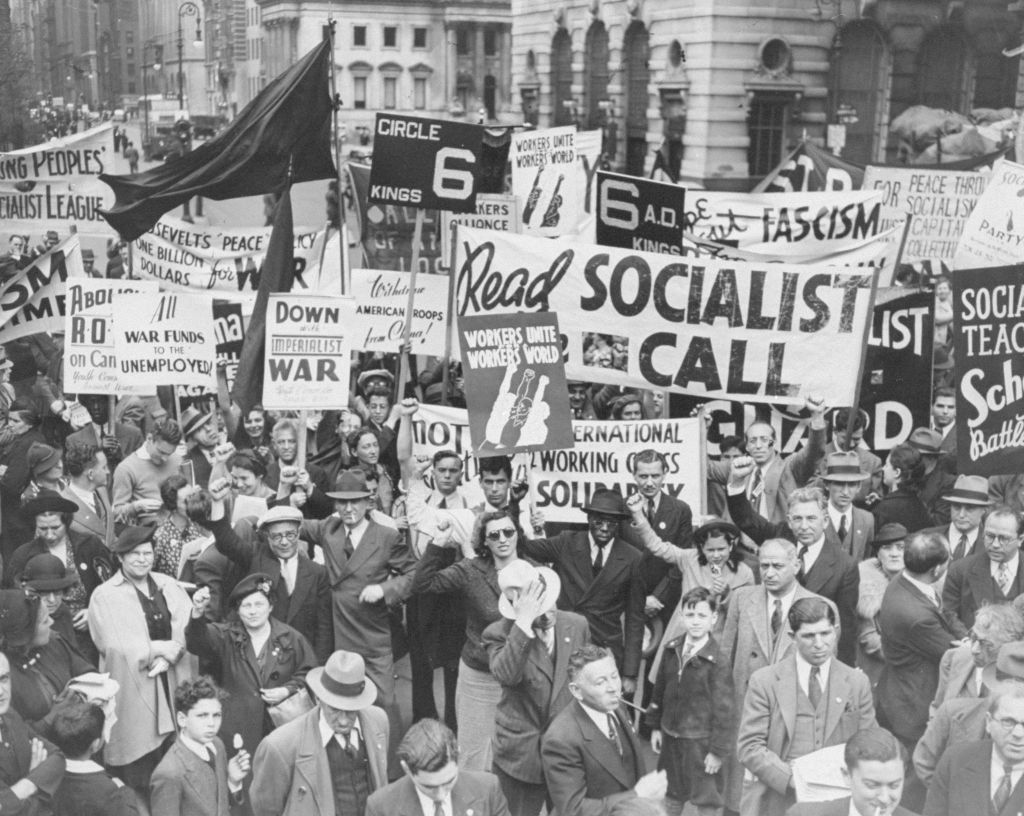
The people who built the socialist movement were not history’s fools. They were people who refused to accept the world as it was. (Victor Twyman / NY Daily News Archive via Getty Images)
Eric Aarons lived through the great defeats of the twentieth-century socialist movement but refused to let those defeats have the last word. He joined the Communist Party of Australia as a young man. He believed, as millions did across the world, that he was on the right side of history. He watched, over decades, as history played out in reality — as Stalinism revealed its horrors, as the official Communist movement broke apart, as the social democratic compromise in the West frayed and was finally torn up. But he kept struggling for a better world. Not through moving back to the certainties of his youth, and not through moving forward into the accommodations of centrist politics, but by trying to move toward a new politics.
That is the spirit in which I want to speak tonight. Because we are gathered as socialists, as trade unionists, as people who want to live in a better world, decades after socialism was declared dead. Indeed, the socialist movement that millions of workers across the world built over 150 years — the parties, the unions, the cooperatives, the newspapers, the cultural institutions, the experiments in workers’ power and public ownership — is either gone or hollowed out.
But we should insist to the world that socialism was not wrong. Socialism suffered defeats.
If socialism was wrong — if the whole project of organizing society around human need rather than private profit was a nineteenth-century enthusiasm we should outgrow — then the only honest thing left for people who once called themselves socialists is to manage capitalism more humanely. To accept, as the capitalist slogan has it, that there is no alternative.
But if socialism suffered defeats — if it was beaten by a combination of its enemies, its own crimes, and its own economic failures, but not refuted in principle — then things are different. Then the task in front of us is not to grieve and accommodate but to learn, to rebuild, and to fight again, with a clearer sense of what we got wrong and a deeper conviction about what we got right.
I want to argue further that a leftism without a socialist destination is not a politics worth fighting for. Not just because of the moral power of our destination but because, without one, we become weaker reformers, not more practical ones. And we lose something that actually made us potent working-class fighters. We lose the grand story — the story that once told ordinary workers that they were not history’s victims in need of either private charity or state charity but history’s authors.
So tonight, I want to do three things. I want to talk about what the socialist movement actually achieved, before it was beaten back. I want to discuss why it was defeated, both from outside and from within. And then I want to talk about what a socialist horizon could mean for us now, in all the complexities and challenges of our era.
The Movement That Almost Won
Let me start with the achievement.
The history of the modern left is usually told as a history of failure. But, at least when it comes to the taking of power, that couldn’t be further from the truth.
The modern socialist movement began, in its recognizable form, in the middle of the nineteenth century — with small groups of workers, artisans, confronting a spectacular and terrifying industrial society. Within seventy years, those small groups had grown into the largest political parties in Europe. Within a hundred years, parties calling themselves socialist or communist governed roughly half the planet.
There was nothing like it in modern history. You have to go back to the early Islamic conquests of the seventh and eighth centuries to find a movement that spread so far and so fast — from a few thousand militants in the 1860s to political power, in some form, across more than half the world’s population by the 1960s.
Hal Draper, an American socialist and a sharp critic of every actually existing version of socialism, observed in 1966 that “for the first time in the history of the world, very likely a majority of its people label themselves ‘socialist’ in one sense or another.” That isn’t a sectarian project. That was, by his estimation, the majority of politically conscious human beings, on every continent, identifying with some version of an idea that, sixty years earlier, had been the property of a few pockets of workers or exiled intellectuals.
But before the socialist movement won state power, it won something even more remarkable. It won a culture.
In the coal villages of Wales, miners asked to be buried with their copies of The Communist Manifesto the way an earlier generation had asked to be buried with their Bibles. In working-class homes across Europe, portraits of socialist leaders hung where icons of saints had once hung. The feasts of the old religious calendar were folded into a new calendar of strikes and secular martyrs and holidays. Eric Hobsbawm recorded an announcement from the Po Valley in 1891: “The priests have their festivals. The First of May is the festival of the workers of the entire world.”
This was not just political organization. This was the building of a countercivilization inside the shell of the old one. Workers had their own newspapers, their own sports clubs, their own choirs, their own schools, their own funeral societies, their own theories of history, their own heroes, their own holidays. They walked through the same streets as their bosses, but they lived, in some real sense, in a different world — a world with its own moral horizon and its own picture of what was coming next.
And what was coming next, many believed, was socialism.
Two broad versions of that future eventually took shape. There was socialism within capitalism — the social democratic project, which sought to humanize the market through the power of collective bargaining and the state. And there was socialism outside capitalism — the communist project, which sought to abolish the market altogether through state ownership and central planning.
Both of those projects, in their heyday, transformed the lives of hundreds of millions of people. Whatever else you say about Soviet communism — and I am from a democratic socialist tradition extremely critical of it — it took a peasant society and industrialized it in a generation, eliminated illiteracy, defeated Nazi Germany on the battlefield, and offered, for many people in the colonized world, a seemingly working model of how to escape the imperial division of labor. And whatever you say about social democracy, postwar Sweden under Olof Palme was among the most decent societies that has ever existed. It featured full employment, strong unions negotiating on more than equal terms with employers, and a universal welfare state. It meant real dignity for working people on the shop floor and in society as a whole.
Even many critical of both models saw them as at least way stations on a road that millions of people genuinely believed led, eventually, to a society in which the great division of human beings into a class that owns and a class that works would be ended for good.
Defeat From Outside and From Within
How did we go from flawed or partial victories to defeat?
The standard story, told by many on the Left, is that socialism was crushed from the outside. By the Cold War. By American imperialism. By the CIA. By Pinochet’s coup, by Operation Condor, by the dirty wars across the Global South. By the Thatcher–Reagan counterrevolution. By the bond markets disciplining François Mitterrand in the early 1980s. By the long, patient work of capitalist agents through their think tanks, media, and political parties.
Part of that story is, of course, true. The socialist movement was indeed the target of the most sustained, well-funded, and ruthless ideological and military counteroffensive in modern history. We shouldn’t forget that, nor should we forget just how many martyrs violent anti-communism from Indonesia to the Southern Cone left behind.
But if we tell ourselves only that story — if we say that we were simply beaten by external enemies — we let ourselves off the hook in a way that makes it impossible to learn from what else happened. And we owe Eric Aarons, and everyone like him who spent a lifetime trying to understand our defeat honestly, more than that.
The truth is that socialism was not only beaten from without. It was beaten also from within — by its own political crimes and by its own economic failures.
The political crimes of the twentieth-century communist movement are not a slander invented by Cold War propagandists. The gulags were real. The bloody terrors and purges were real. The famines that killed millions in Ukraine and in China were real. The destruction of open expression, of free trade unions, of religious freedom, of civil society — that was real too. And those crimes were committed not just by authoritarians who pretended to be socialists but by people who believed, sincerely in many cases, that they were building the future Karl Marx dreamed of. We can’t resort to a No True Scotsman defense. This was the real, historical experience of socialism for millions.
It was what Rosa Luxemburg predicted: The substitution of party for class. The substitution of state for party. The substitution of leader for state.
And the belief that history was so clearly on our side — the belief that I want to resurrect — was used to construct a moral universe in which any means used to accelerate history were justified. Individual rights and the rule of law were seen as bourgeois. The conviction was that, having seized the commanding heights of the economy, one could simply command the rest of society into the shape one wanted.
A socialism that does not understand, in its bones, why the decisions that shaped state socialism were wrong — not just tactically wrong but morally wrong — is a socialism that will not and should not have a future in the twenty-first century.
But most of the Left agrees on these political questions. Where there is less reckoning is on the economic failures of socialism.
Soviet-style central planning did not collapse only because of political repression, or only because of the arms race, or only because of CIA intrigues. It collapsed because, on its own terms, it could not deliver. By the 1970s and ’80s, the gap between what the system promised and what it produced had become impossible to disguise.
The first reason was calculation. Gosplan, the Soviet planning agency, was responsible for coordinating an economy that included nearly 400 bureaucracies, 43,000 factories, 26,000 construction enterprises, 47,000 farming units, 260,000 service establishments, and more than one million retail shops — producing some 12 million distinct products, each of which required the right inputs from the right suppliers at the right locations on the right timelines, with supply chains stretching across eleven time zones. These in total meant tens of billions of variables, rising into the trillions when you extend the planning horizon across time.
To rationally plan that, you would need to know what every enterprise could produce, what every household would want, and how every input connected to every output. No one could know that. Not the most brilliant economists in the world. Not the most powerful computer that has ever been built or ever will be. The information simply does not exist in a form that any central authority can collect and process. So what you got instead was guesswork — last year’s numbers plus a little more — propped up by a sprawling secret economy of barter, hoarding, and back-channel deals that managers ran on the side to keep things moving.
The second and related problem was that of incentives. Every manager understood that next year’s resources depended on this year’s reported numbers. So they lowballed their projected capacity and overstated their actual output. They hoarded labor and materials. They lied. The workers under them figured out very quickly that exceeding a quota just meant a higher quota next quarter. Weak firms were never allowed to fail, because letting them fail meant unemployment and broken supply lines, so inefficiency was never punished. From the Politburo down to the shop floor, the entire hierarchy had an incentive to misrepresent what it was doing.
These were not bugs you could fix with a better algorithm. They were features of the structure of Soviet-style economics itself. And what we, as socialists, have to admit is that there is no version of administrative planning that escapes these problems. The dream of running a complex modern economy purely by planning should not and cannot be revived.
And then there is social democracy, whose failure took a different form. Social democracy didn’t fail because it tried to abolish capitalism. It failed because it tried to tame capitalism without transcending it.
For a generation, its basic formula worked. Social democracy produced strong unions, full employment, a generous welfare state, rising wages, and a growing economy that produced enough surplus to fund all of it.
But there was a contradiction at the heart of the social democratic settlement, and it did not survive the moment growth slowed. Social democracy empowered workers politically while leaving ownership of the means of production in private hands. This produced a permanent standoff between a powerful labor movement and a capitalist class that still controlled investment. As long as the pie was growing, the standoff was tolerable — there was enough for wages, enough for profits, and enough for the welfare state on top. But the moment the pie stopped growing, in the stagflation of the 1970s, the standoff collapsed.
The Swedish social democrats actually saw this coming. Rudolf Meidner, the great Swedish economist, proposed a plan in 1976 to gradually transfer ownership of large firms to worker-controlled funds, using a portion of profits each year — a real bridge from social democracy to socialism, funded by the wage restraint that workers had already practiced for decades. It would have solved both Sweden’s economic difficulties and its political impasse.
But it never came to being in a viable form, not just because of opposition from capital but because the leadership of the Swedish Social Democratic Party itself would not fight for it. They were not willing to mobilize the working class for a transformation of property relations. The plan was watered down, then gutted, then abandoned. And before long, Swedish capital was able to solve the crisis of social democracy in its own way, by pushing along a long campaign of liberalization that has reduced the Swedish welfare state to a shadow of what it was.
We should learn lessons from both failures.
Soviet-style socialism failed because you cannot run a complex modern economy without prices, autonomous firms, and real incentives. Social democracy failed because it tried to leave private ownership of capital intact, and a capitalist class with all the levers of investment in its control will eventually use its power to dismantle whatever constraints have been placed upon it. These two failures were mirror images.
But the lesson of these failures is not that socialism is impossible. The lesson is that socialism has to be rethought in its technical design, without abandoning our goal of a society without exploitation or oppression.
The Destination Is Everything
Before I get to what that twenty-first century socialism might look like, I want to make a practical and not just normative case against moderation. Because the temptation for a defeated Left is to say, “Never mind socialism, let’s just talk about social welfare, or public housing, or higher minimum wages. Those things are winnable. Why burden them with the unpopular word, the discredited dream?”
The first reason is that a Left without a socialist horizon is not even a more effective reformist left. It is a worse reformist left.
Reforms are not abstract policy proposals that float through history on their own merits. Reforms are won by movements. And movements are sustained by stories — stories about who their constituents are, why they matter, where they are going, and what they are part of. A movement that can only say, “We want a more generous unemployment benefit,” is a movement that will not mobilize the energy it needs to win even that benefit, because the unemployment benefit by itself does not answer the questions that working people actually ask when they consider whether to give up an evening, a Saturday, a career, and sometimes a life for political action.
The bigger questions, I would argue, are actually more mainstream: Who am I in this society? Why are resources distributed the way they are? Where are we going as a society? Is there a future in which our children inherit something better than what we have? Who’s standing in the way of realizing that future?
The great socialist parties of the early twentieth century could answer those questions. They could tell a Welsh miner that he was the inheritor of a tradition that ran from the Levellers through the Chartists through the workers’ internationals, that his union or party card signified membership in a movement of millions of workers around the world, that the strike he was about to join was a small skirmish in a global struggle that would eventually, in his children’s lifetime or his grandchildren’s, mark the final triumph of labor. That story is what made him willing to be locked out, to be beaten, or to lose his job. It was not just the wage increase and material security for his family; it was also the story that gave those sacrifices deep meaning.
When you take the story away, you have starved our movement of one of its greatest sources of power. You have asked people to fight a hundred small fights without ever telling them what the fights are for.
Second, a Left without a socialist destination eventually becomes something other than a Left. It becomes a kind of progressive technocracy: a network of policy professionals, NGO staffers, communications consultants, and electoral operatives who manage the symptoms of a system they have given up trying to change.
A progressivism that has nothing to say about class — that talks only about identity, or only about poverty, or only about policy — is no match for a Right that has plenty to say about class, even if everything it says is a lie. The Right will tell working people that their enemies are immigrants, that their enemies are minorities, that their enemies are the cultural elite. A progressivism that refuses to name capitalists and the rich as the enemies leaves working people with nothing to put against that story except the assurance that their feelings will be respected and their ascriptive identities will be honored.
The Left that wins in the twenty-first century will be a Left that can name what is wrong, name who benefits from it, and name what we want to put in its place.
And the third reason is that we owe it to the people who came before us.
The socialist movement was built by people who had no objective reason to believe they would win. The Welsh miner reading The Communist Manifesto in 1890 had every reason to think his life was going to be short, hard, and forgotten. The Russian textile worker in 1905 had every reason to think the autocracy would last forever. The factory worker in São Paulo, the dockworker in Sydney, the metalworker in Turin in 1920 believed because they had decided, against the evidence, that they were not history’s victims. They were history’s authors. They were the protagonists of a story whose ending had not been written.
That world-historic confidence is what built every institution we have inherited: The eight-hour day. The weekend. The old-age pension. The hospital you were born in. The school you went to. The union that, if you are lucky, still represents you at your job. None of those things fell from the sky. They were ripped out of the hands of people who did not want to give them up, by movements of working people who believed they were doing more than just bargaining for crumbs. They believed the future belonged to them.
And we, who have inherited the dividends of their fight, have allowed ourselves to settle for less. We have shrunk our horizon to fit our present weakness, and then we have wondered why we cannot grow.
This is the main reason why we need to recover the horizon of socialism and the language not of parliamentary gossip and media sound bites but of centuries and continents. This is why, as old-fashioned as it might seem, we need to talk about socialism and the abolition of class society. About the end of the millennia-long division between those who command labor and those who perform it. About a world organized around a radical form of democracy and equality.
A Socialism for the Twenty-First Century
Marx famously warned against writing recipes for the cookshops of the future. He was rightly critiquing the utopian socialists of his day. But in our world, our challenge is to prove to people that socialism is not just politically desirable but technically possible.
As a result of not just capitalist propaganda but the real failures of both forms of twentieth-century socialism, a skepticism has grown about socialism’s future. Wouldn’t taking democratic control over a complex economy eventually boomerang into crisis, collapse into inefficiency, or harden into authoritarianism?
To say that socialism is technically possible and we should sketch out blueprints for it doesn’t require pretending that there’s a single settled model of socialism just waiting to be implemented. But it does require confronting a set of unavoidable questions that any credible alternative must answer.
Could a socialist economy use prices, profits, and competition to coordinate complex production without reproducing domination or significant inequality? What incentives encourage efficiency and innovation in an economy of democratically governed firms? How can productivity growth be sustained so that living standards continue to rise, shortages are avoided, and technological change continues without the sort of mass insecurity that workers experience today? And what role must the state play in stabilizing the macro economy, guiding investment, and enforcing democratic priorities without suffocating initiative?
Let me sketch, very briefly, what I think a credible socialism for our century might look like. I am drawing here on a book I have just finished with my colleagues Mike Beggs and Ben Burgis. It’s called The Blueprint: The Case for Socialism in the Real World, where we work out these arguments at greater length.
A twenty-first-century socialism, as we would describe it, has to do two things at once. It has to abolish market dependence — the condition in which your survival depends on success in the market — while preserving markets as one tool, among others, for coordinating a complex economy.
In practice, this means decommodifying broad areas of life. Health care, education, transportation, energy, housing, and telecommunications are the infrastructure of a modern life. Organizing them through markets, through profit-seeking firms that ration by price rather than need, is a mistake — not only morally but practically, because the result is a system that is both more unequal and less efficient than public provision would be.
Beyond these domains, as my colleagues and I describe in The Blueprint, lie the broader economy of goods and services, where coordination problems are more varied, and where markets remain important. In the market sector of an economy composed of democratically governed firms, price signals would still convey information about supply and demand, helping to coordinate production and consumption.
But the surplus generated by economic activity would be controlled by those who produce it. And investment would be allocated through public financial institutions rather than by capitalists. In this way, markets can function as tools of coordination without reproducing the power relations of capitalism.
In this socialist framework, productive enterprises in the commodity-producing sector are controlled by workers rather than external shareholders or private capitalists. Governance rights attach to participation rather than to a financial stake. Membership in a firm, then, resembles membership in a political community. It confers voice and real democratic control at the point of production, and it imposes obligations, but it can’t be traded like a commodity.
This shift in governance requires a corresponding shift in how investment is organized. Any feasible socialism must avoid soft budget constraints and allow inefficient firms to fail while more productive ones expand. From an egalitarian standpoint, this should be common sense. Why should we waste the most valuable thing in the world — human labor — in inefficiency?
But workers in democratic firms should not be expected to supply capital themselves, or to tie their personal savings to the fortune of a single workplace. Leaving investment decisions at the level of individual firms would generate systematic distortions that would destroy a socialist system. Disparities in capital intensity, for example, would encourage workers to cluster in capital-rich sectors, while labor-intensive production and the public sector are left unstaffed. Imagine everyone wanting to work on oil rigs, or some other very capital-intensive sector where your dividends would be massive, instead of working at a childcare clinic.
Organizing ownership and investment as a social function rather than a firm-level one is therefore essential. Public banks serve this role by holding productive assets in common, allocating capital on behalf of society as a whole. In this way, firms operate with real autonomy while remaining stewards rather than owners of social wealth. And the state can use a vast array of macroeconomic tools to influence the direction of development.
One additional mechanism that is essential for such an economy to remain both efficient and egalitarian over time is the creation of minimum wages, differentiated by occupation, to shape development itself. Rather than allowing labor markets to sort worker managers purely through localized bargaining power or sectoral rents, benchmark wages establish a floor that reflects collective priorities about dignity, skill, and social contribution.
Firms and sectors that rely on low pay and labor discipline would be pressured to innovate, reorganize, or contract. Those that raise productivity through new techniques, through additional training, or through technological improvement would be rewarded through increased dividends. In this way, the economy is directed along a high road of development that rewards innovation and investment rather than just sweating out labor.
Of course, in a socialist economy, the goal of increasing productivity isn’t a goal for its own sake. The goal is the expansion of leisure, of security, and, ultimately, of time outside production.
A socialism that merely redistributes income without changing how time is organized would fall short of its promise. But a socialism that combines redistribution with social ownership, democratically guided investment, and wage structures that reward efficiency can translate a dynamic economy into shorter hours, longer lives, and greater freedom over how those lives are lived.
This is a sketch. I am laying it out in five minutes when it deserves five hours. But the point is that we need to be discussing models of socialism as part of our struggle for both near-term and long-term changes.
Ultimately, our goal as egalitarians must simply be the end of class society — not a slightly fairer class society, or a class society with better safety nets, but the end of the division of humanity into a class that owns and a class that works. It would be the first society, in most parts of the world, since the Neolithic Revolution that is not organized around that division.
Unfinished Business
Eric Aarons spent his life advocating for working people and for a better world. He gave that life to the conviction that the society we live in is not the only society we could live in, and that ordinary people, organized, are capable of building something better.
This was a life that was well spent.
We live in an age that has tried very hard to convince us that the lives of people like Eric were wasted. That the organizers, the party members, the union militants, the teachers and shop stewards who gave their decades to the socialist movement were, in the end, deluded. That they bet on the wrong horse. That history has rendered its verdict, and that the verdict was against them.
I couldn’t disagree more.
Eric was not wrong. The Welsh miner buried with his copy of The Communist Manifesto was not wrong. The Russian textile worker, the Italian metalworker, the South African unionist, the Brazilian peasant organizer, the Australian docker, the American socialist who campaigned for Eugene Debs a hundred years ago, or even the one who knocked doors for Zohran Mamdani last year — none of them were wrong. They were not naive. They were not history’s fools. They were people who looked at the world they had been given and decided it was not good enough, and they spent their energy trying to build something better.
The fact that they did not finish the job does not mean they were wrong to start it. And the fact that we have inherited their unfinished business does not diminish what they did. It just places an obligation on us to continue their work.