Mayor Mamdani Can Empower New York’s Municipal Workers
New York City Hall has traditionally had an antagonistic relationship with the city’s municipal workforce. Mayor Zohran Mamdani can chart a new course, working collaboratively with city workers to deliver better public services.
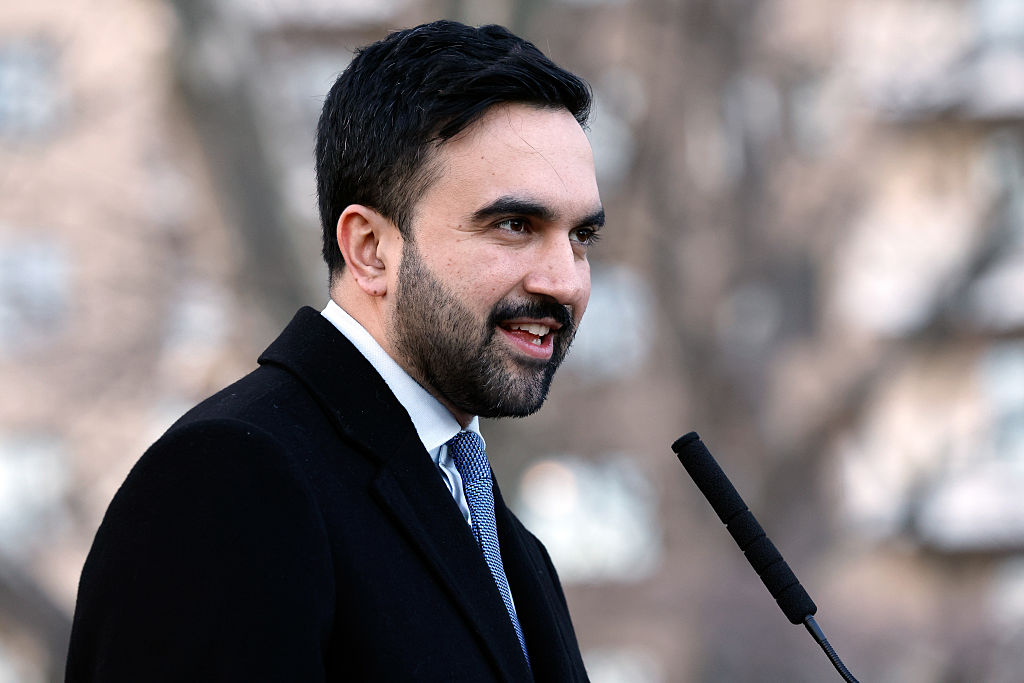
Zohran Mamdani has the chance to turn the page on New York City’s oppositional relationship with its municipal employees and instead collaborate with them, improving worker morale and the quality of city services. (John Lamparski / Bloomberg via Getty Images)
What does it augur to have a socialist mayor of New York City? The basic tenets of Zohran Mamdani’s election platform are, of course, directed at reducing inequality in the most unequal city in the nation: free childcare and buses, frozen rents, and more subsidized housing are all steps in that direction. But sabotage from Washington and resistance from state and local lawmakers and economic elites will all put limits to how far and how fast we can go.
Beyond the economic sphere, however, the city should have a freer hand in empowering the working class — against employers, to be sure, but also by allowing it to participate in the daily administration of the city. Gabriel Hetland and Bhaskar Sunkara have written about the need for popular assemblies, not just as a tactic to fend off capital, but because a basic tenet of socialist strategy should be “to increase the capacity of workers to collectively shape the decisions that shape their lives.” But building assemblies that are both truly democratic and wield institutional and economic power from scratch will take time.
In the meantime, there is another reform aimed at increasing working-class participation in government that the Mamdani administration can begin to put into place immediately: the replacement of antagonistic bargaining with its own workforce and their unions by a model based on consultation and collaboration to improve work, workplaces, and the provision of city services. This is a big piece of what socialism in practice should look like: combining some amount of necessary top-down organization with the opportunity for workers themselves to have meaningful input into how work is organized and services are delivered.
It is a well-worn trope on the Left, but a true one nonetheless, that the best experts on how to do the work better and more efficiently, and how to make the workplace more enjoyable, are the workers themselves. The vast majority of municipal workers — there are hundreds of thousands of them — want to have pride in their work; they want to do it better. And, of course, they would also like to address the workplace concerns that have produced massive worker flight and demoralization among the rest. Yet their experience is that their unions cannot deliver any of these outcomes, and that changes that come down from above — some of them good and useful; others not so much — are implemented unilaterally.
Who’s to blame for this state of affairs? The employer primarily, but city unions also share some measure of culpability.
The Cost-Cutting Dogma
Under both Democratic and Republican administrations, the city government has crafted its labor policies, especially its bargaining practices, as though it were a private employer trying to maximize profits by minimizing labor costs. It has been so successful in holding down those costs that many city agencies are perpetually understaffed because they can’t hire or retain qualified employees. But the problem is not just that it holds down wages and subjects all the municipal unions to one-size-fits-all “pattern bargaining” — a system in which the city bargains with one municipal union first, and then all the other city unions are expected to accept similar terms in their own contracts.
The Public Employees’ Fair Employment Act (commonly known as the Taylor Law) allows the city to refuse to bargain about many issues that private sector labor law allows. It won’t bargain with the United Federation of Teachers (UFT) about class size. It won’t bargain about shift scheduling. It won’t bargain about service changes. It won’t engage in what in other cities and states has come to be known as “Bargaining for the Common Good,” in which the union negotiations process goes beyond bread-and-butter issues like pay to include demands that benefit the broader working class.
In effect, the city has forgotten that its primary imperative should be to maximize service — measured both quantitatively and especially qualitatively — per unit cost. That means thinking about “productivity” in an entirely different way, requiring a completely different bargaining mindset — one based on cooperation and collaboration with its unions and employees. In fact, “bargaining” is too restrictive a term, for it implies that these discussions should only take place when contracts expire every four or five years, rather than continuously, and primarily with the affected agencies rather than a cost-driven labor relations department.
Union Bargaining Excludes the Rank and File
New York’s municipal unions have been well-trained by years of a neoliberal economic and political order to lower their sights and shrink their imaginations. Most unions have come to privately embrace and appreciate the city’s demand that all contracts must conform to a single economic pattern. It took the pressure off them to win better contracts. When members gripe, they shrug their shoulders: the pattern is the pattern. Because so little is negotiated, bargaining is typically a top-down affair, with little or no member participation or agency.
Ironically, unions have the perverse incentive to show at the bargaining table how their proposals will replace skilled veteran workers with inexperienced new hires. One of these long-ago “deals” explains why virtually all newly hired uniformed employees make less than half the wage of “veterans” with sixty-six months on the job, inhibiting recruiting.
Teacher salaries, for instance, are very skewed, with substantive raises beginning only after eight years of service. Years ago, proposals to give early career teachers some relief from the classroom and use that time for additional teacher education and coaching were shot down as being too costly. Exhausted from learning how to teach and having to devise new lesson plans from scratch every day, and underpaid to boot, newer teachers burn out and leave the profession at remarkable rates, with even more inexperienced (and cheaper!) replacements taking their place. How does anyone besides the bean counters in the city’s labor relations department benefit from this vicious circle?
Largely restricted to negotiating about money items, and even hemmed in over those, union leaders have little incentive to engage with their members about their workplace needs; that would only lead to heightened expectations and later frustrations. For the same reason, they rarely engage with the communities their members serve. It is hard now to even imagine that in 1965 New York City social workers went on strike to win an easing of bureaucratic requirements for their clients.
Of course, in many workplaces, workers and their front-line managers use their on-the-ground knowledge to develop unofficial arrangements that ease workflow and working conditions. But because of the opposition of the Office of Labor Relations and union leaders, it is difficult to formalize these agreements.
Toward Collaborative Bargaining
The solution to the problems of low worker morale and poor service delivery is both simple and complicated. It is simple in that the starting point is clear: our new mayor must indicate a willingness to adopt — and then enjoin agency heads to embrace — a different form of labor relations. This approach would mean a collaborative exploration of how services can be delivered better, and worker treatment improved, across whole agencies but also in individual workplaces.
It is more complicated in that the city will need to identify unions ready to partner with it in this new form of bargaining. Judging from my experience in New York City’s labor movement, at the start, many of the municipal unions may be afraid of changes that would disrupt their largely top-down internal equilibriums. In DC 37, for example, with its sixty-one different locals representing one thousand different titles, bargaining about a purposefully wide range of issues will require more open and deliberative processes and also will require that its executive director allow a more decentralized bargaining process.
It is more complicated still, because the types of changes the city desperately needs in its delivery of services require a big shift in culture: listening to, and having serious conversations with, worker representatives, often right in the workplace. And after a start during the cycle of collective bargaining — among the major municipal unions, DC 37’s contract is the first to expire in November 2026 — forms should be institutionalized for ongoing discussions at workplaces between mid-level managers and workers and for codifying changes.
Is this merely a pipe dream — visionary, perhaps, but impracticable? If there will ever be a chance to end decades of ossified and bureaucratically creaky service delivery, to explore new methods of planning and engagement, this is the time, with a pro-worker socialist mayor in city hall.
And imagine the payoff if it works, in whole or part. One of the characteristics of a socialist mayoral administration should be a different and more fruitful government-union-worker-community relationship, one that encourages working-class voices. It is a crime that we have failed to use all the detailed worker knowledge and experience about how to more efficiently and more humanely run this city. It’s time to start now.