The Struggle for Democracy in Iran Isn’t Over
After this war ends, Iranians will carry on their struggle for democracy, but against even steeper odds in a society gutted by US and Israeli bombs, under a regime that will use the horror of this foreign intervention to justify more domestic repression.
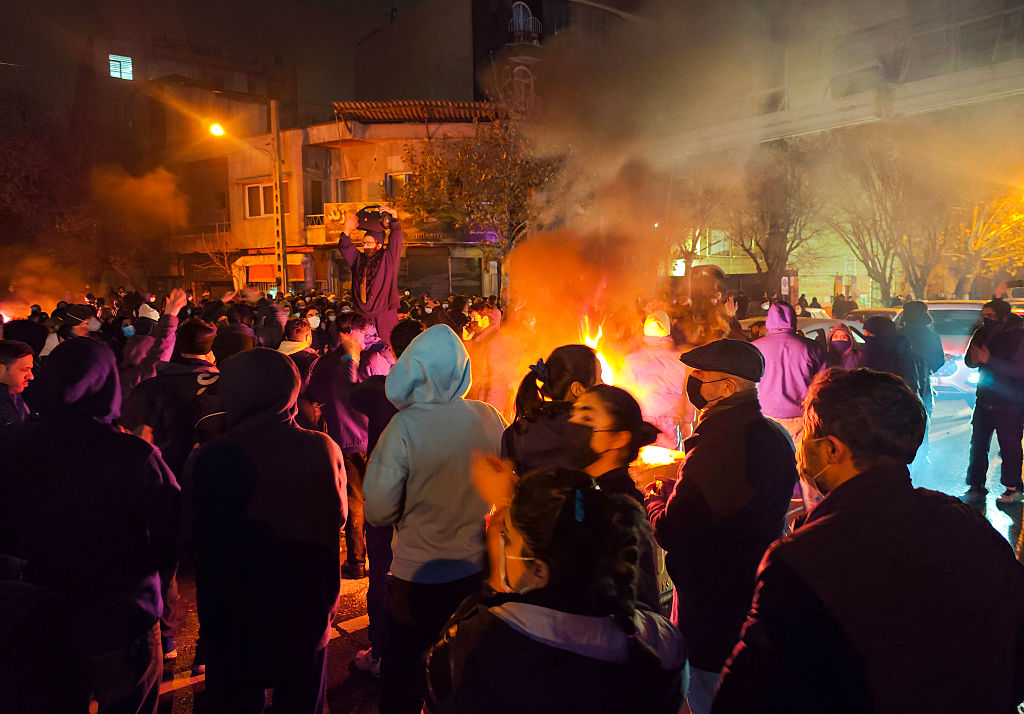
The US media has granted outsize attention to pro-war Iranians. In reality, a strong current within the Iranian diaspora staunchly supports the struggle for Iranian democracy from below while opposing the US and Israel’s heinous war. (Anonymous / Getty Images)
For Iranian people who imagine a democratic future, 2026 began with thrilling promise: the largest uprising in a series of uprisings since the turn of the millennium. It began on December 28, 2025, with a strike of shopkeepers in Tehran’s Grand Bazaar, a social stratum typically supportive of the regime, now fed up with a sharp decline in the national currency. As mass demonstrations spread nationwide, a work stoppage sparked by economic grievances reignited the smoldering political revolt against the Islamic Republic in its most significant eruption yet.
But just as suddenly, two atrocities put a halt to the protests. First, under the cover of an internet blackout, the Islamic Republic’s security forces carried out an indiscriminate slaughter, turning the largest uprising in decades into the largest massacre. Weeks later, the United States and Israel launched an illegal war, killing civilians and destroying their infrastructure, including schools and universities, roads and bridges, hospitals and heritage sites. What began as a hopeful moment has instead become one of the darkest in modern Iranian history: when not one, not two, but three governments took the lives of thousands of Iranians over the span of mere months.
The struggle to achieve democracy in Iran in the face of domestic repression and foreign intervention — dialectically interrelated forms of violence — stretches back for more than a century. Throughout Iranian workers and their labor movement have been central actors in that struggle.
In the early 1950s, workers at the Anglo-Iranian Oil Company (the precursor to British Petroleum) struck multiple times to demand better conditions and demonstrate support for Prime Minister Mohammad Mossadegh’s drive to nationalize the industry. In response, the Central Intelligence Agency (CIA) and Britain’s MI6 organized a coup d'état to crush Mossadegh’s anti-imperialist democratic experiment and restore the primacy of Shah Mohammad Reza Pahlavi. The CIA’s 1953 intervention was one of the first of countless efforts to undermine progressive governments and labor movements throughout what used to be called the Third World (a project that the AFL-CIO directly supported using agency funding, prompting labor radicals to deride it as the “AFL-CIA”). The shah dismantled independent unions, prohibited opposition political parties, and through his notorious secret police, the Bureau for Intelligence and Security of the State (SAVAK), tortured, imprisoned, and executed proponents of democracy.
During the anni mirabiles of 1978–79, organized workers contributed to the revolution against the shah and his alliance with US imperialism in three major ways. First, strikes across the public and private sectors, especially the oil fields, struck the decisive blow to topple the monarchy. Second, strike committees laid the groundwork for shop-floor councils known as shoras, many of which expelled managers and asserted worker control over production and distribution, forging a link between the radical democratization of the workplace and of the state and broader society. Third, the Iranian left — made up of myriad older and newer radical organizations, both secular and religious — emphasized the strategic importance of the working class and, after years of repression and in some cases underground armed struggle during the shah’s regime, expanded their base.
Soon after the shah fled Tehran and Ayatollah Ruhollah Khomeini returned from exile in February 1979, however, conflict between the forces supporting the latter and the revolution’s most progressive forces heated up. One of the earliest examples of this tension burst out into the open a month later on International Women’s Day, a holiday invented by socialist women unionists in Europe and North America, when thousands of Iranian women protested against the imposition of the mandatory hijab at the workplace. While this early mass demonstration received uneven support from the Iranian left, it proved a harbinger. Over the next few years, the Iranian left fractured across and within individual organizations over the question of how to orient toward the emergent Islamic Republic. One side chose to back what they perceived to be an anti-imperialist state, but another side came to oppose what they perceived to be an essentially reactionary state wrapped in an anti-imperialist facade. Some of these oppositional forces took up the same method of armed struggle against the new regime that they had used against the shah’s old one.
By the early 1980s, while Iran engaged in war with Iraq after Saddam Hussein’s invasion, a de facto civil war broke out within. The Islamic Republic made the bid to consolidate power through a violent crackdown on the opposition: liberals, women’s rights activists, oppressed national and religious minorities, dissenting clerics. In particular, the regime attacked the Iranian left, first that side that had decided to fight it and ultimately even that side that had continued to support it, culminating in the mass executions of 1988. Crucially, this counterrevolution targeted the renascent labor movement by shutting down the shoras; imprisoning, torturing, and killing worker leaders; and banning independent labor organizations in favor of regime-approved “Islamic Labor Councils.”
Violent suppression of the independent labor movement is part and parcel of the distinctive kind of state that the leaders of the Islamic Republic entrenched over the following decades: a theocratic capitalist dictatorship. Into the 1990s, while continuing to deny the most basic civil and political rights, the regime assassinated dissidents inside Iran and in foreign countries in a campaign known as the chain murders. Neoliberal economic policies dramatically worsened living conditions, like the flexibilization of labor through the expansion of the contract workforce. Widespread privatizations riddled with corruption transferred state-owned enterprises to politically connected private families, religious foundations tied to the clerical establishment, and firms tied to the military apparatus, especially the Islamic Revolutionary Guard Corps (IRGC). The latter wields significant control over Iran’s political economy, pumping billions of dollars into the regime’s so-called Axis of Resistance across the region while enforcing austerity at home. Combined with the pressure of comprehensive US sanctions, these policies have produced enormous suffering for working-class Iranians, millions of whom struggle with low and unpaid wages, poverty, unemployment, and inflation. Women and LGBTQ people, workers from national and religious minorities, and migrant workers from neighboring countries face compounded oppressions.
Yet wave after wave of uprisings have swelled in opposition to these conditions, including the student protests in 1999 and 2003; the Green Movement’s protest against election fraud in 2009–2011; the concatenation of strikes and mass demonstrations in 2017–18, 2018–19, 2019–2020, and 2021–22; the astounding Woman, Life, Freedom movement in 2022–23 following the police killing of the young Kurdish woman Jina Mahsa Amini, which revived the protest against the mandatory hijab articulated on International Women’s Day in 1979 and linked it with demands for other feminist rights, the rights of national minorities, economic security, and democracy; and the 2025 protests for worker rights, farmer rights, and water rights. Increasingly over time, these uprisings have foregrounded outright opposition to the Islamic Republic. In response, the regime has sought to obliterate them through shocking violence.
In the last decade in particular, Iranian workers have played a prominent part in these uprisings, altering their class composition and tactical repertoire. Teachers, truckers, nurses, steelworkers, oilworkers, and many more have participated in major strikes, often connecting economic demands with political demands. Animating this labor upsurge are dynamic efforts to build independent labor organizations like the Syndicate of Workers of Tehran and Suburbs Bus Company and the Iranian Teachers’ Trade Associations. These efforts have elicited severe repression from the Islamic Republic, which routinely violates the International Labor Organization’s Declaration on Fundamental Principles and Rights at Work to which it remains an official signatory. In one high-profile example, when workers struck after the privatization of the Haft Tappeh Sugarcane Agro-Industrial Complex in 2018, independent union leader Esmail Bakhshi and sympathetic reporter Sepideh Qolian were tortured and imprisoned (where Bhakhshi remains; Qolian won her freedom last year). In another case, labor activist Sharifeh Mohammadi was arrested in 2023 and sentenced to death row, where she remains. But these are only a handful of examples. The list of Iranian unionists languishing in jail is very long.
This cycle of revolt and repression throughout the early twenty-first century synchronized with rising tension between the Islamic Republic and its regional allies, on the one hand, and the United States, Israel, and their regional allies, on the other. This collision course came to a head with the US and Israel’s destructive war. At the time of this writing, as the United States and Iran negotiate in Pakistan, the future of the Islamic Republic and the struggle for Iranian democracy is difficult to foresee. What is certain is that the vast majority of people inside Iran who still yearn for democracy will carry on their struggle, but against even steeper odds than before: a society gutted by US and Israeli bombs, under the continued rule of a regime that will use — in fact, already has used — the horror of this foreign intervention as justification to accelerate domestic repression, just as it did in the 1980s.
Sadly, a sizable portion of the Iranian diaspora has cheered on the United States and Israel. Most vocal are monarchist supporters of the deposed shah’s son, Reza Pahlavi, who has built a warm relationship with Benjamin Netanyahu’s government in Israel and recently spoke about his mission to Make Iran Great Again at the Conservative Political Action Conference. While the danger of this faction should not be dismissed, the media has granted outsize attention to its perspective. In reality, there is a strong current within the diaspora that staunchly supports the struggle for Iranian democracy from below while staunchly opposing the US and Israel’s heinous war. A number of organized efforts are advancing this viewpoint, including one in which I am involved, Iranian-Americans for Peace and Democracy.
For workers and the labor movement here in the United States who seek to support workers and the labor movement in Iran, we must oppose the Trump administration’s illegal war as well as its wider imperialist foreign policy by participating in antiwar actions, passing antiwar resolutions through our unions, and incorporating antiwar demands in our political action programs. At the same time that we must fight to end the war, we must stand in international solidarity with the ongoing struggles of the Iranian people, including our fellow unionists, to win a secular democratic republic rooted in civil and political rights, gender egalitarianism, freedom for the country’s oppressed national and religious minorities, and labor rights for the working millions. After all, that’s precisely the kind of state we’re fighting to defend (and expand) against MAGA here in the US.
Today we face a far-right government in the United States moving fast to destroy the democratic struggles of the American people, joining forces with a far-right government in Israel perpetrating ongoing genocide to destroy the democratic struggles of the Palestinian people, together initiating a war against a far right government in Iran that just committed the worst political massacre in its nearly fifty-year-history of destroying the democratic struggles of the Iranian people. Therefore, we must see ourselves as part of one global movement fighting against all varieties of fascism everywhere, fighting for democracy anchored in free and powerful labor movements everywhere. Although the massacre and the war may have interrupted it, the Iranian uprising that peaked at the beginning of this year was not the first and certainly will not be the last, no matter the deadly machinations of the president in Washington, the prime minister in Tel Aviv, or the ayatollah in Tehran.