There’s a New Dark Money–Backed Democratic Machine
A new influence network of PACs, rich donors, and consultants is taking advantage of increasingly threadbare campaign finance law to pour millions into Democratic campaigns, aiming to elect leaders committed to returning the party to the “moderate” middle.
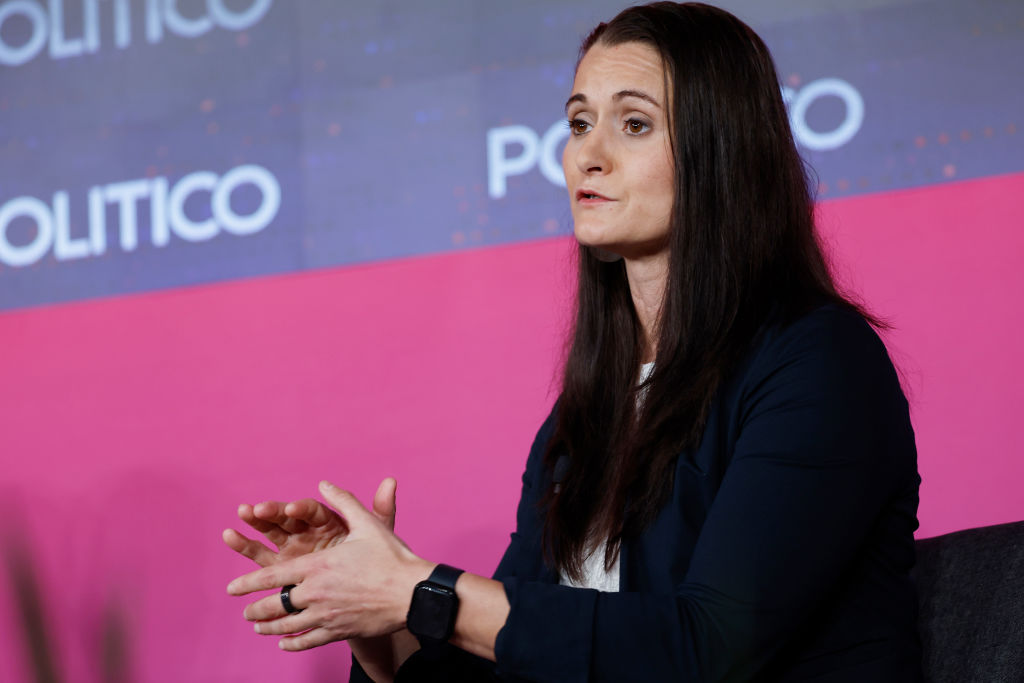
Majority Democrats has assembled a “party within the party” of PACs, wealthy donors, and consultants pushing Democrats to the center. (Anna Moneymaker / Getty Images)
The scandal was minimal, a blip in a Democratic primary race in New York’s Hudson Valley. But the incident was an early sign of a powerful new political machine playing an unprecedented role in Democratic primaries.
The problem emerged in February. Jackie Rosa, a political communications strategist, had been fielding press questions for Cait Conley, a combat veteran vying for New York’s seventeenth congressional district, as though she were a campaign spokesperson. But when controversy erupted after Rosa circulated a memo bashing Conley’s opponent as a “far left political operative,” the strategist claimed she’d mounted the attack on behalf of an outside group, not the campaign.
However, Rosa’s email sign-off listed an affiliation with a different political group — and her email address was tied to yet another organization, a shadowy Delaware consultancy.

Four separate entities, all tied to a single strategist, seemingly collaborated on messaging against a candidate, even though campaign finance law theoretically limits close coordination between campaigns and outside spending vehicles. What exactly was going on?
All of the organizations, it turns out, belonged to a new dark money–backed enterprise of unparalleled scale and complexity. The influence network brands itself as boosting Democrats’ electoral prospects ahead of the 2026 midterm elections. But the project’s true ambitions go much further.
Born from the ashes of the party’s 2024 defeat, this new operation has taken inspiration from Democrats’ free-market neoliberal turn after stinging defeats in the 1980s and 1990s and infused it with the deregulatory zeal of the abundance movement. Funded by Silicon Valley billionaires with skin in the game, the network is exploiting the country’s increasingly threadbare campaign finance laws to elect a new generation of leaders on board with bringing the party back to the “moderate” middle.
The machine operates as two big-name new organizations, Majority Democrats and the Bench, both tied to a single venture capitalist–turned–secretive Democratic adviser. Under this umbrella, the influence network is dispersing millions through a sophisticated nesting doll of political action campaigns (PACs), nonprofits, consultancies, and LLCs, while sharing the same big-money donors, political consultants, and often the same policy proposals.
The convoluted arrangements are sowing confusion on the campaign trail about the roles various campaign operatives play and who pays them.
The ambiguity may be the point. Political influence networks backed by super PACs — which have no limits on the money they can collect from billionaire donors — have become widespread. But the many-tentacled network of Majority Democrats, the Bench, and their affiliates appears to be intervening in campaigns’ day-to-day operations to an unprecedented degree.
Experts say these legal workarounds could undermine campaign finance rules governing coordination between political campaigns and outside groups, designed to limit elected officials’ financial obligations to wealthy special interests.
“These groups are major players behind the scenes,” one Democratic campaign strategist, granted anonymity in order to speak candidly, told the Lever. “I’ve never seen a setup like this where the political action committees are openly coordinating with campaigns to the extent that they are.”
In response to the Lever, Majority Democrats and the Bench disputed this characterization.
“These practices are fully compliant with the law and not uncommon,” said a Majority Democrats spokesperson. “We understand the urgency of this moment demands challenging the broken status quo and elevating the next generation of leaders who can build a sustainable majority.”
A spokesperson for the Bench told the Lever that it “has a strict firewall policy [between campaign and super PAC activity] that adheres to federal regulations.”
There’s no denying these groups’ financial might. New filings reviewed by the Lever show that Majority Democrats and the Bench have together raised $8 million so far this year, most of which came from tycoons like hedge fund manager Stephen Mandel and Nvidia board member Tench Coxe, as CBS News reported this month. Other major donors to the network include venture capitalist Bill Helman, Netflix cofounder Reed Hastings, and cryptocurrency CEO Michael Novogratz.
Those donations build on seed funding from the likes of LinkedIn cofounder Reid Hoffman, who spent millions supporting Democratic presidential candidate Kamala Harris while urging her to go easy on antitrust and Big Tech.

A substantial amount of the funds is going to pay high-profile political operatives working to elect the influence network’s chosen candidates in pivotal elections, often to the detriment of more progressive challengers.
This setup became a point of controversy in the Texas Senate primary last month and is currently playing a role in Michigan, where the Bench-endorsed Democratic Senate candidate Mallory McMorrow is facing off against progressive challenger Abdul El-Sayed, a physician endorsed by Sen. Bernie Sanders (I-VT).
Democrats may very well embrace these groups’ purported focus on electability and their heavy spending to claw back control of the House and Senate in 2026. But others worry that this new configuration may give wealthy donors an even greater voice in elections extending all the way down to campaign personnel, a corrupting influence that may not necessarily benefit the Democratic Party’s long-term electoral prospects — or democracy itself.
“It seems like a new frontier,” Michael Beckel, the money in politics reform director at advocacy group Issue One, said of Majority Democrats’ network. “When you continue to blur the lines of the existing anti-coordination rules, and when you continue to erode those anti-corruption safeguards in the process, that’s giving wealthy donors more access and influence in dictating the terms of the campaign.”
“A Party Within the Party”
Majority Democrats and the Bench, along with their various offshoots, are the brainchild of Seth London, a venture capitalist and adviser to major Democratic donors.
In the weeks after the Democrats’ disastrous performance in the 2024 elections, which bestowed the GOP with a trifecta of power under President Donald Trump, London released a blueprint, to much media fanfare, for rebuilding the party. At the time, Democratic circles were debating whether the Harris campaign floundered because the party had become too left-wing — or too beholden to corporate power.

London’s memo firmly aligned with the former viewpoint, calling on the party to moderate on a host of issues and usher in a new generation of “commonsense Democrats.” While light on policy prescriptions, the memo aligned its priorities with the “abundance agenda,” a liberal project focused on reducing housing costs and building out clean energy mostly through “supply-side” private sector solutions.
But abstract ideas of “abundance” and “moderation” would only be impactful if those who agreed with London could wield power in Democratic primary races and shape the ideological character of the party’s foot soldiers. To do so, London’s memo proposed an organizational infrastructure — “a party within the party” — modeled on the Democratic Leadership Coalition, a powerful organ for the corporate neoliberal wing of the Democratic Party in the 1990s, financed by Wall Street.
As London’s road map dictated, several new PACs would serve as the central nervous system for this project, to be headed up by high-powered political consultants, including Lis Smith, an alum of Pete Buttigieg’s 2020 presidential campaign, and Steve Israel, a former New York congressman-turned-lobbyist.
Months later, as the primary season ramped up, Democratic operatives began to notice a new group of political enterprises amassing outsize influence. The organizations moved together as a pack to back candidates, shared consultants, and appeared to direct the messaging of political campaigns to a remarkable degree.
They all bore London’s imprint.
A Tale of Two Groups
In July 2025, a new group with ambitions to “remake the image” of the Democratic Party staged its launch: Majority Democrats. London was “involved” in the project, per the New York Times, though his precise role remained elusive.
In an inaugural post on Majority Democrats’ Substack, London argued that Democrats’ main problem was their “fear of backlash from interest groups, donors, and online activists; fear of being labeled racist, transphobic, or a sellout.” Majority Democrats, he announced, would “replace fear with confidence” in order to “revive a party that can compete everywhere.”
Majority Democrats’ executive director, Rohan Patel, a former Tesla executive and Obama White House official, was more explicit in a subsequent post. He noted that “a party that can win everywhere” required “recruiting candidates who can credibly compete in tough general elections,” and “rejecting the notion that they need to adopt unpopular, left-wing positions in the primary.”
At launch, Majority Democrats touted a roster of around thirty lawmakers. Those include Sen. Ruben Gallego (D-AZ) and Sen. Elissa Slotkin (D-MI), both first-term Senators elected in 2024 and already rumored to be presidential contenders in 2028. All are relatively young, consistent with Majority Democrats’ criticism that the party establishment is too old.

For the most part, the politicians and candidates endorsed by Majority Democrats align ideologically with the establishment wing of the party, although some have adopted more unorthodox platforms. (At least one of their candidates, Bob Brooks, a House contender in Pennsylvania, has been endorsed by Bernie Sanders.)
By the end of last year, Majority Democrats had amassed a multimillion-dollar fundraising war chest and had embedded itself in a number of Democratic primary races for both House and Senate seats.
Then, in January, another organization staged a splashy launch: the Bench, advertising a supposed mission of “changing the Democratic Party from the inside.” The Bench promised to “help strong candidates launch with the tools they need to succeed — from communications and digital strategy to fundraising and staffing — so they can focus on what matters most: talking with voters and winning tough races.”
The Bench has endorsed a broad slate of candidates, including McMorrow in Michigan, James Talarico in Texas, Josh Turek in Iowa, Angie Craig in Minnesota, and Conley in New York.

Although they are separate entities on paper, with slightly different organizational structures, Majority Democrats and the Bench share a deeply interlinked fundraising apparatus and ground game.
In March, for example, Majority Democrats announced a nationwide “Built to Last Tour,” featuring several Bench-endorsed candidates.
While those operations hit the campaign trail, the Searchlight Institute, a new center-left DC think tank founded in part with London’s financial assistance, has served as the policy brain trust for both groups’ positions on various issues, seemingly shaping the platforms of their endorsed campaigns.
For instance, in March, McMorrow’s campaign in Michigan released its platform on data centers — a plan that mirrored a Searchlight Institute white paper recommending “data center developers pay their way,” a tech-friendly alternative to the moratoriums on data center development that some lawmakers are advancing.
Majority Democrats and the Bench also share a joint fundraising arm, the Majority Fund, which pools fundraising hauls with minimal contribution limits, allowing different players in the network to benefit from the same large donations. Mandel, a billionaire hedge fund manager whose portfolio is now significantly invested in the data center build-out, and his wife, Sue, are the network’s largest financial backers, having collectively donated $9.3 million to entities tied to Majority Democrats and the Bench since their inception.
Other donors have also provided hefty support. Mark Heising, a billionaire tech mogul, has contributed $2.1 million; Tench and Simone Coxe, a megadonor couple with ties to AI chipmaker Nvidia, have given nearly $300,000. And James Murdoch, one of the heirs to the Murdoch media empire, has with his wife, Kathryn, given over $300,000.
Several of those donors, including Simone, sit on the Searchlight Institute’s board.
These megadonors have provided the operation with significant financial firepower to intervene in Democratic primaries. For example, Majority Democrats’ joint fundraising arm is the largest outside contributor to Craig’s Minnesota Senate campaign, transferring $100,000 to her operation in September and another $32,000 last month.
Mapping out the connective tissue of these operations quickly becomes a difficult endeavor. The Bench operates a super PAC, a traditional PAC, a joint fundraising committee, and a 527 nonprofit — a hodgepodge of entities that can engage in political spending with varying restrictions. All of them raise and spend money, at times in coordination with Majority Democrats, which has its own small galaxy of political committees.
All of these entities tie back to London, including through a shadowy Delaware consultancy: Precinct LLC, which per state business filings obtained by the Lever, was incorporated in January 2025 with London’s signature.
The entity — which has no website or hardly any other online footprint — appears to operate as a kind of central hub for the network. The firm’s managing director is Ami Copeland, a senior advisor to Majority Democrats.
The Bench’s PAC, which has no full-time staff of its own on payroll, has paid Precinct over $750,000 for general consulting costs, amounting to almost two-thirds of the PAC’s total operating expenditures for 2025. Precinct also collects regular payments from campaigns. In total, it has received over $1 million from campaigns and PACs associated with Majority Democrats.
“Bench candidates work with a variety of teams, including Precinct, among many others,” said a Bench spokesperson in response to the Lever’s questions. “Precinct’s work for campaigns is not subsidized by the Bench.”
Rosa, the Conley consultant, has used an email address associated with Precinct — as have other consultants in the Majority Democrats network, including Smith and communications strategist Andrew Mamo. One of those operatives, Stef Feldman, also works as a senior fellow at Searchlight.
A spokesperson for Majority Democrats, who was using a Precinct email address, initially declined to answer questions about Precinct. However, when the Lever contacted other Precinct affiliates, Rodericka Applewhaite, the rapid response director at Majority Democrats, subsequently answered several questions on Precinct’s behalf.
Asked about Precinct’s relationship with the Bench and Majority Democrats, Applewhaite said, “Precinct works with a variety of clients including campaigns, non-profits, and other mission-aligned organizations.”
Majority Democrats and the Bench share other top-brass consultants, most prominently Smith, the Buttigieg campaign alum, who sits at the head of the operation, working as a senior adviser for both the Bench and Majority Democrats and advising several campaigns supported by those groups.
A Majority Democrats spokesperson said that while the Bench and Majority Democrats are “aligned,” they are separate organizations.
Supercharging Citizens United
Majority Democrats and its affiliates, including the Bench, rely on a series of campaign finance law loopholes and rollbacks originating from the Citizens United Supreme Court case, which made it easier for moneyed interests to dominate campaign races.
The high court’s 2010 decision tore apart long-standing campaign finance restrictions and greenlit unlimited election spending through outside spending vehicles known as super PACs. While PACs must disclose their donors, Citizens United left the door open for so-called dark money to be funneled to PACs through opaque nonprofits, so the original donors couldn’t be traced.
Such dark money, which is now more prominent in Democratic campaigns than in Republican ones, has fueled Majority Democrats’ fundraising machine. One arm of the operation, a nonprofit called the Bench 527, has received nearly $2.5 million over the past three years from one of the largest Democratic dark money groups, Our American Future. The group’s donors are unknown, even though it spends tens of millions on elections.
One of the few restrictions spared by Citizens United bars super PACs from coordinating with campaigns on advertising and media buys. But political operatives and donors have spent the last decade and a half chipping away at that restriction.
The result is a new frontier in American politics where campaigns effectively outsource ever more of their work to big-money super PACs, which aren’t subject to the same campaign finance restrictions, operating at donors’ beck and call.
“The [Federal Election Commission]’s approach to coordination has been very problematic,” said Shanna Ports, senior legal counsel on campaign finance at the Campaign Legal Center, a legal advocacy group working on campaign finance and ethics. The agency’s weak enforcement, Ports said, has “created an atmosphere where voters don’t have much faith that campaigns and super PACs are actually functioning as separate entities.”
In the 2024 cycle, American Israeli Public Affairs Committee (AIPAC), the primary arm of the Israel lobby and other big election spenders stretched these campaign finance loopholes to new limits to work more closely with campaigns — including taking over their door-knocking operations, typically work that campaigns alone would conduct.
That included billionaire Elon Musk, whose America PAC ran on-the-ground canvassing operations in key battleground states for the Trump campaign. The Federal Election Commission (FEC) opened the door for this activity by issuing a March 2024 opinion that allowed outside groups to canvass on behalf of campaigns.

The barriers between candidates and outside groups are also eroding thanks to joint fundraising committees, which allow multiple campaigns to band together to solicit donations collectively. Through a joint fundraising vehicle, a major donor can cut a single large check for multiple candidates, evading typical campaign contribution limits.
In August 2024, the FEC released an opinion that expanded the power of joint fundraising committees by allowing super PACs and campaign committees to jointly fundraise together.
Now, Majority Democrats’ network is pioneering a supercharged version of this model.
Its joint fundraising committee, Majority Fund, currently funnels donations to thirty-one candidates’ direct campaign committees as well as hybrid super PACs Majority Democrats and the Bench are using to support those campaigns, which have no limitations on how much they can collect from billionaire donors. (Hybrid PACs are super PACs with a separate arm that can give directly to campaigns.)
The new arrangement is now being deployed in Democratic primary elections to benefit candidates approved by Majority Democrats’ operation.
Ground Zero
The Michigan Senate race, which is expected to see razor-thin margins in the general election, has become ground zero for the Majority Democrats network’s efforts to shape the Democratic primaries.
In that primary, the new political machine has thrown its weight behind McMorrow, a millennial state lawmaker who quickly rose to leadership in the state Senate and delivered a viral speech in 2022 bashing Republican demagoguery on LGBTQ issues.
She’s facing off against El-Sayed, a progressive who has campaigned with popular streamer Hasan Piker, and Rep. Haley Stevens (D-MI), who is favored by Democratic leadership and widely considered to be the pick of Senate Minority Leader Chuck Schumer (D-NY).
McMorrow is endorsed by the Bench, and her campaign committee is part of the Bench’s joint fundraising committee, although she has yet to receive any cash from the committee. Heising, the private equity billionaire and key donor in the network, has also donated to McMorrow’s campaign. (McMorrow’s website proclaims that she doesn’t take “any corporate PAC money.” Her campaign did not respond to the Lever’s request for comment.)
But Majority Democrats’ donors aren’t just contributing money to McMorrow’s campaign; the network also appears to be staffing her war room.
At least three consultants paid by the McMorrow campaign are also working for super PACs and other entities connected to Majority Democrats and the Bench.
Last year, McMorrow paid $78,000 in consulting fees to Smith, the senior adviser to both the Bench and Majority Democrats, and $60,000 to Mamo, the Majority Democrats communications adviser who’s also a spokesperson for the Bench.
In one case, a salaried staffer on the McMorrow campaign payroll was at the same time paid by Majority Democrats’ hybrid PAC through his DC consultancy, an unusual arrangement.
Majority Democrats declined to comment on the overlapping consultants in McMorrow’s campaign, saying that the candidate was not a Majority Democrats member but rather supported by the Bench.
“All required disclosures have been made,” a spokesperson for the Bench said of the arrangements.
The prevalence of high-paid consultants in Democratic politics playing both sides is not unprecedented.
“That’s how consultants and political operatives really make their money — by getting hired by lots of different groups,” said Sarah Bryner, the director of Public Agenda, a political accountability organization. “It’s also how these groups become more powerful.”
But the practice can quickly enter a legal gray area, given that campaign consultants have access to privileged information about the campaign that can’t always legally be shared with outside spending outfits.
“Whenever you see a person showing up with both a campaign and a super PAC or hybrid PAC, it raises questions, and I think it warrants a hard look,” Ports said. In particular, she noted, “a campaign staffer is not allowed to work for a super PAC” if that super PAC is spending money on the same race.
“That would violate coordination rules,” Ports said.
But there are widely used loopholes that can allow arrangements like the ones Majority Democrats and the Bench have now adopted on a much larger scale. Under some circumstances, consultants can work for both campaigns and outside PACs as long as they maintain a strict “firewall” between their various projects.
A Majority Democrats spokesperson told the Lever that the Bench maintains a firewall for any paid media work, but Majority Democrats’ PAC does not need to, as it “does not do independent expenditures.”
Hybrid PACs can provide campaign services to candidates, but the cost of that work has to be limited to the same financial caps as monetary contributions and registered with the FEC as “in-kind contributions.”
Although the Bench at its launch touted that it would provide staff, fundraising, and digital services to campaigns, no candidate’s campaign has disclosed in-kind contributions from the Bench or from Majority Democrats.
The Bench noted that while the organization “advises Bench candidates on strategy, press, and messaging,” it “does not incur expenses that support any specific candidate” beyond its firewalled independent expenditures.
“A Mockery and an Outrage”
It’s not just the McMorrow campaign that’s receiving heavy-handed support from the Majority Democrats network. At least four other campaigns — including Rep. Ritchie Torres and Conley in New York — are paying consultants who are also working with the outside operation.
“Unless the individual claims to have multiple personality disorder, I don’t see how you can work on both sides [to this extent],” said Larry Cohen, the former president of the Communications Workers of America and Democratic National Committee member who has spent decades working on campaign finance reforms. “In any functioning democracy, that’s a mockery and an outrage.”
The arrangement sparked controversy in the Texas Senate primary race, where Talarico, a state lawmaker, defeated Rep. Jasmine Crockett (D-TX) last month.
At a campaign event in February, Crockett bashed her opponent for his affiliation with Smith, the senior adviser to both Majority Democrats and the Bench, because of her past work on behalf of disgraced former Gov. Andrew Cuomo (D-NY). Crockett claimed that Talarico had been “running away” from his ties to Smith. In news reports, Smith was described as a strategist for Talarico; she said on a podcast that she had “done some work” for the campaign, but then later claimed she was not involved in the race.
In a comment to the Lever, Smith clarified that she “gave [Talarico] advice pre-launch, but wasn’t involved during the campaign.”

However, Majority Democrats and the Bench backed Talarico and contributed to his campaign through various spending arms — and Talarico’s campaign paid Precinct, the Delaware consultancy affiliated with the Bench and Majority Democrats. Smith advises both groups and has a Precinct email address.
According to campaign finance experts, Precinct’s mysterious operations raise further questions. Consultancies like Precinct aren’t subject to the same disclosure rules as PACs. So it’s not always clear precisely what services the firm is providing to campaigns like Talarico’s and McMorrow’s and what it is spending its money on.
For instance, in the Hudson Valley primary race, the controversial opposition memo, originally produced by the Conley campaign, appears to have been potentially shared with the Bench via Precinct and then distributed to the press on the PAC’s behalf.
“This would be another situation where I think you’d need more facts to know what exactly is going on,” Ports said.
“From a public policy perspective, it’s not ideal that it’s this murky,” Ports added. “Voters should be able to look at an arrangement and just know that everything is aboveboard and have confidence that campaigns are working separately from super PACs.”
Conley’s campaign did not respond to the Lever’s request for comment.
The power players running Majority Democrats’ “party within the party” seem to recognize voters’ concerns about outside groups and special interests playing an ever-larger role in US elections.
At its launch, Majority Democrats promised it would not accept “corporate PAC money,” a claim repeated by several of the candidates it’s supporting.
But the pledge is a sleight of hand. The term “corporate PAC money” conveniently excludes billionaire donors and billionaire-funded super PACs that are pouring money into the network.
Yet voters are catching on. In Texas, Minnesota, and New York, the billionaire and dark money support being funneled to Majority Democrats’ candidates has become a flash point. In Michigan, McMorrow’s opponent, El-Sayed, has seized on the issue.
He’s now opening his speeches with a tagline: “Money out of politics, money in your pocket.”