Democrats Are Split on Tapping Billionaire Power

Since 2024, a growing rift has emerged in the Democratic Party over whether to better coordinate with billionaire-backed political networks to match Republicans. Now this clash between populists and party elites is no longer quiet.
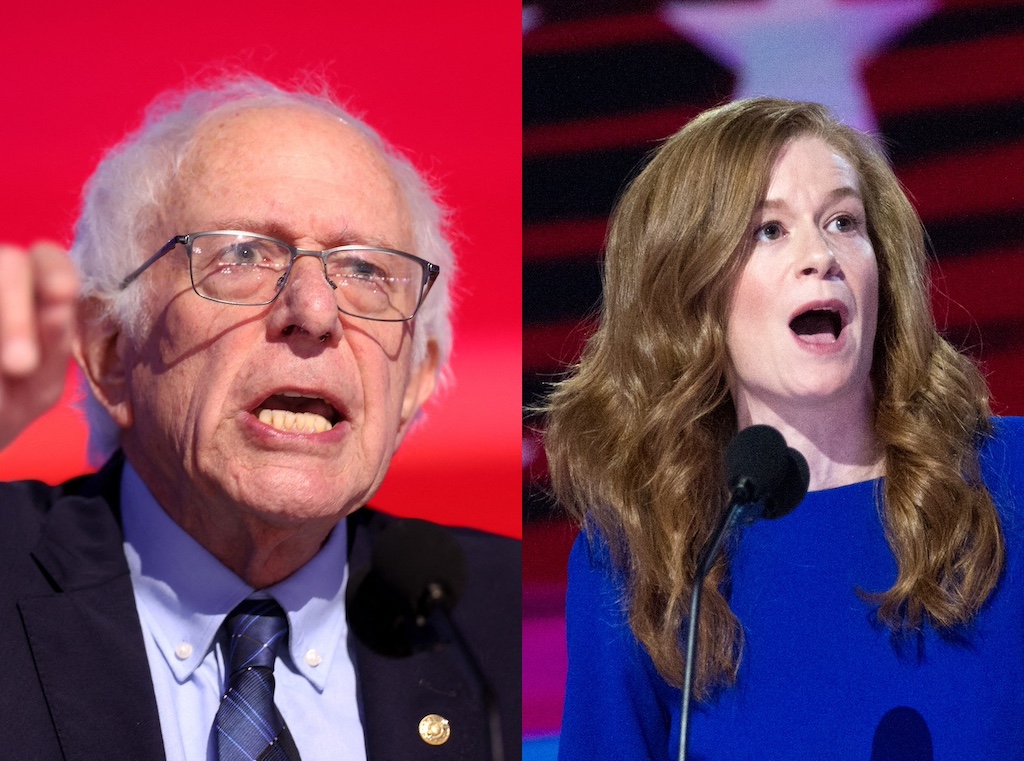
Split image of Bernie Sanders speaking and Mallory McMorrow speaking.

The clash between populists and elites in the Democratic Party is an all-out fight over money and power. (Scott Olson / Getty Images; Jacek Boczarski / Anadolu via Getty Images)


After the 2024 election, a schism in the Democratic Party quickly widened. The party’s corporate faction — which urged nominee Kamala Harris to shun economic populism — decided the lesson of the election wasn’t that voters were sick of an oligarch-appeasing party, but that operatives should better coordinate shadowy shell organizations and slush funds of billionaire cash to match Republicans.

By contrast, the party’s populist faction saw the election as a reminder that the party needs much clearer anti-oligarch and anti-corruption politics.

Today this simmering conflict went from muted and subtle to blatant and explicit, bursting into the spotlight thanks, in part, to good old-fashioned shoe-leather journalism.

Over the weekend, the Lever published a blockbuster report exposing a billionaire-funded political machine designed to co-opt — or defang — a rising tide of economic and anti-corruption populism boiling up in the Democratic Party.

The story is making waves because, for the first time, our reporters detail how this machine of super PACs and overlapping donors and operatives seems to be edging right up to the legal lines of anti-corruption laws prohibiting various forms of coordination between outside entities, consultants, and candidates.

It is, in the words of the Lever’s reporters Luke Goldstein and Katya Schwenk, a “new dark-money-backed enterprise of unparalleled scale and complexity” — the kind that some top Democratic officials seemed to advocate for right after the 2024 election.

Rewind to late November 2024, and you will recall that Pod Save America hosted its official election postmortem. On this particular episode, top Democratic campaign operatives first marveled at Republicans allegedly flouting anti-corruption and campaign finance laws.

Here’s what they said:

Jen O’Malley Dillon: [Trump] had an army of super PACs that were so coordinated. I’m sure there’s some legal way they were communicated, coordinated, but like —

Dan Pfeiffer: I’m sure it was legal.

Jen O’Malley Dillon: Yeah, right.

Stephanie Cutter: Or illegal.

Jen O’Malley Dillon: But they, you know, from the beginning they were, you know, week to week all, you know, one Super PAC would take a couple weeks and hit Pennsylvania and then the next one will come in and do the same and they’re all coordinated. We didn’t have the benefit of that.

And then Harris’s campaign guru, Uber and crypto consultant David Plouffe, insisted that Democrats shouldn’t react by running against that kind of shadiness but instead to appropriate it as Democrats’ own tactic.

Plouffe: We have to stop playing a different game as it relates to super PACs than the Republicans. Love our Democratic lawyers. I’m tired of them. OK. They coordinate more than we do. I think amongst themselves, I think with the presidential campaign, like, I’m just sick and tired of it, OK? So, we cannot be at a disadvantage, number one.

Number two, to Jen’s point, I think you don’t want duplication, but I think having multiple players on the field as long as they’re well-coordinated is great . . . I think that they tend to have more entities that are, to Stephanie’s point — clearly it is not legal what they’re doing. But we’re at a disadvantage when our folks are playing by a different set of rules than they are . . . to win close races, you kind of want to be maximizing every piece of the arsenal. And so I think this is something we really have to reflect on and make some adjustments going forward.

Now, the Lever has proven what that reflection and adjustment birthed: an oligarch-funded machine of overlapping super PACs and fee-reaping consultants circumnavigating campaign finance laws, looking to recreate the old Democratic Leadership Council and aiming to deflate the nascent populism bubbling up inside the party.

As one nonpartisan campaign finance expert told the Lever: “When you continue to blur the lines of the existing anti-coordination rules, and when you continue to erode those anti-corruption safeguards in the process, that’s giving wealthy donors more access and influence in dictating the terms of the campaign.”

The Coming Factional Fight

Just after our story published, though, the other faction made some news: Six Democratic US senators led by Bernie Sanders sent a letter to the Democratic National Committee demanding the party follow up its recent resolution against dark money with a tangible move to actually reduce the influence of that dark money inside the party.

“National and state parties should require all Democratic candidates to sign a pledge opposing billionaire- and corporate-backed super PAC spending on their behalf in Democratic primaries,” they wrote. “Protecting our democracy must begin within our own party. Democratic primaries should be decided by voters — not by billionaires or corporate-backed super PACs.”

I expect this factional fight to intensify in the coming weeks, and I have two thoughts.

First, having worked on campaigns, I’m not someone who thinks unilateral disarmament in general elections is a good idea — so I understand Harris aides’ lament about asymmetry in following or flouting campaign finance laws.

But . . . I do not think the solution for Democrats is to just be as corrupt as Republicans or build as shady a machine as the GOP (particularly because there are plenty of ways to run well-financed campaigns inside America’s minimal campaign finance strictures). Clearly, that’s what the corporate faction is trying to do — and with the first and foremost goal of not necessarily winning general elections, but in maintaining billionaire control of Democratic primaries and by extension the Democratic Party.

As I wrote in a Bulwark essay upon the release of the Lever’s Master Plan book about the legalization of corruption, the better long-term path is for the party to make its brand anti-corruption — in word and in deed.

Primaries are the easiest first place to do this, because adhering to the kind of strict anti-corruption, anti-coordination, and anti-super PAC standards that Sanders’s group is pushing doesn’t risk losing resources for general election fights against Republicans.

It only risks reducing the power of billionaires, which is why they and their political operatives are so opposed to such reforms and so intent on building their own machine to buy primaries and remain in control of the party.

This article was first published by the Lever, an award-winning independent investigative newsroom.

Share this article

Contributors

David Sirota is editor-at-large at Jacobin. He edits the Lever and previously served as a senior adviser and speechwriter on Bernie Sanders’s 2020 presidential campaign.

Filed Under