Defend Cuba From US Efforts to Crush It
Donald Trump’s efforts to blockade Cuba’s fuel supply aim to create chaos. Now more than ever, Cuba needs practical international solidarity to resist US imperialist bullying.
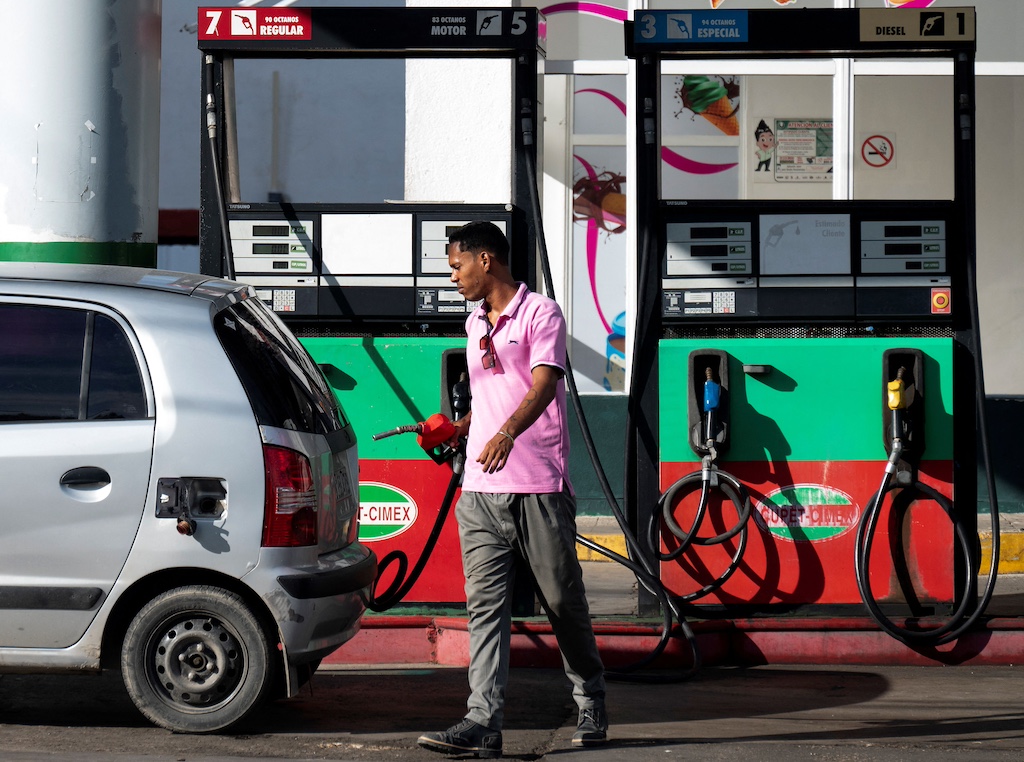
For years, the US establishment has blamed the Cuba’s economic problems on socialism, incompetence, and mismanagement. (Yamil Lage / AFP via Getty Images)
US president Donald Trump and Secretary of State Marco Rubio are seeking regime change in Cuba by the end of 2026. Their actions expose the hypocrisy of US policy toward Cuba over decades — claiming to champion human rights while imposing a blockade that denies Cubans access to vital resources.
Trump openly backs the return of Cuba’s old elite and has even suggested a “friendly takeover” of Cuba by the United States. After years of the US establishment blaming the island’s economic problems on socialism, incompetence, and mismanagement, Trump today openly boasts that the US embargo means “there’s no oil, there’s no money, there’s no anything.” If Cuba really were a failed state, as Trump and his predecessor Joe Biden claim, US economic warfare would be unnecessary. This renewed aggression reveals a declining great power losing hegemony, riven by contradictions and internal crises, and desperate to crush all challenges and alternatives in order to preserve its dominance.
Executive Order
This January 29, Trump signed an executive order claiming that Cuba constitutes “an unusual and extraordinary threat” to US national security and foreign policy and authorizing tariffs on goods from countries selling or providing oil to Cuba. This followed the December 2025 seizure of tankers carrying Venezuelan oil and, this January 3, the violent abduction of Venezuelan president Nicolás Maduro and his wife, Cilia Flores.
In response to Washington’s threat of tariffs, Mexico and other countries abandoned oil shipments to Cuba. Trump’s executive order drew on several laws, including the International Emergency Economic Powers Act, which the US Supreme Court ruled on February 20 cannot be used to impose tariffs. Yet this makes little difference: Trump can use other statues to authorize the measures. In any case, no tariffs had been collected, but the threat alone had effectively stopped oil deliveries to Cuba.
Trump’s executive order had an immediate impact on the island, which depends on imported fuel to generate half of its electricity needs. Within two weeks, the United Nations Human Rights Office warned that essential services were at risk:
Intensive care units and emergency rooms are compromised, as are the production, delivery, and storage of vaccines, blood products, and other temperature-sensitive medications. In Cuba, more than 80 percent of water pumping equipment depends on electricity, and power cuts are undermining access to safe water, sanitation, and hygiene.
The fuel shortage has disrupted the rationing system and the regulated basic food basket, and has affected social protection networks — school feeding, maternity homes, and nursing homes — with the most vulnerable groups being disproportionately impacted.
Already, Cuban hospitals have canceled nonurgent care, while ambulances lack fuel. Many schools, colleges, and universities have also had to close. Public and private transport and goods cargos are drastically reduced. Workplaces, whether state-owned, private, or cooperative, have drastically cut back activity. Fuel scarcity has disrupted food production, refrigeration, and transport, leading to shortages, price hikes, and long queues for basic goods. Rubbish collection has collapsed, increasing sanitary risks. Persistent electricity blackouts make daily life extremely difficult. Some international airlines have canceled flights because Cuba lacks aviation fuel, and several governments have advised against all but essential travel, further hemorrhaging Cuba’s tourism revenue.
Mark Weisbrot, coauthor of a recent Lancet Global Health study calculating that unilateral sanctions cause over half a million deaths worldwide every year, wrote of Trump’s oil blockade: “Right now we can see in real time how such deaths happen. . . . The collapse of oil imports has had immediate and life-threatening effects.”
In February, Trump told reporters that Rubio was involved in high-level talks with Cuban officials. Cuban leaders denied this, and a Drop Site News report suggested that Rubio was lying so he could subsequently claim that talks failed due to Cuban intransigence and then push for regime change. Rubio will not be satisfied with the so-called Venezuela model of only removing the president in Cuba.
Then, on March 13, Cuban president Miguel Díaz–Canel announced that, along with Raúl Castro, he was directing talks with US government representatives “aimed at finding solutions through dialogue.” He restated the revolutionary government’s historic position: that Cuba would participate only “on the basis of equality and respect for the political systems of both states, and for the sovereignty and self-determination of our Government.” This followed an announcement the previous day that fifty-one prisoners would be released, with mediation from the Vatican.
Economic Warfare, Aimed at Regime Change
Recent measures compound hardships resulting from nearly seven decades of economic warfare. The US “embargo” on Cuba is the longest and most extensive system of unliteral sanctions in modern history. This is not merely a legal or bilateral issue between the two countries but a blockade that obstructs Cuba’s interactions with the rest of the world, violates human rights, and hinders development.
Most Cubans on the island have spent their entire lives enduring shortages caused by decisions taken in Washington to garner votes in Miami. In 2025, Cuba’s annual report to the United Nations put the cumulative cost of the US blockade at over US$170 billion. Costs are rising year after year, reaching $7.6 billion from March 2024 to February 2025 alone.
The objective of US policy was long ago set out in a 1960 memorandum by US diplomat Lester Mallory titled “The Decline and Fall of Castro,” which proposed economic warfare “to bring about hunger, desperation and overthrow of government.” Sanctions are part of this tool kit.
During his first administration, Trump adopted a policy of “maximum pressure” against Cuba, introducing more than 240 new sanctions and coercive measures to cut the country off from global trade and the international financial system. This coincided with the COVID-19 pandemic and hit Cuba hard: electricity blackouts returned, goods and medicines became scarce, inflation and emigration soared, foreign investors fled, and international reserves were drained. Life was already extremely tough for Cubans before Trump returned to office in 2025, with Rubio — his career built on hard-line opposition to Cuban socialism — as the new secretary of state.
Can Cuba Survive?
“Cuba is on the brink of collapse,” the mainstream media proclaims in unison. Yet decades of research and lived experience in Cuba counsel skepticism toward such headlines. The demise of Cuban socialism has been foretold more times than the assassination of Fidel Castro was attempted. As I wrote in a book on how revolutionary Cuba survived the collapse of the Soviet-led bloc, this revolution wrote the rulebook on resilience.
Beyond the assertion of national sovereignty, it argued, the creation of an alternative model of development was key to this. One chapter examined the Energy Revolution of 2006, which launched Cuba’s shift to a renewable energy matrix. Faced with today’s onslaught on the oil supply, this shift is proving vital.
Already in 2024, the Cuban government announced plans to install ninety-two solar panel parks by 2028 with credit and technology from China. These will have an installed generation capacity of two gigawatts daily. Half of the planned parks are already installed, contributing around one gigawatt hours daily, around 20 percent of Cuba’s electricity needs. Another 30 percent is derived from domestically produced fossil fuels.
There remain serious obstacles, however: investments and construction are hindered by Trump’s oil blockade; the photovoltaics need to be connected to the national grid; there is a lack of storage capacity for the energy produced, so it only contributes during daylight; and while electric vehicles have entered Cuba in recent years, most of the transport fleet is fuel-dependent. If Trump and Rubio’s oil blockade remains unbroken, how long can Cuban socialism, and indeed, the Cuban people survive?
The World Needs Cuba
This is no mathematical calculation or intellectual puzzle; it is a human crisis that should concern us all. But what would we lose if Trump achieved what twelve of his predecessors failed to do — the destruction of Cuban socialism?
For any of its flaws, Cuba has demonstrated that after centuries of colonialism and imperialist domination, a subjugated people can take control of their land and resources and chart their own path in development, international relations, and values. The historic commitments to sovereignty and social justice by Cuban revolutionaries link the nineteenth-century wars of independence with the 1959 Revolution, the adoption of socialism, and the struggle against imperialism and underdevelopment. They also underpin Cuba’s symbolism for the Global South.
Leftists who criticize the Cuban system are mistaken to dismiss the remarkable gains the Revolution brought to the Cuban masses — in education, health care, housing, sports, culture, participative democracy, science, and economic and social justice — while also making bold strides in confronting racism, sexism, and class oppression.
This is what inspires people across the Global South, where some 85 percent of the world’s population live. Cuba is a small island that defied an empire and brought its own version of socialism to the western hemisphere, forged through its own revolutionary process, not imposed from outside. Emerging from the ragtag Rebel Army, the Cuban Revolutionary Armed Forces humiliated the United States at the Bay of Pigs in 1961.
Cuba has been a permanent thorn in the side of US imperialism: supporting national liberation and guerrilla movements around the Global South and punching above its weight in geopolitical terms. This was the small country that sent 400,000 soldiers to Angola to defend it from the invading forces of apartheid South Africa. It has consistently contested US hegemony in the Americas and imperialism worldwide, sending military and medical personnel to what President George W. Bush once called “any dark corner of the world.”
In turn, Cuba has survived relentless aggression from the world’s dominant power, whether through overt and covert military actions; sabotage and terrorism by US authorities and allied exiles; economic warfare; or international isolation. It has undermined Cuba by promoting dangerous emigration, including by unaccompanied minors (Operation Peter Pan, 1960–62) but also Cuban doctors (the Cuban Medical Professional Parole Program, 2006–17) while obstructing remittances, family visits, and visas. This is topped off by lucrative funding for regime-change programs.
Not least in this context, the Cuban Revolution has achieved a great deal. It has demonstrated to the Global South the benefits of welfare-centered development under a socialist planned economy with a participative democracy. The revolutionary state improved development indicators to rich-country levels within one generation.
Its free, universal public health care system achieved the highest ratio of doctors per person in the world. It slashed infant mortality, raised life expectancy, and eliminated diseases. Its universal public education system is free for all, including at the highest levels, elevating Cubans to among the most literate and cultured people in the world. It invested in art, culture, and sporta, endorsing them as human rights. It invested in science and technology for social development.
It created a unique state-funded, state-owned biotechnology sector producing the world’s first meningitis B vaccine, the first therapeutic lung cancer vaccine, a treatment for diabetic foot ulcers that reduces the need for amputations by over 70 percent, and the only COVID-19 vaccines created in Latin America and the Caribbean. Even now, it is trialing promising new drugs for Alzheimer’s disease. Cuba is world-leading in sustainable development and agroecology and has a unique long-term state plan to confront climate change, known as Tarea Vida.
A 2022 study by Jason Hickel and Dylan Sullivan found that between 1990 and 2019 neoliberal policies caused 15.63 million excess deaths worldwide from malnutrition that could have been prevented with Cuba-style policies, including 35,000 in the United States. In a world where 1.1 billion people live in acute multidimensional poverty, two billion lack clean drinking water, and 3.5 billion lack sanitation, Cuban socialism offers a viable alternative.
This force of example is the only sense in which it poses “an unusual and extraordinary threat” to the United States. As Fidel Castro warned before the Bay of Pigs invasion, Cuba would not be forgiven for carrying out “a socialist revolution right under the nose of the United States!”
Revolutionary Cuba has also mobilized the world’s largest international humanitarian assistance program, from health care professionals to technical specialists and construction workers. Guatemalan researcher Henry Morales calculated that between 1999 and 2015, Cuba’s overseas development aid equaled 6.6 percent of its GDP, compared to the European average of 0.39 percent and 0.17 percent from the United States. Since 1960, over 600,000 Cuban medical professionals have served in 180+ countries, saving and improving millions of lives, especially in underserved populations in the poorest countries.
The US government is actively sabotaging Cuban medical internationalism with lies, manipulations, and threats against recipient countries. Under pressure from Trump, some governments have sent Cuban medics home, directly harming their own citizens who are left without health care. Regime change would not only devastate Cuba but hurt millions of people around the world who rely on Cuban assistance.
Reject Calls on Cuba to Make a Deal
This Trump administration has shown utter contempt for international law. It has conducted extrajudicial killings in the Caribbean and Pacific Ocean, hijacked oil tankers, kidnapping crews and seizing the oil. It has abducted Venezuela’s president and his wife and threatened invasion, even of its own NATO allies, while reviving and expanding the Monroe Doctrine and violating human rights and national self-determination.
In this context, calls on Cuba to “make a deal” with Trump amount to veiled threats against its sovereignty. Instead of dispensing advice to the besieged island, intellectuals and analysts should make demands of the US government, holding it accountable for its crimes. Academics should not legitimize the idea that Trump has the right to carry out regime change, as Florida International University’s new academic initiative does in seeking to “steer Cuba towards freedom and democracy, to support transition.”
A recent online petition, “Scholars in Solidarity with Cuba,” condemns the US government’s policy of asphyxiation and defends Cuba’s right to self-determination and socialist development. We urge scholars and students globally to sign it. Beyond petitions, we need concrete action to defend Cuba. International bodies like the UN, BRICS, EU, and Group of 77 and China must oppose Trump’s bullying by sending fuel and the other essential goods to Cuba. But we cannot wait for them.
We can donate funds and resources now. Let Cuba Live! is purchasing solar panels; the Saving Lives Campaign and Global Health Partners are procuring medical equipment; and the Hatuey Project provides cancer medicines for Cuban children. We can support or join the Nuestra América Convoy to Cuba, led by Progressive International, which urges people from around the world to travel to Havana by land, air, and sea for a mass mobilization on March 21. Whatever we do, we must act now. Cuba has shown unparalleled solidarity with the world. Now the world must stand with Cuba.