Cuba’s Revolution Always Had an Internationalist Spirit
Sixty years ago, delegates from all over the world gathered in Havana for the Tricontinental Conference, forging ties of solidarity and resistance. The anniversary came last month, just as the US stepped up its aggressive campaign against Cuba.
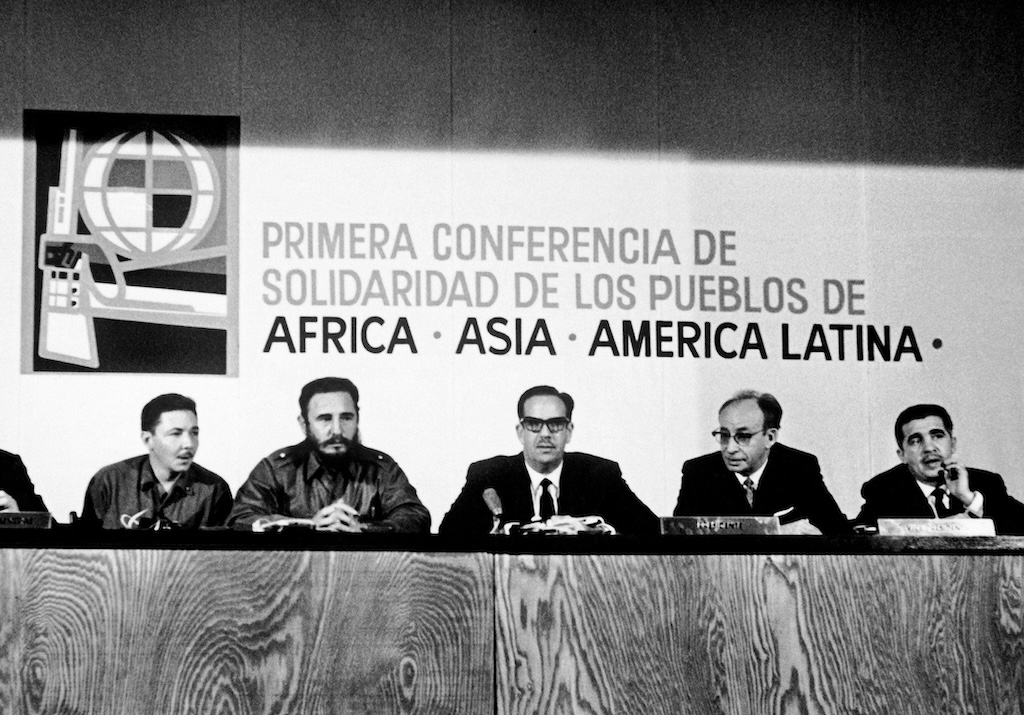
The Tricontinental Conference of 1966 was one of the most striking examples of Cuba’s internationalism during the early years of its revolution. It gave participants from more than 80 countries a lasting awareness of the power of solidarity. (Keystone-France / Gamma-Keystone via Getty Images)
Last month, there was an event in Havana to mark the sixtieth anniversary of the Tricontinental Conference, a major international gathering held in the Cuban capital between January 3 and 13, 1966. This came just as the standoff between the United States and Venezuela escalated dramatically, with US troops seizing President Nicolás Maduro, killing all thirty-two of the Cuban soldiers protecting him, and imposing a quasi-blockade of Cuba’s oil supplies.
The alarming contemporary backdrop makes this an especially apposite moment to reflect on the purpose and legacy of the Tricontinental Conference. The 1966 event attracted 512 activists, mostly anti-colonial and anti-imperialist, from eighty-two countries or colonies from what was then known as the “Third World.” They were joined by 270 journalists and observers, including large delegations from the USSR and China (which, however, were largely left on the margins).
At a time of open schism between Cuba’s leaders and the more cautious Soviet Union, it was a high-profile episode. While Moscow saw it as an opportunity to outflank China’s influence in Africa and Asia, many outsiders believed that Havana was taking over Moscow’s pet project or attempting to lead the Third World against US imperialism and away from the Soviet Cold War strategy of “peaceful coexistence.”
That seemed possible, in view of Cuba’s already active support for armed revolution in Latin America (against Moscow’s wishes) and Ernesto “Che” Guevara’s message to the Conference, which appeared to call for “two, three, many Vietnams.” On reflection, however, we can see a somewhat different purpose and character to the gathering, whose participants responded more to Cuba’s image and example (of successful resistance to US imperialism), rather than to specific Cuban policies.
While the event aroused favorable opinion on the global left, it worried many governments (especially in the United States), who perceived danger in the conference’s size, participants, and wide-ranging discussions. Afterward, its significance seemed to fade: one organization generated in 1967 (the Organization of Latin American Solidarity, OLAS) seemed marginal to developments, and another (the Organization of Solidarity of the Peoples of Asia, Africa and Latin America, OSPAAAL) became known more for its striking posters than its solid actions.
Yet the conference seems to have given participants a lasting awareness of the power of solidarity and intellectual exchange. As Anne Garland Mahler has traced, its legacy is visible in many radical developments across the Global South, including Black Power in the United States. Rather than look for tangible outcomes, we should perhaps address the event’s context and character in its own right.
From Bandung to Havana
The context was incontrovertibly set by the seminal 1957 Bandung Conference, where Josip Broz Tito, Sukarno, and Jawaharlal Nehru, the leaders of Yugoslavia, Indonesia, and India, led a rethinking of the bipolar Cold War, shifting the focus toward a “third world.” What ensued from this were the 1957 Cairo-based Afro-Asian Conference, the Non-Aligned Movement, and the Group of 77.
However, in contrast with Bandung, the Tricontinental included Latin America. It mostly attracted opposition movements and activists rather than government leaders, and instead of being defined by what it was not (i.e., the Cold War divide), focused on active (and even armed) anti-colonialism, anti-imperialism, and radical decolonization. By 1966, moreover, the “Third World” idea had been radicalized, often shaped by Marxist discourse and more clearly opposing US imperialism, largely in response to US actions in Latin America.
The context inside Cuba was the emerging hegemony, in intellectual and political circles, of more radical interpretations of Marxism, reflecting a troubled relationship within the rebel forces that brought about the Cuban Revolution in 1959. On July 26, 1953, Fidel Castro had led an abortive attack on Santiago de Cuba’s Moncada garrison, and the new 26 July Movement (M-26-7) subsequently landed eighty-two rebels in eastern Cuba to begin a guerrilla struggle in 1956. Cuba’s existing (communist and pro-Soviet) People’s Socialist Party (PSP) openly criticized the strategy of armed rebellion.
However, as the M-26-7 rebels turned the tide against President Fulgencio Batista in late 1958, the PSP joined the M-26-7 in rebellion. It became part of a tripartite rebel leadership after January 1, 1959, along with a small guerrilla group that had joined the Che-led rebels in the final battle of Santa Clara. However, the relationship between the PSP and the M-26-7 was never easy, and ideological differences soon arose from the PSP’s rigid and somewhat Stalinist interpretation of Marxism, which was in line with Moscow’s thinking.
According to this school of thought, an underdeveloped Cuba without an industrial proletariat could not undergo a socialist revolution and should not attempt it. Against that interpretation, Cuba’s leaders (especially Che and Fidel) increasingly argued that socialism was possible, given Latin America’s different conditions, and even saw a possible transition to communism coming about faster than orthodox Marxism predicted.
Relations worsened once Fidel referred publicly in April 1961 to the revolution as “socialist,” and after some PSP leaders tried to take control of Cuba’s emerging single-party structure in 1961–62. That all resulted in the PSP being marginalized, with the M-26-7 leading the parties that developed over the course of the 1960s: the 1962–65 United Party of Cuba’s Socialist Revolution (PURSC) and, beginning in 1965, the Cuban Communist Party, both with names that explicitly challenged Moscow.
Moreover, Cuban anger had resulted from the perceived Soviet neglect of Cuba’s demands in the October 1962 Missile Crisis negotiations. From 1962, therefore, Cuba’s revolution followed a very different and more radical path to socialism and communism. Its foreign policy explicitly challenged the United States and implicitly challenged Moscow’s line of “peaceful coexistence”’ and acceptance of global “spheres of influence.” Cuba’s “insurrectionary” strategy supported anti-colonial movements in Africa as well as Vietnam.
Critical Thinking
That, then, was the context for the Tricontinental, with a Cuba much changed since 1959 and seen by many in the Third World as the ideal site for radically rethinking anti-colonialism, anti-imperialism, and decolonization. This was a time of growing disillusion and anger against residual colonialist attitudes in Europe’s decolonization processes and a growing rejection of conventional Global North economic solutions.
While postcolonial African leaders might often look toward Soviet templates of nation-building, younger activists increasingly saw Soviet attitudes as cautious and even complicit. As that wider questioning responded positively to revolutionary Cuba’s example and image, the 1966 event became a meeting of minds on a grand scale.
So far as the conference’s outcomes are concerned, the mark left inside Cuba was clear. In 1967, a group of young Cubans associated with Che and his ideas created the radical magazine Pensamiento Crítico (“Critical Thinking”), often focused on an understanding of the Third World that included US black struggles.
The publication left a legacy of maverick thinking until it closed in 1971 in connection with changing internal politics. The year 1967 also saw Roberto Fernández Retamar’s pathbreaking essay “Caliban,” putting forward the most radical interpretation yet from inside Cuba of the need for Third World intellectuals to rethink what colonialism meant psychologically and what a deep decolonization should entail.
In 1968, the Havana Cultural Congress gathered nearly five hundred leading radical intellectuals from sixty-seven countries, uniting the Third World with First World New Left figures, to find paths toward a genuinely anti-imperialist and decolonizing revolutionary culture. The message of the participants partly drove the contentious 1971 Congress of Education and Culture, which emphasized a militant demand to decolonize thinking, to think in terms of the Third World rather than (aspiring toward) the First.
The 1971 event became contentious, as many non-Cuban intellectuals viewed it as a case of Stalinist orthodoxy ending Cuba’s previous and much-praised “cultural revolution.” Cubans themselves would later see 1971 as having launched a quinquenio gris (“grey five years”) which for a while marginalized some more established intellectuals and artists of the 1960s.
However, the stance of the congress was as much one of militant tercermundismo (“Third Worldism”) as PSP-based Stalinism, with the former reflecting Cuba’s growing understanding of the Third World. That understanding partly followed Lenin’s argument that capitalist monopoly imperialism had shaped a totally different set of conditions, structures, and classes in the colonial and dependent world.
But it also looked to Marxists of the 1920s, including Peru’s José Carlos Mariátegui and Cuba’s Julio Antonio Mella (a founder of the first Cuban Communist Party). Che’s emphasis on the role and power of “subjective conditions” for revolution echoed Antonio Gramsci’s emphasis on ideology and culture as structures equal to economic and social patterns.
What Cuba now proposed was essentially a decolonization of Marxist thought, rejecting the assumptions of orthodox European Marxism as too based on nineteenth-century industrial Europe. Walter Rodney would in due course develop that notion.
Cuban Socialism
The point being made here is that the drive to develop a distinctly “Cuban socialism” and communism remained, even during the years (broadly from 1972 to 1990) when the revolution seemed to many to be slavishly following Soviet models of Marxism. After 1990, that difference appealed to Global South radicals seeking their own voice and their own paths to a genuine postcolonial nation-building.
To some extent, we can see the 1966 Conference as having helped to shape all those challenges and interpretations. Indeed, the evidence seems to show that, despite spawning relatively few concrete measures or strategies, the conference left a mark on many participants. Indeed, a lack of such concrete outcomes should come as no surprise, since events do not always engender further events or organizations, but they can still leave a legacy in the thinking and subsequent readings of participants.
This is especially true if, as was the case with the Tricontinental, the event’s debates and theorizing confirmed and legitimized evolving stances and understandings of the participants, instead of creating them from scratch. Equally, the gathering was often seen as a shot in the arm for those struggling in isolation against colonialism: sharing perspectives and experiences with others over the course of ten days created a new awareness that their struggles were not solitary and that solidarity could be real.
There was one other way in which the conference was significant. By including so many Latin Americans (often from armed guerrilla rebel groups), its discussions and exchanges made Africans and Asians more aware of the parallels between their own experiences of European imperialism and the experiences of those in Latin America who were facing US imperialism.
At the same time, they also persuaded Latin Americans to rethink their own postcolonial experiences. In spite of having been “postcolonial” since the 1830s, their processes of decolonization had often been slow and minimal, distorted by pervasive colonized mentalities and by the sequence of Britain’s “informal imperialism” and direct or indirect US imperialism.
Cuba’s trajectory was even clearer: having achieved formal independence at a late stage in 1902, it went through a phase of overt neocolonialism under US tutelage, distorting any attempt at postcolonial nation-building and effectively postponing that attempt until 1959. Simply put, delegates from different parts of the Third World found that they had much to learn from each other.
Meanwhile, Cuba’s development strategies and survival often drew the attention of those who were embracing dependency theory and other “world system” perspectives, helping to create a wider climate of debate. Global South thinkers took a degree of authority from the Tricontinental’s call for a grassroots-based reassessment of decolonization, seeking structural change to shape more genuine independence.
As Mahler showed, some of the rethinking after 1966 was less radical than the event itself but was often more popularly based and more concrete. Examples might include the New International Economic Order and Latin American Economic System of the 1980s; the enlargement of the Group of 77; and the World Social Forum. Such schemes might not have happened as they did without the Tricontinental inspiring many while frightening others into seeking common ground in the center rather than the Left.
Legacies of Solidarity
Lessons learned in 1966 helped to shape the thinking and actions of some participants, as they took leading roles in their new postcolonial nations (in Africa and Asia) or in Latin America’s changing and more anti-imperialist climate from the 1970s to the 1990s. As those ideas evolved in a different “Global South,” a term that is now less contested than the original “Third World,” Cuba’s enduring image, example, and survival opened doors to greater collaboration with its internationalist strategies of providing aid.
In the 1990s, that would in turn lead to growing support for the UN General Assembly’s annual Cuban motion condemning the US embargo, motions that would give that condemnation the force of international law, making the embargo illegal (usually with only the United States and Israel disagreeing). Subsequent developments did to some extent show that solidarity can work, given the right conditions.
That, ultimately, might be judged to be the Tricontinental’s lasting legacy. This is especially true if Cuba’s internationalist record over the years (including those thirty-two Cubans killed in Caracas) can turn the growing diplomatic solidarity toward Cuba into something more concrete, as it faces the Trump Administration’s punitive stranglehold that is worsening an already deep economic and social crisis.