US Companies Prepare to Profit From Regime Change in Cuba
Eyeing a possible regime change in Cuba, US corporations see an opportunity to recoup assets lost in revolutionary seizures many decades ago. The Supreme Court, at the urging of the Trump administration, might soon clear the way for them.
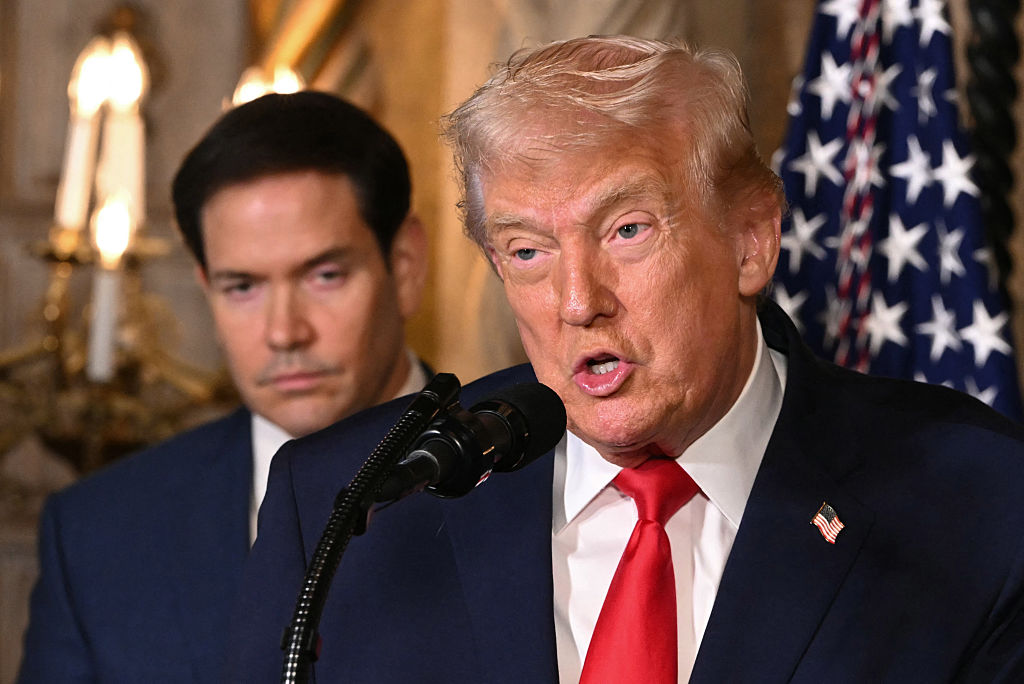
Cuban American hard-liners and fossil fuel giants are adopting an overt strategy of lawfare against Cuba. Encouraged by Donald Trump, a Republican-dominated Supreme Court could soon give the project crucial support. (Andrew Caballero-Reynolds / AFP via Getty Images)
As President Donald Trump gestures toward regime change in Cuba, the US Supreme Court, with Trump’s urging, has agreed to hear lawsuits that could help corporate interests recoup hundreds of millions of dollars in long-expropriated Cuban assets if the United States seizes control of the nation.
One of those lawsuits involves an oil giant claiming damages from Cuban companies for decades-old revolutionary asset seizures. The other, which one of the plaintiffs calls the most important Supreme Court case on Cuba “in the past sixty years,” involves the scion of a fascist-friendly corporate empire who’s taken credit for Trump’s hardline stance on Cuba and is seeking compensation for a 122-year-old expired pier contract.
Together, they build on long-dormant anti-Cuban foreign policy weaponized by Trump and push the court to extend US law beyond its borders to retroactively punish a foreign revolution — and deliver the spoils to profiteers.
“The Supreme Court is doing about seventy cases a year,” Robert Muse, a Washington, DC–based attorney who has long focused on Cuban legal matters, told the Lever. “The fact that it would devote two places on the docket to litigation arising under a statute that’s only produced about fifty cases in total — and where there’s no circuit split — is extraordinary.”
Over the past year, the Trump administration has ratcheted up tactics to deliver regime change in Cuba, which has weathered a comprehensive trade embargo for six decades and has been trapped in fuel, energy, medicine, and foreign exchange crises since the onset of COVID-19 pandemic.
Then, within hours of US troops extracting Venezuelan president Nicolás Maduro on January 3, Donald Trump asserted that “Cuba is ready to fall” because Cuba gets “all of their income” from Venezuelan oil. Secretary of State Marco Rubio, a prominent Cuban American politician, soon echoed the warning, telling the Cuban government that it “should be concerned.” The following week, Trump doubled down on his threats, warning the Cuban government to “make a deal before it’s too late.”
Amid this backdrop, the Supreme Court will hear arguments for Exxon Mobil Corp. v. Corporación Cimex, S.A. and Havana Docks Corporation v. Royal Caribbean Cruises, Ltd. on February 23. If the Supreme Court rules in favor of the corporate plaintiffs, it could create new avenues for private actors to capitalize on regime change in the country — and further boost the vulture capitalism that is already driving US policy in Latin America.
Across the region, corporate interests have been turning political crises into legal clout. Hedge funds have for years prolonged austerity measures in Puerto Rico by pressuring the US territory’s government to pay distressed debts in full. More recently, energy companies positioned themselves to profit from Trump’s Venezuelan regime change.
Codifying Retaliation
After former Cuban president Fidel Castro’s anti-imperialist Cuban Revolution deposed US-backed dictator Fulgencio Batista in 1959, US-Cuba relations quickly deteriorated. The following year, Castro authorized Law 851, allowing the Cuban government to expropriate US-owned or controlled property.
Then, in 1962, the United States imposed a full trade embargo on Cuba, following Deputy Assistant Secretary Lester Mallory’s recommendation three years earlier to deny “money and supplies to Cuba, to decrease monetary and real wages, to bring about hunger, desperation, and overthrow of the government.”
In 1996, Congress hardened the embargo by passing the Helms-Burton Act, which extended the ban beyond US borders. By threatening legal action against both US and non-US firms for conducting business in Cuba, the Helms-Burton Act explicitly sought to expedite the collapse of the Cuban government by discouraging foreign business investment in Cuba.
One section of the Helms-Burton Act, Title III, created a private right of action that allowed “US nationals” to file suit against any US or foreign entity that “traffics” in property expropriated by the Cuban government. Both the drafters of the Helms-Burton Act and Cuban-American hard-liners have argued that Title III is necessary because it provides a means for Cuban-Americans to receive compensation for property that the Cuban government has seized and profits from.
However, the Cuban government has already settled many revolution-era debts without the threat of legal action. It has negotiated settlements for nationalized properties with Canada, Great Britain, France, Spain, and Switzerland. The Cuban government originally agreed to compensate US property owners via proceeds from its long-standing US sugar export deal, but the matter was left at an impasse after the United States ended the trade arrangement in 1961.
Shortly after former president Bill Clinton signed the Helms-Burton Act, the European Union threatened to challenge the law before the World Trade Organization because it would allow the United States to regulate non-US companies operating elsewhere. Clinton agreed to suspend Title III of the law for six months, and the EU dropped its case. For more than twenty years, every president since has suspended Title III in six-month terms, recognizing that its activation would strain its diplomatic relations with allies.
That restraint ended during Donald Trump’s first term when the administration activated Title III in April 2019. The move opened the floodgates for longstanding grievances to become lawsuits. Roughly forty suits were filed in the first two years of Title III’s activation against Cuban, American, and European companies — but so far, most have had little effect.
“Title III has been operative for six years” Muse explained, “and nobody has received a judgment.” Many of the lawsuits have been dismissed on procedural issues, and most early judgments and the only jury verdict award in favor of plaintiffs have been overturned.
But now, two of those lawsuits have reached the Supreme Court.
Exxon and the Assault on Sovereign Immunity
One of those cases was filed by ExxonMobil against two Cuban state corporations: Union CubaPetroleo (CUPET) and Corporación CIMEX. Exxon Mobil argues that the companies are liable for the losses incurred by Cuba’s 1960 revolutionary expropriation of its service stations and oil refineries, which were at the time owned by the oil giant’s Panamanian subsidiary, Esso Standard Oil.
The 1976 Foreign Sovereign Immunities Act — as well as international law — agrees that one nation cannot be sued in the courts of another. So, for a plaintiff to proceed with a civil suit against a foreign state under the Helms-Burton Act, it would need to qualify for an exception to the law. Last year, the US Court of Appeals for the DC Circuit determined that Exxon did not satisfy the criteria to qualify for any such exception.
Exxon then petitioned the Supreme Court to do something far more radical: strip Cuban government entities of their sovereignty altogether by arguing that Title III of the Helms-Burton Act does away with foreign sovereign immunity.
Last August, the Trump administration filed an amicus brief in the case agreeing that the Foreign Sovereign Immunities Act imposes undue burdens on plaintiffs and that Title III of the Helms-Burton Act alone should suffice. Sovereign immunity, in the eyes of Trump’s Solicitor General, appears to be an inconvenience standing in the way of retribution.
In its brief, the government insisted that it has “compelling” and “paramount” foreign policy interests in ensuring that US nationals receive compensation, citing a January 2025 Trump memo titled “Restoring a Tough U.S.-Cuba Policy.” What it does not explain, though, is how the courts would enforce any resulting judgments against the Cuban companies involved — unless there is a regime change.
“You’ve got your Helms-Burton judgment — where are you going to execute it?” said Muse. “There are no Cuban assets in the United States to execute on.”
Havana Docks and the Fiction of Stolen Property
The same day that the Supreme Court agreed to hear the Exxon case, it also agreed to hear Havana Docks Corporation’s lawsuit against four US-based cruise lines.
The Kentucky-based company seeks $439 million from cruise ship operators Carnival, Royal Caribbean, MSC Cruises, and Norwegian for alleged damages incurred between 2016 and 2019, when President Barack Obama removed Cuba from a list of countries deemed to have inadequate port security to allow for US-based cruises to stop there. Havana Docks argues that it holds a long-standing claim to a concession for a long-nationalized terminal and piers used by cruise operators during that time for passenger loading and unloading.
In 1904, Cuban president Tomás Estrada Palma granted Compañia del Puerto, a predecessor to Havana Docks Corporation, a public works concession to build a pier on the state-owned San Francisco Wharf in Havana. According to Decree 467, the concession was explicitly for public purposes and only for cargo loading and unloading; despite Havana Dock’s current claims, Compañia del Puerto was never authorized to offer passenger services on the pier. The initial term of the lease was for fifty years beginning in 1905; the lease was later extended to ninety-nine years, with an expiration date of 2004.
The Cuban Law of Ports made clear that ports are public property and that the public has a “fundamental right to the use of the littoral sea,” which includes the specific right to embark and disembark passengers. According to legal expert Ambar Diaz, in a report created for the Supreme Court at the request of the cruise lines, Havana Docks’ rights were always contingent on state ownership, public rights, and a nonexclusive concession — meaning that the company’s lease could at any time have been terminated, including through expropriation, if the state determined that public needs required it.
Havana Docks is adamant, though, that its expired lease still qualifies as property that was expropriated by the Cuban government.
Behind Havana Docks Corporation’s litigation stands an extensive lobbying campaign by Mickael Behn, a London-based heir to International Telephone and Telegraph Corporation. The company became a global telecommunications empire by the 1930s under Sosthenes Behn, who leveraged connections and cozied up to officials from the Franco and Hitler regimes, and paid Cuban officials under Batista. In 1917, Sosthenes formed Havana Docks Corporation and acquired the concession from Compañia del Puerto to operate cargo loading and unloading on the Havana piers.
Now Mickael, Sosthenes’ grandson, along with his two cousins in France, holds a majority of Havana Docks’ shares. A small group of shareholders, including Warren Buffett, owns the rest. Behn joined forces with Javier Garcia-Bengochea, a Cuban American who claims to own more than 82 percent of commercial waterfront property that was used by cruise operators following Obama’s legalization of Cuban travel. Only 32.5 percent of Garcia-Bengochea’s interest was certified by the International Claims Settlement Act — the remaining 50 percent stake was never certified.
In 2018, Behn and fellow Title III claimant Javier Garcia-Bengochea began to run a public smear campaign to discourage American tourists from taking cruises to Cuba, placing billboards across Miami and running radio ads to link the Cuban military with US-based cruise operators. Behn and his associates effectively ran the ad campaign with the help of the Miami-based Cuban Democratic Directorate, a nongovernmental organization that received more than $3 million in US federal grants to “promote freedom of information” in Cuba.
Behn and Garcia-Bengochea indirectly lobbied the first Trump administration in 2018 to activate Title III of the Helms-Burton Act with the help of former US diplomat Otto Reich (famous for his role in the Iran-Contra scandal), former National Security Advisor John Bolton, and DC-based lobbying firm Cormac Group. The lobbying firm scheduled “$10k coffees” for Behn and Garcia-Bengochea with then-Senator Rubio and then-Governor Rick Scott to request that Trump enforces Titles III and IV of the Helms-Burton Act.
On April 17, 2019, the Trump administration announced the activation of Title III. Less than two months later, the administration halted cruises to Cuba and ended the “people-to-people” visa category that allowed American citizens to visit Cuba as tourists.
Behn and Garcia-Bengochea have openly credited their lobbying efforts to the successful implementation of Title III and the following restrictive US travel policy to Cuba.
“We were able to muster our resources and bring them together and ultimately connect with the Trump administration to get Title III enacted,” Garcia-Bengochea told the Miami New Times in 2023. “Everybody who has sued [under Title III] owes us. We did this for them, and they know it.”
Since 2000, Garcia-Bengochea has donated $25,400 to Marco Rubio’s political coffers and $18,600 to Florida congressman Mario Díaz-Balart. Díaz-Balart, a Republican, filed an amicus curiae brief in support of Havana Docks in March 2025, arguing that US foreign policy is to “bring democratic institutions to Cuba” by cutting off “hard currency, oil, and productive investment and expertise.”
In their own Supreme Court brief on the issue, the cruise lines and related industry groups warned that accepting Havana Docks’ theory that expired, nonexclusive, public-purpose concessions can be converted to indefinite property claims. They argue that this would expose companies to potentially massive retroactive liability and would chill any future normalization policy between the United States and Cuba.
“The sum-total of the Eleventh Circuit’s holding is that [Havana Docks Corporation]’s time-limited interest expired before 2016,” the cruise lines noted. “That narrow, factbound conclusion is not the stuff of certiorari, let alone of diplomatic crises.”
An Imperial Court in Waiting
The Trump administration’s foreign policy goals, which align with Secretary of State Marco Rubio’s lifelong vendettas against leftist governments in Latin America, particularly Venezuela and Cuba, have worked in tandem to drive the Title III lawsuits to the Supreme Court’s docket.
In both the Exxon and Havana Docks cases, US Solicitor General D. John Sauer contends that an immediate review of the Helms-Burton Act’s meaning and scope as a “priority for US foreign policy.”
While this is the first time a Helms-Burton Act Title III lawsuit has ever reached the Supreme Court, the Trump administration has interpreted the 1996 law squarely as it was intended — to curtail foreign investment in Cuba because it “undermines the foreign policy of the United States.” That foreign policy is to bring about regime change in Cuba.
It is with good reason that the Cuban hard-liner community can expect the US Supreme Court to rule in favor of these lawsuits. In the first year of its second administration, Trump’s solicitor general has been masterful at identifying lower court decisions that the Supreme Court would likely reverse or stay in Trump’s favor; last year, the Trump administration lost only five of twenty-six cases on the Supreme Court’s emergency docket.
“History teaches us that the courts are exceptionally deferential to the executive branch in the area of foreign relations,” said Muse. “If the US government tells the court there’s a national security interest, the court is not going to examine the basis for that claim.”
Since 1996, the primary goal of the Helms-Burton Act has been to scare US investors away from Cuba in order to choke any supply of US dollars to the island.
“Helms-Burton is a truly bizarre statute,” says Robert Muse. “It doesn’t advance national security, it doesn’t compensate anyone, and it produces judgments with nowhere to enforce them.”
Today, however, there is a very real possibility that legal action could be taken against US companies — in this case, cruise lines — to satisfy Trump’s regime-change ambitions and the avarice of corporate vultures.