The Sordid History of State Collusion With the Far Right
During the conflict in the North of Ireland, British security forces colluded with loyalist paramilitaries responsible for hundreds of sectarian murders. The record of collusion should be a cautionary tale for the contemporary US as the far right grows.
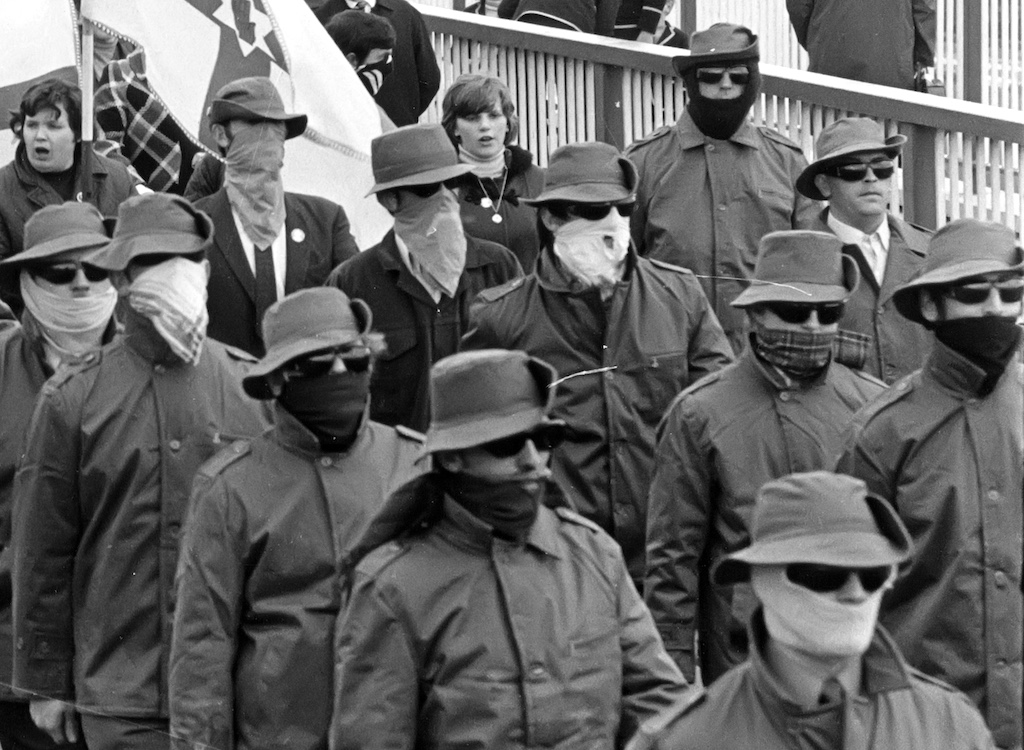
Members of the Ulster Defense Association march in Londonderry, Northern Ireland, ca. June 1972. (PL Gould / Images / Getty Images)
The protest taunt “Cops and Klan, hand in hand” emerged from an observable phenomenon: far-right vigilantes have long been either disproportionately represented in law enforcement agencies or allied with them. During the 1960s, Southern sheriffs fought civil rights advocates by day while Klansmen took over at night — and they were often the same people.
While the Klan may have seen themselves as opponents of the state, they frequently served the same ends. The far right has always played this role, drawing sections of the working class into reactionary movements that claim to be rebellious while ultimately defending the status quo by acting as an effective foil to the political left.
This dynamic has played out in other countries, especially in areas like the North of Ireland where minority rights are at the heart of conflict. When a civil rights movement emerged demanding equal rights for the nationalist minority in the late 1960s, unionists responded with violence, dismissing it as a plot by the Irish Republican Army (IRA).
Loyalism was a militant working-class unionist movement based around paramilitary groups such as the Ulster Volunteer Force (UVF) and the Ulster Defence Association (UDA), ostensibly to defend against IRA violence but primarily geared toward repressing Catholics in general. There was a thirty-year guerrilla war involving the IRA, the British state, and loyalist paramilitaries.
Although loyalists occasionally clashed with British soldiers, their violence overwhelmingly targeted Catholic civilians. From beginning to end, the state security forces treated Irish republicans and loyalists in radically different ways. Collaboration rarely appears as formal policy but instead operates through informal relationships, ideological alignment, and the quiet avoidance of accountability.
Crimes of Loyalty
According to the Sutton Index, the most comprehensive record of violence between 1969 and 2001, loyalists killed 1,027 people, of whom 878 were civilians, the vast majority being Catholics who were selected mostly at random because of their communal background. When the modern UVF formed in 1966, it was banned after carrying out sectarian murders at a time when the IRA was inactive in the North. Apart from a brief period of legalization in the mid-1970s, it remained a proscribed organization.
The UDA, on the other hand, was not outlawed until 1992. If journalists wanted to contact its leaders, they only had to consult the telephone book. UDA members carried out sectarian murders under a flag of convenience, calling themselves the “Ulster Freedom Fighters” (UFF) to hide culpability. The UFF had no independent existence, and its supposed members served time in prison on UDA-controlled wings.
In one 1981 government memo, the secretary of state for Northern Ireland is alleged to have said that proscription would be counterproductive, undermine the recruitment of informants, and lead to further distrust of the government on the part of Protestants. The chief constable of the Royal Ulster Constabulary claimed that the majority of UDA members “did not act illegally.” In the year when the group was finally proscribed, loyalist paramilitaries killed more people than the IRA.
The British Army had a locally recruited part-time militia called the Ulster Defence Regiment (UDR) whose membership was almost exclusively Protestant. British state documents admitted that it was “inevitable that a part of the Protestant element of a part-time regiment in Ulster will sympathize with the aims of the UDA; and it is suspected that there are cases where this sympathy is carried to the test of active membership.”
A 1973 British military intelligence document reported that “joint membership” of the UDR and the UDA was believed to be common, with as many as 15 percent of UDR recruits belonging to “Protestant extremist organizations.” A 2006 international panel report looked at twenty-five cases relating to a total of seventy-six murders between 1972 and 1976. It found that “evidence suggests collusion by members of the RUC or the UDR” arising from shared membership.
In 1974, in response to a proposed power-sharing agreement between unionist and nationalist parties, the UVF bombed Dublin and Monaghan, killing thirty-three people and injuring nearly three hundred. The following year, UVF members staged a fake UDR checkpoint near the border with the South, where they stopped a popular Irish music group, the Miami Showband. At first, they attempted to place a bomb in the band’s van to frame them as Republican terrorists who were accidently blown up by their own weapon. When the bomb detonated prematurely, they opened fire on the band members, killing three of them.
In both cases, there was extensive evidence of collusion by the state security forces with the UVF. Several UVF members who participated in the Miami Showband massacre were also members of the UDR. The Glenanne Gang, a squad of UVF-affiliated gunmen under the leadership of Robin Jackson, was linked with both atrocities, as well as dozens of other sectarian killings. The gang included serving members of the RUC and the UDR.
Intelligence Sharing
One of the most important forms of collusion involved the leaking of intelligence. Debate persists over whether intelligence reached loyalist paramilitaries simply because of political sympathy from members of the security forces or whether there was a high-level strategy to intentionally guide loyalist assassinations in service of the British state. The Force Research Unit (FRU), a secretive army intelligence force, is at the heart of those debates.
Brian Nelson, who served as director of intelligence for the UDA during the 1980s, was a paid FRU informant. He reorganized the UDA’s intelligence files with the assistance of his army handlers. The FRU is historically controversial for prioritizing the protection of its own agents over intervening to stop attacks. Nelson helped the UDA assassinate key Republicans and organized a major shipment of weapons from South Africa in the late 1980s.
Nelson’s targets included Pat Finucane, a Belfast lawyer who represented several IRA suspects and had exposed police misconduct. Two UDA operatives stormed Finucane’s home and shot him over a dozen times in 1989 while his wife and children watched. The murder was one of the most blatant examples of collusion in Northern Irish history: the men responsible for it included agents from the FRU and RUC Special Branch. There have been multiple inquiries into Finucane’s killing that have generated vast quantities of documentation about the record of collusion, despite efforts by successive British governments to conceal the truth.
In 1989, the UDA killed a twenty-eight-year-old father of four, Loughlin Maginn, who had no relationship with Republican organizations. In an effort to prove their target was a legitimate one, the UDA pointed to intelligence, including documents and videos, it had received from state security forces. This was one of the cases that revealed Nelson’s role as government agent and UDA intelligence chief. Two UDR members were convicted of Maginn’s murder, and Maginn’s family sued the British state over evidence of collusion.
One of the conflict’s most appalling atrocities took place in the small village of Loughinisland in 1994, when UVF gunmen murdered six men in a bar who had been watching the Republic of Ireland play in the World Cup. There were no arrests by the authorities in connection with the massacre. The police ombudsman later concluded police officers actively protected informants, interfered in the investigation, and knew that weapons were being imported for loyalist operations.
The peace process that began in the 1990s led to further revelations about Britain’s role in the “dirty war,” much to the displeasure of British government officials. The Northern Ireland Troubles (Legacy and Reconciliation) Act of 2023 shut down legal channels of accountability by halting criminal investigations into events that took place before the Good Friday Agreement.
Murky Boundaries
The patterns we can observe in recent Irish history have also been apparent in the United States for decades. In a 2019 Military Times poll, 35 percent of active-duty military personnel reported encountering white supremacist ideology among their fellow troops. Servicemen have been found associating with the Aryan Nations, a neo-Nazi organization, and more recently with accelerationist terror networks like The Base and Atomwaffen.
This led to a 2020 congressional hearing, which identified the influence of white supremacists in the military as an “alarming” terror threat. Anti-fascist researchers have further validated this concern over the past few years, revealing service members in the ranks of groups like Patriot Front and on the neo-Nazi Iron March forum.
With police forces, the connections to far-right groups are even more striking. As of 2022, the Anti-Defamation League reported that the Oath Keepers, a leading far-right group, had at least 373 active police officers in its ranks as well as at least 1,100 former officers and at least a hundred military personnel. Similarly, Reuters found a significant number of far-right militants operating inside police forces around the country, including the Proud Boys.
During the 2000s, the Minuteman Project ran “spot and report” missions on the border where they allegedly handed captives over to Border Patrol. More recently, we have seen the same picture with Arizona Border Recon. Recent reporting has suggested “murky boundaries” between local militias and private security officers who are being deputized to go after migrants near the border. The murkiness also comes from Immigration and Customs Enforcement’s (ICE) recruitment tactics, which seek to pull from the same ideological communities as militias and promote a general acceptance of far-right views.
Police have also been found to draw on support from far-right militias in arresting left-wing protesters, including a 2018 incident in Portland, Oregon, where a Patriot Prayer member aided a Department of Homeland Security (DHS) officer in arresting an anti-fascist. This may be because the Portland police saw the far right as “more mainstream” than the anti-fascists, which may also be why they have passed information to them about counterdemonstrations.
Far-right officers are rarely sanctioned. The Chicago Police Department declined to investigate Proud Boys and Oath Keeper membership among eight officers. Studies show police are three times more likely to use violence against left-wing protesters. In 2018, Santa Clara County police were found liable for publicizing information about anti-fascist demonstrators that could leave them open to assault and harassment.
In Kenosha, Wisconsin, during the 2020 uprising, armed militia members walked the streets, allegedly to protect businesses. The police on the scene thanked these armed civilians, supplied them with water, and refused to enforce the curfew against them. Soon afterward, Kyle Rittenhouse, a seventeen-year-old boy who had traveled to the area with an AR-15, shot and killed two people. Rittenhouse was allowed to walk right past officers with his gun visible; he was later acquitted of homicide and lionized by the Republican Party.
Subsequent reporting showed that the police in Kenosha saw the militias as allies rather than as adversaries. This phenomenon is called “auxiliary policing,” where non-state actors committing violence are allowed to act as an extension of law enforcement against the shared object of their hostility. This was how loyalist paramilitaries were treated in the North of Ireland, with police and security forces seeing them as potential allies in the dirty war they were fighting.
America in 2026
Like the UVF and the UDA, far-right groups in the United States can engage in a type of violence the state is not able to deploy itself, one that is without accountability. However, such paramilitary squads are only necessary when the state cannot act with impunity in its own right. With ICE’s massive expansion and the National Guard deployment, the Trump administration may simply not need extrajudicial violence since it has state actors available.
Trump has invited ideologically committed figures into a range of senior governmental positions, including Stephen Miller, whose connections to organized white supremacy run deep, and Ken Cuccinelli, an admirer of the Confederacy whose rhetoric echoes the “great replacement” conspiracy theory. These leaders are hiring the personnel who will enact their vision.
DHS social media accounts have been posting rank racist memes, including celebratory videos of immigrants being dragged away. The government has refocused “anti-extremism” on the alleged threat of left-wing violence rather than far-right terrorism and directed law enforcement to consider left-wing movements as inherently terroristic.
Trump has, of course, pardoned his supporters who stormed the Capitol on January 6, 2021. A recent Senate Homeland Security and Government Affairs Committee report found that both the FBI and DHS failed to assess the threat on January 6 despite advance warnings and did not share relevant intelligence.
One former FBI special agent was indicted for assault, as was a former police officer (himself a member of the Proud Boys) who participated in the raid on the Capitol. A Washington, DC, police intelligence lieutenant was later charged with obstruction and providing false statements after he leaked intelligence information to Proud Boys leader Enrique Tarrio, then lied to cover up the collusion. For those with an eye to Northern Ireland’s history, this all looks uncomfortably familiar.