Where Is the Off-Ramp From All This State Violence?

It’s hard to think of a parallel effort in US history to build a domestic agency of violence specialists at the scale of ICE.
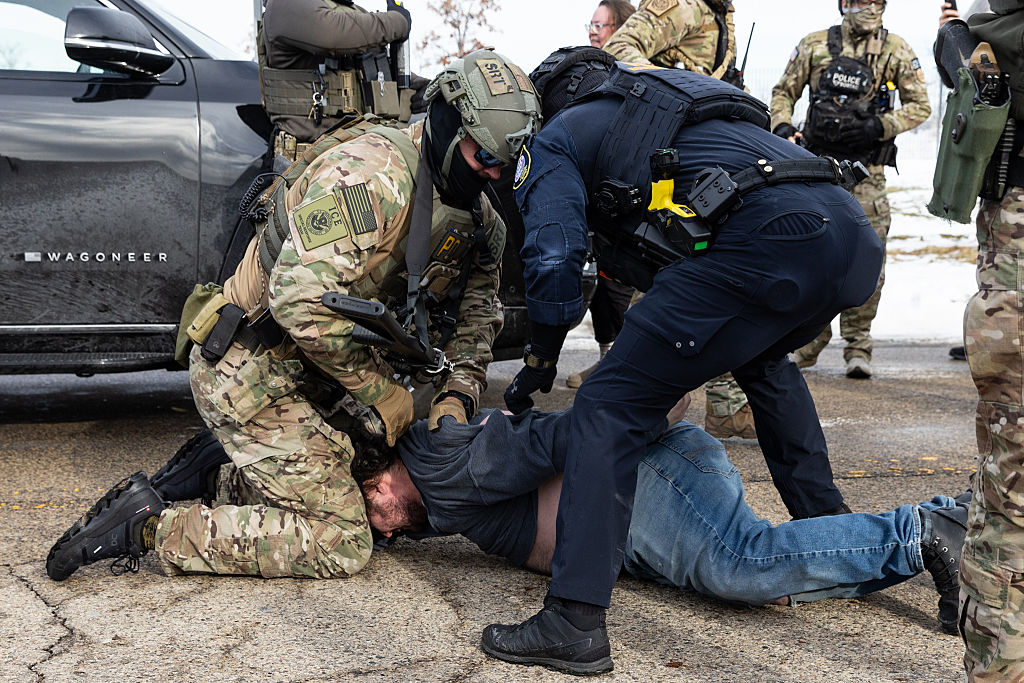
As as of October 2025, ICE has increased its weapons spending by some 600 percent in comparison to 2024. (Mostafa Bassim / Anadolu via Getty Images)

What work does it do, the spectacular and superfluous excess of Immigration and Customs Enforcement (ICE) violence, cruelty, and killing on the streets of Los Angeles, Chicago, and most recently Minneapolis? As much as its immediate political and psychological ends are evident, the violence’s enduring effects on the arc of future democratic, emancipatory political projects remains elusive, because we are not yet asking the right questions about how an emboldened ICE might change the possibilities for democratic self-rule.

There is a direct political payoff from exemplary state violence. The brutality and risk of violent death, long the bitter heritage of ghettoized communities of color, offers the president’s supporters a psychological payoff: all of their enemies, even those who believed themselves immune, can be at its receiving end. That resentment has spilled over after the murder of Renee Good into a more generalized anger against white women, despite the value of that demographic to the MAGA coalition. Such irrational hatred suggest an emotional surge that overflows its motivating political logic.

There is a second, more sinister logic at work: today’s violence is accompanied by a refrain of ostentatious, obviously false gaslighting. Hence, when ICE’s erstwhile “commander at large” Greg Bovino trumpets his troops’ “lawful” and “professional” conduct at a Minneapolis press conference, it’s hard to believe he doesn’t know he’s lying. When the term “domestic terrorist” is thrown at intensive care unit nurse Alex Pretti before his blood is dry on the sidewalk, and when widely available videos give the lie to that slander, one might wonder who takes such talk seriously.

Set aside the fact that this rhetoric determines the pace of reporting within the MAGA-aligned media ecosystem, which includes Fox News. It’s possible that the self-evident lies about moral atrocities help build a perverse kind of political community. Lying blatantly to the public, then daring the faithful to show their fealty by genuflecting before the leaders’ traducing of the truth, is a way of reinforcing a political identity. Performative violence that echoes actual brutality may be a particularly effective, even supercharged, way to reaffirm and deepen the political bonds that make brutalization an attractive political strategy in the first place. In effect, it sends the message that certain people are so deserving of hate that even in death they do not warrant the truth.

The ICE deployments, however, are also signs of a distinct, if not wholly novel, instrument of US politics: an engine of internal violence, controlled by the state, with a major violent capacity and malignant esprit de corps. Either paramilitary in form or embedded within the state, organized violence specialists have long played a central role in undoing democracy. Parastatal violence had an important historic role, for example, in Colombia and Mexico, shaping horizons of political possibilities. But such violence specialists have hardly been absent from North American history.

On Sunday 13, 1873, a group of three hundred white supremacists led by a former Confederate captain massacred more than 150 black Republicans who were defending an election site near Louisiana’s Red River. The Colfax massacre set a template for exemplary violence against black people for a century, peaking with Fred Hampton’s 1969 murder. Then, during the August 1921 Battle of Blair Mountain, President Warren Harding’s Air Force supplied mine owners in West Virginia with aerial surveillance and threatened a federal troop deployment, even as private armies fought it out with the United Mine Workers. Throughout the late nineteenth century, the same capitalists called on Pinkerton detectives to act as the industry’s paramilitary wing to crush labor organizing.

How might ICE become an instrument of more general political repression? The Ku Klux Klan (KKK) and the Pinkertons were private, paramilitary formations. Hampton, by contrast, was murdered by agents of the state; the civil rights movement and other movements for black rights during that period were subject to extensive surveillance and subversion by the state. But it is hard to think of a parallel effort to build a national agency of violence specialists at the scale of ICE. Thinking about its larger political repercussions requires some speculation about how this new body might change both the rhetoric and the very possibility of national political contestation to progressive ends.

Notice first how the justifying rhetoric of repression is being refined over time. In the wake of Good’s murder, Donald Trump’s cabinet members pivoted to rhetoric honed after the Charlie Kirk shooting, with the Department of Homeland Security’s (DHS) head, Kristi Noem, (falsely) accusing Good of an “act of domestic terrorism” and Vice President J. D. Vance insinuating that protesters and neighborhood support groups were all engaged in “domestic terror tactics.” Noem used the same label for Pretti within hours of his death. Not to be outdone, Trump’s homeland security adviser, Stephen Miller, labeled him an “assassin.”

Their rhetoric is being picked up and embroidered into law by the administration’s lawyers. In September 2025, for example, the White House issued a presidential memorandum describing the “sophisticated, organized campaigns” run by an imaginary phalanx of “anti-fascist” organizations. That document doesn’t mention ICE by name but directs the secretary of homeland security to make the fight against “anti-fascist” organizations “a national priority area.”

DHS agents in other parts of the country are allegedly threatening people who videotape ICE encounters that they, too, will be treated as “domestic terrorists.” And right-wing media outlets have been inveighing against a “complex network of far-left groups” that supposedly drove Pretti to his death. Such reports seed the ground for larger campaigns of repression by transforming the reaction of decent, ordinary people to state violence into a sinister conspiracy in need of squashing.

At present, federal statutes don’t permit domestic organizations to be designated as “domestic terrorists.” This is likely of little relevance to an administration that scoffs at the very notion of being constrained by law. Nor is it of any interest to its self-proclaimed champions of free speech that their sweeping renunciations flagrantly violate the First Amendment. If the framing can be made to work politically, if enough in Congress and on the federal bench can be cowed, the legal barriers to the proscription of everyday political speech will fall away.

Such rhetoric matters little without the tools to carve out new political facts on the ground — to remake civil society in a brutalist image, in the way that universities and science are being remade. ICE has always sucked up an inordinate share of public resources. In 2012, less than a decade after its formation, ICE and Customs and Border Protection (CBP) together were spending some $17.9 billion a year, around fifteen times the amount spent in the mid-1980s on the same functions within what was then the Immigration and Naturalization Service. Then, as now, the official justification for these expenditures was the removal of “criminal aliens,” noncitizens who had violated some element of American criminal laws.

Under the Trump administration, ICE has become the hyperscaler of federal agencies. In July 2025, the once-austerity-obsessed Republican caucus assigned ICE alone some $75 billion over four years; along with existing budgetary allotments, the agency enjoys revenues of $28.7 billion per year, which is roughly four times its Biden-era budget. ICE now has a larger budget than several of the world’s militaries, including those of Brazil, Italy, and even Israel. Tellingly, as of October 2025, ICE had also increased its weapons spending by some 600 percent in comparison to 2024, with most of the new funds going to fund small arms and protective gear. The destructive capacity of the Israeli Defense Forces, recently on graphic display in Gaza, offers a gauge of the potential for violence being constructed within ICE.

A recent version of new budgetary measures being considered in the Senate — which needs to be passed to prevent a fresh government shutdown — added another $3.43 billion for detentions and $5.08 billion for “Enforcement and Removal Operations.” This version, negotiated with Senate Democrats before some started having slight spasms of conscience, as one commentator notes, would mean that the Minneapolis model could become “business as usual.”

This accelerating engorgement of ICE comes with a change in the character of the people it recruits. Even with offers of $50,000 starting bonuses and tuition reimbursement, ICE is recruiting from the margins of the carceral state. Corrections officials, for example, are “jumping ship” for ICE en masse. It seems likely that those trained to discipline and punish convicts using violence will bring that training and disposition to their new roles on the streets. New recruits are also being deployed despite not having been screened for disqualifying criminal convictions or for failing drug tests. Journalist Laura Jedeed was able to apply to ICE without paperwork or a background test and receive an offer within days. And ICE has cut short its entry-level training to forty-seven days — a number selected, naturally, to honor the forty-seventh president.

The inevitable result of this scramble to expand the agency’s muscle is the fortification of an unwillingness and incapability to hew to legalistic constraints on violence. While there is no exact historical parallel for ICE, there is a parallel for its recruitment style in the Pinkertons, who “gathered in from the gambling dens and slums of our large cities . . . creatures who are outcasts from decent society.” Labor leaders like the Knights of Labor’s Terence Powderly, who offered this description, pointed to the shady character of recruits as a reason for anti-Pinkerton legislation.

A year ago, Trump’s pardon spree might have raised concerns that the Proud Boys and the Oath Keepers would become contemporary versions of Ernst Röhm’s Sturmabteilung, the original paramilitary wing of the Nazi party. Today that worry looks quaint. Rather than needing to outsource the suppression of political difference, the administration — at times with the aid of blinkered House Democrats — is building in-house capacity to do the same job. This is the inverse of the privatization strategy run through Elon Musk’s Department of Government Efficiency (DOGE), Palantir, and BlackRock. But it shows that autocratic state capacity can be sewn together in many ways, and there is no reason to fetishize the perils of outsourcing if even worse dangers await when the same capacity is constructed within the government.

As the November elections start to come into focus, there is a real question about how and where the enlarged faculty of ICE will be used, and how much it will disrupt the capacity of Americans to vote and of progressive candidates to mobilize. Having built a machine of muscle, sinew, and greased gun-metal, there is inevitable pressure toward its use. As we know from the policing context, once a military-grade force is built up, it’s very hard to resist its use — if only because its personnel become restive. Disuse, after all, would be a waste of taxpayer dollars. And the target lists have already been drawn up and justified through media blitzes on right-wing media.

If the violence in Minneapolis is cleaving open a path to generalized political suppression, are there off-ramps? It’s hard to see any easy or straightforward ones. Electoral outcomes will be crucial, but there’s every reason to expect an acceleration of violence up to the November midterms. Standing firm in the face of such threats will require fortitude from both leaders and ordinary people. The solidarity evinced by last week’s Minneapolis general strike is an admirable model in this regard.

The Left and center have strong reasons to seek alliances at a moment of rebarbative and violent reaction, but efforts forging such bonds will amount to nothing if mainstream politicians misunderstand how dramatically the ground is shifting under them. Perhaps the materialization of actual indictments against Jacob Frey and Tim Walz will serve to concentrate minds muddled by decades of havering moral compromise, but you never know. The project of American demilitarization, already a complex and fraught one, in short, just got a considerable degree more difficult.