A Movement for Civil Rights Underpinned Republicanism in Northern Ireland
Mainstream accounts of republicanism in Northern Ireland tend to focus exclusively on the armed campaign that produced one of the most devastating conflicts in postwar Europe. Left out, however, is the radical, grassroots movement for civil rights that was a driving force for popular republicanism from the late 1960s.
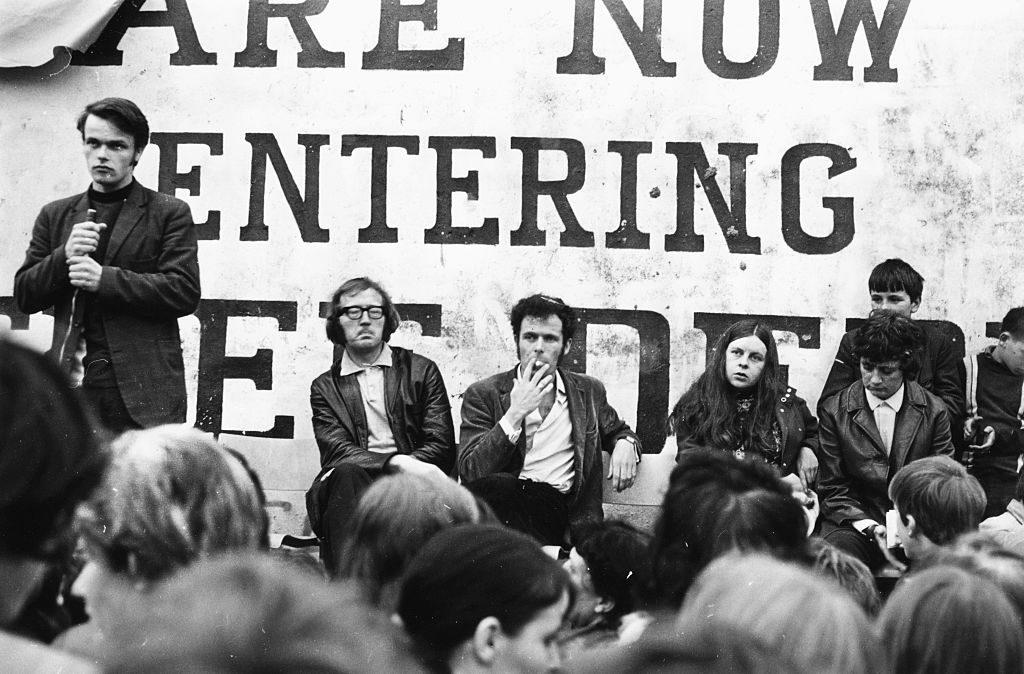
Irish civil rights campaigner Eamonn McCann (center, smoking a cigarette) taking part in a campaign speech with other activists in Londonderry, Northern Ireland, circa 1970. Keystone Features / Hulton Archive / Getty
There currently exists a wide range of literature published about the Provisional Irish Republican Army (PIRA) — not all of it of high quality. What sets Daniel Finn’s One Man’s Terrorist apart from others in the field is its combination of a rigorous — and very readable — assessment of the changing politics of the modern Republican movement alongside a thorough understanding of the wider forces that wracked the North of Ireland during the “Troubles,” a journalistic euphemism for the period of low-level armed conflict that claimed the lives of some 4,000 people at the end of the last century.
The essential context for understanding these events — often been quite deliberately mischaracterized — includes the mass upsurge for civil rights directed against the Unionist’s one-party regime in the late 1960s, a challenge that faced a wave of repression from the “Orange State” and its supporters among hard-right loyalists, and later from British military and security forces. This led to a permanent crisis for the government at Stormont, and opened the door to a sustained period of communal violence from the 1970s onwards, where the Provisional IRA became the main protagonist in an armed struggle to end the partition of Ireland.
Beyond Violence
Historiography on Irish republicanism tends to focus obsessively on the machinations of the armed campaign, bolstering a now well-worn narrative that attributes blame for the emergence of conflict disproportionally on the Provisionals. While Finn does not avoid the many — at times brutal and, indeed, indefensible — instances in which Republicans committed atrocities, unlike much of the genre his work does not lose sight of the absence of basic democracy or the propensity for state repression intrinsic to the Northern state throughout its existence. One Man’s Terrorist, therefore, offers a nuanced and balanced account, and one willing to look out beyond the “pathological” narrative to which so much of the literature subscribes.