Shame of the Americas

The Trump administration’s Shield of the Americas summit in Miami convened leaders from Latin America and the Caribbean’s emboldened reactionary bloc. True to form, the president ensured the summit was a ritual of humiliation and debasement.
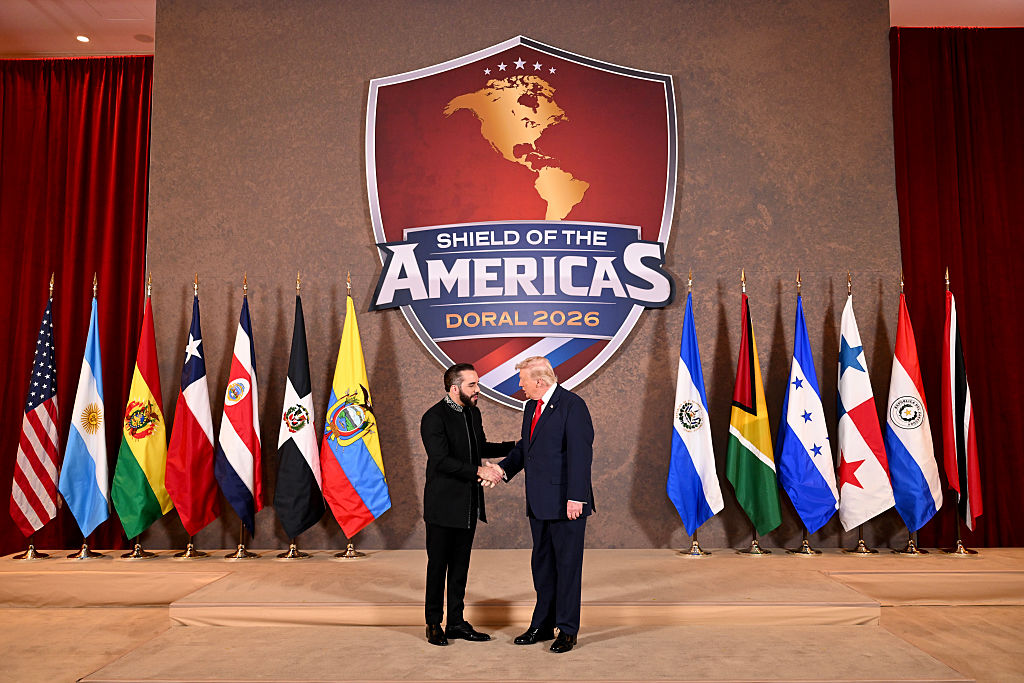
At the “Shield of Americas” summit, Donald Trump made ominous threats of impending interventions in Latin America and Caribbean, including allusions to regime-change action in Cuba. (Roberto Schmidt / Getty Images)

This weekend, Donald Trump convened right-wing leaders from Latin America and the Caribbean to his Miami golf resort for the “Shield of the Americas” summit. Amid renewed US military aggression in the region, the gathering showcased an emboldened reactionary bloc eager to demonstrate its subservience to US dictates.

The summit drew twelve heads of state to the Trump National Doral Golf Club, with Argentina’s Javier Milei, Ecuador’s Daniel Noboa, El Salvador’s Nayib Bukele, and Chile’s president-elect, José Antonio Kast, joining the conservative presidents of Bolivia, Paraguay, Panama, Honduras, Costa Rica, Guyana, the Dominican Republic, and the prime minister of Trinidad and Tobago. The Miami country club setting was not only typically gauche but, as the Center for Economic and Policy Research (CEPR) notes, a means of channeling funds into Trump’s private enterprise.

Seventeen Latin American countries have signed on to Trump’s new “Americas Counter Cartel Coalition,” which promises to mobilize military action against criminal groups “to defeat these threats to our security and civilization.” That many of its members are themselves implicated in organized crime operations is hardly an obstacle. After all, this is the administration that pardoned Juan Orlando Hernández, the former Honduran president who was serving a forty-year US prison term on a drug-trafficking conviction, then kidnapped the sitting president of Venezuela on the same alleged grounds.

Willingness to shore up convenient drug traffickers has long been bipartisan policy in the region. The cocaine trade was notoriously central to the CIA’s covert Contra supply network throughout the 1980s in Central America, and the United States provided millions in counternarcotics support to the Mexican government of Felipe Calderón (2006–12), who prosecuted a war on drugs in favor of the Sinaloa Cartel. Like the Cold War and the” war on terror,” the “war on drugs” provides a framework for the region’s subordinate integration into US economic and security regimes.

True to form, President Trump ensured the summit was a ritual of humiliation and debasement. After promising bilateral meetings, the US president’s face time with each head of state was instead reduced to a handshake and photo. He displayed characteristic disdain for his guests, quipping, “I’m not learning your damn language” and stumbling over the name of El Salvador’s Bukele (“He runs a good operation, that’s all I care about”).

In his rambling remarks, the president likened drug cartels to ISIS, an apt enough analogy given the US role in stoking the region’s drug violence. He made ominous threats of impending interventions, including allusions to regime-change action in Cuba, now plunged into an historic humanitarian crisis by the economic warfare waged by the unilateral US blockade: “Cuba’s in its last moments of life the way it is, but our focus right now is on Iran.” Mexico was also in the crosshairs, with Trump warning that “the cartels are running Mexico, we can’t have that.”

Also featured was Defense Secretary Pete Hegseth, who delivered a fascistic screed that opened with a quote from Andrew Jackson and rallied the region together as “Christian nations under God” against “radical narco-comunism and narco-tyranny.” This invocation of what historian Greg Grandin calls “neofasict Pan-Americanism,” however, was largely performative. The nations gathered appeared united only in their submission to Trump; no joint agenda emerged beyond each nation’s commitment to US intervention.

In addition to a brief statement from Secretary of State Marco Rubio, the group was addressed by the recently ousted Department of Homeland Security (DHS) secretary Kristi Noem, who was announced as a special envoy to the new military coalition. Noem’s transfer to the region came alongside the confirmation of her number two, former DHS deputy secretary Troy Edgar, as the new US ambassador to El Salvador, in yet another affirmation of the administration’s belligerent footing in Latin America. Noem told the gathering,

Our objectives are going to be to destroy the cartels, to go after these narcoterrorists that are destroying our people, killing our children and our grandchildren. We’re also going to keep our adversaries at bay. Those adversaries that wish to change our way of life and our values that are outside of our hemisphere, we want to ensure that we’re continuing to keep them out of our hemisphere and focus on building alliances amongst ourselves and our strengths.

Noem’s remarks pointed to US hopes to weaken its allies’ relations with China, now Latin America’s largest lender and trading partner. “We’ll have [to] reverse these harmful foreign influences that have come into many of our businesses, our technologies, and we’ve seen infiltrate different areas of our way of life,” she concluded. On that score, the United States is unlikely to prevail. Chinese trade and aid have proven critical to even Trump’s staunchest supporters, providing essential commerce to Milei’s Argentina and major infrastructure works for the Bukele government in El Salvador.

Coordinated military actions, however, will continue to escalate. Operation Southern Spear, which began with an unprecedented naval buildup in the Caribbean, has expanded inland, with US forces engaged in a joint bombardment campaign targeting a dissident faction of Colombia’s demobilized Revolutionary Armed Forces of Colombia (FARC) guerillas on its border with Ecuador, risking major regional destabilization. Illegal US strikes against speedboats in the Caribbean and Pacific continue, the official death toll of these extrajudicial executions surpassing 150. Trinidad and Tobago has offered its airports for mission logistic support, while El Salvador, which has rendered services as a US penal colony for deported migrants, is hosting US combat aircraft.

As the Latin American right rallies around Trump’s campaign of destruction, the Left is troublingly quiet. Progressives still govern in the powerhouse economies of Brazil, Mexico, and Colombia, but the once robust Pink Tide agenda for regional integration and cooperation has eroded, and the response to the recent parade of US outrages has been muted. A regional diplomatic project in defense of peace, solidarity, and self-determination is urgent. Without a counterweight, the reckless, unchecked violence of US empire threatens not just the hemisphere but the entire planet.