El Salvador’s Nayib Bukele Is Donald Trump’s Jailer-for-Hire
Nayib Bukele swept to power in 2019 by presenting himself as an insurgent outsider who was going to clean up corruption in El Salvador. In reality he has waged war on democratic rights and turned his country into a MAGA prison camp.
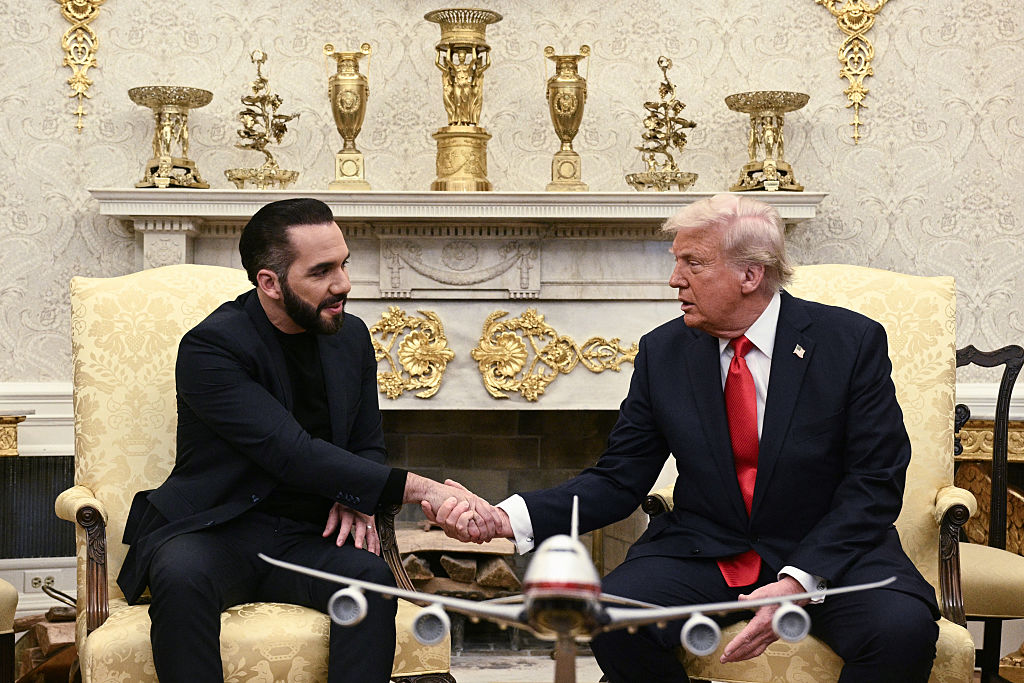
When Nayib Bukele took office as president in El Salvador, he bet everything on his relationship with Donald Trump. That was a risk, but it turned out to be a good strategic calculation when Trump returned to the White House in 2024. (Brendan Smialowski / AFP via Getty Images)
- Interview by
- Daniel Finn
El Salvador’s President Nayib Bukele has become a poster boy of the international far right and a key ally of the Trump administration, offering his country’s prison system as a MAGA labor camp. We spoke to journalist Hilary Goodfriend about the political context that made Bukele’s rise possible and the prospects for resistance to his iron-fisted rule.
This is an edited transcript from Jacobin’s Long Reads podcast. You can listen to the interview here.
Daniel Finn
What was the political backdrop in El Salvador at the point when Nayib Bukele first ran for office? What was the balance sheet in particular from the record in office of the FMLN [Farabundo Martí National Liberation Front], the former guerrilla movement that had transformed into a political party?
Hilary Goodfriend
I’m going to take us back a little bit further to answer that question. El Salvador came out of a twelve-year civil war in 1992 between the leftist guerillas and the US-backed military dictatorship. The guerillas demobilized and became a political party, the FMLN. But in the period immediately after the end of the armed conflict, it was the far-right ARENA Party, the Nationalist Republican Alliance, that took power and ruled uninterrupted for twenty years over four consecutive terms.
Between 1989, when ARENA first took power, and 2009, when the FMLN was first elected, this far-right party with major US support implemented a massive program of neoliberal restructuring. It aligned El Salvador with the rest of the region in its subordinate place in the new international division of labor, as an exporter of maquiladora products and of low-wage migrants to serve in the lowest ranks of the deindustrialized US economy as criminalized service workers.
It was in this situation of the disappointments of peacetime, of economic hardship and exclusion, that the FMLN slowly accumulated political power over the years and finally was in a position to win the presidency in 2009. The FMLN governed for two terms, from 2009 to 2014 and from 2014 to 2019. Over the course of that period, they implemented major social policy reforms.
In terms of health care, they established a massive, Cuban-modeled preventative community health care system with clinics across the country, as well as carrying out major hospital construction projects. They removed fees for access to public health care services. In education, they enacted major reforms, making the public university free to public school students and distributing school supplies, uniforms, and meals to those students, first at the elementary level and then through to high school. All of those materials were provided by local, community-based small producers.
The FMLN made legislative and policy gains in terms of gender equity, fighting violence and discrimination against women, LGBTQ inclusion, anti-corruption politics, and transparency. They created a system for access to public records and information, because the rampant corruption and brazen embezzlement of public funds under the Right was a huge part of the FMLN’s platform in getting elected.
There was also state acknowledgement of wartime atrocities. Mauricio Funes, the first FMLN president, went to the site of the El Mozote massacre, where about one thousand people, mostly women, children, and elderly folks, were massacred by US-backed forces in 1981, and he apologized on behalf of the state. That was a very significant act. They passed a constitutional reform to acknowledge indigenous communities in the country.
I should also say that there was diplomatic alignment with the so-called Pink Tide, the progressive wave of left-of-center governments that came to power democratically throughout South America around this time. The FMLN finally ditched El Salvador’s relations with Taiwan in favor of China at the very end of their second term, so they weren’t able to actually reap the benefits of that political move — that was all for Bukele.
However, the fundamental dependent insertion of El Salvador’s economy was untouched. There were no major changes to the structures of accumulation and inequality, despite gains against poverty, minimum wage raises, and the like. Those structures remained untouched.
There was also a huge surge in homicides, which peaked in 2015, driven by gang violence. Under the first FMLN administration, the government supported a truce that was mediated through the Catholic Church and representatives of the Organization of American States to bring down homicide levels. This was nothing new. All governments in El Salvador have had to grapple with the gangs and negotiate with them to some degree as major territorial actors in the country that control significant portions of the social landscape.
What was unique about this process was that it was actually imagined as a multistage effort to demobilize gang members. It was paired with gang prevention, violence prevention, and rehabilitation programs, with the idea that the gangs would first come to the table to bring down the murder rate through these dialogues, then they would start turning in weapons and demobilizing members through the different social programs. There were certainly all kinds of contradictory elements to this process, but when the press got ahold of the story and blew it wide open, there was a major public backlash.
In the end, these additional phases were never implemented. The FMLN reverted to the same old iron-fisted security strategy that was implemented throughout the course of the prior period of right-wing rule and had only resulted in the radicalization of these criminal structures into increasingly sophisticated organizations.
The result was a major escalation in state confrontations with the criminal gangs that led to the peak level of homicides in 2015. After 2015, they steadily declined. By the time Bukele was running for president, there had been a major reduction. However, the widespread perception, after having lived through that experience at the start of the FMLN’s second term, was that the gangs were out of control, and certainly very little had been done to change the balance of power in that sense.
We have a mixed balance sheet of FMLN governance, with social investment and gains but very little in terms of major economic changes, and some diplomatic progress, which was also undercut by the impact of the Great Recession finally hitting Latin America around the time of the FMLN’s second term. That meant a lot of the FMLN’s major alliances with the Pink Tide were cut short by the blow to commodity prices.
At the same time, the FMLN was confronting a constant right-wing destabilization campaign that was being promoted by ARENA, which represents the business class — the traditional oligarchy, which in the postwar period had pivoted toward finance and commerce in the region, partnering with major transnational investors — and of course by the US embassy.
One aspect of this campaign was oriented toward using entrenched right-wing power in the court system and the legislature to block major points of the FMLN’s reform agenda. This involved striking down progressive tax reforms, but also absurd moves, like ruling bus lanes unconstitutional when the FMLN was going to implement a major transit infrastructure program. Bukele was able to come forward on top of this right-wing destabilization campaign and use it to paint both the FMLN, his former party, and the right-wing opposition as hopelessly corrupt. The issue of corruption became central to his campaign.
I should say that another big part of the FMLN program was prosecuting those cases of corruption that the statute of limitations would still permit them to prosecute from the previous ARENA administrations. ARENA was significantly weakened over the course of FMLN rule and thoroughly discredited in the public eye from the airing of all this rampant corruption.
However, the right wing in the courts was able to mount a prosecution against Mauricio Funes, the president from 2009 to 2014, over corruption allegations. This struck a major blow to FMLN morale, and Funes sought asylum in Nicaragua. Bukele was able to use this political climate to paint “both sides” as being hopelessly corrupt and position himself as a sort of insurgent reformer.
Daniel Finn
One of the big claims that has been made on behalf of Bukele is that he has been uniquely effective in combating criminal gangs in El Salvador. What have been the main factors in a longer-term perspective behind gang-related violence? As you mentioned, it was a problem that the FMLN administrations and their conservative predecessors had to confront while they were in office as well. What factors are behind this phenomenon? And what impact does it have on society?
Hilary Goodfriend
The roots of gang violence are complex, but the conditions that allowed this particular kind of illicit economy and the violence that is associated with it to flourish cannot be separated from the neoliberal restructuring of the country in the postwar period: the liberalization of trade, the mass privatizations, the reorientation of the country’s economy toward certain low-wage maquiladora exports, the devastation of the country’s agricultural sector.
Subordinate integration into the neoliberal global economy meant that El Salvador had very little to offer its young people coming out of twelve years of armed conflict, which had already done enough to destroy the economic structures of opportunity in the country. In those conditions, at the same time, the gang structures themselves were formed not in El Salvador, but in the United States.
The two major criminal gangs that operate in the country, MS-13 and the 18th Street Gang (which later had its own divisions), were formed in the streets and prisons of southern California by the children of refugees from the civil war. These were migrants who ended up in these deindustrializing US cities, in over-policed, criminalized, racialized neighborhoods, and adapted to the gang culture that was already thriving by that time, in southern California in particular.
When, in the mid ’90s, the United States launched a massive deportation campaign against allegedly gang-affiliated migrants, these young people returned to El Salvador to find an economy that was structured around the massive exclusion of the working-age population. In those conditions, they were able to reproduce these criminal structures and create petty economies of extortion that eventually became integrated — again, in a very subordinate way — into the new trafficking routes that were using Central America as a corridor for bringing drugs into the United States.
Over the course of successive US-backed, heavy-handed, carceral-security responses under right-wing governments, those gangs became increasingly sophisticated and further entrenched in Salvadoran society, to the point where they controlled major parts of the country’s territory. They controlled the mobility of many working-class people and rural communities and thrived off of extorting informal businesses. The informal sector in El Salvador is well over 50 percent of the economy, so this was a huge burden on working people, even leaving aside the direct violence.
Daniel Finn
As you mentioned, when he ran for the presidency in 2019, Bukele presented himself as an outsider, as an insurgent, someone who was going to sweep away the established political class, including the FMLN. What was his personal background before he went into politics, and how did he end up running for the highest office?
Hilary Goodfriend
Bukele is one of many children of a curious figure in Salvadoran society and history, Armando Bukele Kattán. He came from a Christian Palestinian family that migrated to El Salvador at the turn of the century. He converted to Islam and was a founder of the country’s Muslim community, opening several mosques. He was also a scientist and an industrialist.
The Bukele family rose up through the ranks of the bourgeois class of non-oligarchic elites in El Salvador. It is very common in Central America to have a racialized bourgeois class of people who migrated from the Levant at the turn of the century — they would be called the turcos, although most of them might have been Lebanese or Palestinian in their origins rather than Turkish. They came to acquire a lot of economic power, but they were never able to enter the traditional oligarchy — they were always looked down upon by the old landed elites.
Bukele’s family came to own a lot of major commercial assets. They owned El Salvador’s Yamaha dealership, and they brought the first McDonald’s franchise to the country; in fact, they actually sued McDonald’s at one point and ran them out of the country. They owned a major advertising firm.
Bukele studied law at one of the country’s big private universities, although he never graduated. He owned a nightclub for a while before it was shut down, and ended up working in the family advertising firm, which ran many of the FMLN’s campaigns.
Armando Bukele is an interesting figure in the sense that while he comes from the business sector, he was very close with the FMLN and particularly with its Communist Party wing under the leadership of Schafik Hándal, who was also of Palestinian origin. The FMLN was a front of five different political-military organizations that came together and officially dissolved to form the party. But those previous factional traditions remained (and remain) politically relevant.
At a certain point, Bukele decided to go into politics — the word is that his father decided to put him into politics — and he ran as the FMLN candidate for mayor of a small San Salvador suburb called Nuevo Cuscatlán. This was unusual, because the FMLN was a very traditional party with cadres and processes for training their representatives. Bukele did not come up through the party youth wing or the FMLN’s political schools.
However, he was chosen to be a candidate and ran a very successful campaign in which political marketing was key, using social media and his own individualized branding, which he continued as he ran the municipality. He used his own color, a sort of baby-blue “cyan” color, which notably set him apart from the FMLN’s traditional red and white flag. Everything was branded with the signature blue and white “N,” which was allegedly for Nuevo Cuscatlán, but of course it was really for “Nayib.”
He succeeded in projecting the image of a youthful renovating figure within the party, which was certainly welcome at the time, because the FMLN was still being run by the same generation of ex-combatants that had led it through the civil war. He ended up being chosen to run as the party’s candidate for mayor of San Salvador, the capital city, in 2015, and he won. Of course, San Salvador is a major platform from which a lot of people have gone on to run for the presidency.
However, over the course of his tenure as mayor of San Salvador, he increasingly came into conflict with party structures. On the one hand, he was just not subordinate to traditional party discipline. He would buck the leadership structures and speak out of turn to the press in a way that made the FMLN leadership uncomfortable. But it was also clear that he had presidential ambitions, and he did not govern as a traditional FMLN politician would.
His administration was staffed by FMLN people in addition to members of Bukele’s own circle, but there was a lot of corporate sponsorship and a private sector–friendly approach that was a little alien to the traditional style of leftist governance. As it became clear that he was not going to be the party’s presidential candidate, tensions grew, and he was eventually expelled from the party in 2017 by its ethics committee over a sexist incident in a city council meeting.
In that context, he decided to run as an independent — actually, not quite as an independent. He was hoping to form his own party, but it was too late in the game for him to obtain all of the necessary signatures and get his party registered ahead of the election, so he ended up partnering with a small far-right party called GANA [Grand Alliance for National Unity] that had split off from ARENA. They took him on as their candidate and he ran as an outsider, having of course come up through the structures of the FMLN to position himself to make this bid.
Daniel Finn
When he became president, what economic policies did Bukele set about trying to implement? Was the emphasis on Bitcoin, which attracted a lot of attention outside El Salvador, anything more than a political gimmick? Was it some kind of serious attempt to reconfigure the Salvadoran economy?
Hilary Goodfriend
Bukele didn’t run on Bitcoin — it came later, as a huge surprise to everyone, I think, both inside and outside El Salvador. In fact, Bukele ran as a progressive, courting the FMLN vote.
This was the party that had been in power for the last two terms, and it was the base that had voted him in as mayor of San Salvador. He was trying to run to the left in order to capture the vote of disenchanted FMLN supporters, so he made strong pledges to tax the rich. The major plank of his platform was anti-corruption: he recycled a slogan from his time as mayor, “There’s enough money when nobody steals.”
The Bitcoin turn is a little hard to parse, but the influence of his brothers, especially Yusef, an economist and businessman, appears to have been decisive. Bukele is surrounded in office by unelected advisers that include members of his family as well as a group of far-right Venezuelans that even accompanied him to the Oval Office when he met with Donald Trump. It seems that Yusef Bukele is actually a true believer with the Bitcoin stuff, and maybe Nayib himself is, too — he’s an Elon Musk reply guy — so there’s reason to think that they just bought into this.
At the same time, it’s part of a tourism strategy, which has also emerged as the major economic proposal of the Bukele administration. A big part of his economic program is the redevelopment of the Pacific coastline and San Salvador’s historic city center with a focus on international tourism, although it should be said that the Bukele family is buying up major properties across San Salvador. There have been lots of very conveniently placed fires recently that destroyed historic buildings in various states of disrepair.
There’s a major process of displacement going on right now, pushing out rural communities and informal vendors to make way for big real estate developments all across the country in the context of a state of exception. The land grabs are happening at the point of a gun. The return to metals mining in 2023 is part of this pivot to what I would characterize as rent-based accumulation strategies, along with the use of slave labor in the context of mass incarceration and the state of exception. They’re using unpaid prison labor for public infrastructure works as well as private events. There have been reports of inmates being used to work on the private properties of cabinet members and their families.
At the height of the Bitcoin spin, Bukele pitched the idea of Bitcoin City, which was going to be financed by Bitcoin bonds — “volcano bonds.” He launched it at a spectacular event on the beach. It never got off the ground, because the price of Bitcoin tanked shortly afterward. But the Bitcoin City idea encapsulates his economic strategy perfectly, because it was very much along the lines of the charter-city model promoted on the island of Roatán in Honduras by figures like Peter Thiel and Patri Friedman, the grandson of Milton Friedman.
The economy is his biggest problem right now. Poverty has increased enormously since he took over and foreign direct investment is actually down, despite all of his efforts to court international investors. Public debt has exploded, and there’s a major crisis in the pension system, which his government has been using as a slush fund.
Daniel Finn
As we’ve discussed already, the main factor that has been put forward by Bukele and his international admirers to justify his record in office is the way that he has confronted gangs in El Salvador. How did he approach that question, and what was the pathway that led to the declaration of a state of exception?
Hilary Goodfriend
As I mentioned, Bukele didn’t run on the issue of crime — it was mostly an anti-corruption pitch — but he pivoted very quickly and very dramatically to a focus on security. The point of inflection that we can identify is February 9, 2020, when the legislature was in session and considering a vote over some international loans, which would have meant taking on more debt to finance a security strategy for the Bukele government.
That was when Bukele invaded the legislature with the armed forces. He brought the military into the legislative chamber, took the podium, and sat in the chair of the legislature’s president to try and force this vote in his favor. It was a very dramatic, jarring, and traumatic moment in a country that had gone to great lengths to demilitarize its system of governance. It set the tone for everything that was to come.
The COVID-19 pandemic hit El Salvador shortly thereafter, and it was in that context that we saw the state of exception modeled. Bukele decreed a state of exception from the office of the presidency, which was entirely unlawful and unconstitutional — it has to come through the legislature. Eventually, he got the legislature to adopt his emergency regime, but he fully militarized the country and created a constitutional crisis over this question.
He was coming up again and again against the insistence of the courts that he could not indefinitely maintain the suspension of major constitutional guarantees. This constitutional crisis was not resolved until May 1, 2021, after the midterm elections in which Bukele’s party won a supermajority. In the first legislative section, they illegally dismissed the whole constitutional court — all five magistrates — and the attorney general, replacing them with Bukele loyalists. They also went on to conduct a purge of the lower ranks of the judiciary.
Those magistrates would go on to authorize Bukele’s reelection bid and create the legal environment under which this indefinite state of exception could be maintained. Bukele was starting to face public backlash by late 2021. El Salvador had finally come out of the pandemic lockdown, and he had rolled out the Bitcoin law as a major surprise to everyone in the country.
Remember that El Salvador is a dollarized economy — they lost their currency overnight in 2001, and people remember the implications of that policy very well. There was never much support for Bitcoin when it was announced in June 2021. There were major protests against the law’s implementation in September of that year, and there were also big marches in defense of the peace accords on their thirtieth anniversary after Bukele’s legislative majority revoked the national commemoration of their signing.
Against that backdrop, Bukele was beginning to see some cracks in his apparently invincible popularity levels. In March 2022, there was a killing spree across El Salvador in the course of one three-day period, with dozens of innocent civilians indiscriminately executed by gang members, principally from MS-13. This appeared to be a reaction to the breakdown of a pact that had been secretly negotiated between Bukele’s government and the imprisoned gang leadership in exchange for all kinds of outrageous favors, including having government agents escort leaders out of the country.
The breakdown of the pact resulted in the wave of indiscriminate executions across the country. Bukele’s response was to enact the state of exception that has been renewed like clockwork every thirty days by the legislature for the last four years.
Daniel Finn
How has Bukele’s administration dealt with the opposition parties and social organizations in El Salvador, and how far has it gone to date in rolling back democratic rights for those parties and organizations?
Hilary Goodfriend
Well before the state of exception was implemented, Bukele’s government began targeted prosecutions of mostly former FMLN politicians and government officials. They would bring up charges of implicit enrichment that I would say were almost entirely spurious, though not in every single case. Often unable to point to the actual misuse of public funds, they would try to demonstrate that these former officials couldn’t account for a certain amount of money in their personal bank accounts.
That resulted in the imprisonment and prosecution of dozens of former public servants and FMLN leaders, from very high-ranking figures to low-ranking ones, and they moved into selective prosecutions of certain right-wing politicians as well. The targeted prosecution of the political opposition did not meet with much of a backlash, domestically or internationally. I think that is because the previous governments had been so successfully discredited and painted as equally corrupt.
That lack of a reaction was unfortunate, because it foreshadowed the kind of prosecutions that were going to follow. Under the guise of the state of exception, the government now has an indiscriminate blunt instrument with which it can throw anybody it wants behind bars, and it doesn’t even have to bring charges against them. It can just leave them there indefinitely.
In addition to the targeted political persecution of opposition figures, Bukele and his party have entirely remade El Salvador’s electoral system. They did this just ahead of the 2024 elections, restructuring the entire political system to the detriment of smaller parties. They reduced the number of seats in the legislature and the number of municipalities in the country. El Salvador used to have 262 municipalities; now it has 44.
This meant erasing entire jurisdictions where the opposition not only might have retained some representation but actually stood to make gains. If we look at the results of the 2024 elections, the FMLN would have gained seats under the previous system. However, because of the reduction in seats and the changing of the mathematical formula by which those seats were apportioned, they were eliminated entirely from the legislature.
They’ve certainly done a lot to disadvantage any formal opposition to Bukele’s agenda. Having said that, Bukele’s electoral support is real. There are certainly a lot of shenanigans going on, but there’s no doubt that Bukele retains majority electoral support that has been the basis of his legitimacy through the massive erosion of the entire postwar democratic system.
In contrast with other governments coming from a left position that have restructured bourgeois-democratic systems to the detriment of the separation of powers, Bukele has never sought to enact additional popular democratic measures by which he might be able to legitimize his rule. He has never tried, for example, to institute a referendum on all of the major policies that he has been implementing, including the state of exception. Instead, he has progressively insulated his rule from democratic input, as though anticipating the eventual erosion of his support.
Daniel Finn
What were the circumstances around Bukele’s bid for a second term in office in 2024, and what was the fallout from that election?
Hilary Goodfriend
By the time of the 2024 elections, El Salvador had been under a state of exception for nearly two years. In that time, there had been something in the region of seventy thousand people arrested arbitrarily, because all of the constitutional rights to due process had been suspended. El Salvador had displaced the United States as the country with the highest incarceration rate in the world. Hundreds of people had died behind bars; visits by lawyers or by family members had been suspended; the country’s prison population had more than doubled.
In that context, Bukele decided to run for reelection, even though El Salvador’s constitution prohibited reelection in at least six different articles. It was a classic example in Latin America of a situation where countries with histories of military dictatorships have worded their constitutions in a very explicit way to prohibit reelection and avoid the kind of self-perpetuation in power that had characterized previous regimes.
The magistrates who had been imposed through the legislative coup against the judiciary in May 2021 reinterpreted those six constitutional articles to say that in fact, Bukele could run for reelection. Amid the state of exception and the remilitarization of the country, there was very little opposition to that proposal from the election authorities.
With a massive indiscriminate campaign of arrests in progress, the street-level structures and activities of gangs in the country had been visibly and palpably reduced. People were enjoying relief from the pressures of gang violence and extortion that had been plaguing communities for decades by this point. It was the sense of relief that carried Bukele through to his unconstitutional second term, despite the reservations that were very clearly expressed in polling with regards to the suspension of constitutional measures.
The 2024 election was plagued by outrageous irregularities: the system went down, there were ballot boxes unaccounted for, and so on. However, Bukele and his party incontrovertibly were the winners of that process. Even so, the president received way more votes than his party members did for the legislative seats and the mayorships that they were seeking.
That disparity spoke to the sense, as we can also see in polling, that Salvadorans are not in favor of a one-party state. A lot of the smaller opposition parties received significant support. However, the restructuring of the system meant that Bukele’s party came out stronger than ever and the opposition parties, including the FMLN, were effectively wiped out from the legislature.
Daniel Finn
How would you place Bukele in the wider picture of advances by the hard right and the far right in Latin America?
Hilary Goodfriend
Bukele is very much a product of the crisis of El Salvador’s neoliberal postwar political economy, in the same way that the rise of those far-right figures across the region and indeed across the world constitutes a response to the exhaustion of neoliberal structures of accumulation and liberal structures of governance that have structured the world system for the last few decades.
In the Salvadoran context, the FMLN was the first, more hopeful response to the same crisis. The FMLN came to power in 2009, during a moment of Pink Tide advances, with a post-neoliberal project being pitched from the left that was more radical in some cases and more like standard social democracy in others. Overall, there was certainly an effort to reimagine the country with a more inclusive, equitable, and solidarity-minded exit from the ruins of neoliberalism.
The shortcomings and disappointments of the FMLN governments provided the opportunity for Bukele to mount his campaign and his hard-right pivot shortly after taking office. This was another response to the same crisis that has yet to find a resolution in terms of stabilizing into some kind of pattern or regime of accumulation that we could easily identify.
Bukele is part of this tendency, and he has come to model himself as a particular kind of Silicon Valley–aligned, far-right, anarcho-capitalist politician, but at the same time an extremely militarist and almost monarchical or patriarchal figure. It has been interesting to see him assume this character over time, and Trump’s second term has done a lot to cement that turn. In many ways, Bukele is a model for the figures that we can see coming to power throughout the region, including Daniel Noboa in Ecuador and to some extent Argentina’s Javier Milei, who is perhaps more of a true believer when it comes to the anarcho-capitalist rhetoric.
Daniel Finn
How important is his relationship with the second Trump administration since it took office at the start of last year? What are the conditions in the prison complex that has been used for deportees from the United States who have been accused of belonging to Venezuelan gangs, without any semblance of a trial?
Hilary Goodfriend
When Bukele took office, he bet everything on his relationship with Trump. That was a risk, but it turned out to be a good strategic calculation. His first visit abroad when he was elected president was to Washington to speak at the Heritage Foundation. He immediately aligned himself with Trump.
He signed a safe third-country agreement to make El Salvador (preposterously) a country to receive asylum seekers who were trying to reach the United States. That created a lot of problems for Bukele during the Biden administration, because he had set himself up as an antagonist to the Democrats, to the point where his government was under some limited sanctions and there were some restrictions on military and security aid to the country.
When Trump came back into office, that was a huge boost to Bukele and his agenda. We should remember that a big portion of Bukele’s support is actually in the United States: one quarter of the Salvadoran population resides in the United States, and remittances from those workers account for at least one-quarter of El Salvador’s GDP. This is a very influential section of the population that Bukele has targeted on social media and with his advertising campaigns. He bet everything on Trump. What we’ve seen throughout the second term has been the consolidation of this relationship.
As you mentioned, he opened up El Salvador’s prisons, not only to Venezuelan deportees but also to deportees from El Salvador itself. There has been a lot of good reporting coming out recently on the forced disappearances of many of those Salvadoran deportees, who were deported into Salvadoran prisons despite having no active charges against them in El Salvador, and whose whereabouts remain unaccounted for to this day. In addition to renting out the country’s prisons to the Department of Homeland Security, Bukele has also opened up the country’s airports for US attack planes to use as part of the illegal assassination campaign they have been conducting in the Pacific and the Caribbean.
The deal to imprison US deportees was made not only in exchange for several million dollars, but also in exchange for the return to El Salvador of gang leaders who were facing trial in the United States. Those prosecutions and investigations were set up during the first Trump administration against MS-13. This was seemingly in order to avoid the testimony of those gang leaders in US courts about the terms and conditions of their previous arrangements with the Bukele administration.
With regard to the situation inside El Salvador’s prisons, a lot of attention is paid to CECOT, the Terrorism Confinement Center, which has become a sort of influencer platform for everyone from Kristi Noem to various YouTubers who are routinely invited to livestream from CECOT, even though lawyers and family members are prohibited from accessing the space. But El Salvador’s prison network is much bigger than CECOT, which only contains a small fraction of the people who are being held.
CECOT is ostensibly designed just to house gang members. The vast majority of people arrested during the state of exception are not in CECOT, because tens of thousands of people who have been arrested have no ties to gangs whatsoever. Conditions are deplorable. A report was presented recently to the Inter-American Court of Human Rights that concluded that the crimes committed as part of Bukele’s security strategy amount to crimes against humanity. They document the systemic use of torture and sexual violence and massive human rights violations, especially in the prison system.
Human rights groups have documented at least five hundred deaths of inmates, some with signs of violence, many of them due to medical neglect, and more for unknown reasons. The vast majority had yet to be convicted of any crime and were simply being held indefinitely in pretrial detention for years, in many cases without proper access to medication.
Bukele’s legislature has now amended the constitution once again to allow for life imprisonment, which was not previously permitted under Salvadoran law. Bukele’s remodeled judiciary was already handing down sentences of hundreds of years, so it’s not as though there was a huge barrier in place, but they’re setting up the country to continue imprisoning well over 1 percent of its population indefinitely.
Daniel Finn
In the light of everything that you’ve been telling us about the national and international context in which Bukele is operating, would you say there are any prospects on the horizon for significant internal opposition to his continued rule?
Hilary Goodfriend
The electoral reforms have dealt major structural blows to the existing opposition parties and set things up so that it is all but impossible for those parties to mount a significant challenge to Bukele, at least in the near term. Having said that, there is courageous organizing being done from popular sectors despite escalating state repression.
There is major organizing happening under the umbrella of groups in the Popular Rebellion and Resistance Bloc (BRP). That includes organizations like the Movement of Regime Victims (MOVIR) that works with the relatives of people imprisoned under the state of exception. There is a committee of family members of political prisoners that is organizing, especially with the relatives of former politicians and FMLN leaders who have been targeted for political persecution.
El Salvador contains a lot of rural communities that have strong collective traditions that go back to the civil war. Many of them are facing evictions as part of the massive land grab that’s happening under Bukele, and there has been significant resistance to that. But the resistance is being met with increasingly brutal state repression. What we’ve seen over the last year is the widening of the dragnet to include human rights activists, lawyers, journalists, and especially community organizers.
The situation is quite grim. There are a lot of people in exile, and there is a lot of organizing being done from exile. But the hope for opposition to Bukele and his project is going to come from those popular sectors and those organizations like the BRP that are turning to these very strong legacies of organizing against dictatorship and continuing that struggle today.